Singapore Paper bags and sacks packaging Market Summary
The singapore paper bags and sacks packaging market was estimated at USD 430 Million in 2025 and is projected to reach USD 602 Million by 2032, growing at a CAGR of 5.8% from 2026 to 2032.
Singapore Paper bags and sacks packaging Market Year-wise Growth Rate and Key Drivers
This graph highlights how the Singapore Paper bags and sacks packaging Market has steadily grown over the past five years, supported by major growth factors.
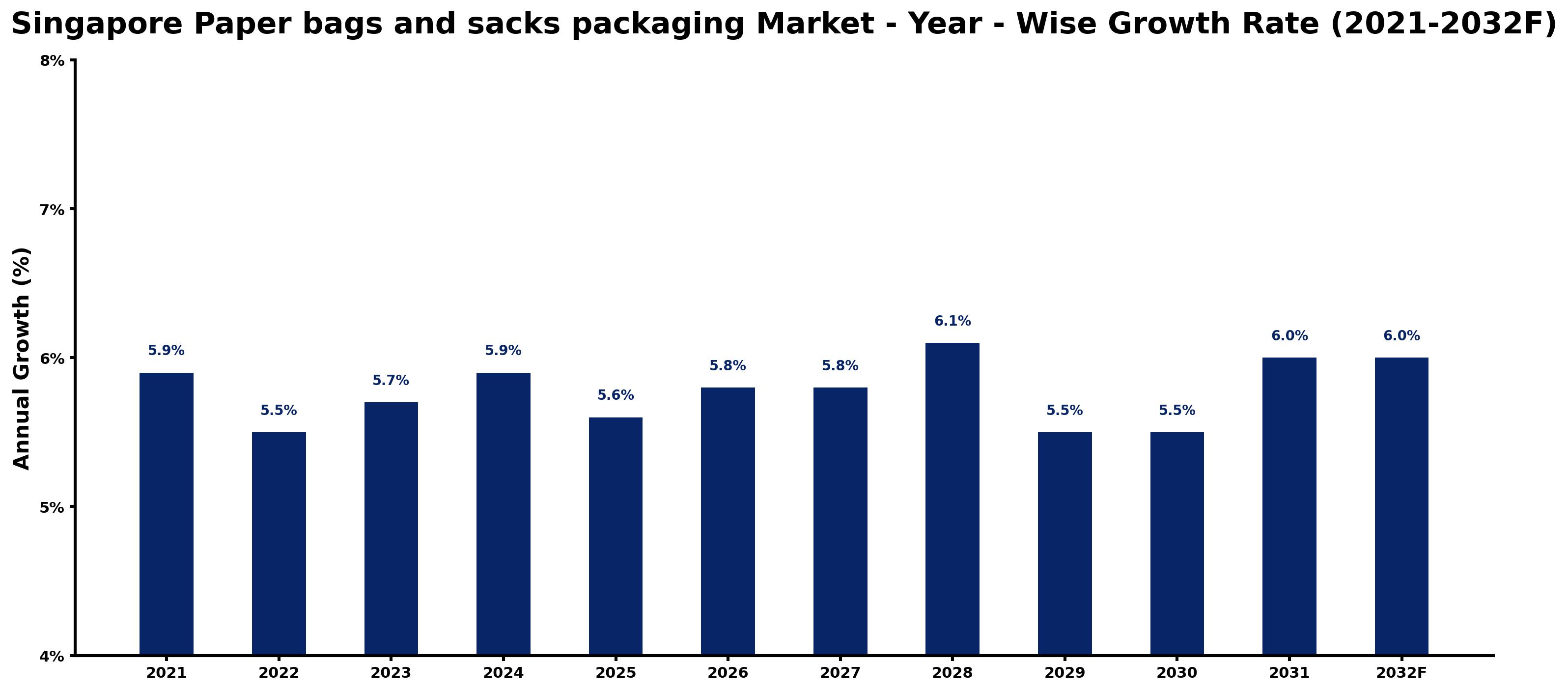
The table below presents the year wise growth rates along with the key drivers influencing the market
| Year | Growth Rate | Major Drivers |
| 2021 | 5.9% | Sustainability trends encouraged businesses to explore eco-friendly packaging options. |
| 2022 | 5.5% | Retailers increasingly favored paper bags to enhance brand image and customer loyalty. |
| 2023 | 5.7% | Consumer awareness on plastic pollution shifted preferences towards biodegradable materials. |
| 2024 | 5.9% | E-commerce expansion required robust packaging solutions, boosting demand for paper sacks. |
| 2025 | 5.6% | Local manufacturers began investing in innovative production techniques for efficiency. |
| 2026 | 5.8% | Collaboration between retail and packaging sectors created tailored solutions for customers. |
| 2027 | 5.8% | Emerging cafes and restaurants opted for stylish paper bags, enhancing customer experiences. |
| 2028 | 6.1% | Corporate sustainability pledges led to increased procurement of environmentally friendly materials. |
| 2029 | 5.5% | Market players explored customization options, appealing to niche consumer segments. |
| 2030 | 5.5% | Technological advancements in printing enabled unique designs on paper packaging. |
| 2031 | 6.0% | Consumer preferences shifted towards minimalism, influencing packaging aesthetics and functionality. |
| 2032 | 6.0% | Investment in green technologies streamlined production processes, reducing overall costs. |
Note - Market size estimations and growth projections presented in this report are based on 6Wresearch's advanced forecasting approach, validated with industry datasets as of June 2026.
Singapore Paper bags and sacks packaging Market Synopsis
The Singapore Paper bags and sacks packaging Market is projected to reach 5.8% and witness significant growth during the forecast period (2026-2032). With a compounded annual growth rate (CAGR) of 8.7%, this market reflects a robust trajectory driven by an increasing consumer inclination towards sustainable practices and a heightened awareness of environmental concerns. The growing popularity of eco-friendly packing materials such as paper sacks and bags is central to this growth, as stakeholders across various sectors prioritize sustainability.
Singapore Paper bags and sacks packaging Market Growth Drivers
The expansion of the Singapore paper bags and sacks packaging market can be attributed to several key drivers:
- Increasing Demand for Sustainable Packaging: There is a notable shift in consumer preferences towards sustainable products, prompting businesses to integrate eco-friendly materials such as paper into their packaging strategies.
- Rising Environmental Concerns: As awareness of the environmental impact of non-biodegradable plastics grows, industries are increasingly opting for paper-based alternatives that lessen carbon footprints and align with sustainability initiatives.
- Regulatory Support: Government incentives aimed at reducing plastic usage and promoting recyclable materials are facilitating market growth by encouraging enterprises to adopt paper bags and sacks.
- Consumer Preferences: With shifting consumer behaviors towards more responsible purchasing decisions, eco-friendly packaging is becoming a standard expectation among consumers, driving companies to adapt.
- Innovative Product Offerings: The evolution of paper bag and sack designs, including enhanced durability and aesthetic appeal, is capturing the interest of both businesses and consumers, fostering market expansion.
Singapore Paper bags and sacks packaging Market Challenges and Restraints
Despite the favorable growth prospects, the Singapore paper bags and sacks packaging market faces several challenges:
- High Cost of Production: Compared to traditional plastic packaging, the cost of manufacturing paper bags and sacks remains a concern for many producers, making it difficult for some sectors to fully transition.
- Competition from Conventional Packaging: The established presence of plastic packaging continues to pose a competitive challenge, as it often provides lower upfront costs and greater versatility.
- Supply Chain Disruptions: Recent global events, including the COVID-19 pandemic, have highlighted vulnerabilities within supply chains, potentially affecting the availability and cost of raw materials required for paper packaging.
- Performance Limitations: In some applications, paper packaging may not provide the same level of moisture resistance or strength as traditional plastic, which could limit its usage in certain industries.
- Market Maturity: As the paper packaging segment grows, establishing market differentiation and innovation becomes critical to avoid saturation and price wars.
Singapore Paper bags and sacks packaging Market Government Investment and Initiatives
The Singapore government has actively pursued policies and initiatives aimed at promoting sustainable packaging solutions. Various public spending programs have been earmarked to encourage industries to adopt eco-friendly alternatives to single-use plastics. These initiatives are part of broader environmental goals, including rigorous waste reduction strategies and sustainability frameworks. Incentives for research and development in advanced packaging materials also bolster innovation within the sector. Various agencies are collaborating with industries to facilitate knowledge sharing and technological advancements that support the growth of the paper bags and sacks packaging market.
Singapore Paper bags and sacks packaging Market Latest Developments (May 2025 - June 2026)
The period between May 2025 and June 2026 has seen notable developments within the Singapore paper bags and sacks packaging market. Organizations have increasingly shifted their focus towards enhancing the sustainability of their packaging solutions, with many investing in biodegradable materials and innovative designs. Additionally, partnerships between NGOs and packaging firms have strengthened efforts towards reducing plastic waste and promoting recycling initiatives. The market has also observed an uptick in consumer demand for customized paper packaging solutions that resonate with brand values and sustainable practices. As e-commerce continues to thrive, delivery services are exploring the use of paper bags that are both functional and environmentally friendly, aligning with consumer expectations.
Singapore Paper bags and sacks packaging Market - Key Attractiveness of the Report
- 10 Years of Market Numbers
- Historical Data Starting from 2022 to 2025
- Base Year: 2025
- Forecast Data until 2032
- Key Performance Indicators Impacting the Market
- Major Upcoming Developments and Projects
Key Highlights of the Report:
- Singapore Paper bags and sacks packaging Market Outlook
- Market Size of Singapore Paper bags and sacks packaging Market, 2025
- Forecast of Singapore Paper bags and sacks packaging Market, 2032F
- Historical Data and Forecast of Singapore Paper bags and sacks packaging Revenues & Volume for the Period 2022-2032F
- Singapore Paper bags and sacks packaging Market Trend Evolution
- Singapore Paper bags and sacks packaging Market Drivers and Challenges
- Singapore Paper bags and sacks packaging Price Trends
- Singapore Paper bags and sacks packaging Porter's Five Forces
- Singapore Paper bags and sacks packaging Industry Life Cycle
- Historical Data and Forecast of Singapore Paper bags and sacks packaging Market Revenues & Volume By Product for the Period 2022-2032F
- Historical Data and Forecast of Singapore Paper bags and sacks packaging Market Revenues & Volume By Flat Paper Bag for the Period 2022-2032F
- Historical Data and Forecast of Singapore Paper bags and sacks packaging Market Revenues & Volume By Multi-wall Paper Sacks for the Period 2022-2032F
- Historical Data and Forecast of Singapore Paper bags and sacks packaging Market Revenues & Volume By Other for the Period 2022-2032F
- Historical Data and Forecast of Singapore Paper bags and sacks packaging Market Revenues & Volume By Application for the Period 2022-2032F
- Historical Data and Forecast of Singapore Paper bags and sacks packaging Market Revenues & Volume By Food & Beverage for the Period 2022-2032F
- Historical Data and Forecast of Singapore Paper bags and sacks packaging Market Revenues & Volume By Pharmaceutical for the Period 2022-2032F
- Historical Data and Forecast of Singapore Paper bags and sacks packaging Market Revenues & Volume By Retail for the Period 2022-2032F
- Historical Data and Forecast of Singapore Paper bags and sacks packaging Market Revenues & Volume By Construction for the Period 2022-2032F
- Historical Data and Forecast of Singapore Paper bags and sacks packaging Market Revenues & Volume By Chemicals for the Period 2022-2032F
- Historical Data and Forecast of Singapore Paper bags and sacks packaging Market Revenues & Volume By Others for the Period 2022-2032F
- Singapore Paper bags and sacks packaging Import Export Trade Statistics
- Market Opportunity Assessment By Product
- Market Opportunity Assessment By Application
- Singapore Paper bags and sacks packaging Top Companies Market Share
- Singapore Paper bags and sacks packaging Competitive Benchmarking By Technical and Operational Parameters
- Singapore Paper bags and sacks packaging Company Profiles
- Singapore Paper bags and sacks packaging Key Strategic Recommendations






































