Singapore Point Of Sale Terminals Market Size, Share & Growth Rate
The Singapore Point Of Sale Terminals Market was estimated at USD 271 Million in 2025 and is projected to reach USD 379 Million by 2032, growing at a CAGR of 4.9% from 2026 to 2032. This growth trajectory is primarily fueled by the ongoing digital transformation within the retail and hospitality sectors, where businesses are increasingly adopting advanced POS systems to enhance operational efficiency and improve customer engagement. Additionally, the rising prevalence of contactless payment methods has accelerated the demand for versatile POS terminals that can seamlessly integrate various payment options.
Singapore Point Of Sale Terminals Market Year-wise Growth Rate and Key Drivers
This graph highlights how the Singapore Point Of Sale Terminals Market has steadily grown over the years, supported by major growth factors.
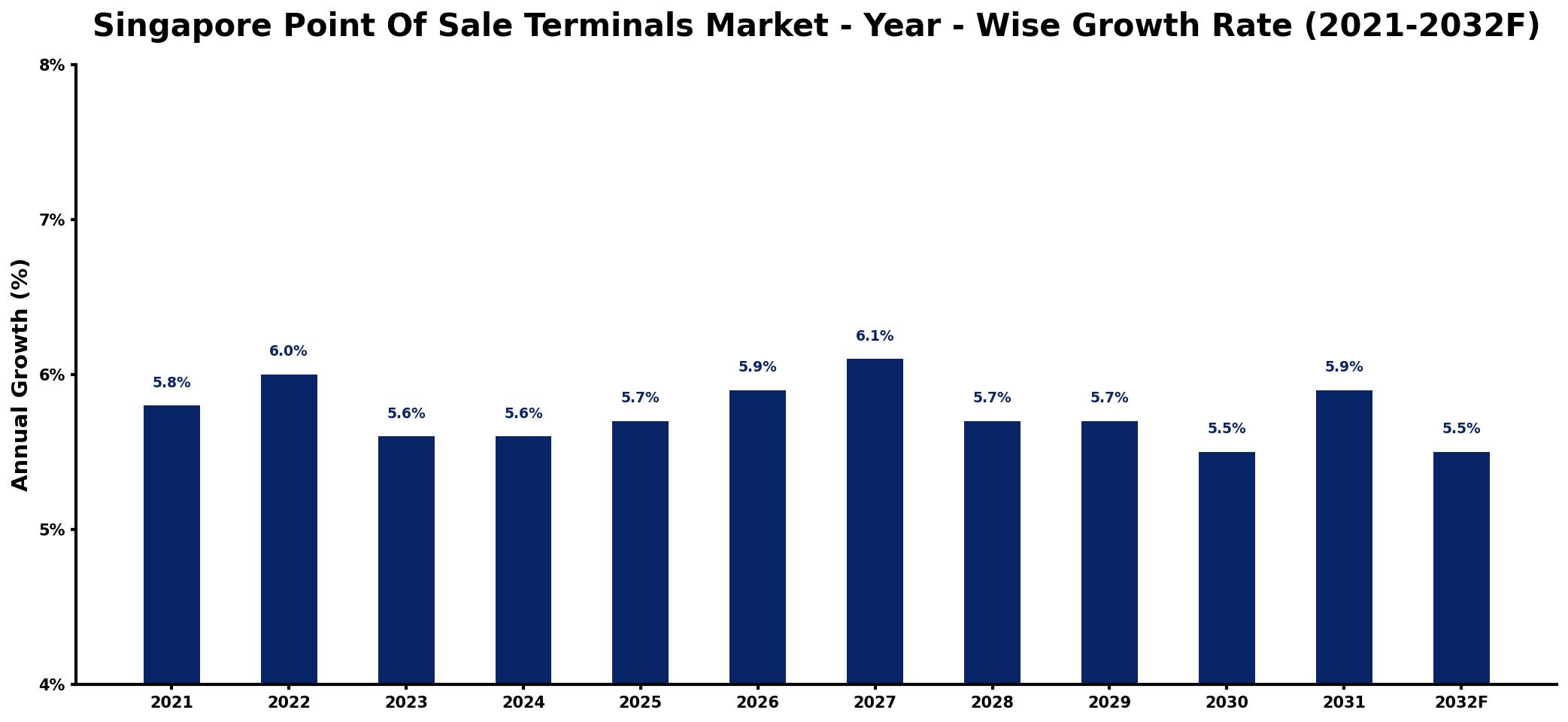
The table below presents the year‑wise growth rates along with the key drivers influencing the market
| Year | Growth Rate | Major Drivers |
| 2021 | 5.8% | Rising consumer digital payment adoption |
| 2022 | 6.0% | Increase in retail sector transactions |
| 2023 | 5.6% | Growth in e-commerce platforms usage |
| 2024 | 5.6% | Expansion of fintech innovations market |
| 2025 | 5.7% | Surge in mobile wallet acceptance |
| 2026 | 5.9% | Increased investment in payment infrastructure |
| 2027 | 6.1% | Growing demand for contactless transactions |
| 2028 | 5.7% | Boost in small business transactions |
| 2029 | 5.7% | Rise in subscription-based services |
| 2030 | 5.5% | increased domestic production output |
| 2031 | 5.9% | strengthening international trade flows |
| 2032 | 5.5% | expanding manufacturing base activity |
Note: Market size estimations and growth projections presented in this report are based on 6Wresearch's proprietary forecasting methodology, utilizing the latest available industry data, government publications, and primary research inputs.
Singapore Point Of Sale Terminals Market Synopsis
The most compelling force shaping the Singapore Point Of Sale Terminals Market is the rapid adoption of digital payment solutions. As consumers increasingly favor cashless transactions, businesses are compelled to upgrade their POS systems to accommodate this shift while also ensuring a seamless customer experience. This trend is further supported by the government's initiatives promoting cashless transactions, which contribute to the overall growth of the market.
In addition, the integration of data analytics capabilities within POS systems is transforming how retailers interact with their customers. By leveraging insights gained from transaction data, businesses can enhance customer engagement and tailor their offerings to meet evolving consumer preferences. As a result, the POS terminals market in Singapore remains dynamic and responsive to technological advancements and changing consumer behaviors.
Singapore Point Of Sale Terminals Market Key Takeaways
- The market is set to grow steadily, driven by an increasing demand for digital payment solutions.
- Integration of advanced analytics in POS systems is reshaping customer engagement strategies.
- Government initiatives are significantly promoting cashless transactions in Singapore.
- Emerging technology trends are prompting continuous upgrades in POS hardware and software.
- The shift to omni-channel retailing is driving the need for adaptable and integrated POS solutions.
Evaluation of Restraints in Singapore Point Of Sale Terminals Market
The Singapore Point Of Sale Terminals Market faces significant hurdles primarily related to the rapid pace of technological advancements. Businesses must constantly invest in hardware and software updates to keep pace with evolving payment technologies and regulatory standards, which can strain resources, particularly for smaller enterprises. Data security also remains a major concern, as increasing cyber threats necessitate robust protections to safeguard sensitive consumer information. Furthermore, the competitive pressure from online payment platforms continues to challenge traditional brick-and-mortar businesses, compelling them to innovate continuously.
Singapore Point Of Sale Terminals Market Trends
Several current and emerging trends are shaping the Singapore Point Of Sale Terminals Market. One prominent trend is the rise of contactless payment methods, spurred by both consumer preferences for convenience and health considerations stemming from the COVID-19 pandemic. Moreover, there is a growing interest in POS systems that incorporate artificial intelligence for predictive analytics, enabling retailers to better anticipate customer needs and optimize inventory management. Furthermore, the push towards omni-channel retailing is leading to increased integration between online and offline sales channels, compelling POS solutions to adapt accordingly.
Singapore Point Of Sale Terminals Market Opportunities
The Singapore Point Of Sale Terminals Market presents numerous growth and investment opportunities. Businesses that innovate by offering enhanced features such as mobile payment solutions, loyalty program integration, and robust data analytics capabilities are likely to gain a competitive edge. Additionally, as the retail landscape continues to evolve, there will be increased demand for customized POS systems that cater specifically to the needs of various sectors, including food and beverage, entertainment, and retail. Furthermore, the ongoing shift towards cloud-based solutions provides substantial opportunities for providers aiming to deliver scalable and flexible POS systems.
Government Initiatives in the Singapore Point Of Sale Terminals Market
The Singaporean government has undertaken several initiatives to promote cashless transactions and digital payment solutions, which are crucial for the growth of the Point Of Sale Terminals Market. Various programs aim to encourage businesses to adopt digital payment technologies, enhancing overall economic efficiency. Additionally, public spending on infrastructure improvements, including secure payment processing systems and the promotion of e-wallets, aligns with the governments vision of a smart nation, further driving the demand for advanced POS solutions across various sectors.
Future Insights of the Singapore Point Of Sale Terminals Market
Looking ahead to the period between 2026 and 2032, the Singapore Point Of Sale Terminals Market is poised for significant evolution. As consumer expectations for seamless and personalized shopping experiences increase, POS systems will need to incorporate advanced technologies such as AI, machine learning, and enhanced data security features. Additionally, the continued emphasis on cashless payments and integrated omnichannel solutions will further propel market growth. In this evolving landscape, businesses that successfully leverage these trends and adapt to shifting consumer behaviors will be well-positioned to capitalize on new opportunities.
Singapore Point Of Sale Terminals Market Latest Developments (2025 - 2026)
Recent industry developments indicate a notable trend towards the integration of advanced technology within POS systems. Companies are increasingly focusing on enhancing the functionality of their terminals to support contactless payments and mobile wallet integration. Furthermore, there is a marked increase in partnerships between POS providers and technology firms aimed at developing innovative solutions that enhance the customer experience. These developments reflect the ongoing need for businesses to adapt to the rapidly changing retail environment.
Singapore Point Of Sale Terminals Market - Key Attractiveness of the Report
- 10 Years of Market Numbers
- Historical Data Starting from 2022 to 2025
- Base Year: 2025
- Forecast Data until 2032
- Key Performance Indicators Impacting the Market
- Major Upcoming Developments and Projects
Key Highlights of the Report:
- Singapore Point Of Sale Terminals Market Outlook
- Market Size of Singapore Point Of Sale Terminals Market, 2025
- Forecast of Singapore Point Of Sale Terminals Market, 2032
- Historical Data and Forecast of Singapore Point Of Sale Terminals Revenues & Volume for the Period 2022-2032F
- Singapore Point Of Sale Terminals Market Trend Evolution
- Singapore Point Of Sale Terminals Market Drivers and Challenges
- Singapore Point Of Sale Terminals Price Trends
- Singapore Point Of Sale Terminals Porter's Five Forces
- Singapore Point Of Sale Terminals Industry Life Cycle
- Historical Data and Forecast of Singapore Point Of Sale Terminals Market Revenues & Volume By Product for the Period 2022-2032F
- Historical Data and Forecast of Singapore Point Of Sale Terminals Market Revenues & Volume By Fixed for the Period 2022-2032F
- Historical Data and Forecast of Singapore Point Of Sale Terminals Market Revenues & Volume By Mobile for the Period 2022-2032F
- Historical Data and Forecast of Singapore Point Of Sale Terminals Market Revenues & Volume By Component for the Period 2022-2032F
- Historical Data and Forecast of Singapore Point Of Sale Terminals Market Revenues & Volume By Hardware for the Period 2022-2032F
- Historical Data and Forecast of Singapore Point Of Sale Terminals Market Revenues & Volume By Software for the Period 2022-2032F
- Historical Data and Forecast of Singapore Point Of Sale Terminals Market Revenues & Volume By Services for the Period 2022-2032F
- Historical Data and Forecast of Singapore Point Of Sale Terminals Market Revenues & Volume By Deployment for the Period 2022-2032F
- Historical Data and Forecast of Singapore Point Of Sale Terminals Market Revenues & Volume By Cloud for the Period 2022-2032F
- Historical Data and Forecast of Singapore Point Of Sale Terminals Market Revenues & Volume By On-premise for the Period 2022-2032F
- Historical Data and Forecast of Singapore Point Of Sale Terminals Market Revenues & Volume By End Use for the Period 2022-2032F
- Historical Data and Forecast of Singapore Point Of Sale Terminals Market Revenues & Volume By Restaurants for the Period 2022-2032F
- Historical Data and Forecast of Singapore Point Of Sale Terminals Market Revenues & Volume By Retail for the Period 2022-2032F
- Historical Data and Forecast of Singapore Point Of Sale Terminals Market Revenues & Volume By Hospitality for the Period 2022-2032F
- Historical Data and Forecast of Singapore Point Of Sale Terminals Market Revenues & Volume By Healthcare for the Period 2022-2032F
- Historical Data and Forecast of Singapore Point Of Sale Terminals Market Revenues & Volume By Warehouse for the Period 2022-2032F
- Historical Data and Forecast of Singapore Point Of Sale Terminals Market Revenues & Volume By Entertainment for the Period 2022-2032F
- Historical Data and Forecast of Singapore Point Of Sale Terminals Market Revenues & Volume By Others for the Period 2022-2032F
- Singapore Point Of Sale Terminals Import Export Trade Statistics
- Market Opportunity Assessment By Product
- Market Opportunity Assessment By Component
- Market Opportunity Assessment By Deployment
- Market Opportunity Assessment By End Use
- Singapore Point Of Sale Terminals Top Companies Market Share
- Singapore Point Of Sale Terminals Competitive Benchmarking By Technical and Operational Parameters
- Singapore Point Of Sale Terminals Company Profiles
- Singapore Point Of Sale Terminals Key Strategic Recommendations






































