Singapore Railway Maintenance Machinery Market Size, Share & Growth Rate
The Singapore Railway Maintenance Machinery Market was estimated at USD 1432 Million in 2025 and is projected to reach USD 2649 Million by 2032, growing at a CAGR of 9.2% from 2026 to 2032. This notable growth trajectory can be attributed to the integration of advanced maintenance technologies, such as automated track inspection systems, that enhance operational efficiency and safety. Furthermore, substantial investments by both public entities and private enterprises in the modernization of rail infrastructure are anticipated to sustain this momentum.
Singapore Railway Maintenance Machinery Market Year-wise Growth Rate and Key Drivers
This graph highlights how the Singapore Railway Maintenance Machinery Market has steadily grown over the years, supported by major growth factors.
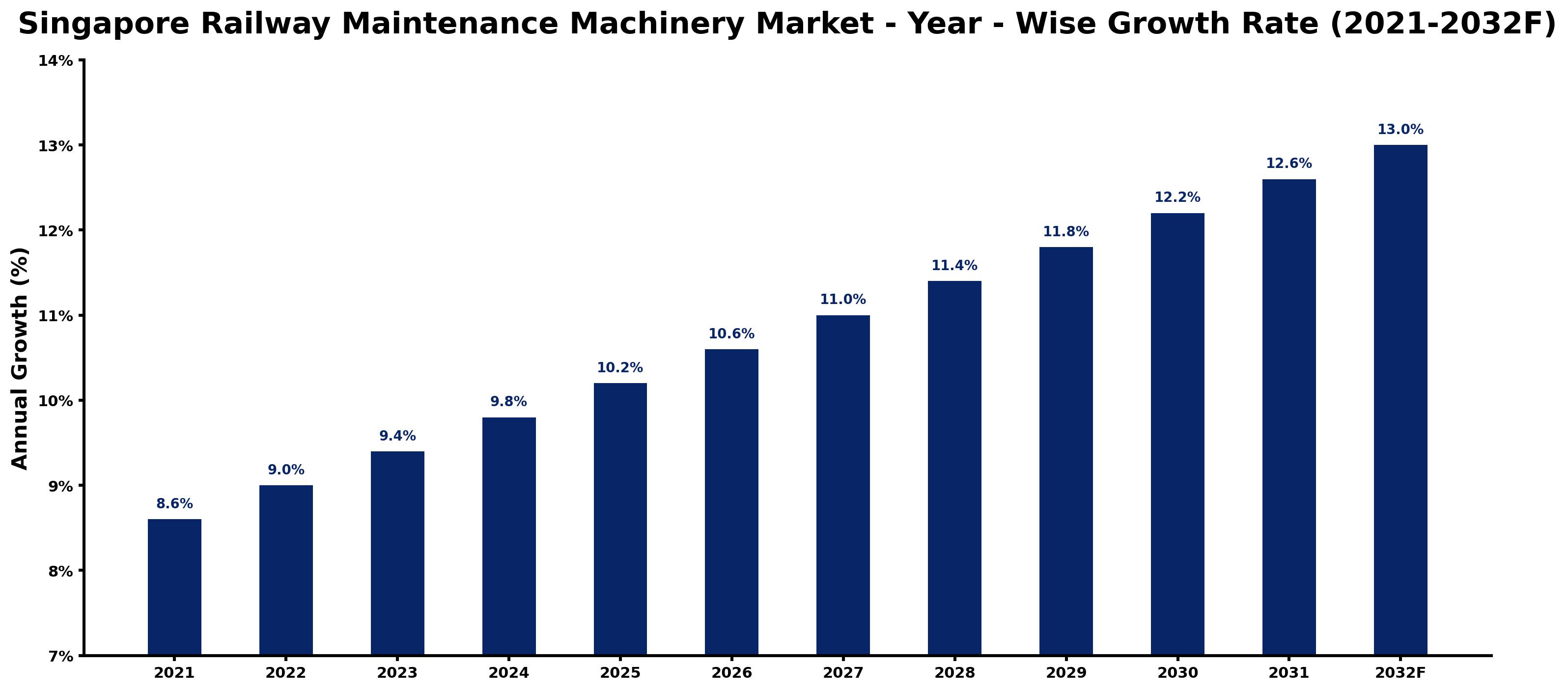
The table below presents the year‑wise growth rates along with the key drivers influencing the market
| Year | Growth Rate | Major Drivers |
| 2021 | 8.6% | Rising electricity demand across industries |
| 2022 | 9.0% | Increasing adoption of advanced technologies |
| 2023 | 9.4% | Government infrastructure modernization initiatives |
| 2024 | 9.8% | Growing urbanization and commercial development |
| 2025 | 10.2% | Increasing smart city development projects |
| 2026 | 10.6% | Expansion of commercial construction activities |
| 2027 | 11.0% | Growing urbanization and commercial development |
| 2028 | 11.4% | Expansion of transportation and logistics networks |
| 2029 | 11.8% | Rising electricity demand across industries |
| 2030 | 12.2% | Growing urbanization and commercial development |
| 2031 | 12.6% | Growing urbanization and commercial development |
| 2032 | 13.0% | Expansion of commercial construction activities |
Note - Market size estimations and growth projections presented in this report are based on 6Wresearch’s advanced forecasting approach, validated with industry datasets as of June 2026.
Singapore Railway Maintenance Machinery Market Synopsis
Singapore's railway maintenance machinery landscape is evolving rapidly, driven by the need for greater efficiency and safety in rail operations. The city-state's commitment to improving its railway infrastructure and systems presents a dynamic environment for technological advancement in maintenance equipment.
The ongoing development of new metro lines, such as the Jurong Region Line, underscores the increasing demand for state-of-the-art maintenance solutions. This is coupled with significant investments in upgrading existing facilities and rolling stock, indicating robust growth potential in this market.
Singapore Railway Maintenance Machinery Market Key Takeaways
- Rapid technological advancements are driving the adoption of innovative maintenance machinery in Singapore's railway sector.
- Government and private sector investments are significantly enhancing the modernization of the railway infrastructure.
- Artificial Intelligence and predictive analytics are becoming integral to maintenance strategies, reducing costs and improving efficiency.
- Challenges such as high installation costs and supply chain issues must be addressed for sustained market growth.
- The market is poised for recovery and growth following the disruptions caused by the COVID-19 pandemic.
Evaluation of Restraints in Singapore Railway Maintenance Machinery Market
Despite the promising growth outlook, several restraints are impacting the Singapore railway maintenance machinery market. The high costs associated with the installation and operation of automated systems present a significant barrier to entry for smaller operators and might deter broader market penetration. Additionally, the reliance on timely delivery of spare parts can lead to operational inefficiencies, as long product delivery cycles can cause delays in maintenance and repairs. A notable lack of awareness among operators regarding the benefits of these advanced solutions further hinders market adoption.
Singapore Railway Maintenance Machinery Market Trends
Emerging trends in the Singapore railway maintenance machinery market reveal a strong inclination towards automation and artificial intelligence. Technologies such as predictive maintenance are transforming traditional approaches by enabling more efficient scheduling of repairs and minimizing downtime. Moreover, there is an increasing emphasis on sustainability within the rail sector, encouraging the adoption of eco-friendly machinery and practices to align with global environmental goals.
Singapore Railway Maintenance Machinery Market Opportunities
The landscape is ripe with opportunities for investment and innovation in the Singapore railway maintenance machinery market. Companies can capitalize on the rising demand for sophisticated maintenance solutions as public and private sectors undertake infrastructure upgrades. Furthermore, partnerships with technology firms specializing in AI and data analytics can unlock new avenues for improving operational efficiency. With ongoing projects set to expand the rail network, there will be increasing requirements for advanced maintenance equipment, creating a favorable environment for market players.
Government Initiatives in the Singapore Railway Maintenance Machinery Market
The Singapore government has demonstrated a strong commitment to enhancing the nation's railway infrastructure through various public spending initiatives. Significant funding has been allocated to support the development of new rail lines and the modernization of existing assets, aimed at boosting efficiency and safety. Additionally, public-private partnerships are encouraged to facilitate innovation in railway maintenance technologies, creating a collaborative environment that fosters growth within the sector.
Future Insights of the Singapore Railway Maintenance Machinery Market
Looking ahead to the period of 2026-2032, the Singapore railway maintenance machinery market is expected to experience substantial transformation driven by technological advancements and increased governmental support. As modernization projects gain momentum, the demand for efficient and reliable maintenance solutions will surge. The integration of smart technologies will likely redefine maintenance practices, paving the way for a more resilient and capable rail network.
Singapore Railway Maintenance Machinery Market Latest Developments (May 2025 - June 2026)
In recent months, the industry has seen a flurry of activity centered on the development of advanced maintenance technologies. Companies are increasingly focusing on automation, with several new products being launched to enhance operational efficiency. Additionally, collaborative projects between public authorities and technology firms have been announced, aimed at streamlining maintenance processes and addressing the challenges posed by supply chain delays.
Singapore Railway Maintenance Machinery Market - Key Attractiveness of the Report
- 10 Years of Market Numbers
- Historical Data Starting from 2022 to 2025
- Base Year: 2025
- Forecast Data until 2032
- Key Performance Indicators Impacting the Market
- Major Upcoming Developments and Projects
Key Highlights of the Report:
- Singapore Railway Maintenance Machinery Market Outlook
- Market Size of Singapore Railway Maintenance Machinery Market, 2025
- Forecast of Singapore Railway Maintenance Machinery Market, 2032F
- Historical Data and Forecast of Singapore Railway Maintenance Machinery Revenues & Volume for the Period 2022-2032F
- Singapore Railway Maintenance Machinery Market Trend Evolution
- Singapore Railway Maintenance Machinery Market Drivers and Challenges
- Singapore Railway Maintenance Machinery Price Trends
- Singapore Railway Maintenance Machinery Porter's Five Forces
- Singapore Railway Maintenance Machinery Industry Life Cycle
- Historical Data and Forecast of Singapore Railway Maintenance Machinery Market Revenues & Volume By Type for the Period 2022-2032F
- Historical Data and Forecast of Singapore Railway Maintenance Machinery Market Revenues & Volume By Tamping Machine for the Period 2022-2032F
- Historical Data and Forecast of Singapore Railway Maintenance Machinery Market Revenues & Volume By Stabilizing Machinery for the Period 2022-2032F
- Historical Data and Forecast of Singapore Railway Maintenance Machinery Market Revenues & Volume By Rail Handling Machinery for the Period 2022-2032F
- Historical Data and Forecast of Singapore Railway Maintenance Machinery Market Revenues & Volume By Ballast Cleaning Machine for the Period 2022-2032F
- Historical Data and Forecast of Singapore Railway Maintenance Machinery Market Revenues & Volume By Other for the Period 2022-2032F
- Historical Data and Forecast of Singapore Railway Maintenance Machinery Market Revenues & Volume By Applications for the Period 2022-2032F
- Historical Data and Forecast of Singapore Railway Maintenance Machinery Market Revenues & Volume By Ballast Track for the Period 2022-2032F
- Historical Data and Forecast of Singapore Railway Maintenance Machinery Market Revenues & Volume By Ballastless Track for the Period 2022-2032F
- Singapore Railway Maintenance Machinery Import Export Trade Statistics
- Market Opportunity Assessment By Type
- Market Opportunity Assessment By Applications
- Singapore Railway Maintenance Machinery Top Companies Market Share
- Singapore Railway Maintenance Machinery Competitive Benchmarking By Technical and Operational Parameters
- Singapore Railway Maintenance Machinery Company Profiles
- Singapore Railway Maintenance Machinery Key Strategic Recommendations






































