Singapore Rolling Mill Components and Ancillary Equipment Market Size, Share & Growth Rate
The Singapore Rolling Mill Components and Ancillary Equipment Market was estimated at USD 970 Million in 2025 and is projected to reach USD 1405 Million by 2032, growing at a CAGR of 5.4% from 2026 to 2032. This upward trajectory is underpinned by Singapore's role as a vital manufacturing hub, coupled with a rising demand for high-quality metal products across various sectors. Industrial expansion, technological advancements, and a push for customized solutions are critical factors steering this growth.
Singapore Rolling Mill Components and Ancillary Equipment Market Year-wise Growth Rate and Key Drivers
This graph highlights how the Singapore Rolling Mill Components and Ancillary Equipment Market has steadily grown over the years, supported by major growth factors.
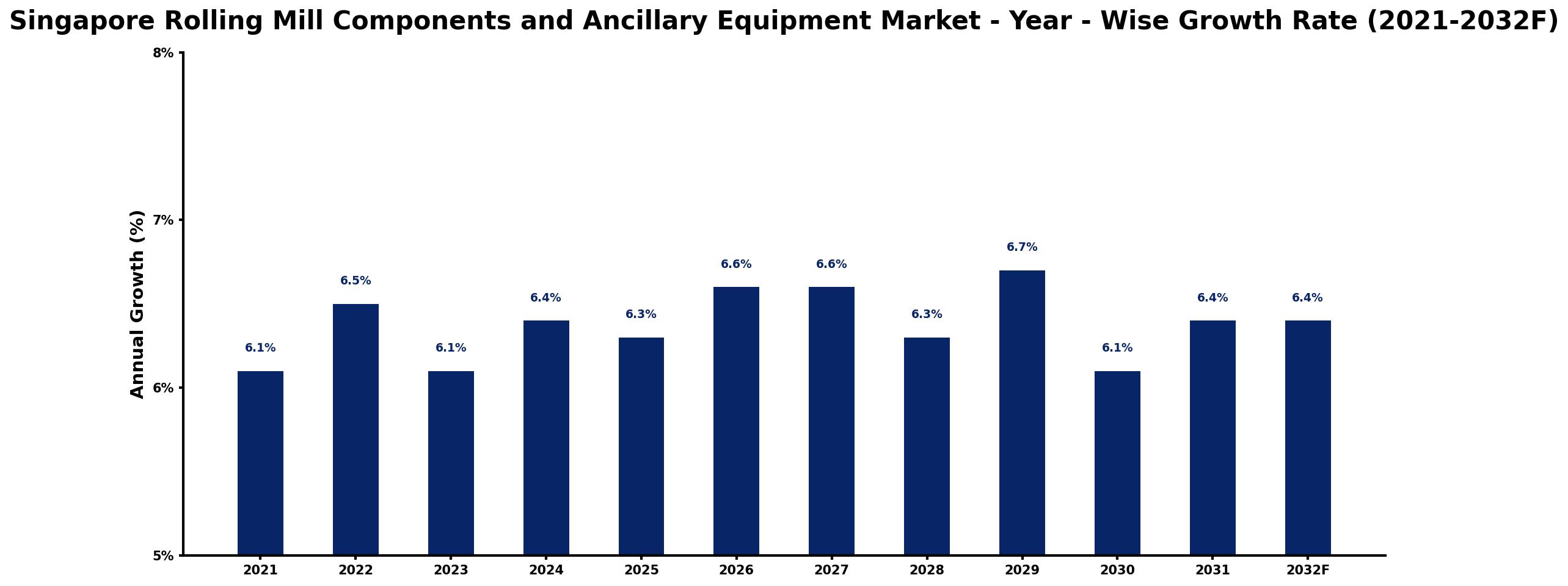
The table below presents the year‑wise growth rates along with the key drivers influencing the market
| Year | Growth Rate | Major Drivers |
| 2021 | 6.1% | increased industrial investment activity |
| 2022 | 6.5% | growing demand for automation solutions |
| 2023 | 6.1% | expansion in construction sector projects |
| 2024 | 6.4% | rising focus on sustainable practices |
| 2025 | 6.3% | advancements in manufacturing technologies |
| 2026 | 6.6% | increased production capacity requirements |
| 2027 | 6.6% | enhanced product quality standards |
| 2028 | 6.3% | expansion of regional trade agreements |
| 2029 | 6.7% | increased foreign direct investments |
| 2030 | 6.1% | growing adoption of digital solutions |
| 2031 | 6.4% | rising demand for customized solutions |
| 2032 | 6.4% | increased capital investment inflows |
Note: Market size estimations and growth projections presented in this report are based on 6Wresearch's proprietary forecasting methodology, utilizing the latest available industry data, government publications, and primary research inputs.
Singapore Rolling Mill Components and Ancillary Equipment Market Synopsis
Singapores rolling mill sector is witnessing an increasing need for efficient components, driven by the booming construction and automotive industries. Modern rolling mills depend on innovative and reliable equipment to enhance productivity and ensure high-quality output.
Furthermore, the industry's shift towards automation and digitalization reflects a larger trend in manufacturing, emphasizing the necessity of advanced ancillary equipment. As these trends unfold, manufacturers are poised to invest in solutions that provide competitive advantages.
Singapore Rolling Mill Components and Ancillary Equipment Market Key Takeaways
- The market is driven by increased demand for high-quality metal products, especially in construction and automotive.
- Technological advancements are vital, enhancing productivity and efficiency in rolling mill operations.
- Government support for advanced manufacturing is fostering greater adoption of digital solutions in the sector.
- Adaptation to global supply chain challenges remains a priority for industry players.
- Market recovery post-COVID-19 is anticipated to be gradual but promising, focusing on resilience and innovation.
Evaluation of Restraints in Singapore Rolling Mill Components and Ancillary Equipment Market
Despite the optimistic outlook, the Singapore rolling mill components and ancillary equipment market faces several constraints. The rapid pace of technological innovation in the steel industry necessitates continuous development of components that can keep up with evolving standards. Additionally, the pressure to reduce costs and manage supply chain uncertainties can hinder growth potential. Companies must navigate these complexities while balancing performance enhancements with sustainability goals.
Singapore Rolling Mill Components and Ancillary Equipment Market Trends
Several trends are shaping the landscape of the rolling mill components and ancillary equipment market in Singapore. There is a significant movement towards integrating automation in manufacturing processes, as businesses strive to optimize productivity and reduce labor costs. Moreover, the increasing emphasis on sustainability is prompting companies to invest in energy-efficient solutions, which are becoming paramount in meeting regulatory requirements and consumer expectations. Additionally, advancements in digital technologies are enabling real-time monitoring and predictive maintenance, further enhancing operational efficiency.
Singapore Rolling Mill Components and Ancillary Equipment Market Opportunities
The landscape offers genuine growth opportunities, particularly in the development of customized solutions tailored to specific industry needs. As industries continue to evolve, there is a rising demand for niche products that cater to specialized applications. Investments in R&D can also lead to innovations that boost productivity while minimizing energy consumption. Furthermore, as global supply chains recover, expanding into emerging markets for exports can provide new avenues for growth.
Government Initiatives in the Singapore Rolling Mill Components and Ancillary Equipment Market
The Singapore government has been actively promoting initiatives aimed at enhancing the advanced manufacturing sector. Public spending on infrastructure projects and incentives for technological adoption are pivotal in stimulating growth in this market. Programs supporting research and development, along with investments in digital transformation, are set to encourage manufacturers to embrace innovative solutions, ultimately benefiting the rolling mill components market.
Future Insights of the Singapore Rolling Mill Components and Ancillary Equipment Market
Looking ahead to the period from 2026 to 2032, the Singapore rolling mill components and ancillary equipment market is poised for substantial advancements. The continuous pursuit of efficiency will likely drive innovations in product offerings, with a strong emphasis on sustainability and automation. As industries recover from the pandemic, there will be renewed investment in infrastructure, further elevating demand. The market is expected to adapt to changing global dynamics, positioning itself strategically for future growth.
Singapore Rolling Mill Components and Ancillary Equipment Market Latest Developments (2025 - 2026)
Recent industry directions have indicated a concerted effort towards enhancing supply chain resilience and product offerings. Companies are exploring collaborations to integrate advanced technologies in their rolling mill operations. Additionally, the market is witnessing shifts towards more sustainable practices, as companies respond to regulatory changes and environmental concerns. There is also a notable increase in investment in training and development, preparing the workforce for the future of advanced manufacturing.
Singapore Rolling Mill Components and Ancillary Equipment Market - Key Attractiveness of the Report
- 10 Years of Market Numbers
- Historical Data Starting from 2022 to 2025
- Base Year: 2025
- Forecast Data until 2032
- Key Performance Indicators Impacting the Market
- Major Upcoming Developments and Projects
Key Highlights of the Report:
- Singapore Rolling Mill Components and Ancillary Equipment Market Outlook
- Market Size of Singapore Rolling Mill Components and Ancillary Equipment Market, 2025
- Forecast of Singapore Rolling Mill Components and Ancillary Equipment Market, 2032
- Historical Data and Forecast of Singapore Rolling Mill Components and Ancillary Equipment Revenues & Volume for the Period 2022-2032F
- Singapore Rolling Mill Components and Ancillary Equipment Market Trend Evolution
- Singapore Rolling Mill Components and Ancillary Equipment Market Drivers and Challenges
- Singapore Rolling Mill Components and Ancillary Equipment Price Trends
- Singapore Rolling Mill Components and Ancillary Equipment Porter's Five Forces
- Singapore Rolling Mill Components and Ancillary Equipment Industry Life Cycle
- Historical Data and Forecast of Singapore Rolling Mill Components and Ancillary Equipment Market Revenues & Volume By Product for the Period 2022-2032F
- Historical Data and Forecast of Singapore Rolling Mill Components and Ancillary Equipment Market Revenues & Volume By Iron Rolls for the Period 2022-2032F
- Historical Data and Forecast of Singapore Rolling Mill Components and Ancillary Equipment Market Revenues & Volume By Steel Rolls for the Period 2022-2032F
- Historical Data and Forecast of Singapore Rolling Mill Components and Ancillary Equipment Market Revenues & Volume By Others for the Period 2022-2032F
- Historical Data and Forecast of Singapore Rolling Mill Components and Ancillary Equipment Market Revenues & Volume By End User for the Period 2022-2032F
- Historical Data and Forecast of Singapore Rolling Mill Components and Ancillary Equipment Market Revenues & Volume By Oil & Gas for the Period 2022-2032F
- Historical Data and Forecast of Singapore Rolling Mill Components and Ancillary Equipment Market Revenues & Volume By Industrial for the Period 2022-2032F
- Historical Data and Forecast of Singapore Rolling Mill Components and Ancillary Equipment Market Revenues & Volume By Automotive for the Period 2022-2032F
- Historical Data and Forecast of Singapore Rolling Mill Components and Ancillary Equipment Market Revenues & Volume By Mining for the Period 2022-2032F
- Historical Data and Forecast of Singapore Rolling Mill Components and Ancillary Equipment Market Revenues & Volume By Others for the Period 2022-2032F
- Singapore Rolling Mill Components and Ancillary Equipment Import Export Trade Statistics
- Market Opportunity Assessment By Product
- Market Opportunity Assessment By End User
- Singapore Rolling Mill Components and Ancillary Equipment Top Companies Market Share
- Singapore Rolling Mill Components and Ancillary Equipment Competitive Benchmarking By Technical and Operational Parameters
- Singapore Rolling Mill Components and Ancillary Equipment Company Profiles
- Singapore Rolling Mill Components and Ancillary Equipment Key Strategic Recommendations






































