Singapore Rolling Mill Market Size, Share & Growth Rate
The Singapore Rolling Mill Market was estimated at USD 495 Million in 2025 and is projected to reach USD 689 Million by 2032, growing at a CAGR of 4.8% from 2026 to 2032. This growth trajectory is primarily driven by the robust expansion of the construction, automotive, and manufacturing sectors, which are increasingly reliant on rolled metal products. Additionally, ongoing infrastructure projects and rising industrial activities are further stimulating demand, positioning the market for stable growth in the coming years.
Singapore Rolling Mill Market Year-wise Growth Rate and Key Drivers
This graph highlights how the Singapore Rolling Mill Market has steadily grown over the years, supported by major growth factors.
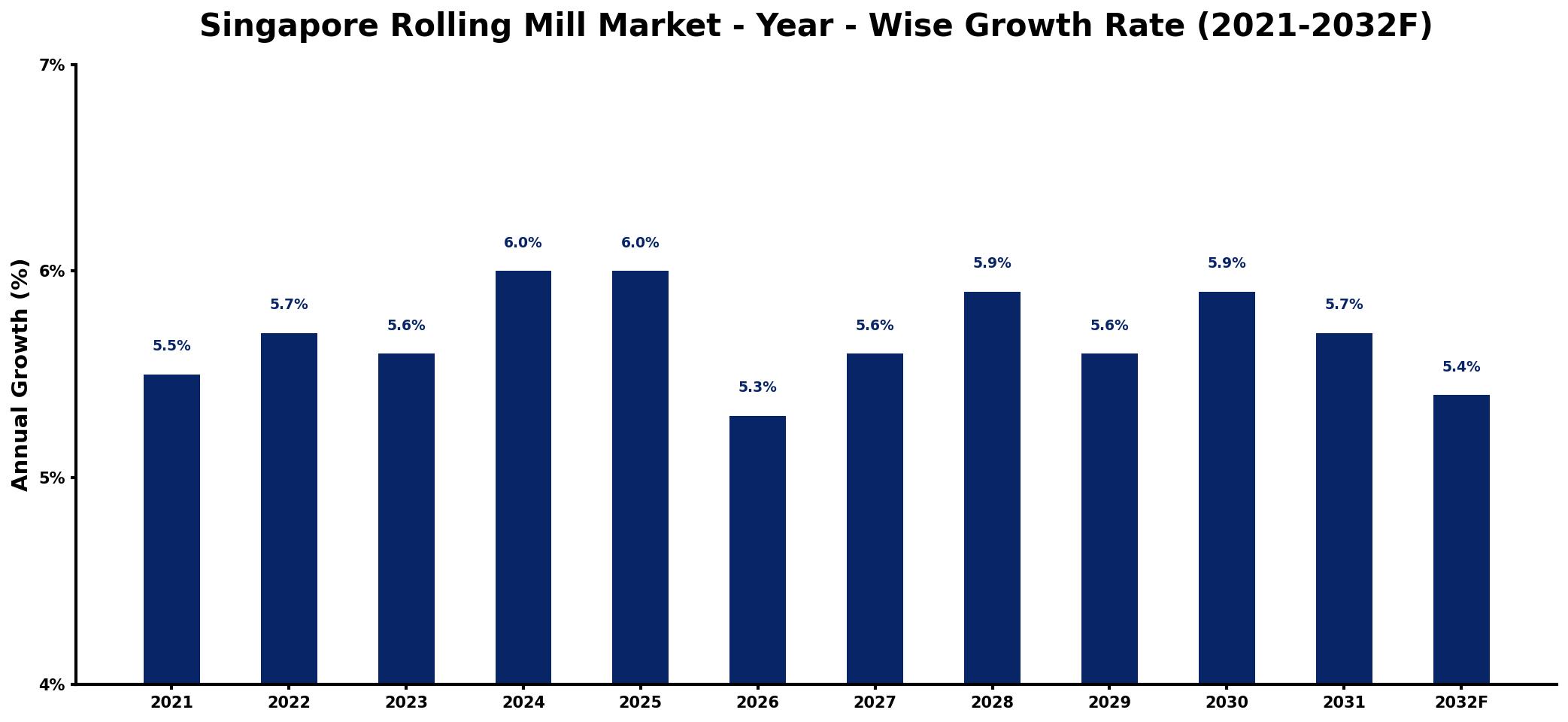
The table below presents the year‑wise growth rates along with the key drivers influencing the market
| Year | Growth Rate | Major Drivers |
| 2021 | 5.5% | Rising construction sector investments |
| 2022 | 5.7% | Increased infrastructure development projects |
| 2023 | 5.6% | Growing automotive manufacturing demands |
| 2024 | 6.0% | Expansion in renewable energy initiatives |
| 2025 | 6.0% | Surge in residential construction activities |
| 2026 | 5.3% | Higher demand for industrial applications |
| 2027 | 5.6% | Investments in transportation infrastructure |
| 2028 | 5.9% | Boost in regional export opportunities |
| 2029 | 5.6% | Emergence of new technology applications |
| 2030 | 5.9% | Increasing focus on sustainability practices |
| 2031 | 5.7% | Growth in urbanization trends |
| 2032 | 5.4% | Rising demand for lightweight materials |
Note: Market size estimations and growth projections presented in this report are based on 6Wresearch's proprietary forecasting methodology, utilizing the latest available industry data, government publications, and primary research inputs.
Singapore Rolling Mill Market Synopsis
The current surge in construction activities is the most significant force shaping the Singapore Rolling Mill Market today. With government initiatives promoting infrastructure development and a rebound in manufacturing output, the demand for rolling mill products is witnessing a steady increase. Furthermore, advancements in manufacturing processes and technology are enhancing the efficiency and output of rolling mills, catalyzing market growth.
Additionally, the automotive industry's rebound post-COVID-19 is driving a resurgence in demand for rolled metals, further embedding the rolling mill sector's role in supporting this vital economic segment. As collaborative efforts among construction firms and equipment manufacturers evolve, we can expect significant innovations that will bolster market resilience and expansion.
Singapore Rolling Mill Market Key Takeaways
- The market is on a stable growth path, backed by government investments in infrastructure.
- Technological advancements are enhancing the efficiency of rolling mill operations.
- The construction and automotive sectors are primary demand drivers for rolled metal products.
- Collaborations among industry stakeholders are fostering innovation and competitiveness.
- Despite challenges, the market shows resilience, adapting to evolving economic conditions.
Evaluation of Restraints in Singapore Rolling Mill Market
Despite promising growth potential, the Singapore rolling mill market faces notable restraints. Primarily, it is intricately linked to the fluctuations of the global steel industry, exposing local businesses to price volatility and demand uncertainty. This dependence complicates long-term strategy formulation for industry players, as they must navigate unpredictable market conditions. Additionally, high energy costs and stringent environmental regulations create an operational challenge, forcing rolling mill companies to balance compliance with cost-effectiveness. Lastly, competition from international low-cost steel producers further pressures local firms, necessitating continual technological upgrades to maintain competitiveness in the market.
Singapore Rolling Mill Market Trends
Current trends within the Singapore rolling mill market are shaped by the growing emphasis on sustainability and innovation. Manufacturers are increasingly adopting energy-efficient technologies to meet regulatory requirements and reduce operational costs. Moreover, digitalization and automation are reshaping production processes, enhancing productivity while minimizing waste. The focus on high-strength steel and specialty alloys is also rising, driven by the demand for more durable and lightweight materials in the automotive and construction sectors. Collectively, these trends indicate a shift toward more environmentally responsible and technologically advanced operations.
Singapore Rolling Mill Market Opportunities
Amidst the challenges, significant opportunities exist within the Singapore rolling mill market. The governments continued focus on infrastructure development offers a promising horizon for rolling mill products, particularly in construction and transportation projects. Additionally, the ongoing advancements in steel processing technology present avenues for investments, with companies poised to capitalize on innovations that enhance product quality and operational efficiency. The rise in demand for customized metal products across various sectors also indicates a burgeoning market for tailored solutions, allowing companies to expand their service offerings effectively.
Government Initiatives in the Singapore Rolling Mill Market
The Singapore government actively supports the rolling mill sector through various initiatives aimed at promoting infrastructure growth and industrial development. Public spending on major infrastructure projects is expected to rise, fostering demand for rolled metal products. Additionally, policies encouraging technological innovation and sustainability practices within manufacturing operations are pivotal in shaping the market. These initiatives not only aim to enhance productivity but also align with global sustainability goals, thereby creating a conducive environment for market growth.
Future Insights of the Singapore Rolling Mill Market
Looking ahead to 2026-2032, the Singapore rolling mill market is poised for a positive trajectory, driven by the ongoing recovery in construction and manufacturing sectors. The anticipated growth of the automotive industry, alongside increased investments in infrastructure, will significantly boost demand for rolled metal products. Furthermore, as the industry adapts to technological advancements and evolves with sustainability trends, the market is likely to experience diversification in product offerings and enhanced operational efficiencies. Companies that embrace innovation and foster strategic collaborations will likely emerge as leaders in this dynamic landscape.
Singapore Rolling Mill Market Latest Developments (2025 - 2026)
In recent months, the Singapore rolling mill market has seen heightened activity, particularly in response to escalating infrastructure projects spearheaded by government initiatives. The focus on adopting advanced technologies has intensified, with local manufacturers exploring automation solutions to streamline production processes. Additionally, environmental sustainability has gained traction, prompting companies to invest in energy-efficient equipment. These developments signal a proactive approach to meeting both market demands and regulatory requirements, highlighting the sectors resilience in a recovering economy.
Singapore Rolling Mill Market - Key Attractiveness of the Report
- 10 Years of Market Numbers
- Historical Data Starting from 2022 to 2025
- Base Year: 2025
- Forecast Data until 2032
- Key Performance Indicators Impacting the Market
- Major Upcoming Developments and Projects
Key Highlights of the Report:
- Singapore Rolling Mill Market Outlook
- Market Size of Singapore Rolling Mill Market, 2025
- Forecast of Singapore Rolling Mill Market, 2032
- Historical Data and Forecast of Singapore Rolling Mill Revenues & Volume for the Period 2022-2032F
- Singapore Rolling Mill Market Trend Evolution
- Singapore Rolling Mill Market Drivers and Challenges
- Singapore Rolling Mill Price Trends
- Singapore Rolling Mill Porter's Five Forces
- Singapore Rolling Mill Industry Life Cycle
- Historical Data and Forecast of Singapore Rolling Mill Market Revenues & Volume By Machine Type for the Period 2022-2032F
- Historical Data and Forecast of Singapore Rolling Mill Market Revenues & Volume By Two high rolling mill for the Period 2022-2032F
- Historical Data and Forecast of Singapore Rolling Mill Market Revenues & Volume By Three high rolling mill for the Period 2022-2032F
- Historical Data and Forecast of Singapore Rolling Mill Market Revenues & Volume By Four high rolling mill for the Period 2022-2032F
- Historical Data and Forecast of Singapore Rolling Mill Market Revenues & Volume By Tandem rolling mill for the Period 2022-2032F
- Historical Data and Forecast of Singapore Rolling Mill Market Revenues & Volume By Cluster rolling mill for the Period 2022-2032F
- Historical Data and Forecast of Singapore Rolling Mill Market Revenues & Volume By Planetary rolling mill for the Period 2022-2032F
- Historical Data and Forecast of Singapore Rolling Mill Market Revenues & Volume By Process for the Period 2022-2032F
- Historical Data and Forecast of Singapore Rolling Mill Market Revenues & Volume By Controlled rolling for the Period 2022-2032F
- Historical Data and Forecast of Singapore Rolling Mill Market Revenues & Volume By Forge rolling for the Period 2022-2032F
- Historical Data and Forecast of Singapore Rolling Mill Market Revenues & Volume By Profile rolling for the Period 2022-2032F
- Historical Data and Forecast of Singapore Rolling Mill Market Revenues & Volume By Ring rolling for the Period 2022-2032F
- Historical Data and Forecast of Singapore Rolling Mill Market Revenues & Volume By Hot rolling for the Period 2022-2032F
- Historical Data and Forecast of Singapore Rolling Mill Market Revenues & Volume By Cold rolling for the Period 2022-2032F
- Historical Data and Forecast of Singapore Rolling Mill Market Revenues & Volume By Application for the Period 2022-2032F
- Historical Data and Forecast of Singapore Rolling Mill Market Revenues & Volume By Metal fabrication for the Period 2022-2032F
- Historical Data and Forecast of Singapore Rolling Mill Market Revenues & Volume By Household appliances for the Period 2022-2032F
- Historical Data and Forecast of Singapore Rolling Mill Market Revenues & Volume By Construction materials for the Period 2022-2032F
- Historical Data and Forecast of Singapore Rolling Mill Market Revenues & Volume By Railway tracks for the Period 2022-2032F
- Historical Data and Forecast of Singapore Rolling Mill Market Revenues & Volume By End Use for the Period 2022-2032F
- Historical Data and Forecast of Singapore Rolling Mill Market Revenues & Volume By Automotive and Transportation for the Period 2022-2032F
- Historical Data and Forecast of Singapore Rolling Mill Market Revenues & Volume By General Manufacturing for the Period 2022-2032F
- Historical Data and Forecast of Singapore Rolling Mill Market Revenues & Volume By Construction for the Period 2022-2032F
- Historical Data and Forecast of Singapore Rolling Mill Market Revenues & Volume By Residential and Commercial for the Period 2022-2032F
- Historical Data and Forecast of Singapore Rolling Mill Market Revenues & Volume By Defense for the Period 2022-2032F
- Historical Data and Forecast of Singapore Rolling Mill Market Revenues & Volume By Energy for the Period 2022-2032F
- Singapore Rolling Mill Import Export Trade Statistics
- Market Opportunity Assessment By Machine Type
- Market Opportunity Assessment By Process
- Market Opportunity Assessment By Application
- Market Opportunity Assessment By End Use
- Singapore Rolling Mill Top Companies Market Share
- Singapore Rolling Mill Competitive Benchmarking By Technical and Operational Parameters
- Singapore Rolling Mill Company Profiles
- Singapore Rolling Mill Key Strategic Recommendations






































