Singapore Simulation Software Market Size & Growth Rate (2026-2032)
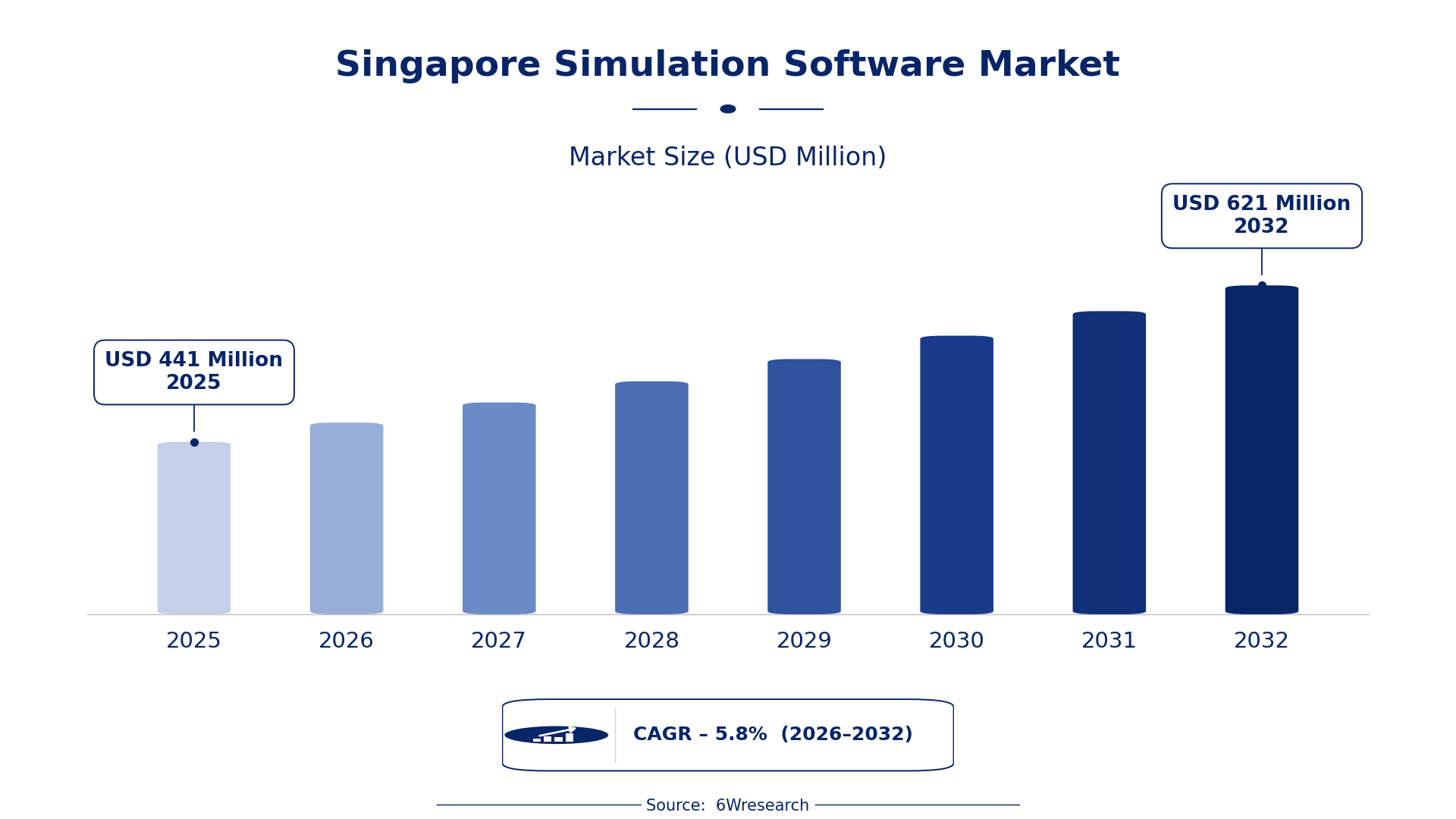
The Singapore Simulation Software Market was estimated at USD 441 Million in 2025 and is projected to reach USD 621 Million by 2032, growing at a CAGR of 5.8% from 2026 to 2032.
Singapore Simulation Software Market Synopsis
The Singapore Simulation Software Market is witnessing a notable surge, fueled by the increasing necessity for accurate modeling across various sectors. Industries such as manufacturing, healthcare, and aviation are increasingly relying on simulation tools to drive efficiency and improve decision-making processes. This trend reflects a broader shift towards data-driven practices in business operations.
As organizations in Singapore strive to enhance their operational efficiency, simulation software emerges as a critical asset. These tools not only facilitate training and process optimization but also help in minimizing risks associated with complex decision-making scenarios. The growth of this market is indicative of a competitive drive among enterprises to innovate and adapt.
Singapore Simulation Software Market Year-wise Growth Rate and Key Drivers
This graph illustrates the annual growth rates of the Singapore Simulation Software Market from 2021 to 2032, highlighting a steady upward trajectory and projected expansion over the forecast period.
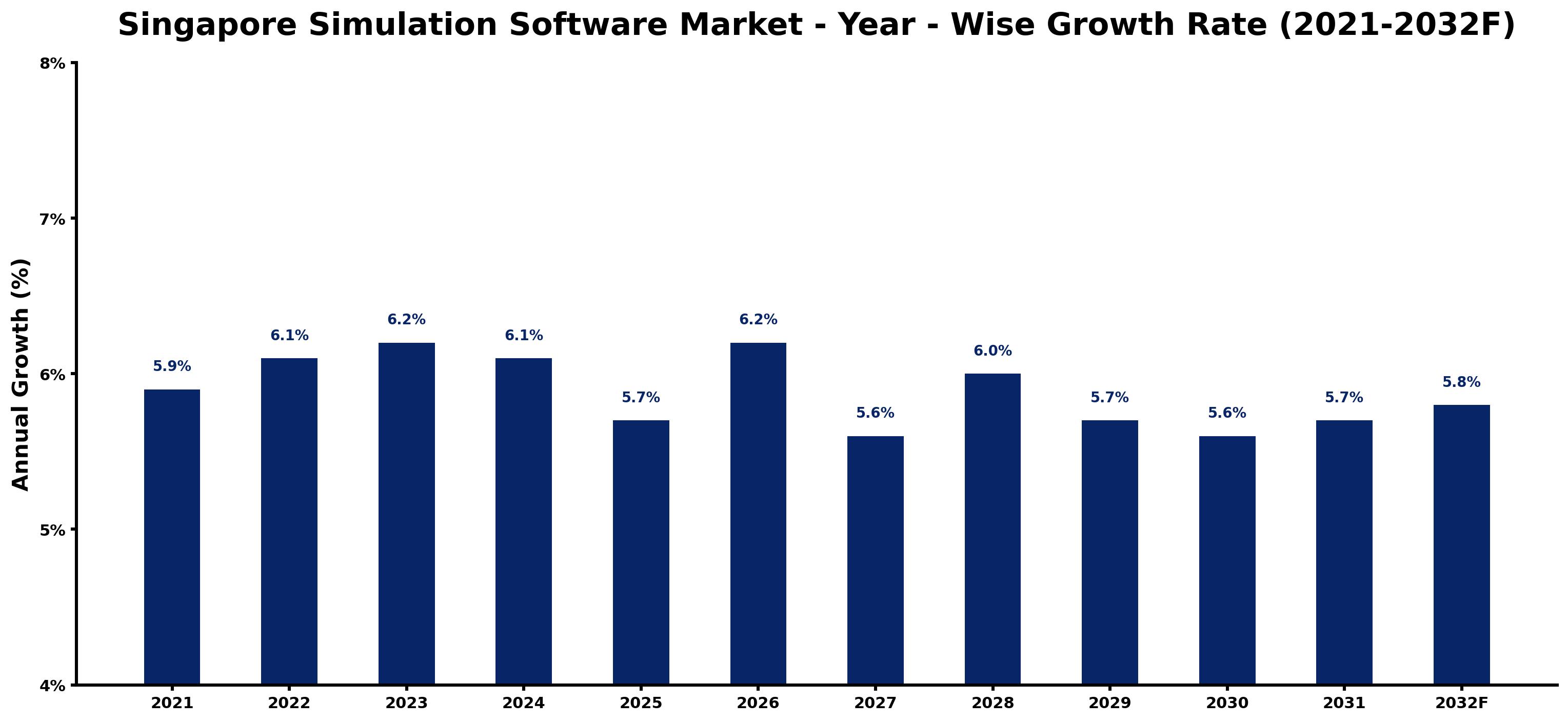
The table below presents the year‑wise growth rates along with the key drivers influencing the market
| Year | Growth Rate | Major Drivers |
| 2021 | 5.9% | National AI Strategy promoting advanced simulation technologies. |
| 2022 | 6.1% | Increased government funding for smart manufacturing solutions. |
| 2023 | 6.2% | Rising focus on urban planning simulations by URA. |
| 2024 | 6.1% | Advancements in virtual reality enhancing simulation capabilities. |
| 2025 | 5.7% | Local startups innovating in simulation for logistics. |
| 2026 | 6.2% | Demand for climate modeling simulations from NEA. |
| 2027 | 5.6% | Integration of simulation software in defense industry projects. |
| 2028 | 6.0% | Research initiatives boosting aerospace simulation development. |
| 2029 | 5.7% | Emerging fintech sector utilizing risk simulation tools. |
| 2030 | 5.6% | Government-supported initiatives for city resiliency simulations. |
| 2031 | 5.7% | Increased demand for simulations in transportation planning. |
| 2032 | 5.8% | Growth of esports driving advanced simulation technology adoption. |
Note: Market size estimations and growth projections presented in this report are based on 6Wresearch's proprietary forecasting methodology, utilizing the latest available industry data, government publications, and primary research inputs.
Singapore Simulation Software Market Key Takeaways
Below are some of the specific key takeaways from the market, including:
- Growing adoption of simulation tools in diverse sectors like healthcare and manufacturing.
- Increased demand for data-driven decision-making processes.
- Technological advancements enhancing simulation accuracy and user experience.
- COVID-19 highlighted the necessity of simulation software in crisis management.
- Competitive pressure drives innovation in simulation methodologies and applications.
Evaluation of Restraints in Singapore Simulation Software Market
Despite its growth, the Singapore Simulation Software Market faces notable restraints. One key limitation is the challenge of delivering realistic and accurate simulations across various sectors. Companies often struggle with the technical demands of creating simulations that reflect real-world scenarios accurately. on top of that, the need for user-friendly interfaces complicates the integration of advanced simulation technologies into existing workflows.
Singapore Simulation Software Market Trends
Several trends are currently shaping the Singapore Simulation Software Market. The integration of artificial intelligence and machine learning into simulation tools is enhancing their capabilities, allowing for more complex modeling and predictive analytics. Additionally, the rise of cloud-based simulation solutions is making these tools more accessible, facilitating collaboration across teams and organizations. The emphasis on sustainability is also prompting industries to adopt simulation technologies to optimize resource usage and minimize waste.
Singapore Simulation Software Market Opportunities
Opportunities abound in the Singapore Simulation Software Market, particularly as industries seek to streamline operations and adapt to new challenges. The healthcare sector, for instance, presents substantial potential for simulation tools to improve patient care and resource management. Additionally, advancements in virtual reality and augmented reality are creating avenues for immersive training simulations, especially in sectors like aerospace and manufacturing. Investment in research and development for simulation technologies can also yield significant returns as businesses strive for innovation.
Government Initiatives in the Singapore Simulation Software Market
The Singapore government plays a crucial role in shaping the Simulation Software Market through targeted initiatives and policies. By prioritizing digital transformation and technological innovation, the government aims to enhance the competitiveness of local industries. Public funding for research and development in simulation technologies underscores the commitment to fostering a vibrant ecosystem that supports businesses in adopting advanced tools.
- A recently completed initiative involved the launch of a national digital infrastructure upgrade program aimed at enhancing data accessibility for simulation applications.
- A current initiative focuses on supporting SMEs with grants for adopting simulation technologies to improve operational efficiency.
- Upcoming policies are expected to include a framework encouraging public-private partnerships for simulation software development, slated to roll out by 2026.
- A continuous effort to enhance educational programs surrounding simulation technologies is currently underway, promoting skill development among the workforce.
Future Insights of the Singapore Simulation Software Market
Looking ahead to 2026-2032, the Singapore Simulation Software Market is set to expand significantly. As industries increasingly recognize the value of simulation in enhancing operational efficiency, adoption rates are likely to soar. The convergence of emerging technologies, such as AI and cloud computing, will further elevate the capabilities of simulation tools, driving innovation. Companies that invest in these technologies now will position themselves advantageously in a competitive market landscape.
Singapore Simulation Software Market Latest Developments
Recent developments in the Singapore Simulation Software Market reflect a dynamic shift towards innovation and technology integration. Over the past year, several initiatives have emerged, indicating a growing recognition of the importance of simulation tools across industries.
- A major technology vendor announced a new simulation software platform in early 2025, designed to facilitate real-time data analysis and modeling.
- An initiative that began in mid-2025 focuses on integrating simulation capabilities into existing manufacturing processes, currently underway across multiple firms.
- A rollout expected to begin in the second half of 2026 aims to provide virtual reality training simulations for healthcare professionals, enhancing learning experiences.
- A partnership between educational institutions and tech firms, initiated in early 2025, aims to foster research in simulation technologies and applications.
Singapore Simulation Software Market - Key Attractiveness of the Report
- 10 Years of Market Numbers
- Historical Data Starting from 2022 to 2025
- Base Year: 2025
- Forecast Data until 2032
- Key Performance Indicators Impacting the Market
- Major Upcoming Developments and Projects
Key Highlights of the Report:
- Singapore Simulation Software Market Outlook
- Market Size of Singapore Simulation Software Market, 2025
- Forecast of Singapore Simulation Software Market, 2032
- Historical Data and Forecast of Singapore Simulation Software Revenues & Volume for the Period 2022-2032F
- Singapore Simulation Software Market Trend Evolution
- Singapore Simulation Software Market Drivers and Challenges
- Singapore Simulation Software Price Trends
- Singapore Simulation Software Porter's Five Forces
- Singapore Simulation Software Industry Life Cycle
- Historical Data and Forecast of Singapore Simulation Software Market Revenues & Volume By Component for the Period 2022-2032F
- Historical Data and Forecast of Singapore Simulation Software Market Revenues & Volume By Software for the Period 2022-2032F
- Historical Data and Forecast of Singapore Simulation Software Market Revenues & Volume By Professional Services for the Period 2022-2032F
- Historical Data and Forecast of Singapore Simulation Software Market Revenues & Volume By Deployment for the Period 2022-2032F
- Historical Data and Forecast of Singapore Simulation Software Market Revenues & Volume By Cloud for the Period 2022-2032F
- Historical Data and Forecast of Singapore Simulation Software Market Revenues & Volume By On-premises for the Period 2022-2032F
- Historical Data and Forecast of Singapore Simulation Software Market Revenues & Volume By Application for the Period 2022-2032F
- Historical Data and Forecast of Singapore Simulation Software Market Revenues & Volume By Product Engineering for the Period 2022-2032F
- Historical Data and Forecast of Singapore Simulation Software Market Revenues & Volume By Research and Development for the Period 2022-2032F
- Historical Data and Forecast of Singapore Simulation Software Market Revenues & Volume By Gamification for the Period 2022-2032F
- Historical Data and Forecast of Singapore Simulation Software Market Revenues & Volume By Vertical Automobile for the Period 2022-2032F
- Historical Data and Forecast of Singapore Simulation Software Market Revenues & Volume By Automobile for the Period 2022-2032F
- Historical Data and Forecast of Singapore Simulation Software Market Revenues & Volume By Aerospace and Defense for the Period 2022-2032F
- Historical Data and Forecast of Singapore Simulation Software Market Revenues & Volume By Electrical and Electronics for the Period 2022-2032F
- Historical Data and Forecast of Singapore Simulation Software Market Revenues & Volume By Healthcare and Pharmaceuticals for the Period 2022-2032F
- Historical Data and Forecast of Singapore Simulation Software Market Revenues & Volume By Oil and Gas and Mining for the Period 2022-2032F
- Historical Data and Forecast of Singapore Simulation Software Market Revenues & Volume By Construction for the Period 2022-2032F
- Historical Data and Forecast of Singapore Simulation Software Market Revenues & Volume By Ship Buildings and Marine for the Period 2022-2032F
- Historical Data and Forecast of Singapore Simulation Software Market Revenues & Volume By Chemicals for the Period 2022-2032F
- Singapore Simulation Software Import Export Trade Statistics
- Market Opportunity Assessment By Component
- Market Opportunity Assessment By Deployment
- Market Opportunity Assessment By Application
- Market Opportunity Assessment By Vertical Automobile
- Singapore Simulation Software Top Companies Market Share
- Singapore Simulation Software Competitive Benchmarking By Technical and Operational Parameters
- Singapore Simulation Software Company Profiles
- Singapore Simulation Software Key Strategic Recommendations






































