Singapore Toys and Hobby Goods Market: Import Trend Analysis
In 2024, Singapore`s toys and hobby goods market saw a steady increase in imports. The market experienced a growing demand for a diverse range of toys and hobby products from international suppliers, reflecting consumers` evolving preferences for quality and variety.
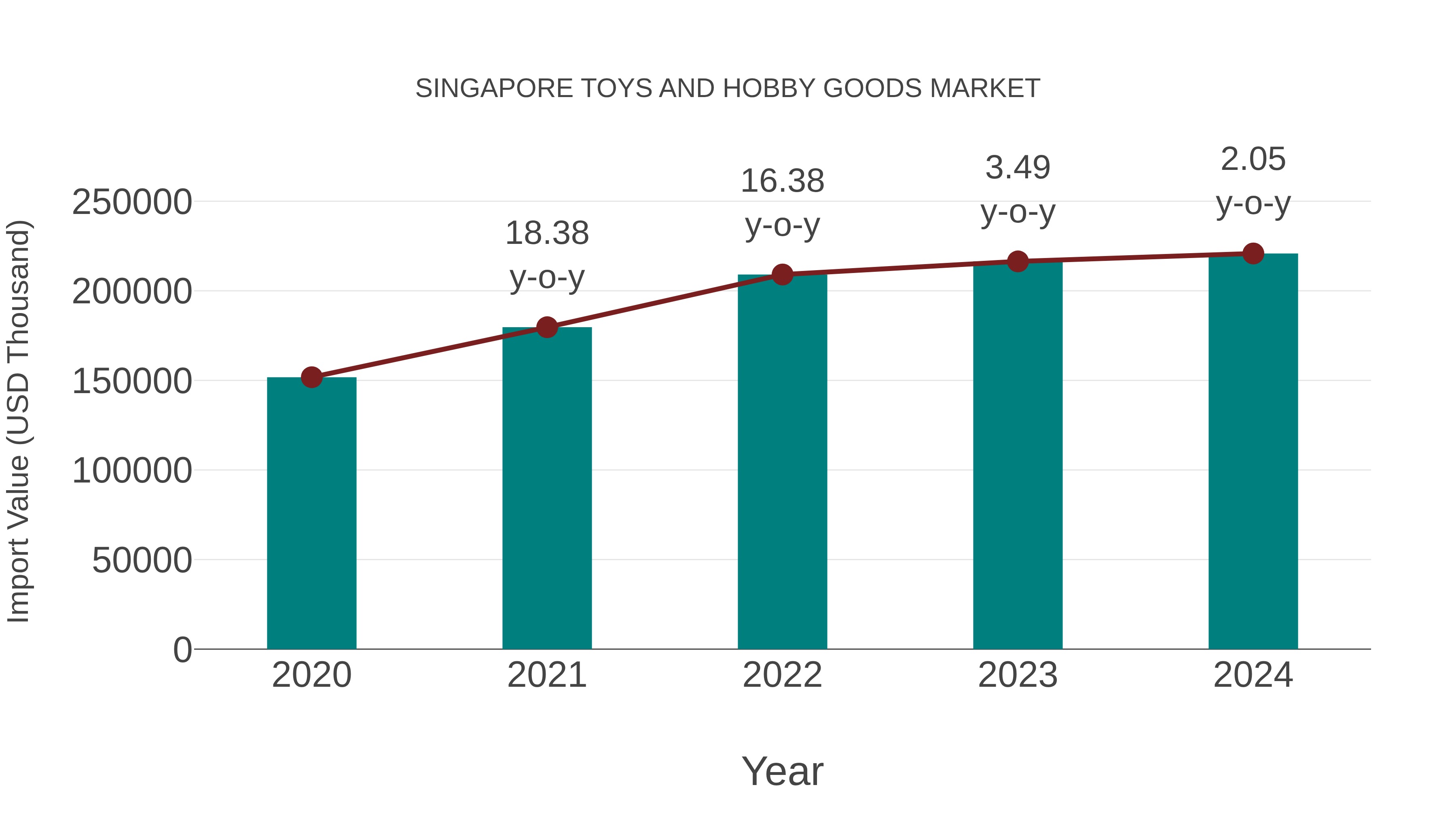
Singapore Toys and Hobby Goods Market Synopsis
The Singapore Toys and Hobby Goods Market are projected to witness a healthy growth rate during the forecast period of 2020-2026. This is mainly due to the increasing demand for toys and hobby goods from children, rising disposable income levels, growing awareness regarding mental health issues among parents, and technological advancements in toy production which make them more interactive and fun. Moreover, initiatives taken by the government such as organizing various events related to toy manufacturing are expected to further drive market growth.
Market Drivers
Rising Demand from Children: The rise in demand for toys and hobby goods among children has been one of the major factors driving market growth over recent years. In addition, many parents now view these items as necessary investments that help their child???s development rather than just luxury expenses. Growing Disposable Income Levels: As disposable incomes have increased across Singapore households over recent years, this has allowed people more access to purchasing things like toys or hobby goods. This trend is likely only going to increase with time given that economic stability increases in Singapore too.
Market challenges
High Cost of Raw Materials & Labor Charges: One challenge facing this industry is the high cost associated with raw materials used in producing toys or hobby goods such as plastics or metals which can be quite expensive depending on availability at times. Additionally labor costs charged by skilled workers can also add up resulting in higher prices for consumers making it difficult for some companies operating within this space who may not be able price competitively enough compared to others.
Key players
Some key players dominating the Singapore Toys & Hobby Goods Market include Hasbro Inc., Mattel Inc., Lego Group, Bandai Namco Holdings Inc., Jakks Pacific Inc., MGA Entertainment Inc., Spin Master Ltd., Tomy Company Ltd.
Covid-19 Impact
Although there was an initial dip in sales when COVID-19 first emerged globally, later on there was an uptick seen driven largely by online purchases made from customers staying indoors due to lockdown measures implemented worldwide.This resulted in a surge of interest towards digital platforms offering safety benefits while still allowing people access products they need enabling market players within this space capitalize on opportunities presented virtually instead.
Key Highlights of the Report:
- Singapore Toys and Hobby Goods Market Outlook
- Market Size of Singapore Toys and Hobby Goods Market, 2023
- Forecast of Singapore Toys and Hobby Goods Market, 2030
- Historical Data and Forecast of Singapore Toys and Hobby Goods Revenues & Volume for the Period 2020-2030
- Singapore Toys and Hobby Goods Market Trend Evolution
- Singapore Toys and Hobby Goods Market Drivers and Challenges
- Singapore Toys and Hobby Goods Price Trends
- Singapore Toys and Hobby Goods Porter's Five Forces
- Singapore Toys and Hobby Goods Industry Life Cycle
- Historical Data and Forecast of Singapore Toys and Hobby Goods Market Revenues & Volume By Type for the Period 2020-2030
- Historical Data and Forecast of Singapore Toys and Hobby Goods Market Revenues & Volume By Sports Toys for the Period 2020-2030
- Historical Data and Forecast of Singapore Toys and Hobby Goods Market Revenues & Volume By Intellectual Toys for the Period 2020-2030
- Historical Data and Forecast of Singapore Toys and Hobby Goods Market Revenues & Volume By Education Toys for the Period 2020-2030
- Historical Data and Forecast of Singapore Toys and Hobby Goods Market Revenues & Volume By Decorative Toys for the Period 2020-2030
- Historical Data and Forecast of Singapore Toys and Hobby Goods Market Revenues & Volume By Other for the Period 2020-2030
- Historical Data and Forecast of Singapore Toys and Hobby Goods Market Revenues & Volume By Application for the Period 2020-2030
- Historical Data and Forecast of Singapore Toys and Hobby Goods Market Revenues & Volume By Online Sales for the Period 2020-2030
- Historical Data and Forecast of Singapore Toys and Hobby Goods Market Revenues & Volume By Offline Sales for the Period 2020-2030
- Historical Data and Forecast of Singapore Toys and Hobby Goods Market Revenues & Volume By Others for the Period 2020-2030
- Singapore Toys and Hobby Goods Import Export Trade Statistics
- Market Opportunity Assessment By Type
- Market Opportunity Assessment By Application
- Singapore Toys and Hobby Goods Top Companies Market Share
- Singapore Toys and Hobby Goods Competitive Benchmarking By Technical and Operational Parameters
- Singapore Toys and Hobby Goods Company Profiles
- Singapore Toys and Hobby Goods Key Strategic Recommendations






































