Singapore Web Application Firewall Market Size & Growth Rate (2026-2032)
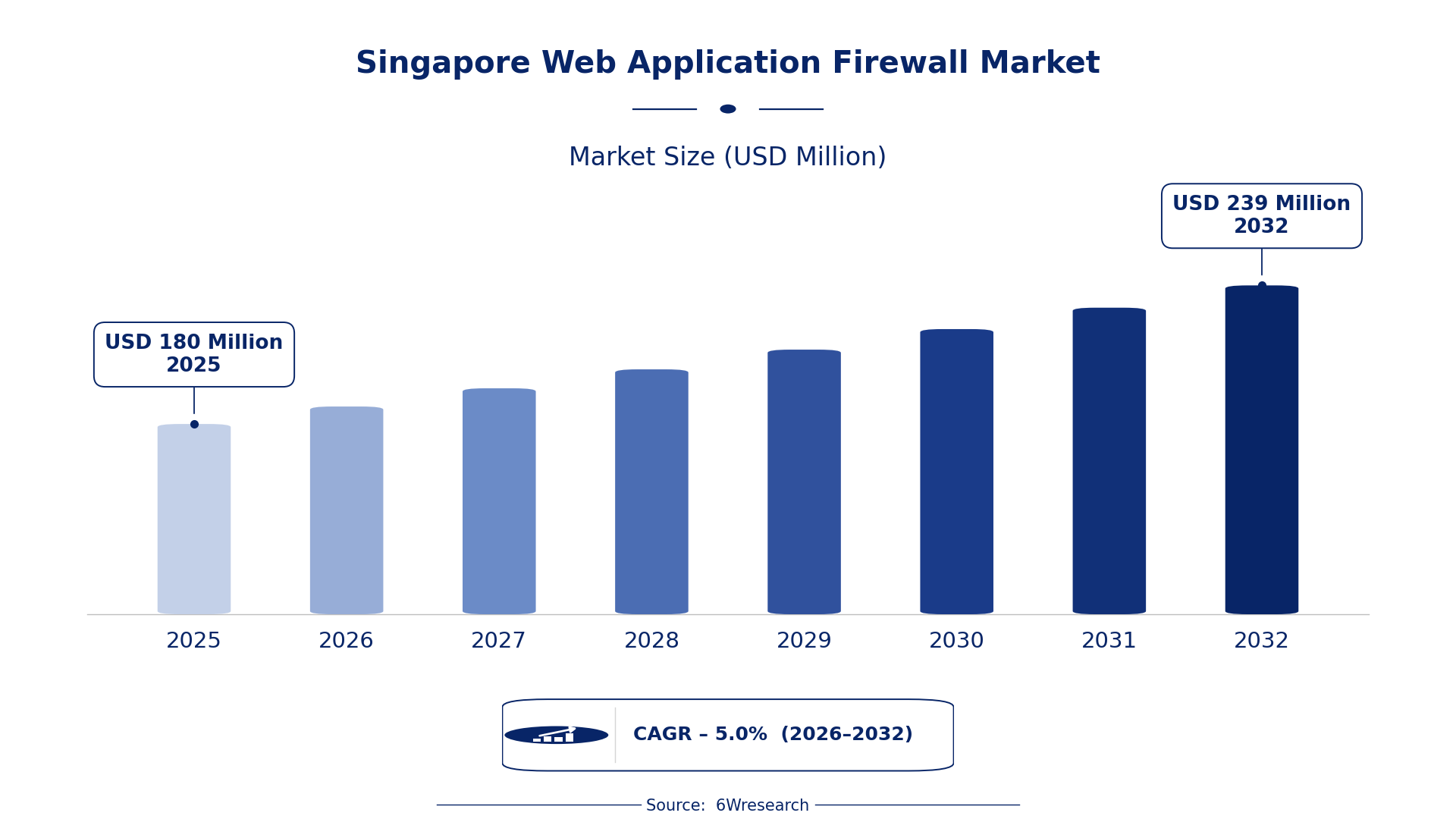
The Singapore Web Application Firewall Market was estimated at USD 180 Million in 2025 and is projected to reach USD 239 Million by 2032, growing at a CAGR of 5.0% from 2026 to 2032.
Singapore Web Application Firewall Market Synopsis
The rise of digital commerce in Singapore has underscored the critical need for stringent web application security measures. As businesses increasingly shift operations online, the vulnerability to cyberattacks, including SQL injections and cross-site scripting, has become a pressing concern. The web application firewall (WAF) market is at the forefront of addressing these security challenges.
Organizations in Singapore are recognizing that robust web application firewalls are not just a protective layer but essential components for maintaining consumer trust. With regulatory requirements, such as the Personal Data Protection Act (PDPA), emphasizing the safeguarding of user data, the demand for WAF solutions is expected to grow substantially.
Singapore Web Application Firewall Market Year-wise Growth Rate and Key Drivers
This graph illustrates the annual growth rates of the Singapore Web Application Firewall Market from 2021 to 2032, highlighting a steady upward trajectory and projected expansion over the forecast period.
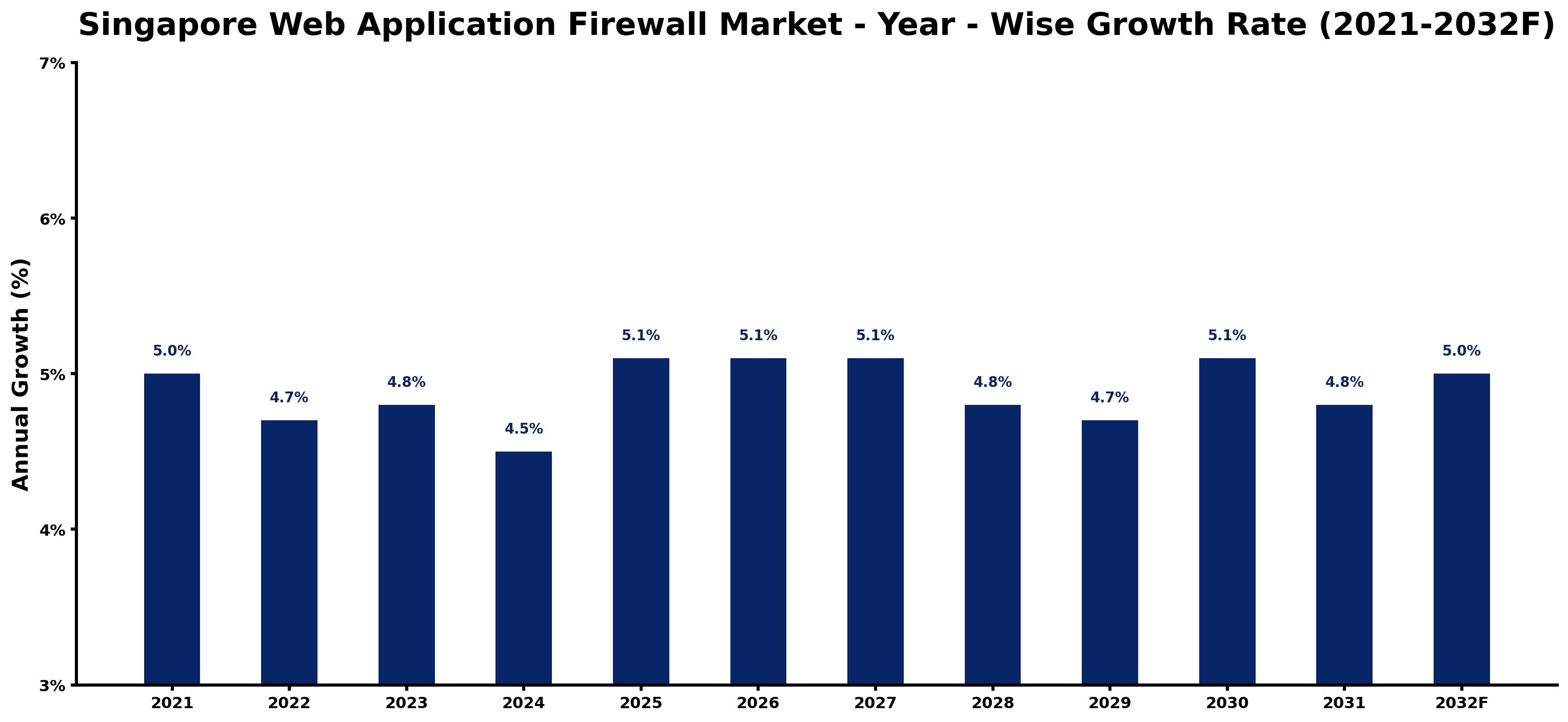
The table below presents the year‑wise growth rates along with the key drivers influencing the market
| Year | Growth Rate | Major Drivers |
| 2021 | 5.0% | Government initiatives to enhance national cybersecurity framework. |
| 2022 | 4.7% | Growing adoption of cloud services among enterprises. |
| 2023 | 4.8% | Increased cyberattack incidents prompting stronger security measures. |
| 2024 | 4.5% | Regulatory focus on GDPR compliance driving WAF implementation. |
| 2025 | 5.1% | Surge in e-commerce platforms necessitating robust security solutions. |
| 2026 | 5.1% | Investment in digital banking accelerating web security requirements. |
| 2027 | 5.1% | Rise in remote work culture heightening security needs. |
| 2028 | 4.8% | Proliferation of mobile applications increasing security focus. |
| 2029 | 4.7% | Emergence of IoT devices driving web application protection. |
| 2030 | 5.1% | Awareness campaigns on phishing threats boosting security investments. |
| 2031 | 4.8% | Collaboration between government and tech firms enhancing resilience. |
| 2032 | 5.0% | Academic research promoting advanced web security technologies. |
Note: Market size estimations and growth projections presented in this report are based on 6Wresearch's proprietary forecasting methodology, utilizing the latest available industry data, government publications, and primary research inputs.
Singapore Web Application Firewall Market Key Takeaways
Below are some of the specific key takeaways from the market, including:
- Increasing cyber threats have amplified the demand for web application firewalls in Singapore.
- Regulatory frameworks necessitate improved web application security protocols.
- The e-commerce sector's expansion is a major driver of WAF adoption.
- Advanced web application firewalls are evolving to counter sophisticated attack vectors.
- Market growth presents opportunities for innovative security solutions tailored to local needs.
Evaluation of Restraints in Singapore Web Application Firewall Market
Despite the market's growth, several restraints limit its full potential. One major hurdle is the complexity of modern web applications. As these applications evolve, the risk of new vulnerabilities increases, making it challenging for WAFs to provide comprehensive protection. Additionally, organizations often face issues with false positives, which can lead to critical alerts being overlooked or, conversely, unnecessary disruptions. Ensuring compatibility with agile development practices also remains an area needing attention as businesses strive to innovate while maintaining security standards.
Singapore Web Application Firewall Market Trends
Current trends indicate a significant shift towards integrating artificial intelligence and machine learning within WAF solutions. These technologies enhance threat detection and response capabilities, allowing for quicker adaptation to emerging cyber threats. Furthermore, there is a growing focus on solutions that offer ease of integration with existing development frameworks, reflecting the urgency for businesses to adopt agile security measures.
Singapore Web Application Firewall Market Opportunities
Several opportunities exist within the Singapore WAF market for proactive players. The demand for tailored solutions to meet local regulatory requirements can lead to innovative product offerings. As companies increasingly adopt multi-cloud strategies, WAF vendors can position themselves as essential partners in securing diverse environments. Furthermore, the continuous evolution of online payment systems and e-commerce platforms presents a fertile ground for WAF growth.
Government Initiatives in the Singapore Web Application Firewall Market
The Singaporean government is actively shaping the WAF market through a combination of regulatory measures and initiatives aimed at enhancing cybersecurity resilience. By enforcing stringent data protection laws and promoting cybersecurity awareness, authorities are compelling businesses to adopt more effective web application security practices. This proactive stance is crucial as Singapore aims to establish itself as a trusted digital hub.
- A recent regulatory framework implemented in 2025 mandates businesses to enhance their web security protocols, directly affecting WAF adoption rates.
- Currently ongoing is a national cybersecurity campaign aimed at educating enterprises about the importance of web application firewalls in safeguarding digital assets.
- A planned public-private partnership set to launch in 2026 aims to provide funding and resources for small and medium-sized enterprises (SMEs) to bolster their online security measures.
- In 2024, the government initiated a review of existing cybersecurity legislation to ensure alignment with international best practices.
Future Insights of the Singapore Web Application Firewall Market
Looking ahead to 2026-2032, the Singapore web application firewall market is set to expand significantly. The interplay between regulatory compliance and the increasing complexity of cyber threats will drive ongoing investment in WAF solutions. As businesses prioritize data integrity and consumer trust, we can expect innovations in WAF technology that address specific local requirements while enhancing overall security posture.
Singapore Web Application Firewall Market Latest Developments
In the past year, the Singapore web application firewall market has witnessed several noteworthy developments. With a notable uptick in cyber incidents, organizations are increasingly prioritizing security investments. Providers are responding by launching advanced WAF solutions designed to combat sophisticated attack vectors while maintaining user accessibility and performance.
- A leading technology vendor launched a next-generation WAF solution in early 2025, focusing on enhanced real-time threat intelligence capabilities.
- In late 2025, a major regional operator completed a comprehensive upgrade of its WAF infrastructure to support cloud-based applications.
- Currently ongoing is an industry-wide initiative to develop standardized protocols for WAF integration with various e-commerce platforms, set to conclude by mid-2026.
- By early 2026, an expansion of existing WAF offerings is anticipated, aimed at small businesses to help them better secure their online transactions.
Singapore Web Application Firewall Market - Key Attractiveness of the Report
- 10 Years of Market Numbers
- Historical Data Starting from 2022 to 2025
- Base Year: 2025
- Forecast Data until 2032
- Key Performance Indicators Impacting the Market
- Major Upcoming Developments and Projects
Key Highlights of the Report:
- Singapore Web Application Firewall Market Outlook
- Market Size of Singapore Web Application Firewall Market, 2025
- Forecast of Singapore Web Application Firewall Market, 2032
- Historical Data and Forecast of Singapore Web Application Firewall Revenues & Volume for the Period 2022-2032F
- Singapore Web Application Firewall Market Trend Evolution
- Singapore Web Application Firewall Market Drivers and Challenges
- Singapore Web Application Firewall Price Trends
- Singapore Web Application Firewall Porter's Five Forces
- Singapore Web Application Firewall Industry Life Cycle
- Historical Data and Forecast of Singapore Web Application Firewall Market Revenues & Volume By Component for the Period 2022-2032F
- Historical Data and Forecast of Singapore Web Application Firewall Market Revenues & Volume By Solutions (Hardware Appliances, Virtual Appliances, Cloud-Based) for the Period 2022-2032F
- Historical Data and Forecast of Singapore Web Application Firewall Market Revenues & Volume By Services (Professional and Managed) for the Period 2022-2032F
- Historical Data and Forecast of Singapore Web Application Firewall Market Revenues & Volume By Organization Size for the Period 2022-2032F
- Historical Data and Forecast of Singapore Web Application Firewall Market Revenues & Volume By SMEs for the Period 2022-2032F
- Historical Data and Forecast of Singapore Web Application Firewall Market Revenues & Volume By Large Enterprises for the Period 2022-2032F
- Historical Data and Forecast of Singapore Web Application Firewall Market Revenues & Volume By Vertical for the Period 2022-2032F
- Historical Data and Forecast of Singapore Web Application Firewall Market Revenues & Volume By Banking, Financial Services & Insurance for the Period 2022-2032F
- Historical Data and Forecast of Singapore Web Application Firewall Market Revenues & Volume By Retail for the Period 2022-2032F
- Historical Data and Forecast of Singapore Web Application Firewall Market Revenues & Volume By IT & Telecommunications for the Period 2022-2032F
- Historical Data and Forecast of Singapore Web Application Firewall Market Revenues & Volume By Government & Defense for the Period 2022-2032F
- Historical Data and Forecast of Singapore Web Application Firewall Market Revenues & Volume By Healthcare for the Period 2022-2032F
- Historical Data and Forecast of Singapore Web Application Firewall Market Revenues & Volume By Energy & Utilities for the Period 2022-2032F
- Historical Data and Forecast of Singapore Web Application Firewall Market Revenues & Volume By Education for the Period 2022-2032F
- Historical Data and Forecast of Singapore Web Application Firewall Market Revenues & Volume By Other Verticals for the Period 2022-2032F
- Singapore Web Application Firewall Import Export Trade Statistics
- Market Opportunity Assessment By Component
- Market Opportunity Assessment By Organization Size
- Market Opportunity Assessment By Vertical
- Singapore Web Application Firewall Top Companies Market Share
- Singapore Web Application Firewall Competitive Benchmarking By Technical and Operational Parameters
- Singapore Web Application Firewall Company Profiles
- Singapore Web Application Firewall Key Strategic Recommendations






































