Slovakia Air Traffic Control Market Size, Share & Growth Rate
The Slovakia Air Traffic Control Market was estimated at USD 1245 Million in 2025 and is projected to reach USD 2053 Million by 2032, growing at a CAGR of 7.4% from 2026 to 2032. This growth trajectory is driven by the rising demand for air travel within and beyond Slovakian borders, necessitating a robust air traffic management system. Additionally, ongoing modernization efforts in air traffic control technology, such as the adoption of automation and data analytics, are expected to further enhance operational efficiency and safety, paving the way for a more dynamic market environment.
Slovakia Air Traffic Control Market Year-wise Growth Rate and Key Drivers
This graph highlights how the Slovakia Air Traffic Control Market has steadily grown over the years, supported by major growth factors.
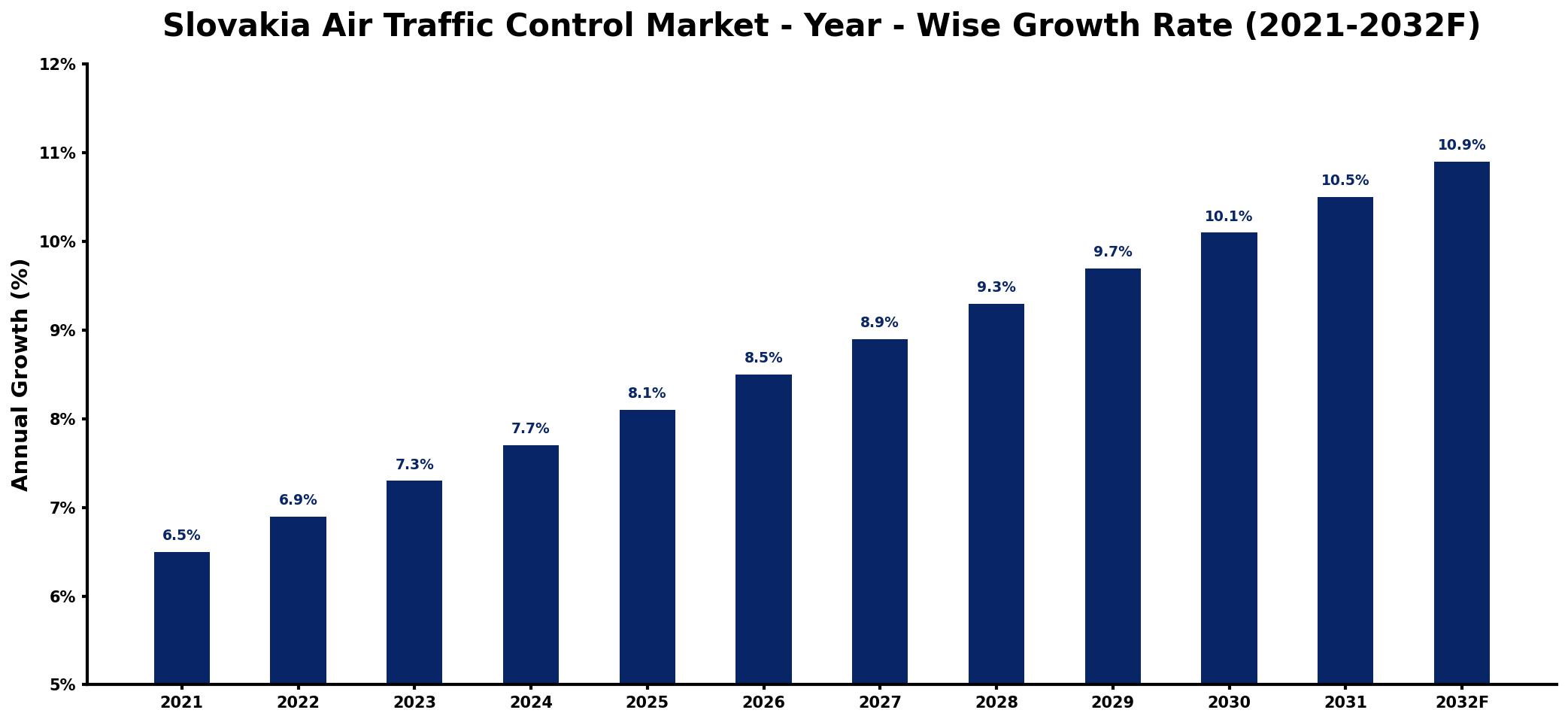
The table below presents the year‑wise growth rates along with the key drivers influencing the market
| Year | Growth Rate | Major Drivers |
| 2021 | 6.5% | Increased investment in infrastructure |
| 2022 | 6.9% | Rising demand for safe operations |
| 2023 | 7.3% | Expansion of commercial aviation |
| 2024 | 7.7% | Growth in tourism sector activities |
| 2025 | 8.1% | strengthening international trade flows |
| 2026 | 8.5% | Technological advancements in navigation |
| 2027 | 8.9% | Increase in cargo transportation needs |
| 2028 | 9.3% | Boost in regional connectivity projects |
| 2029 | 9.7% | growing commercial sector adoption |
| 2030 | 10.1% | Rising passenger travel expectations |
| 2031 | 10.5% | Growing emphasis on sustainability |
| 2032 | 10.9% | Increased collaboration with EU initiatives |
Note: Market size estimations and growth projections presented in this report are based on 6Wresearch's proprietary forecasting methodology, utilizing the latest available industry data, government publications, and primary research inputs.
Slovakia Air Traffic Control Market Synopsis
The Slovakia Air Traffic Control Market is currently undergoing significant transformation, characterized by advancements in technology and a strong commitment to safety and efficiency. With a well-established regulatory framework in place, the market is poised to adapt to the evolving needs of airspace management in an increasingly busy aviation landscape.
Recent trends indicate a pronounced shift towards the integration of innovative solutions, as stakeholders recognize the importance of collaboration and knowledge sharing in enhancing the air traffic control infrastructure. As Slovakia positions itself as a key player in Central European aviation, the focus remains on modernization initiatives that cater to both current demands and future growth.
Slovakia Air Traffic Control Market Key Takeaways
- The market is expected to achieve significant growth, driven by modernization and increasing air travel.
- Technological advancements such as automation, AI, and data analytics are reshaping air traffic management.
- The emphasis on sustainability and reducing environmental impact is gaining traction in operational strategies.
- Collaboration between local and international players is vital for addressing regulatory and technological challenges.
- Investment opportunities are emerging in areas such as infrastructure upgrades and software development.
Evaluation of Restraints in Slovakia Air Traffic Control Market
Despite the promising outlook, several constraints are inhibiting the growth of the Slovakia Air Traffic Control Market. The necessity for substantial modernization and technological upgrades to meet increasing air traffic demands presents a formidable challenge. Limited financial resources allocated for infrastructure development may hinder rapid advancements in air traffic control systems. Furthermore, the need for harmonization with European Union regulations poses additional complexities, as does the difficulty in attracting and retaining skilled professionals within the air traffic control sector. These challenges necessitate strategic planning and investment to ensure that Slovakia's air traffic management remains efficient and safe.
Slovakia Air Traffic Control Market Trends
Current trends in the Slovakia Air Traffic Control Market reveal a clear trajectory towards increased automation and digitalization of air traffic management systems. The incorporation of artificial intelligence and data analytics is expected to streamline operations and enhance decision-making processes for air traffic controllers. Additionally, growing awareness of sustainability is prompting stakeholders to seek solutions that minimize carbon emissions and maximize fuel efficiency in air traffic operations. These trends indicate a proactive approach to addressing modern challenges within the aviation sector.
Slovakia Air Traffic Control Market Opportunities
The Slovakia Air Traffic Control Market offers a wealth of investment opportunities. Modernization projects aimed at upgrading existing infrastructure are essential for maintaining operational efficiency and safety. Furthermore, the introduction of cutting-edge technologies such as automation and artificial intelligence presents avenues for enhancing air traffic management. Collaborations with international aviation companies can facilitate knowledge transfer and foster innovation, while areas such as equipment procurement and training services remain lucrative for investors looking to capitalize on the evolving market landscape.
Government Initiatives in the Slovakia Air Traffic Control Market
The Slovak government is actively involved in overseeing the air traffic control market through the Civil Aviation Authority of the Slovak Republic (CAA). The CAA's efforts focus on implementing EU regulations to ensure the highest standards of safety and efficiency within the aviation sector. Furthermore, policies aimed at modernizing air traffic control infrastructure demonstrate the governments commitment to enhancing the operational capabilities of Slovakias airspace management. By fostering competition among service providers, the government is also driving improvements in quality and efficiency.
Future Insights of the Slovakia Air Traffic Control Market
The future of the Slovakia Air Traffic Control Market is set to be marked by continued growth and innovation. As air travel demand rises, the market will likely necessitate more sophisticated air traffic control systems to manage the increasing volume of aircraft effectively. The anticipated adoption of advanced technologies, alongside infrastructure expansion at airports, will be pivotal in ensuring the resilience and adaptability of Slovakias aviation sector. Overall, the market outlook remains optimistic, reflecting a commitment to modernization and safety in air traffic management.
Slovakia Air Traffic Control Market Latest Developments (2025 - 2026)
Recent industry developments indicate a strong focus on the integration of new technologies aimed at enhancing air traffic control services in Slovakia. Notable initiatives have been observed in the realm of automation and AI implementation, positioning the country to better manage air traffic efficiently. Collaborative efforts with international aviation bodies are on the rise, signaling a commitment to aligning with global best practices. Moreover, discussions around potential infrastructure investments are gaining momentum as stakeholders seek to address current and future airspace management needs.
Slovakia Air Traffic Control Market - Key Attractiveness of the Report
- 10 Years of Market Numbers
- Historical Data Starting from 2022 to 2025
- Base Year: 2025
- Forecast Data until 2032
- Key Performance Indicators Impacting the Market
- Major Upcoming Developments and Projects
Key Highlights of the Report:
- Slovakia Air Traffic Control Market Outlook
- Market Size of Slovakia Air Traffic Control Market, 2025
- Forecast of Slovakia Air Traffic Control Market, 2032
- Historical Data and Forecast of Slovakia Air Traffic Control Revenues & Volume for the Period 2022-2032F
- Slovakia Air Traffic Control Market Trend Evolution
- Slovakia Air Traffic Control Market Drivers and Challenges
- Slovakia Air Traffic Control Price Trends
- Slovakia Air Traffic Control Porter's Five Forces
- Slovakia Air Traffic Control Industry Life Cycle
- Historical Data and Forecast of Slovakia Air Traffic Control Market Revenues & Volume By Airspace for the Period 2022-2032F
- Historical Data and Forecast of Slovakia Air Traffic Control Market Revenues & Volume By Air Route Traffic Control Centers for the Period 2022-2032F
- Historical Data and Forecast of Slovakia Air Traffic Control Market Revenues & Volume By Terminal Radar Approach Control for the Period 2022-2032F
- Historical Data and Forecast of Slovakia Air Traffic Control Market Revenues & Volume By Air Traffic Control Tower for the Period 2022-2032F
- Historical Data and Forecast of Slovakia Air Traffic Control Market Revenues & Volume By Remote Tower for the Period 2022-2032F
- Historical Data and Forecast of Slovakia Air Traffic Control Market Revenues & Volume By Application for the Period 2022-2032F
- Historical Data and Forecast of Slovakia Air Traffic Control Market Revenues & Volume By Communication for the Period 2022-2032F
- Historical Data and Forecast of Slovakia Air Traffic Control Market Revenues & Volume By Navigation for the Period 2022-2032F
- Historical Data and Forecast of Slovakia Air Traffic Control Market Revenues & Volume By Surveillance for the Period 2022-2032F
- Historical Data and Forecast of Slovakia Air Traffic Control Market Revenues & Volume By Automation for the Period 2022-2032F
- Historical Data and Forecast of Slovakia Air Traffic Control Market Revenues & Volume By Offerings for the Period 2022-2032F
- Historical Data and Forecast of Slovakia Air Traffic Control Market Revenues & Volume By Hardware for the Period 2022-2032F
- Historical Data and Forecast of Slovakia Air Traffic Control Market Revenues & Volume By Software & Solutions for the Period 2022-2032F
- Historical Data and Forecast of Slovakia Air Traffic Control Market Revenues & Volume By Services for the Period 2022-2032F
- Historical Data and Forecast of Slovakia Air Traffic Control Market Revenues & Volume By Airport Size for the Period 2022-2032F
- Historical Data and Forecast of Slovakia Air Traffic Control Market Revenues & Volume By Large for the Period 2022-2032F
- Historical Data and Forecast of Slovakia Air Traffic Control Market Revenues & Volume By Medium for the Period 2022-2032F
- Historical Data and Forecast of Slovakia Air Traffic Control Market Revenues & Volume By Small for the Period 2022-2032F
- Historical Data and Forecast of Slovakia Air Traffic Control Market Revenues & Volume By Sector for the Period 2022-2032F
- Historical Data and Forecast of Slovakia Air Traffic Control Market Revenues & Volume By Commercial for the Period 2022-2032F
- Historical Data and Forecast of Slovakia Air Traffic Control Market Revenues & Volume By Military & Defense for the Period 2022-2032F
- Slovakia Air Traffic Control Import Export Trade Statistics
- Market Opportunity Assessment By Airspace
- Market Opportunity Assessment By Application
- Market Opportunity Assessment By Offerings
- Market Opportunity Assessment By Airport Size
- Market Opportunity Assessment By Sector
- Slovakia Air Traffic Control Top Companies Market Share
- Slovakia Air Traffic Control Competitive Benchmarking By Technical and Operational Parameters
- Slovakia Air Traffic Control Company Profiles
- Slovakia Air Traffic Control Key Strategic Recommendations






































