Slovakia Centrifugal Industrial Dryer Market Top 5 Importing Countries and Market Competition (HHI) Analysis
The import shipments of centrifugal industrial dryers to Slovakia in 2024 continued to be predominantly sourced from top exporting countries such as Germany, Serbia, Czechia, Other European countries, and China. Despite a decrease in concentration compared to 2023, the Market Top 5 Importing Countries and Market Competition (HHI) Analysis still exhibited high concentration levels in 2024. The negative CAGR of -19.4% over the period of 2020-2024 and a significant decline in growth rate of -62.06% from 2023 to 2024 reflect a challenging landscape for centrifugal industrial dryer imports in Slovakia.
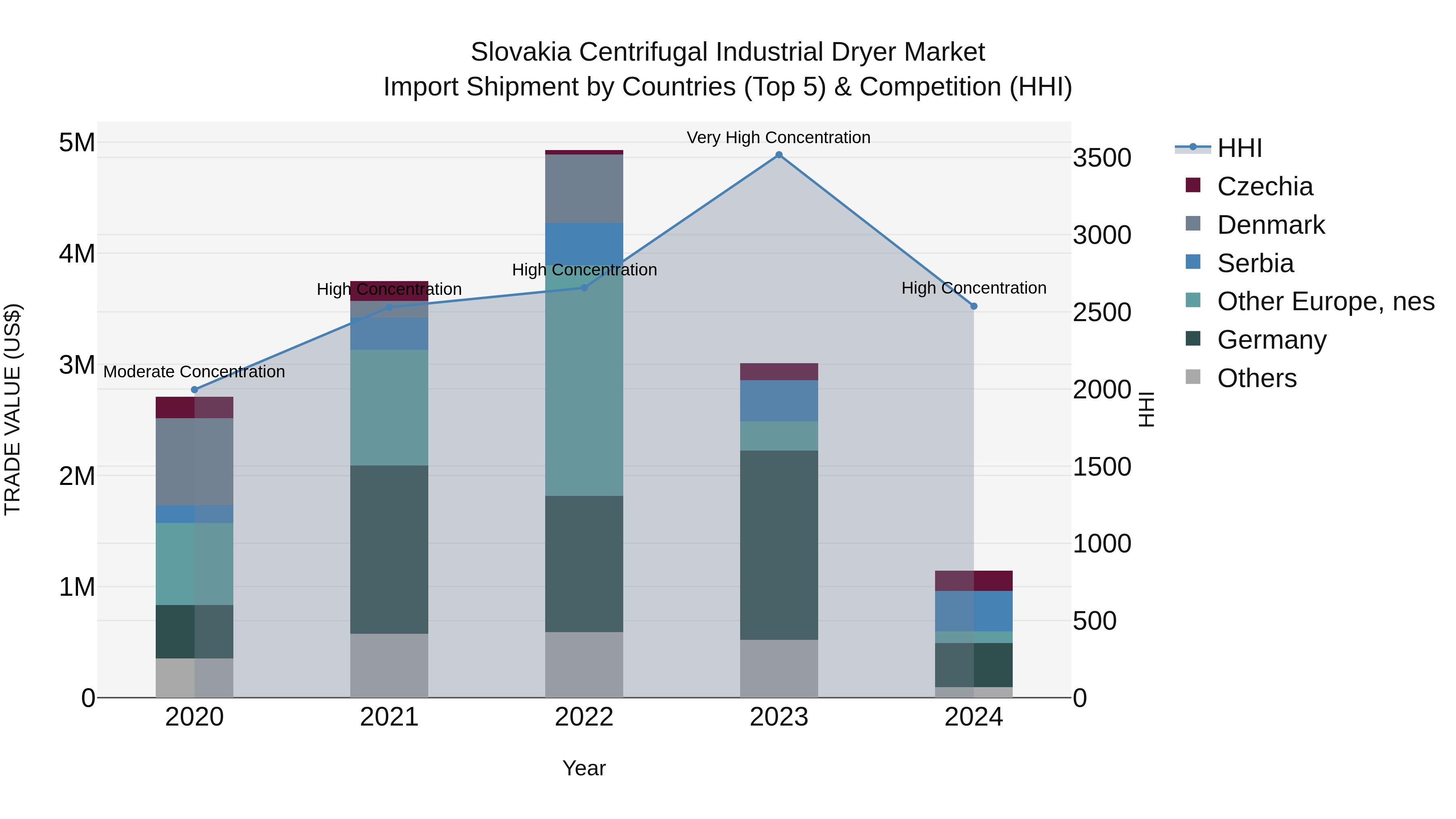
Slovakia Centrifugal Industrial Dryer Market Overview
The Slovakia Centrifugal Industrial Dryer Market is experiencing steady growth driven by increasing demand across various industries such as food processing, pharmaceuticals, and chemicals. The market is characterized by the presence of both domestic manufacturers and international players offering a wide range of centrifugal industrial dryers to meet diverse industry requirements. Key factors influencing market growth include technological advancements leading to more efficient and environmentally friendly dryers, strict regulations regarding product quality and safety, and the need for faster drying processes to enhance overall production efficiency. Market players are focusing on product innovation, strategic partnerships, and expansion of distribution networks to gain a competitive edge in the Slovakia Centrifugal Industrial Dryer Market. Additionally, rising investments in industrial infrastructure and the growing trend towards automation are expected to further drive market growth in the forecast period.
Slovakia Centrifugal Industrial Dryer Market Trends
As of recent trends in the Slovakia Centrifugal Industrial Dryer Market, there is a noticeable shift towards more energy-efficient and eco-friendly dryer models. Manufacturers are focusing on developing dryers that consume less energy while maintaining high performance levels. Additionally, there is a growing demand for industrial dryers with advanced automation and digital connectivity features for improved efficiency and monitoring. Another emerging trend is the increasing adoption of centrifugal industrial dryers in various industries such as food processing, pharmaceuticals, and chemicals due to their ability to quickly and effectively dry a wide range of materials. Overall, the market is witnessing a push towards innovation and sustainability in response to changing consumer preferences and regulatory requirements.
Slovakia Centrifugal Industrial Dryer Market Challenges
In the Slovakia Centrifugal Industrial Dryer Market, some of the key challenges faced include intense competition from both domestic and international manufacturers, leading to price wars and margin pressure. Additionally, the market is highly dependent on the overall economic conditions and the manufacturing sector`s performance, making it susceptible to fluctuations in demand. Another challenge is the need for continuous innovation and technology upgrades to stay competitive and meet the evolving needs of the customers. Moreover, regulatory requirements and environmental concerns regarding energy efficiency and emissions further add complexity to the market landscape. Overall, companies operating in the Slovakia Centrifugal Industrial Dryer Market need to navigate these challenges effectively to sustain growth and profitability in a dynamic and competitive environment.
Slovakia Centrifugal Industrial Dryer Market Investment Opportunities
The Slovakia Centrifugal Industrial Dryer Market presents promising investment opportunities due to the country`s growing industrial sector and increasing demand for efficient drying solutions. With a focus on sectors such as agriculture, food processing, and manufacturing, there is a rising need for advanced drying technologies to improve production processes. Investors can explore opportunities in supplying high-quality centrifugal industrial dryers to meet the market demand. Additionally, there is potential for offering maintenance and servicing of existing dryers to cater to the expanding industrial base. By leveraging the country`s industrial growth and demand for innovative drying solutions, investors can tap into a niche market with substantial growth prospects in Slovakia.
Slovakia Centrifugal Industrial Dryer Market Government Policy
Government policies related to the Slovakia Centrifugal Industrial Dryer Market include regulations on energy efficiency, environmental protection, and safety standards. The government of Slovakia has implemented initiatives to promote energy-efficient technologies in industrial processes, which may impact the adoption of centrifugal industrial dryers in the market. Additionally, environmental regulations aim to reduce emissions and promote sustainable practices within the industry, influencing the choice of equipment used, including industrial dryers. Safety standards outlined by the government ensure that manufacturers and users comply with stringent guidelines to protect workers and the environment. Overall, government policies in Slovakia play a crucial role in shaping the operating environment for the centrifugal industrial dryer market, emphasizing sustainability, efficiency, and safety considerations.
Slovakia Centrifugal Industrial Dryer Market Future Outlook
The Slovakia Centrifugal Industrial Dryer Market is expected to witness steady growth in the coming years due to factors such as increasing demand for efficient drying solutions across various industries including food processing, pharmaceuticals, textiles, and chemicals. The market is likely to be driven by advancements in dryer technology, leading to improved energy efficiency, faster drying times, and better product quality. Additionally, stringent regulations regarding energy consumption and environmental impact are expected to drive the adoption of centrifugal industrial dryers in Slovakia. Market players are also focusing on product innovations and customization to cater to the specific requirements of different industries, further fueling market growth. Overall, the Slovakia Centrifugal Industrial Dryer Market is projected to experience a positive trajectory in the foreseeable future.
Key Highlights of the Report:
- Slovakia Centrifugal Industrial Dryer Market Outlook
- Market Size of Slovakia Centrifugal Industrial Dryer Market, 2024
- Forecast of Slovakia Centrifugal Industrial Dryer Market, 2031
- Historical Data and Forecast of Slovakia Centrifugal Industrial Dryer Revenues & Volume for the Period 2021 - 2031
- Slovakia Centrifugal Industrial Dryer Market Trend Evolution
- Slovakia Centrifugal Industrial Dryer Market Drivers and Challenges
- Slovakia Centrifugal Industrial Dryer Price Trends
- Slovakia Centrifugal Industrial Dryer Porter's Five Forces
- Slovakia Centrifugal Industrial Dryer Industry Life Cycle
- Historical Data and Forecast of Slovakia Centrifugal Industrial Dryer Market Revenues & Volume By Application for the Period 2021 - 2031
- Historical Data and Forecast of Slovakia Centrifugal Industrial Dryer Market Revenues & Volume By Metal Finishing for the Period 2021 - 2031
- Historical Data and Forecast of Slovakia Centrifugal Industrial Dryer Market Revenues & Volume By Food Processing for the Period 2021 - 2031
- Historical Data and Forecast of Slovakia Centrifugal Industrial Dryer Market Revenues & Volume By Plastic Recycling for the Period 2021 - 2031
- Historical Data and Forecast of Slovakia Centrifugal Industrial Dryer Market Revenues & Volume By Chemical for the Period 2021 - 2031
- Historical Data and Forecast of Slovakia Centrifugal Industrial Dryer Market Revenues & Volume By Pharmaceutical for the Period 2021 - 2031
- Historical Data and Forecast of Slovakia Centrifugal Industrial Dryer Market Revenues & Volume By Type for the Period 2021 - 2031
- Historical Data and Forecast of Slovakia Centrifugal Industrial Dryer Market Revenues & Volume By Direct for the Period 2021 - 2031
- Historical Data and Forecast of Slovakia Centrifugal Industrial Dryer Market Revenues & Volume By Indirect for the Period 2021 - 2031
- Slovakia Centrifugal Industrial Dryer Import Export Trade Statistics
- Market Opportunity Assessment By Application
- Market Opportunity Assessment By Type
- Slovakia Centrifugal Industrial Dryer Top Companies Market Share
- Slovakia Centrifugal Industrial Dryer Competitive Benchmarking By Technical and Operational Parameters
- Slovakia Centrifugal Industrial Dryer Company Profiles
- Slovakia Centrifugal Industrial Dryer Key Strategic Recommendations






































