Slovakia Fatty Alcohol Market Size (2020-2030)
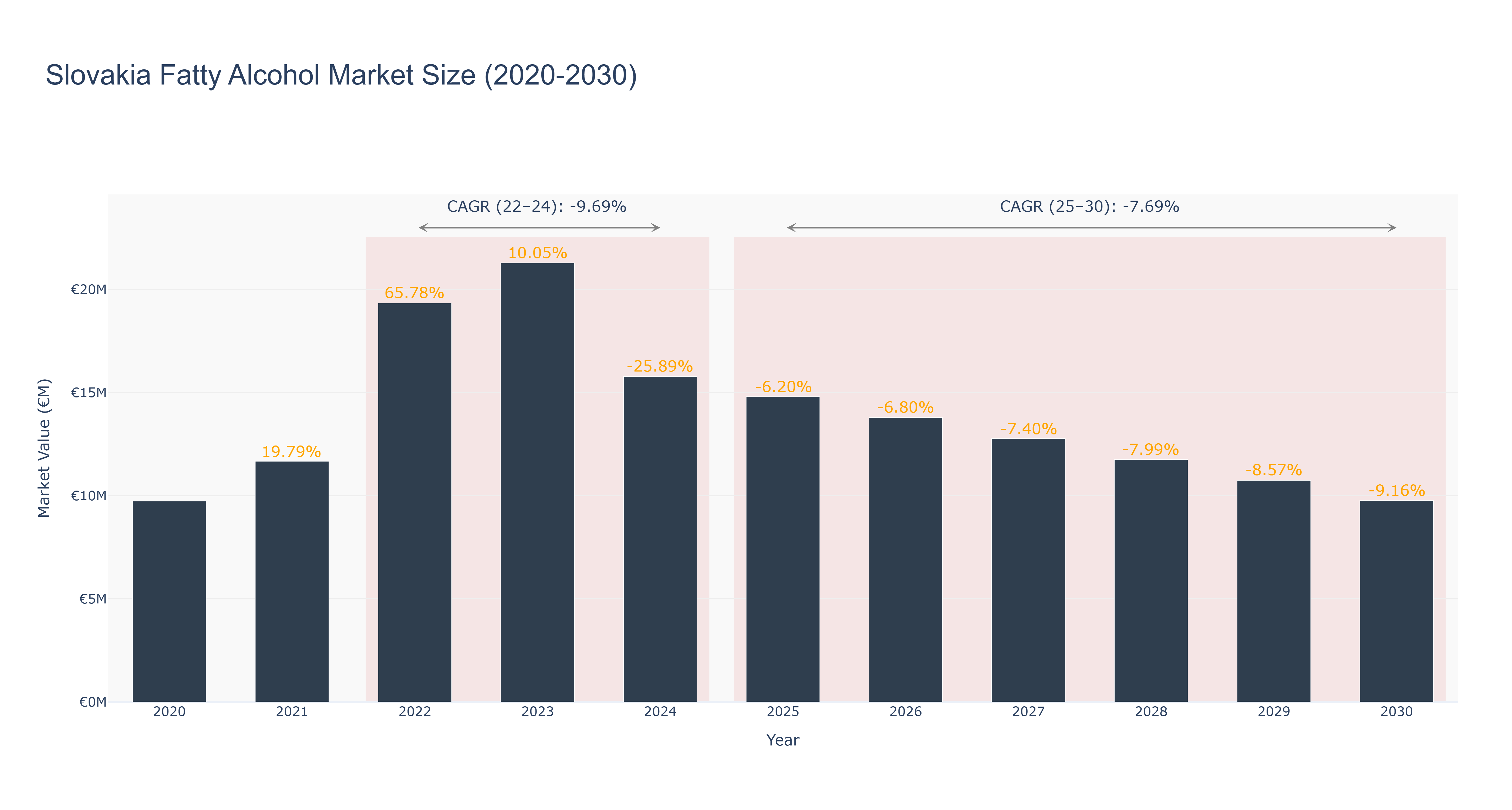
Slovakia Fatty Alcohol Market has experienced a fluctuating trend over the years. The peak market size of €21.29 million was observed in 2023, followed by a decline to €15.78 million in 2024. Forecasted market sizes show a continued decrease from €14.80 million in 2025 to an estimated €9.76 million in 2030. The CAGR values indicate a negative trend, with a decline of -9.69% from 2022 to 2024 and -7.69% from 2025 to 2030. The downturn in market size can be attributed to factors such as changing consumer preferences, economic conditions, and regulatory challenges. Looking ahead, the industry's drivers include innovation in product formulations, sustainability initiatives, and expanding applications in various sectors. Recent developments in the market include collaborations with research institutions to develop eco-friendly production processes and partnerships with key players to enhance distribution networks for increased market penetration.
Slovakia Fatty Alcohol Market: Production & Trade Performance (2019-2025)
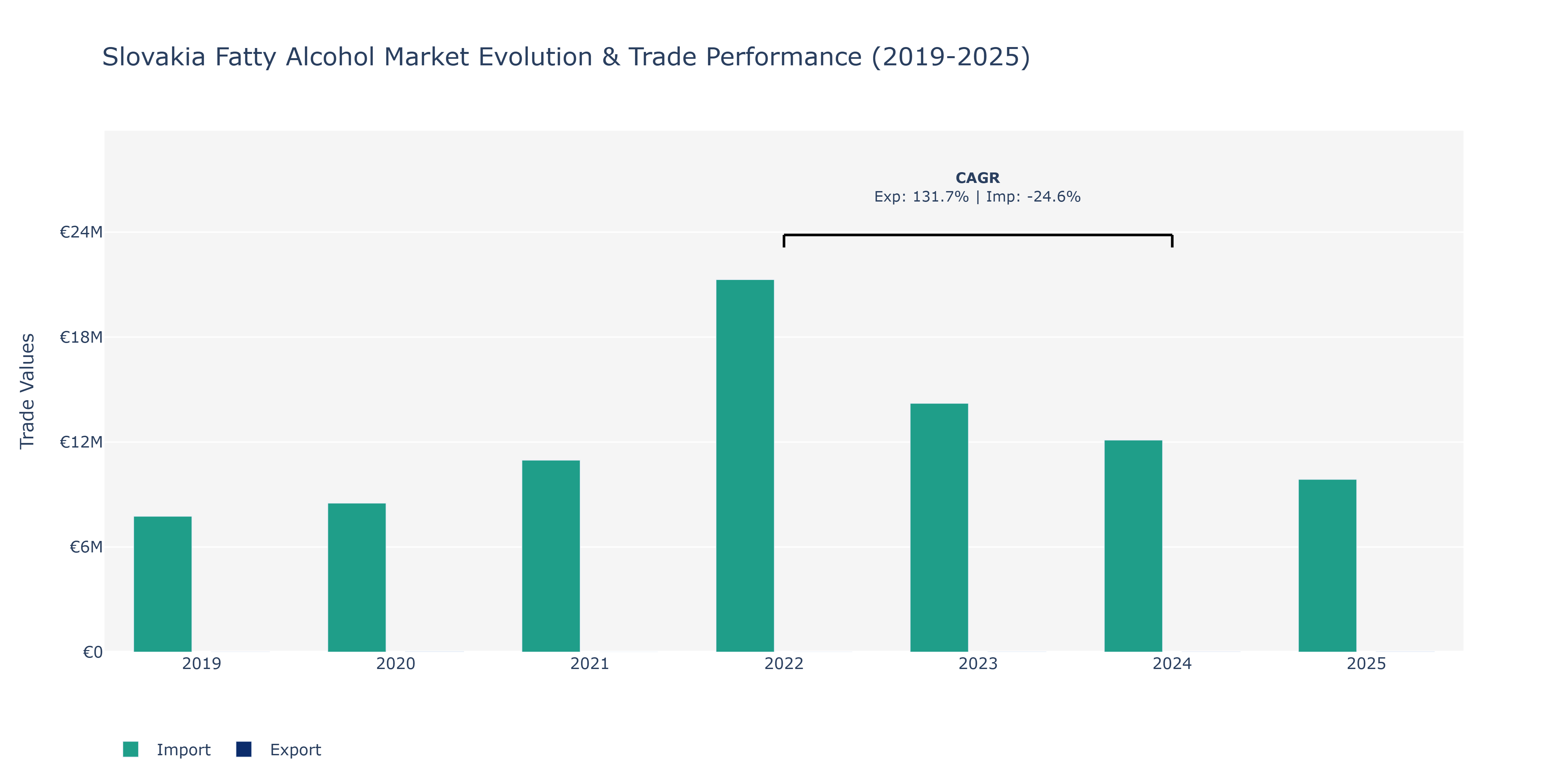
Between 2019 and 2025, Slovakia's Fatty Alcohol Market witnessed notable fluctuations in both exports and imports. In 2019, exports amounted to €7.54 thousand, increasing substantially to €28.58 thousand in 2020, which can be attributed to growing demand or new market entry. However, a sharp decline was observed in 2022, with exports falling to €3.72 thousand, possibly due to changes in market dynamics or regulatory factors. Interestingly, exports rebounded in 2023 and 2024, reaching €19.97 thousand, showcasing a positive trend supported by strategic market positioning or investment in production capabilities. On the other hand, imports followed a different trajectory, increasing steadily from €7.76 million in 2019 to a peak of €21.28 million in 2022, reflecting a surge in demand or global sourcing strategies. The subsequent decline in imports to €9.87 million in 2025 could be linked to shifting consumer preferences or domestic supply enhancements. These fluctuations highlight the market's sensitivity to external factors and the need for adaptive strategies to navigate changing market conditions effectively.
Slovakia Fatty Alcohol Market Synopsis
The Slovakia Fatty Alcohol Market is experiencing steady growth driven by increasing demand from various industries such as personal care, pharmaceuticals, and household products. Fatty alcohols are widely used in the production of cosmetics, detergents, and pharmaceuticals due to their emollient and surfactant properties. The market is witnessing a rise in demand for natural and sustainable fatty alcohols, reflecting consumer preferences for environmentally friendly products. Key players in the Slovakia Fatty Alcohol Market include Sasol Limited, KLK OLEO, Wilmar International Ltd., and BASF SE. Market trends also indicate a shift towards plant-based fatty alcohols to cater to the growing demand for organic and vegan products. Overall, the Slovakia Fatty Alcohol Market is poised for further growth as industries continue to innovate and adapt to changing consumer preferences.
Slovakia Fatty Alcohol Market Trends
The Slovakia fatty alcohol market is experiencing steady growth driven by increasing demand in various industries such as personal care, pharmaceuticals, and agrochemicals. Consumers are increasingly seeking natural and sustainable products, leading to a rise in the demand for fatty alcohols derived from renewable sources. Manufacturers are focusing on developing innovative products with enhanced functionalities such as moisturizing properties in personal care products and emulsifying agents in pharmaceuticals. Additionally, the growing awareness about the harmful effects of synthetic chemicals is prompting consumers to shift towards organic and natural ingredients, further boosting the demand for fatty alcohols. The market is also witnessing a trend towards product differentiation through customization to cater to specific industry requirements, driving competition among key players to innovate and expand their product portfolios.
Slovakia Fatty Alcohol Market Challenges
In the Slovakia Fatty Alcohol Market, some of the challenges faced include intense competition from foreign suppliers, fluctuating raw material prices, and strict environmental regulations. Foreign suppliers often have cost advantages and established distribution networks, making it difficult for domestic producers to compete. Additionally, the prices of raw materials such as palm oil or coconut oil can be volatile, impacting production costs and profitability. Moreover, stringent environmental regulations in Slovakia require compliance with sustainability standards and emissions controls, adding complexity and costs to production processes. To remain competitive and sustainable in the market, companies in the Slovakia Fatty Alcohol industry must focus on innovation, cost efficiency, and environmental stewardship.
Slovakia Fatty Alcohol Market Investment Opportunities
The Slovakia Fatty Alcohol Market presents promising investment opportunities due to the increasing demand for fatty alcohols in various industries such as personal care, pharmaceuticals, and detergents. With a growing population and rising disposable incomes, there is a higher consumption of products containing fatty alcohols, driving market growth. Investors can capitalize on this trend by investing in fatty alcohol manufacturers or suppliers in Slovakia to cater to the local demand as well as potentially expand into neighboring markets within the European Union. Additionally, advancements in technology and sustainable practices in fatty alcohol production offer a competitive edge and appeal to environmentally conscious consumers, further enhancing investment prospects in the Slovakia Fatty Alcohol Market.
Jordan Agar Market Government Policies
The Slovakia government does not have specific policies targeting the Fatty Alcohol Market. However, the country`s overall regulatory framework, including environmental regulations, trade policies, and food safety standards, may impact the Fatty Alcohol Market. Slovakia is a member of the European Union, and as such, it adheres to EU regulations that may indirectly affect the Fatty Alcohol Market. Companies operating in the Fatty Alcohol Market in Slovakia need to comply with relevant EU directives and regulations to ensure product quality, safety, and environmental sustainability. Additionally, the government`s broader policies on economic development, investment incentives, and trade agreements could also influence the growth and competitiveness of the Fatty Alcohol Market in Slovakia.
Slovakia Fatty Alcohol Market Future Outlook
The Slovakia Fatty Alcohol Market is expected to witness steady growth in the coming years due to increasing demand from end-use industries such as personal care, household cleaning, and pharmaceuticals. Factors driving this growth include rising disposable incomes, changing consumer preferences towards natural and organic products, and the expanding industrial sector. Additionally, the growing awareness regarding the benefits of fatty alcohols, such as their emollient and moisturizing properties, is expected to further fuel market growth. Market players are likely to focus on product innovation, sustainability, and strategic partnerships to capitalize on emerging opportunities in the Slovakia Fatty Alcohol Market. However, challenges such as volatile raw material prices and regulatory hurdles may impact market growth to some extent.
Key Highlights of the Report:
- Slovakia Fatty Alcohol Market Outlook
- Market Size of Slovakia Fatty Alcohol Market, 2021
- Forecast of Slovakia Fatty Alcohol Market, 2031
- Historical Data and Forecast of Slovakia Fatty Alcohol Revenues & Volume for the Period 2018 - 2031
- Slovakia Fatty Alcohol Market Trend Evolution
- Slovakia Fatty Alcohol Market Drivers and Challenges
- Slovakia Fatty Alcohol Price Trends
- Slovakia Fatty Alcohol Porter's Five Forces
- Slovakia Fatty Alcohol Industry Life Cycle
- Historical Data and Forecast of Slovakia Fatty Alcohol Market Revenues & Volume By Product for the Period 2018 - 2031
- Historical Data and Forecast of Slovakia Fatty Alcohol Market Revenues & Volume By C6-C10 for the Period 2018 - 2031
- Historical Data and Forecast of Slovakia Fatty Alcohol Market Revenues & Volume By C11-C14 for the Period 2018 - 2031
- Historical Data and Forecast of Slovakia Fatty Alcohol Market Revenues & Volume By C15-C22 for the Period 2018 - 2031
- Historical Data and Forecast of Slovakia Fatty Alcohol Market Revenues & Volume By Application for the Period 2018 - 2031
- Historical Data and Forecast of Slovakia Fatty Alcohol Market Revenues & Volume By Soaps & Detergents for the Period 2018 - 2031
- Historical Data and Forecast of Slovakia Fatty Alcohol Market Revenues & Volume By Personal Care for the Period 2018 - 2031
- Historical Data and Forecast of Slovakia Fatty Alcohol Market Revenues & Volume By Lubricants for the Period 2018 - 2031
- Historical Data and Forecast of Slovakia Fatty Alcohol Market Revenues & Volume By Amines for the Period 2018 - 2031
- Historical Data and Forecast of Slovakia Fatty Alcohol Market Revenues & Volume By Others for the Period 2018 - 2031
- Slovakia Fatty Alcohol Import Export Trade Statistics
- Market Opportunity Assessment By Product
- Market Opportunity Assessment By Application
- Slovakia Fatty Alcohol Top Companies Market Share
- Slovakia Fatty Alcohol Competitive Benchmarking By Technical and Operational Parameters
- Slovakia Fatty Alcohol Company Profiles
- Slovakia Fatty Alcohol Key Strategic Recommendations






































