Slovenia Adipic Acid Market Size (2020-2030)
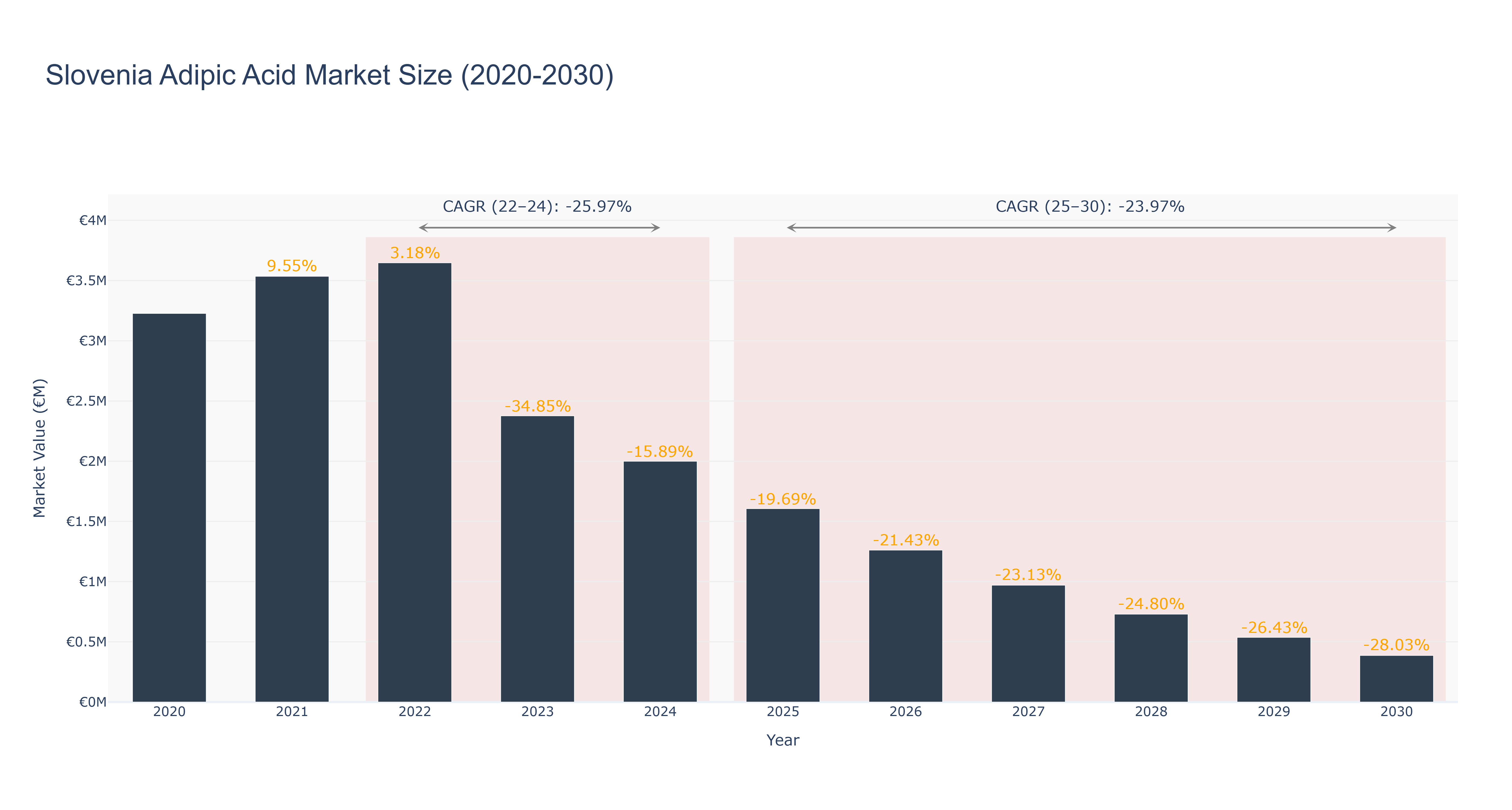
The Slovenia Adipic Acid Market has experienced a significant decline in market size over the years. The peak market size of €3.65 million was recorded in 2022, followed by a sharp decrease to €1.26 million in 2026. The market is forecasted to continue shrinking, with an expected size of €0.39 million by 2030. The CAGR for the period 2022-24 is -25.97%, while for 2025-30, it is projected at -23.97%. This downward trend can be attributed to various factors such as changing consumer preferences, increased competition, and economic challenges. Despite the challenging market conditions, there are ongoing efforts to explore new applications and technologies in the adipic acid industry in Slovenia, which could potentially drive growth in the future.
Slovenia Adipic Acid Market: Production & Trade Performance (2019-2025)
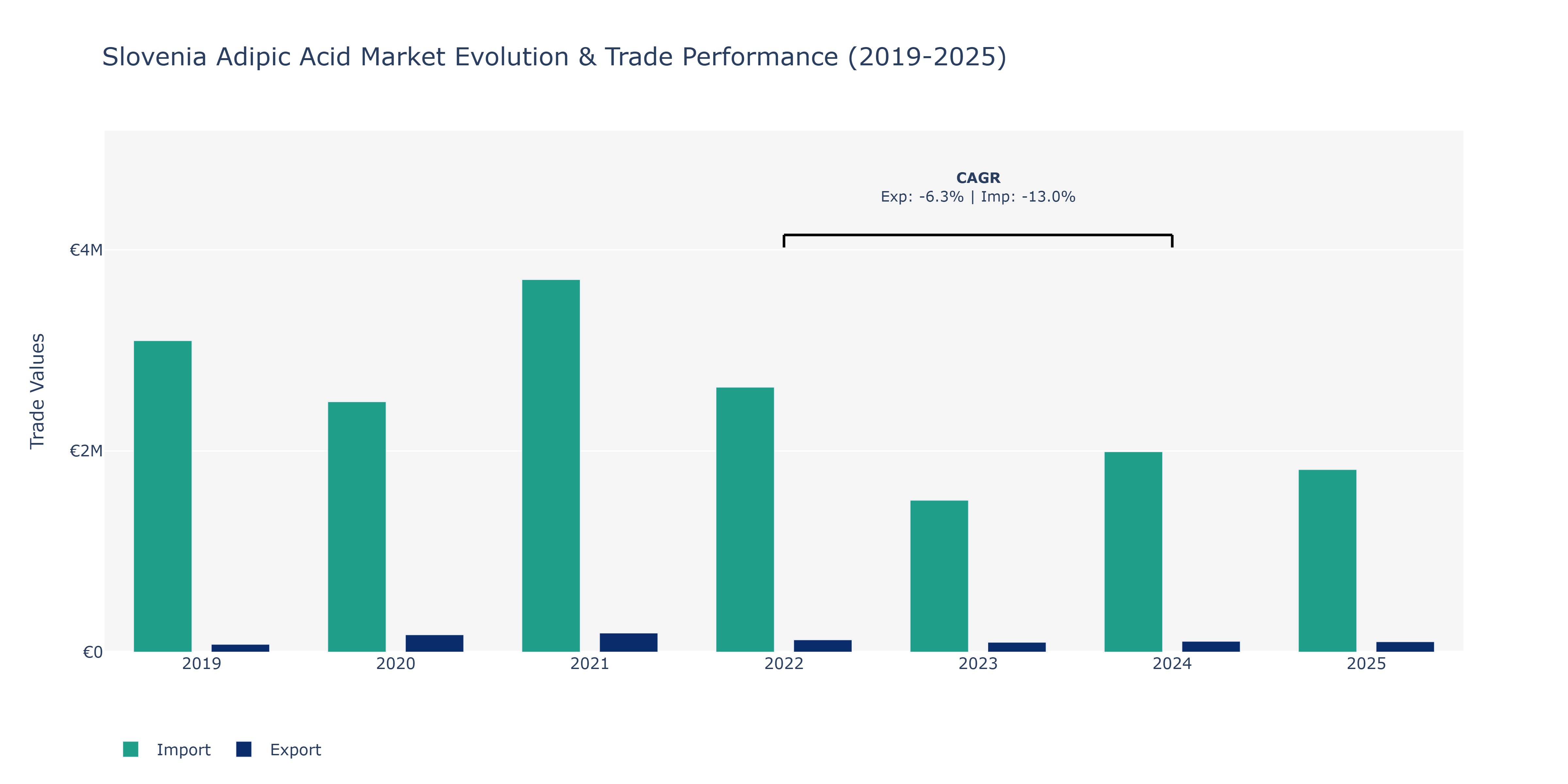
Between 2019 and 2025, Slovenia's Adipic Acid Market saw a mix of fluctuations in exports and imports. Exports increased steadily from €76.35 thousand in 2019 to €188.46 thousand in 2021 before experiencing a slight decline in 2022 to €120.72 thousand. However, they rebounded in 2024 and decreased marginally to €102.34 thousand in 2025. On the other hand, imports fluctuated notably, starting at €3.1 million in 2019, dropping to €1.51 million in 2023, and then rising to €1.81 million in 2025. The decrease in imports in 2023 could be attributed to factors such as changes in global demand dynamics, while the subsequent rebound might reflect increased domestic consumption or shifts in sourcing strategies. The overall trends suggest the market is responsive to both global and domestic economic conditions, emphasizing the need for market players to remain agile and responsive to changing trade dynamics in the Adipic Acid Market.
Key Highlights of the Report:
- Slovenia Adipic acid Market Outlook
- Market Size of Slovenia Adipic acid Market, 2025
- Forecast of Slovenia Adipic acid Market, 2032
- Historical Data and Forecast of Slovenia Adipic acid Revenues & Volume for the Period 2022-2032F
- Slovenia Adipic acid Market Trend Evolution
- Slovenia Adipic acid Market Drivers and Challenges
- Slovenia Adipic acid Price Trends
- Slovenia Adipic acid Porter`s Five Forces
- Slovenia Adipic acid Industry Life Cycle
- Historical Data and Forecast of Slovenia Adipic acid Market Revenues & Volume By Application for the Period 2022-2032F
- Historical Data and Forecast of Slovenia Adipic acid Market Revenues & Volume By Nylon 6,6 Fiber for the Period 2022-2032F
- Historical Data and Forecast of Slovenia Adipic acid Market Revenues & Volume By Nylon 6,6 Resin for the Period 2022-2032F
- Historical Data and Forecast of Slovenia Adipic acid Market Revenues & Volume By Polyurethane for the Period 2022-2032F
- Historical Data and Forecast of Slovenia Adipic acid Market Revenues & Volume By Adipate Esters for the Period 2022-2032F
- Historical Data and Forecast of Slovenia Adipic acid Market Revenues & Volume By Others for the Period 2022-2032F
- Historical Data and Forecast of Slovenia Adipic acid Market Revenues & Volume By Raw Material for the Period 2022-2032F
- Historical Data and Forecast of Slovenia Adipic acid Market Revenues & Volume By Cyclohexanol for the Period 2022-2032F
- Historical Data and Forecast of Slovenia Adipic acid Market Revenues & Volume By Cyclohexanone for the Period 2022-2032F
- Slovenia Adipic acid Import Export Trade Statistics
- Market Opportunity Assessment By Application
- Market Opportunity Assessment By Raw Material
- Slovenia Adipic acid Top Companies Market Share
- Slovenia Adipic acid Competitive Benchmarking By Technical and Operational Parameters
- Slovenia Adipic acid Company Profiles
- Slovenia Adipic acid Key Strategic Recommendations






































