| Product Code: ETC5356277 | Publication Date: Nov 2023 | Updated Date: Feb 2026 | Product Type: Market Research Report | |
| Publisher: 6Wresearch | Author: Ravi Bhandari | No. of Pages: 60 | No. of Figures: 30 | No. of Tables: 5 |
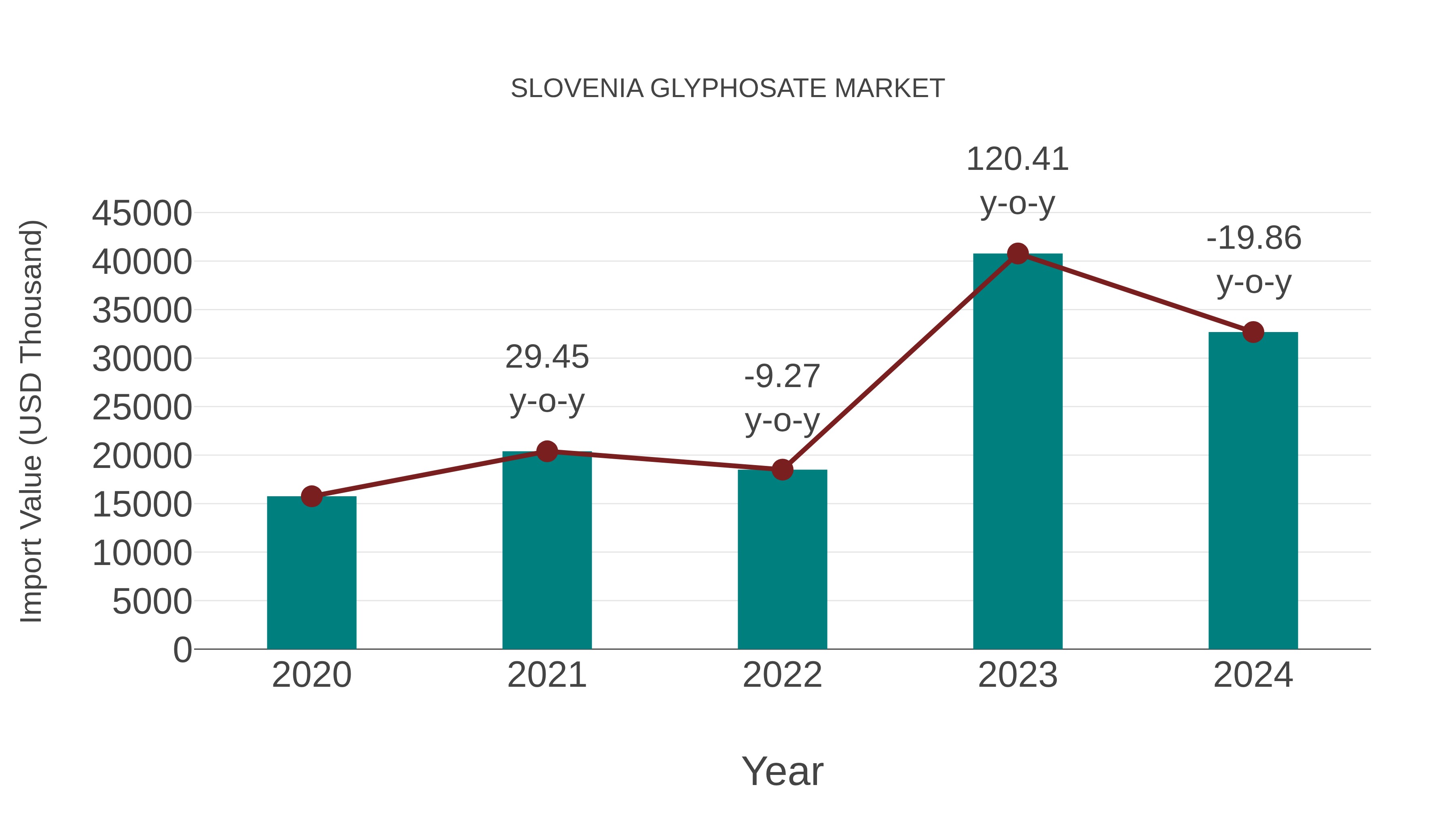
Slovenia import trend for glyphosate in 2024 experienced a decline of -19.86% compared to 2023, with a notable compound annual growth rate (CAGR) of 20.02% from 2020 to 2024. This decrease in import momentum could be attributed to shifting demand patterns or changes in market dynamics impacting the country`s glyphosate trade.
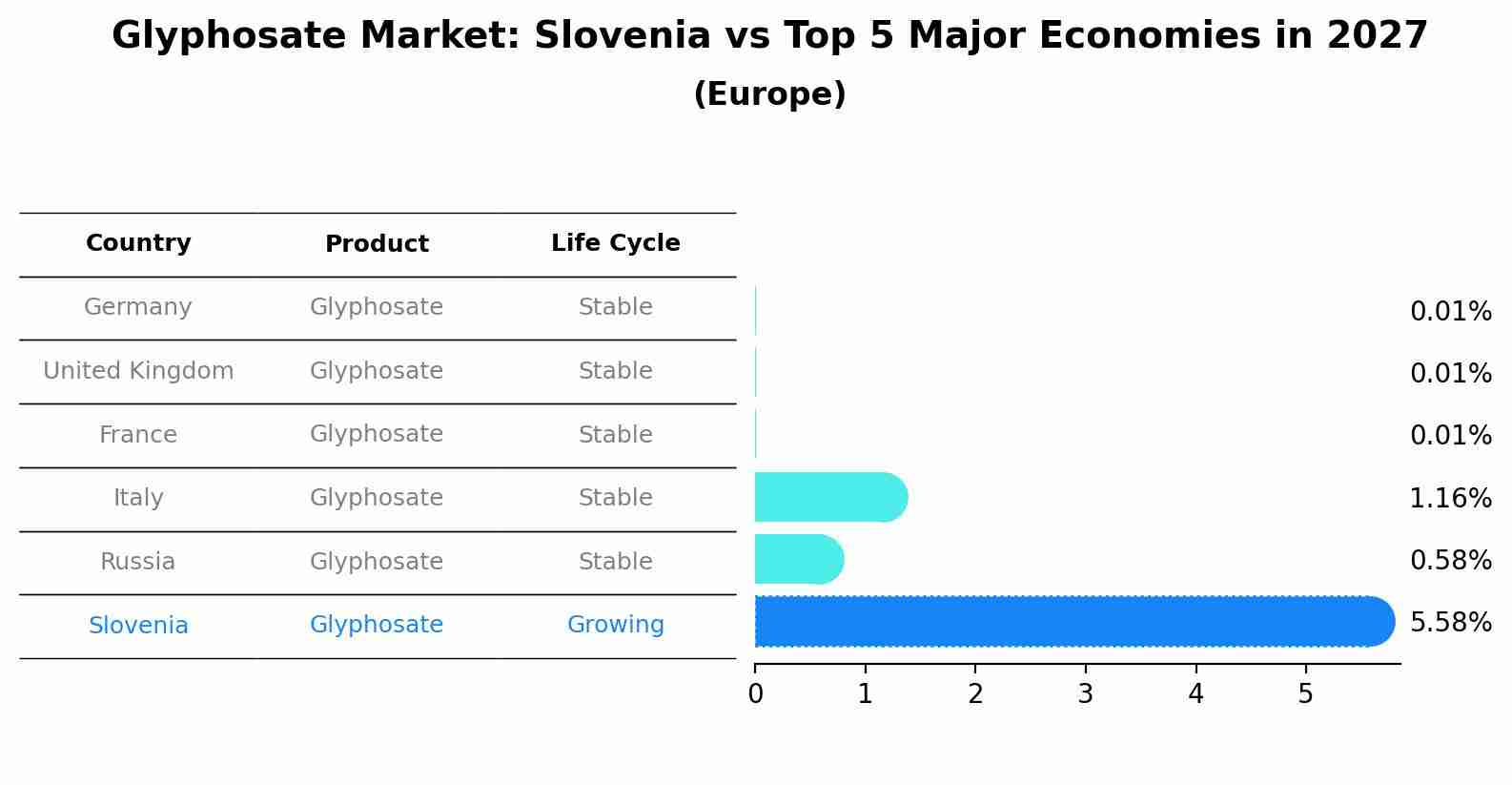
By 2027, the Glyphosate market in Slovenia is anticipated to reach a growth rate of 5.58%, as part of an increasingly competitive Europe region, where Germany remains at the forefront, supported by United Kingdom, France, Italy and Russia, driving innovations and market adoption across sectors.
1 Executive Summary |
2 Introduction |
2.1 Key Highlights of the Report |
2.2 Report Description |
2.3 Market Scope & Segmentation |
2.4 Research Methodology |
2.5 Assumptions |
3 Slovenia Glyphosate Market Overview |
3.1 Slovenia Country Macro Economic Indicators |
3.2 Slovenia Glyphosate Market Revenues & Volume, 2022 & 2032F |
3.3 Slovenia Glyphosate Market - Industry Life Cycle |
3.4 Slovenia Glyphosate Market - Porter's Five Forces |
3.5 Slovenia Glyphosate Market Revenues & Volume Share, By Application, 2022 & 2032F |
4 Slovenia Glyphosate Market Dynamics |
4.1 Impact Analysis |
4.2 Market Drivers |
4.2.1 Increasing demand for glyphosate-based herbicides in agriculture due to their effectiveness in weed control and cost-efficiency. |
4.2.2 Adoption of modern farming practices and technologies in Slovenia leading to higher usage of glyphosate products. |
4.3 Market Restraints |
4.3.1 Growing concerns about the environmental impact of glyphosate on soil health and biodiversity. |
4.3.2 Stringent regulations and potential bans on glyphosate in Slovenia and the European Union due to health and environmental concerns. |
5 Slovenia Glyphosate Market Trends |
6 Slovenia Glyphosate Market Segmentations |
6.1 Slovenia Glyphosate Market, By Application |
6.1.1 Overview and Analysis |
6.1.2 Slovenia Glyphosate Market Revenues & Volume, By Genetically Modified (GM) Crops, 2022-2032F |
6.1.3 Slovenia Glyphosate Market Revenues & Volume, By Conventional Crops, 2022-2032F |
7 Slovenia Glyphosate Market Import-Export Trade Statistics |
7.1 Slovenia Glyphosate Market Export to Major Countries |
7.2 Slovenia Glyphosate Market Imports from Major Countries |
8 Slovenia Glyphosate Market Key Performance Indicators |
8.1 Average application rate of glyphosate per hectare in Slovenia. |
8.2 Adoption rate of integrated weed management practices among farmers. |
8.3 Number of research studies or publications on glyphosate alternatives in the Slovenian agricultural sector. |
9 Slovenia Glyphosate Market - Opportunity Assessment |
9.1 Slovenia Glyphosate Market Opportunity Assessment, By Application, 2022 & 2032F |
10 Slovenia Glyphosate Market - Competitive Landscape |
10.1 Slovenia Glyphosate Market Revenue Share, By Companies, 2025 |
10.2 Slovenia Glyphosate Market Competitive Benchmarking, By Operating and Technical Parameters |
11 Company Profiles |
12 Recommendations | 13 Disclaimer |

Export potential enables firms to identify high-growth global markets with greater confidence by combining advanced trade intelligence with a structured quantitative methodology. The framework analyzes emerging demand trends and country-level import patterns while integrating macroeconomic and trade datasets such as GDP and population forecasts, bilateral import–export flows, tariff structures, elasticity differentials between developed and developing economies, geographic distance, and import demand projections. Using weighted trade values from 2020–2024 as the base period to project country-to-country export potential for 2030, these inputs are operationalized through calculated drivers such as gravity model parameters, tariff impact factors, and projected GDP per-capita growth. Through an analysis of hidden potentials, demand hotspots, and market conditions that are most favorable to success, this method enables firms to focus on target countries, maximize returns, and global expansion with data, backed by accuracy.


By factoring in the projected importer demand gap that is currently unmet and could be potential opportunity, it identifies the potential for the Exporter (Country) among 190 countries, against the general trade analysis, which identifies the biggest importer or exporter.
To discover high-growth global markets and optimize your business strategy:
Click Here































