South Korea 3D Rendering Software Market Growth Rate
According to 6Wresearch internal database and industry insights, the South Korea 3D Rendering Software Market is projected to grow at a compound annual growth rate (CAGR) of 7.7% during the forecast period (2026-2032).
South Korea 3D Rendering Software Market Year-wise Growth Rate and Key Drivers
This graph illustrates the annual growth rates of the South Korea 3D Rendering Software Market from 2021 to 2032, highlighting a steady upward trajectory and projected market expansion over the forecast period.
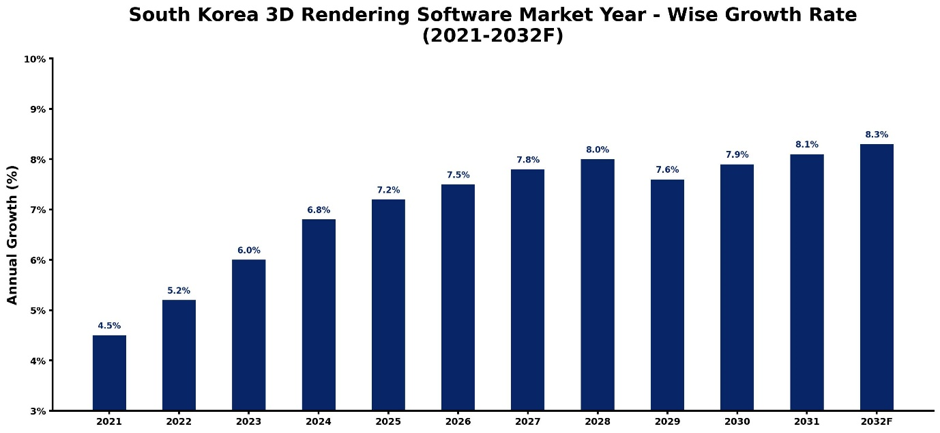
The following table summarizes the historical and forecasted growth rates of the South Korea 3D Rendering Software Market, along with the rationale behind each year’s performance.
| Year | Estimated Growth (%) | Market Rationale |
| 2021 | 4.5% | Rising adoption of 3D visualisation in architecture and gaming fueled initial market uptake. |
| 2022 | 5.2% | Increased investment in virtual production studios and corporate digital transformation initiatives. |
| 2023 | 6% | Expansion of the gaming and media sectors, leading to higher demand for advanced rendering software. |
| 2024 | 6.8% | Integration of AI-powered rendering solutions reduces time and improves quality, attracting professionals. |
| 2025 | 7.2% | Growing adoption of cloud-based rendering platforms by SMEs and freelancers for efficiency. |
| 2026 | 7.5% | Demand increases from AR/VR applications in the entertainment and product visualisation sectors. |
| 2027 | 7.8% | More collaborative rendering workflows across studios enhance project scalability and output quality. |
| 2028 | 8% | Market stabilises slightly as leading software saturates corporate and freelance adoption. |
| 2029 | 7.6% | Minor decline due to competition from open-source solutions and niche plugins. |
| 2030 | 7.9% | Introduction of real-time ray tracing and GPU-accelerated software drives renewed growth. |
| 2031 | 8.1% | Government incentives for digital content creation promote 3D rendering software adoption. |
| 2032 | 8.3% | Strong growth projected due to integration of cloud rendering, AI optimization, and immersive VR experiences. |
Topics Covered in the South Korea 3D Rendering Software Market Report
The South Korea 3D Rendering Software Market report thoroughly covers the market by Type, Deployment, Application and End User. The market report provides an unbiased and detailed analysis of ongoing market trends, opportunities/high growth areas, and market drivers, which help stakeholders devise and align their market strategies according to the current and future market dynamics.
South Korea 3D Rendering Software Market Highlights
| Report Name | South Korea 3D Rendering Software Market |
| Forecast period | 2026-2032 |
| CAGR | 7.7% |
| Growing Sector | Media & Entertainment Studios |
South Korea 3D Rendering Software Market Synopsis
The South Korea 3D Rendering Software Market will witness tremendous growth owing to higher investments made in the creation of digital content, architectural visualisation, and gaming sectors. The use of advanced 3D rendering software assists in creating high-end visualisation, making it easier to integrate with the workflow system and deploy on various platforms. Some other major contributing factors responsible for the growth of the market include the use of VR/AR technology, investment in movies, and digital innovations supported by the government.
Evaluation of Growth Drivers in the South Korea 3D Rendering Software Market (2026-2032)
Below mentioned are some prominent drivers and their influence on the market dynamics:
| Drivers | Primary Segments Affected | Why it Matters (Evidence) |
| Adoption of Cloud Rendering Platforms | Software, Services | Cloud solutions reduce hardware costs and allow distributed rendering across multiple locations. |
| Integration of Real-Time Ray Tracing | Software, Gaming & Animation | Realistic lighting and material rendering improves visualisation quality, attracting media and gaming developers. |
| Expansion of AR/VR Applications | Software & Services, Media | Immersive content creation in entertainment and education drives demand for advanced 3D rendering tools. |
| Government Digital Innovation Programs | Software & Services, Architects | Incentives for digital content creation and software adoption increase overall market penetration. |
| Growing Demand from Architectural & Product Design | Software, Architects | High-quality visualisation software is critical for design presentations and client approvals. |
South Korea 3D Rendering Software Market is expected to grow at the CAGR of 7.7% during the forecast period of 2026-2032. Growth is driven by rising investments in digital content creation, architectural visualisation, VR/AR integration, and cloud-based rendering platforms. Additionally, government programs promoting digital innovation, increasing production budgets in media, and cross-industry adoption of collaborative software platforms further strengthen South Korea 3D Rendering Software Market Growth.
Evaluation of Restraints in the South Korea 3D Rendering Software Market
Below mentioned are some major restraints and their influence on the market dynamics:
| Restraints | Primary Segments Affected | What This Means (Evidence) |
| High Cost of Advanced Software | Software, Media & Entertainment | Licensing fees for premium rendering engines reduce adoption among smaller studios. |
| Skills Shortage in 3D Visualisation | Software & Services, Architects & Designers | The unavailability of skilled personnel affects the implementation process of rendering technology. |
| Hardware Constraints | Software & Services, Gaming | Rendering software demands high hardware configurations, limiting access to smaller players. |
| Dependence on Foreign Software | Software, All End Users | The use of imported software is costly and restricts tailor-making for specific markets. |
| Integration Problems | Software & Services, Architects | The inability to integrate rendering technology with other software limits effectiveness. |
South Korea 3D Rendering Software Market Challenges
Even with considerable growth, the South Korea 3D Rendering Software Industry experiences issues like costly licensing fees, lack of trained personnel, and hardware problems, which inhibit the involvement of smaller studios. Dependence on software imports, compatibility issues, and resistance to adoption outside urban settings are factors inhibiting market growth.
South Korea 3D Rendering Software Market Trends
The emerging trends influencing the market for South Korea 3D Rendering Software include:
- AI-Powered Render Pipeline: AI-powered render pipelines increase efficiency and deliver photo-realistic renders faster.
- Cloud Collaboration: Teams working remotely rely on cloud technology to collaborate and save on expenses.
- Real-Time Renders: Real-time renders are in increasing demand for gaming and architectural purposes.
- AR/VR Visualisation Capabilities: The capabilities of render software have been expanded to support AR/VR visualisation applications.
Investment Opportunities in the South Korea 3D Rendering Software Market
Some significant investment possibilities in the South Korea 3D Rendering Software Market are:
- Growth through Studio Expansion: Expanding into cloud-rendering solutions for multi-location operations.
- AI-Powered Rendering Software: Developing rendering software that is backed by AI for improved efficiency.
- Educational Courses on 3D Renderings: Conducting training programs to address the skill shortage.
- AR/VR Applications: Investment in development of augmented or virtual reality visualisations.
Top 5 Leading Players in the South Korea 3D Rendering Software Market
Some leading players operating in the South Korea 3D Rendering Software Market include:
1. Autodesk Inc.
| Company Name | Autodesk Inc. |
|---|---|
| Established Year | 1982 |
| Headquarters | San Rafael, USA |
| Official Website | Click Here |
Autodesk develops industry-standard 3D modeling and rendering software widely used in architecture, engineering, and media content creation.
2. Chaos Group
| Company Name | Chaos Group |
|---|---|
| Established Year | 1997 |
| Headquarters | Sofia, Bulgaria |
| Official Website | Click Here |
Chaos Group offers advanced rendering engines such as V-Ray, delivering high-quality photorealistic outputs for media and architectural industries.
3. Adobe Inc.
| Company Name | Adobe Inc. |
|---|---|
| Established Year | 1982 |
| Headquarters | San Jose, USA |
| Official Website | Click Here |
Adobe provides rendering and animation tools integrated with creative suites, enhancing visualisation capabilities across media and design sectors.
4. Maxon Computer GmbH
| Company Name | Maxon Computer GmbH |
|---|---|
| Established Year | 1986 |
| Headquarters | Friedrichsdorf, Germany |
| Official Website | Click Here |
Maxon produces Cinema 4D, a leading software for 3D modeling, rendering, and animation in film, advertising, and VR/AR content.
5. NVIDIA Corporation
| Company Name | NVIDIA Corporation |
|---|---|
| Established Year | 1993 |
| Headquarters | Santa Clara, USA |
| Official Website | Click Here |
NVIDIA develops GPU-accelerated rendering solutions, enabling real-time visualisation and AI-powered rendering workflows in multiple industries.
Government Initiatives Being Implemented in the South Korea 3D Rendering Software Market
As per the South Korean Government data, some of the main actions currently underway include:
Digital Content Industry Promotion Act (2021): Subsidies, tax breaks, and grants to software developers engaged in making innovative digital content and visualisation tools.
Creative Economy Innovation Center: The creation of centers that will help small studios by providing technical assistance, funds, and research and development in 3D software and VR/AR technologies.
K-ICT Industry Promotion Plan (2022): Funding of AI and cloud software solutions, concentrating on improved 3D content creation capabilities.
Future Insights of the South Korea 3D Rendering Software Market
The prospects for this market look bright owing to rising investments in media creation, architectural visualisation, and VR/AR content creation. Utilisation of GPU-powered engines, AI-based rendering processes, and cloud collaboration tools will lead to greater efficiency and cost savings. Initiatives launched by the government to promote digital innovations and the creative economy will aid in entering the market, while the rising popularity of real-time rendering technologies in different industries will positively affect the South Korea 3D Rendering Software Market Growth during the forecast period.
Market Segmentation Analysis
The report offers a comprehensive study of the subsequent market segments and their leading categories:
By Type- Software Dominates Market, Services Show Rapid Expansion
According to Sachin Kumar Rai, Senior Research Analyst, 6Wresearch, Software solutions accounted for a dominant 68% of the South Korea 3D Rendering Software Market Share in 2025, driven by the critical need for high-performance engines, CAD integration, and photorealistic visualisation tools. Meanwhile, professional services are expected to expand at a CAGR of 9.2% from 2026 to 2032, fueled by increasing demand for system integration, workflow consulting, and customised rendering solutions.
By Deployment- Cloud-Based Solutions Lead Market, On-Premise Expands Rapidly
The cloud-based rendering platforms have been observed to garner a 62% share of the market in 2025 due to the flexibility, affordability, and collaboration advantages offered by them. The on-premises solutions are forecasted to register a CAGR of 8.1%, owing to high demand among big studios for having complete control over their rendering processes.
By Application- Architectural Visualisation Dominates, VR/AR Applications Grow Rapidly
Architectural visualisation played an important role of 55% of total sales contribution in 2025, owing to the increased need for realistic visualisation of projects and customer acceptance. The anticipated CAGR from 2026 to 2032 in VR/AR applications would be 9%, mainly due to the entertainment industry, training simulators, and product visualisation.
By End User- Media & Entertainment Leads, Healthcare Shows Rapid Growth
The share of media and entertainment studios in the revenue pie was 60% in 2025 owing to its use in animation, visual effects, and video games. The healthcare and education sectors are projected to grow significantly at an annual rate of 8.7%.
Note: Market size estimations and growth projections presented in this report are based on 6Wresearch’s advanced forecasting approach, validated with industry datasets as of June 2026.
Key Attractiveness of the Report
- 10 Years of Market Numbers.
- Historical Data Starting from 2022 to 2025.
- Base Year: 2025.
- Forecast Data until 2032.
- Key Performance Indicators Impacting the Market.
- Major Upcoming Developments and Projects.
Key Highlights of the Report:
- South Korea 3D Rendering Software Market Outlook
- Market Size of South Korea 3D Rendering Software Market,2025
- Forecast of South Korea 3D Rendering Software Market, 2032
- Historical Data and Forecast of South Korea 3D Rendering Software Revenues & Volume for the Period 2022-2032
- South Korea 3D Rendering Software Market Trend Evolution
- South Korea 3D Rendering Software Market Drivers and Challenges
- South Korea 3D Rendering Software Price Trends
- South Korea 3D Rendering Software Porter's Five Forces
- South Korea 3D Rendering Software Industry Life Cycle
- Historical Data and Forecast of South Korea 3D Rendering Software Market Revenues & Volume By Type for the Period 2022-2032
- Historical Data and Forecast of South Korea 3D Rendering Software Market Revenues & Volume By Software for the Period 2022-2032
- Historical Data and Forecast of South Korea 3D Rendering Software Market Revenues & Volume By Services for the Period 2022-2032
- Historical Data and Forecast of South Korea 3D Rendering Software Market Revenues & Volume By Deployment for the Period 2022-2032
- Historical Data and Forecast of South Korea 3D Rendering Software Market Revenues & Volume By Cloud-Based for the Period 2022-2032
- Historical Data and Forecast of South Korea 3D Rendering Software Market Revenues & Volume By On-Premise for the Period 2022-2032
- Historical Data and Forecast of South Korea 3D Rendering Software Market Revenues & Volume By Standalone for the Period 2022-2032
- Historical Data and Forecast of South Korea 3D Rendering Software Market Revenues & Volume By Offline Rendering for the Period 2022-2032
- Historical Data and Forecast of South Korea 3D Rendering Software Market Revenues & Volume By Application for the Period 2022-2032
- Historical Data and Forecast of South Korea 3D Rendering Software Market Revenues & Volume By Architectural Visualisation for the Period 2022-2032
- Historical Data and Forecast of South Korea 3D Rendering Software Market Revenues & Volume By Gaming & Animation for the Period 2022-2032
- Historical Data and Forecast of South Korea 3D Rendering Software Market Revenues & Volume By Product Design for the Period 2022-2032
- Historical Data and Forecast of South Korea 3D Rendering Software Market Revenues & Volume By Virtual Reality for the Period 2022-2032
- Historical Data and Forecast of South Korea 3D Rendering Software Market Revenues & Volume By End User for the Period 2022-2032
- Historical Data and Forecast of South Korea 3D Rendering Software Market Revenues & Volume By Architects & Designers for the Period 2022-2032
- Historical Data and Forecast of South Korea 3D Rendering Software Market Revenues & Volume By Media & Entertainment for the Period 2022-2032
- Historical Data and Forecast of South Korea 3D Rendering Software Market Revenues & Volume By Manufacturers for the Period 2022-2032
- Historical Data and Forecast of South Korea 3D Rendering Software Market Revenues & Volume By Healthcare for the Period 2022-2032
- South Korea 3D Rendering Software Import Export Trade Statistics
- Market Opportunity Assessment By Type
- Market Opportunity Assessment By Deployment
- Market Opportunity Assessment By Application
- Market Opportunity Assessment By End User
- South Korea 3D Rendering Software Top Companies Market Share
- South Korea 3D Rendering Software Competitive Benchmarking By Technical and Operational Parameters
- South Korea 3D Rendering Software Company Profiles
- South Korea 3D Rendering Software Key Strategic Recommendations
Market Covered
The report offers a comprehensive study of the subsequent market segments:
By Type
- Software
- Services
By Deployment
- Cloud-Based
- On-Premise
- Standalone
- Offline Rendering
By Application
- Architectural Visualisation
- Gaming & Animation
- Product Design
- Virtual Reality
By End User
- Architects & Designers
- Media & Entertainment
- Manufacturers
- Healthcare






































