South Korea 3D Technology Market Growth Rate
According to 6Wresearch internal database and industry insights, the South Korea 3D Technology Market is projected to grow at a compound annual growth rate (CAGR) of 19.9% during the forecast period (2026-2032).
South Korea 3D Technology Market Year-wise Growth Rate and Key Drivers
This graph illustrates the annual growth rates of the South Korea 3D Technology Market from 2021 to 2032, highlighting a steady upward trajectory and projected market expansion over the forecast period.
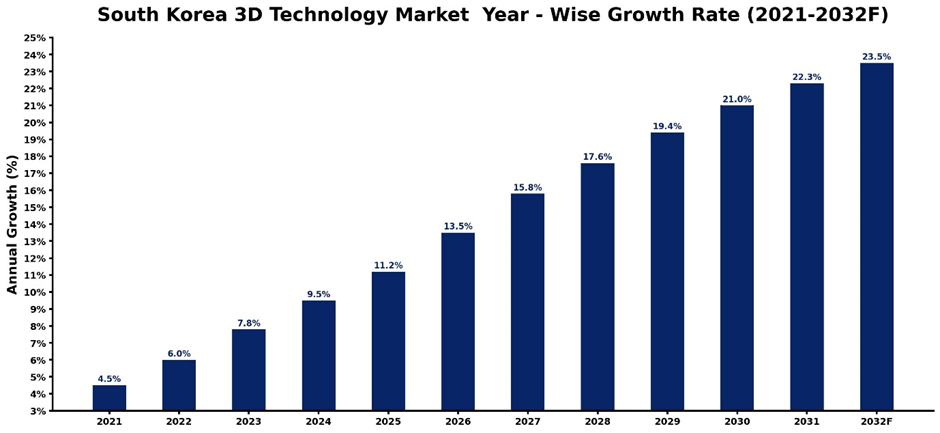
The following table summarizes the historical and forecasted growth rates of the South Korea 3D Technology Market, along with the rationale behind each year’s performance.
| Year | Estimated Growth (%) | Market Rationale |
| 2021 | 4.5% | Post-pandemic recovery in manufacturing and R&D activities |
| 2022 | 6% | Rising adoption in healthcare imaging and design tools |
| 2023 | 7.8% | Growth in 3D imaging, gaming, and VFX demand |
| 2024 | 9.5% | AI integration in CAD and industrial automation expansion |
| 2025 | 11.2% | Metaverse, AR/VR adoption in consumer electronics |
| 2026 | 13.5% | Government support for digital manufacturing and smart industry |
| 2027 | 15.8% | Scaling of industrial 3D printing in aerospace and defense |
| 2028 | 17.6% | Expansion of smart factories and robotics integration |
| 2029 | 19.4% | Growth in healthcare imaging and precision manufacturing |
| 2030 | 21% | Full commercialization of integrated 3D technology ecosystems |
| 2031 | 22.3% | Export-driven demand and optimization of mature systems |
| 2032 | 23.5% | Market maturity with continuous incremental innovation |
Topics Covered in the South Korea 3D Technology Market Report
The South Korea 3D Technology Market report thoroughly covers the market by type and application. The market report provides an unbiased and detailed analysis of ongoing market trends, opportunities/high growth areas, and market drivers, which help stakeholders devise and align their market strategies according to the current and future market dynamics.
South Korea 3D Technology Market Highlights
| Report Name | South Korea 3D Technology Market |
| Forecast period | 2026-2032 |
| CAGR | 19.9% |
| Growing Sector | Healthcare & Industrial Automation |
South Korea 3D Technology Market Synopsis
The South Korea 3D Technology Market is witnessing tremendous growth due to modern advancements in additive manufacturing and accurate visualization systems becoming integral parts of the industry setup of the country. Such high-end systems consist of equipment and software tools that provide unparalleled accuracy in designing products and performing diagnostics.
Moreover, the increasing focus on digital transformation by the giant South Korea conglomerates will drive their implementation as well, which would not only help organizations stay ahead in competition but would also ensure efficiency in operations through innovative technology-based practices.
Evaluation of Growth Drivers in the South Korea 3D Technology Market (2026-2032)
Below mentioned are some prominent drivers and their influence on the market dynamics:
| Drivers | Primary Segments Affected | Why it Matters (Evidence) |
| Industrial AI Integration | Software, Manufacturing | AI-driven 3D modeling significantly reduces time-to-market. |
| Government R&D Funding | Printing, Prototyping | Direct financial support accelerates adoption in SMEs. |
| Healthcare Customization | 3D Imaging, Medical | Increased demand for personalized implants and surgical tools. |
| Smart City Development | Scanning, Infrastructure | 3D mapping and modeling are vital for urban planning. |
| Automotive Digitalization | 3D Display, Automotive | High demand for 3D holographic displays in modern vehicles. |
South Korea 3D Technology Market is expected to grow at the CAGR of 19.9% during the forecast period of 2026-2032. Growth is driven by the rapid evolution of smart manufacturing environments, increasing domestic production of high-end 3D scanners, and robust investment in R&D.
Additionally, the correlation between 3D technology and the national policy regarding digital transformation ensures that there is always a reliable source of skilled manpower and infrastructure to facilitate its adoption into important industries such as medicine, electronics, and automobile engineering.
Evaluation of Restraints in the South Korea 3D Technology Market
Below mentioned are some major restraints and their influence on the market dynamics:
| Restraints | Primary Segments Affected | What This Means (Evidence) |
| High Initial Capital | Hardware, Industrial | Expensive machinery limits penetration among small start-ups. |
| Skilled Labor Shortage | Software, Engineering | Lack of specialized 3D developers creates project backlogs. |
| Data Security Concerns | Cloud 3D, Enterprise | IP theft risks deter firms from cloud-based 3D platforms. |
| Standard Interoperability | All Segments | Diverse file formats complicate integration in existing workflows. |
| High Energy Costs | Large-scale Printing | High power requirements impact profitability for some users. |
South Korea 3D Technology Market Challenges
However, notwithstanding the impressive prospects for South Korea 3D Technology Market Growth, there exist major constraints, particularly the considerable expense associated with specialist equipment and the continuing shortage of skilled personnel able to develop sophisticated 3D software.
Businesses can have difficulty integrating their data into various diagnostic and manufacturing tools owing to incompatible standards, which pose a barrier to interoperability. The issue of protecting the intellectual property of any proprietary designs used in 3D printing, together with the energy consumption associated with additive manufacturing on an industrial scale, pose serious challenges to be overcome.
South Korea 3D Technology Market Trends
Key developments and emerging patterns defining the South Korea 3D Technology Market landscape are:
- Real-time Volumetric Rendering: Increased focus on high-fidelity, real-time 3D visualization for surgical planning and remote medical assistance.
- AI-Powered Generative Design: Widespread adoption of machine learning to automatically create optimized 3D geometries, reducing material waste and production time.
- Sustainable Material Innovation: Growing preference for eco-friendly, bio-derived resins and recycled metal powders in 3D printing workflows.
- Edge Computing for 3D Data: Shift toward processing complex 3D rendering tasks locally on edge devices to minimize latency in industrial robotics.
Investment Opportunities in the South Korea 3D Technology Market
The following represent promising strategic investment opportunities and growth sectors in the South Korea 3D Technology Market:
- Custom Prosthetics Lab: Setting up centers that will produce quick 3D printed prosthetic devices for the local hospital community.
- Cloud-based 3D PLM Software: Investing in collaborative software applications that enable product life cycle management from different locations.
- Semiconductor 3D Inspection Systems: Creating special 3D scanning tools to ensure precise production of microelectronics.
- Technical Training Centers: Creating educational alliances to address the skills shortage in 3D modeling and printing technology.
Top 5 Leading Players in the South Korea 3D Technology Market
Prominent industry stakeholders and key enterprises shaping the South Korea 3D Technology Market include:
1. Doosan Enerbility
| Company Name | Doosan Enerbility |
|---|---|
| Established Year | 1962 |
| Headquarters | Changwon, South Korea |
| Official Website | Click Here |
Doosan Enerbility leads Korea’s metal 3D printing sector, offering advanced additive manufacturing services for aerospace, energy, and defense industries.
2. Samsung Electronics
| Company Name | Samsung Electronics |
|---|---|
| Established Year | 1969 |
| Headquarters | Suwon, South Korea |
| Official Website | Click Here |
Samsung integrates 3D display and imaging technologies into consumer electronics and professional visualization solutions globally.
3. LG Display
| Company Name | LG Display |
|---|---|
| Established Year | 1985 |
| Headquarters | Seoul, South Korea |
| Official Website | Click Here |
LG Display develops advanced 3D screen technologies for immersive gaming, medical visualization, and automotive displays.
4. Dassault Systèmes (Korea)
| Company Name | Dassault Systèmes (Korea) |
|---|---|
| Established Year | 1981 |
| Headquarters | Vélizy-Villacoublay, France (Seoul Office) |
| Official Website | Click Here |
Dassault Systèmes provides the 3DEXPERIENCE platform for 3D design, simulation, and product lifecycle management used by major manufacturers.
5. Autodesk, Inc.
| Company Name | Autodesk, Inc. |
|---|---|
| Established Year | 1982 |
| Headquarters | San Francisco, USA |
| Official Website | Click Here |
Autodesk offers widely used 3D design and engineering software for architecture, manufacturing, and entertainment industries.
Government Initiatives Being Implemented in the South Korea 3D Technology Market
According to South Korean Government Data, The initiative of the Ministry of Science and ICT in the form of “Digital Innovation 2030” will facilitate the 3D technology ecosystem. The Digital Innovation 2030 initiative will give huge tax breaks to firms engaged in developing their technology locally for the purposes of additive manufacturing and volumetric displays. Moreover, the government of South Korea has opened the “3D Printing Convergence Hub,” providing subsidies to firms to use cutting-edge prototyping tools in major industrial areas of South Korea.
Future Insights of the South Korea 3D Technology Market
South Korea 3D Technology Industry is poised for an era of hyper-specialisation, driven by the synergy between high-speed 5G connectivity and sophisticated 3D rendering capabilities.
The future outlook remains growing as industries move beyond simple prototyping into functional end-user part production and immersive digital-twin factory management. Furthering its support for the sector, along with growing investments in software that uses AI to design products, would enhance its position as a global leader in additive manufacturing, creating vast possibilities for start-ups operating in the cutting-edge field.
Market Segmentation Analysis
The report offers a comprehensive study of the subsequent market segments and their leading categories:
By Type – Dominated by 3D Printing, 3D Imaging Shows Rapid Expansion
According to Bhawna Singh, Assistant Manager, 6Wresearch, Technology 3D Printers have claimed a 42.5% of the South Korea 3D Technology Market share in 2025. This is because of their extensive use within the automotive and aerospace industries in prototype construction. The future is bright for 3D imaging, which is expected to grow at an incredible rate of 16.2%.
By Application – Healthcare Leads Market, Consumer Electronics Shows Rapid Growth
Usage of 3D printing in the healthcare industry made up 38.2% of the market share in 2025 due to the increasing demand for custom-made medical equipment. Meanwhile, consumer electronics will experience a growth of 15.5% in their CAGR due to their integration of 3D display capabilities.
Note: Market size estimations and growth projections presented in this report are based on 6Wresearch’s advanced forecasting approach, validated with industry datasets as of June 2026.
Key Attractiveness of the Report
- 10 Years of Market Numbers.
- Historical Data Starting from 2022 to 2025.
- Base Year: 2025.
- Forecast Data until 2032.
- Key Performance Indicators Impacting the Market.
- Major Upcoming Developments and Projects.
Key Highlights of the Report:
- South Korea 3D Technology Market Outlook
- Market Size of South Korea 3D Technology Market, 2025
- Forecast of South Korea 3D Technology Market, 2032
- Historical Data and Forecast of South Korea 3D Technology Revenues & Volume for the Period 2022-2032
- South Korea 3D Technology Market Trend Evolution
- South Korea 3D Technology Market Drivers and Challenges
- South Korea 3D Technology Price Trends
- South Korea 3D Technology Porter's Five Forces
- South Korea 3D Technology Industry Life Cycle
- Historical Data and Forecast of South Korea 3D Technology Market Revenues & Volume By Type for the Period 2022-2032
- Historical Data and Forecast of South Korea 3D Technology Market Revenues & Volume By 3D Printing for the Period 2022-2032
- Historical Data and Forecast of South Korea 3D Technology Market Revenues & Volume By 3D Display for the Period 2022-2032
- Historical Data and Forecast of South Korea 3D Technology Market Revenues & Volume By 3D Scanning for the Period 2022-2032
- Historical Data and Forecast of South Korea 3D Technology Market Revenues & Volume By 3D Imaging for the Period 2022-2032
- Historical Data and Forecast of South Korea 3D Technology Market Revenues & Volume By Others for the Period 2022 - 2032
- Historical Data and Forecast of South Korea 3D Technology Market Revenues & Volume By Application for the Period 2022-2032
- Historical Data and Forecast of South Korea 3D Technology Market Revenues & Volume By Healthcare for the Period 2022-2032
- Historical Data and Forecast of South Korea 3D Technology Market Revenues & Volume By Automotive for the Period 2022-2032
- Historical Data and Forecast of South Korea 3D Technology Market Revenues & Volume By Aerospace & Defense for the Period 2022-2032
- Historical Data and Forecast of South Korea 3D Technology Market Revenues & Volume By Consumer Electronics for the Period 2022-2032
- Historical Data and Forecast of South Korea 3D Technology Market Revenues & Volume By Others for the Period 2022-2032
- South Korea 3D Technology Import Export Trade Statistics
- Market Opportunity Assessment By Type
- Market Opportunity Assessment By Application
- South Korea 3D Technology Top Companies Market Share
- South Korea 3D Technology Competitive Benchmarking By Technical and Operational Parameters
- South Korea 3D Technology Company Profiles
- South Korea 3D Technology Key Strategic Recommendations
Market Covered
The report offers a comprehensive study of the subsequent market segments:
By Type
- 3D Printing
- 3D Display
- 3D Scanning
- 3D Imaging
- Others
By Application
- Healthcare
- Automotive
- Aerospace & Defense
- Consumer Electronics
- Others






































