South Korea Acrylic Bathtub Market Growth Rate
According to 6Wresearch internal database and industry insights, the South Korea Acrylic Bathtub Market is projected to grow at a compound annual growth rate (CAGR) of 5.19% during the forecast period (2026-2032).
South Korea Acrylic Bathtub Market Year-wise Growth Rate and Key Drivers (2022-2032)
This graph illustrates the annual growth rates of the South Korea Acrylic Bathtub Market from 2022 to 2032, highlighting a steady upward trajectory and projected market expansion over the forecast period.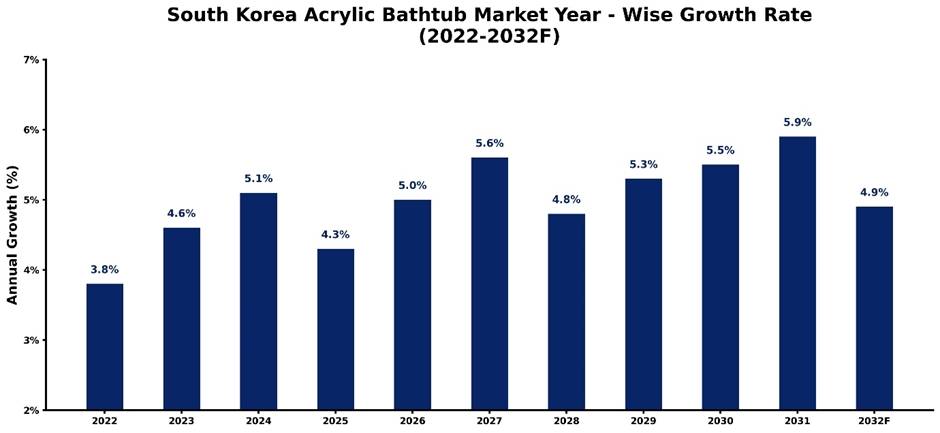
The following table summarizes the historical and forecasted growth rates of the South Korea Acrylic Bathtub Market, along with the rationale behind each year’s performance.
| Year | Estimated Growth (%) | Market Rationale |
| 2022 | 3.8% | Increasing home renovation activities supported bathtub demand. |
| 2023 | 4.6% | Rising preference for premium bathroom products increased adoption. |
| 2024 | 5.1% | Growth in luxury housing projects supported market expansion. |
| 2025 | 4.3% | Consumer demand for bathroom upgrades supported steady growth. |
| 2026 | 5% | Smart bathroom solutions and remodeling activities increased demand. |
| 2027 | 5.6% | Growing use of lightweight acrylic bathtubs in residential projects supported growth. |
| 2028 | 4.8% | Continued demand for acrylic bathroom products supported market development. |
| 2029 | 5.3% | Rising interest in premium and spa-style bathrooms increased adoption. |
| 2030 | 5.5% | Sustainable bathroom designs and wellness trends supported growth. |
| 2031 | 5.9% | Customized bathtubs and advanced features increased market demand. |
| 2032 | 4.9% | Replacement demand and premium product adoption supported steady growth. |
Topics Covered in the South Korea Acrylic Bathtub Market Report
The South Korea Acrylic Bathtub Market Report provides a comprehensive analysis based on Type and Application. It offers detailed insights into key industry trends, growth drivers, emerging opportunities, competitive developments, and high-growth segments. The report presents an objective assessment of current dynamics and future prospects, enabling stakeholders to make informed business decisions and develop effective strategies aligned with the evolving industry landscape.
South Korea Acrylic Bathtub Market Highlights
| Report Name | South Korea Acrylic Bathtub Market |
| Forecast period | 2026-2032 |
| CAGR | 5.19% |
| Growing Sector | Home Use |
South Korea Acrylic Bathtub Market Synopsis
South Korea Acrylic Bathtub Market is witnessing constant growth owing to the thriving interior design industry and urbanization. Acrylic bathtubs are gaining popularity as these products, being light, tough, and customizable bathroom fixtures that are formed by vacuum-formed acrylic sheets and strengthened with fiberglass, are perfect for the contemporary household needs.
As the country balances a shrinking overall population with a record surge in single-person households and an expanding super-aged demographic, manufacturers are strategically pivoting toward compact, accessible, and eco-certified acrylic solutions. Despite ongoing macroeconomic friction from raw material inflation and rising construction labor wages, government-backed green remodeling incentives and strong domestic replacement cycles will continue to anchor resilient demand and drive continuous material innovation across the housing sector.
Evaluation of Growth Drivers in the South Korea Acrylic Bathtub Market (2026-2032)
Below mentioned are some prominent drivers and their influence on the market dynamics:
| Drivers | Primary Segments Affected | Why it Matters (Evidence) |
| Rising Urbanization | Medium Type, Home Use | Rising Urbanization |
| Growth in Hospitality Sector | Large Type, Commercial Use | Growth in Hospitality Sector |
| Increasing Disposable Income | All Types, Home Use | Increasing Disposable Income |
| Trend of Home Wellness | Large Type, Home Use | Trend of Home Wellness |
| Lightweight and Durable Properties | All Types, Commercial Use | Lightweight and Durable Properties |
South Korea Acrylic Bathtub Market is expected to grow at the CAGR of 5.19% during the forecast period of 2026-2032. The market derives its primary growth momentum from widespread residential remodeling cycles and shifting lifestyle preferences. More than 40% of households in the Seoul metropolitan area now consist of a single person, cultivating robust demand for modular, space-saving acrylic fixtures that fit seamlessly into compact urban apartments. The rapid transformation of the country into a super-aged society by 2025, whereby seniors make up over 21.21% of the total population, makes ergonomic, therapeutic bathtubs popular. Good heat retention qualities of acrylic materials make them appealing to consumers that desire efficient bathing experiences.
Evaluation of Restraints in the South Korea Acrylic Bathtub Market
Below mentioned are some major restraints and their influence on the market dynamics:
| Restraints | Primary Segments Affected | What This Means (Evidence) |
| Fluctuating Raw Material Costs | All Types | High petroleum prices directly impact acrylic sheet production and manufacturing costs. |
| Availability of Substitutes | Home Use, Small Type | Ceramic and enameled steel tubs offer strong traditional competition in the market. |
| Environmental Concerns | All Types | Non-biodegradable nature of acrylic raises long-term waste management and recycling issues. |
| Limited Bathroom Space | Large Type, Home Use | High-density urban apartments restrict the installation of larger, freestanding bathtub models. |
| Installation Complexities | Commercial Use | Requires skilled labor for proper fiberglass reinforcement and secure structural mounting procedures. |
South Korea Acrylic Bathtub Market Challenges
Irrespective of massive growth and development, the industry faces several hurdles that could restrain the South Korea Acrylic Bathtub Market Growth, such as volatile petrochemical prices affecting manufacturing overheads and intense competition from alternatives. Inflationary pressures on raw materials, particularly petroleum-derived polymethyl methacrylate (PMMA) resins, have persistently squeezed manufacturing margins.
At the same time, the domestic construction industry has increased labor costs, due to the minimum wage nationally exceeding 10,300 KRW per hour beginning 2026, thus increasing installation costs. Moreover, the whole housing market is facing the challenge of a shrinking population, since the birth rate has been declining, and, consequently, the number of large apartments with families has reduced.
South Korea Acrylic Bathtub Market Trends
Significant trends driving the South Korea Acrylic Bathtub Market are presented below:
- Integration of Smart Features: The adoption of built-in chromotherapy lighting and digital temperature controls is rising rapidly to enhance the therapeutic bathing experience.
- Freestanding Minimalist Designs: Modern renovations are seeing a trend towards freestanding tubs, which serve as design elements in the bathroom.
- Eco-Friendly Acrylic Material: Increasing preference for eco-friendly materials such as recyclable acrylic that provides good insulation with low environmental impact.
- Matte and Textured Finish: An important transition from glossy white finish to textured matte black finish is being observed in luxury residential buildings.
Investment Opportunities in the South Korea Acrylic Bathtub Market
Promising investment avenues in the South Korea Acrylic Bathtub Market are presented below:
- Space Saving Designs: Creating specially designed, deep soaking tubs that would be suitable for use in the small square footage available in standard South Korean apartments.
- B2B Contracts in Hospitality: Entering into supply contracts with hotels and resorts that are being upgraded to more modern facilities.
- Green Production Facilities: Creating production facilities powered by renewable sources of energy and adopting sustainable production techniques to appeal to environmentally minded customers.
- Virtual Bathtub Showroom: Using virtual means such as augmented reality (AR) technology on online shopping platforms to help visualize bathtubs in the customer’s home.
Top Players in the South Korea Acrylic Bathtub Market
A list of leading companies operating in the South Korea Acrylic Bathtub Market is presented below:
1. Daelim Bath
| Company Name | Daelim Bath |
|---|---|
| Established Year | 1966 |
| Headquarters | Seoul, South Korea |
| Official Website | Click Here |
Daelim Bath is a recognized South Korean sanitary ware provider offering residential bathtubs, smart toilets, and modern bathroom fixtures.
2. Kohler Co.
| Company Name | Kohler Co. |
|---|---|
| Established Year | 1873 |
| Headquarters | Kohler, United States |
| Official Website | Click Here |
Kohler supplies premium acrylic and composite bathtubs, luxury bathroom fixtures, and customized solutions for residential and hospitality projects worldwide.
3. TOTO Ltd.
| Company Name | TOTO Ltd. |
|---|---|
| Established Year | 1917 |
| Headquarters | Kitakyushu, Japan |
| Official Website | Click Here |
TOTO develops advanced sanitary ware and bathroom solutions, including ergonomic soaking tubs and eco-friendly designs for modern residential spaces.
4. American Standard (LIXIL Group)
| Company Name | American Standard (LIXIL Group) |
|---|---|
| Established Year | 1875 |
| Headquarters | Tokyo, Japan |
| Official Website | Click Here |
American Standard provides durable acrylic and composite bathtub solutions designed for residential renovations and urban housing developments.
5. Duravit AG
| Company Name | Duravit AG |
|---|---|
| Established Year | 1817 |
| Headquarters | Hornberg, Germany |
| Official Website | Click Here |
Duravit produces luxury bathroom solutions, including designer freestanding and built-in bathtubs, serving premium architectural and interior design projects.
Government Initiatives Being Implemented in the South Korea Acrylic Bathtub Market
According to South Korean Government Data, major initiatives that are being implemented are mentioned below:
- Green Remodeling Project (2022): Financial grants and interest-free loans were provided by the government for home remodeling into energy efficient and very insulated plumbing appliances such as heat retaining acrylic bathtubs.
- Smart Residential Development Policy (2023): National policies on residential dwellings stipulate that bathrooms made of new materials and designed to conserve space and water must be incorporated in new residential buildings.
- Eco-Friendly Material Tax Incentive Program (2024): Regulatory mechanism to grant tax incentives to local manufacturers who use a lot of recycled acrylic or sustainable fiberglass in their manufacturing process.
Future Insights of the South Korea Acrylic Bathtub Market
The South Korea Acrylic Bathtub Industry is set to undergo a period of rapid development as the country adopts an aging and very urbanized population trend by 2032. Given that the older generation is projected to make up more than 30% of the population in the next decade, future developments will be based on accessibility elements, including slip-resistant PMMA material and walk-in bathtubs.
Furthermore, given that the country already has single individual households making up 36.6% of all households in 2025, the trend in the industry will also lean towards smaller space-saving bathtubs. The replacement cycle for residential sanitary ware is also projected to gradually increase, supported by growing premiumization trends and rising consumer preference for high quality, durable, and aesthetically appealing bathroom solutions.
Market Segmentation Analysis
This report presents a detailed analysis of the market segments along with their leading categories:
By Type – Market Dominated by Medium Type, Large Type Set for Rapid Expansion
According to Ravi Bhandari, Research Head, 6Wresearch, Medium Type bathtubs captured 52.10% of the South Korea Acrylic Bathtub Market Share in 2025. This is driven by apartment space constraints, increasing preference for space-efficient bathroom solutions, and rising demand for compact yet comfortable bathtub designs in urban households. Meanwhile, Large Type bathtubs will rapidly register the fastest CAGR of 6.20% during 2026–2032, supported by growing consumer interest in luxury bathroom spaces and premium home renovation projects.
By Application – Home Use Maintains Market Leadership, Commercial Use Accelerates
The Home Use category had the highest market share at 65.30% in 2025, backed by increasing remodeling activities, increased disposable incomes, and modernization of bathroom appliances at homes. On the other hand, the Commercial Use category is projected to experience the highest CAGR of 5.80% from 2026 to 2032, fueled by the growth in hospitality constructions, hotels, wellness centers, and other commercial facilities.
Note: Market size estimations and growth projections presented in this report are based on 6Wresearch's proprietary forecasting methodology, utilizing the latest available industry data, government publications, and primary research inputs.
Key Attractiveness of the Report
- 10 Years of Market Numbers.
- Historical Data Starting from 2022 to 2025.
- Base Year: 2025.
- Forecast Data until 2032.
- Key Performance Indicators Impacting the Market.
- Major Upcoming Developments and Projects.
Key Highlights of the Report:
- South Korea Acrylic Bathtub Market Outlook
- Market Size of South Korea Acrylic Bathtub Market, 2025
- Forecast of South Korea Acrylic Bathtub Market, 2032
- Historical Data and Forecast of South Korea Acrylic Bathtub Revenues & Volume for the Period 2022-2032
- South Korea Acrylic Bathtub Market Trend Evolution
- South Korea Acrylic Bathtub Market Drivers and Challenges
- South Korea Acrylic Bathtub Price Trends
- South Korea Acrylic Bathtub Porter's Five Forces
- South Korea Acrylic Bathtub Industry Life Cycle
- Historical Data and Forecast of South Korea Acrylic Bathtub Market Revenues & Volume By Type for the Period 2022-2032
- Historical Data and Forecast of South Korea Acrylic Bathtub Market Revenues & Volume By Large Type for the Period 2022-2032
- Historical Data and Forecast of South Korea Acrylic Bathtub Market Revenues & Volume By Medium Type for the Period 2022-2032
- Historical Data and Forecast of South Korea Acrylic Bathtub Market Revenues & Volume By Small Type for the Period 2022-2032
- Historical Data and Forecast of South Korea Acrylic Bathtub Market Revenues & Volume By Application for the Period 2022-2032
- Historical Data and Forecast of South Korea Acrylic Bathtub Market Revenues & Volume By Home Use for the Period 2022-2032
- Historical Data and Forecast of South Korea Acrylic Bathtub Market Revenues & Volume By Commercial Use for the Period 2022-2032
- South Korea Acrylic Bathtub Import Export Trade Statistics
- Market Opportunity Assessment By Type
- Market Opportunity Assessment By Application
- South Korea Acrylic Bathtub Top Companies Market Share
- South Korea Acrylic Bathtub Competitive Benchmarking By Technical and Operational Parameters
- South Korea Acrylic Bathtub Company Profiles
- South Korea Acrylic Bathtub Key Strategic Recommendations






































