South Korea Agricultural Film Market Size & Growth Rate
According to 6Wresearch internal database and industry insights, the South Korea Agricultural Film Market was valued at USD 453.5 million in 2025 and is projected to reach USD 729.18 million by 2032, growing at a CAGR of approximately 7.02% during 2026–2032.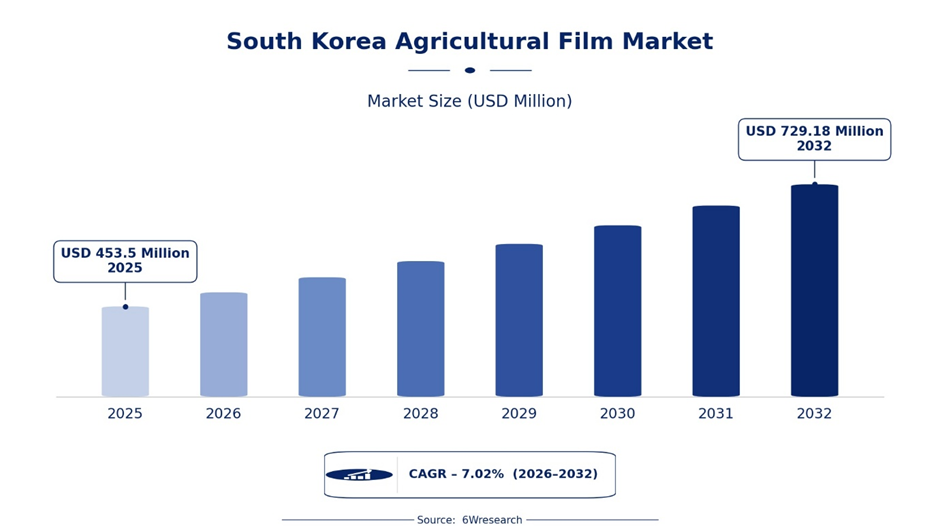
South Korea Agricultural Film Market Highlights
|
Report Metric |
Details |
|
Report Name |
South Korea Agricultural Film Market (2026-2032) |
|
Market Size 2025 |
USD 453.5 million |
|
Market Size 2032 |
USD 729.18 million |
|
Absolute Growth 2025–2032 |
USD 275.68 million |
|
CAGR 2026–2032 |
7.02% |
|
Peak Annual Growth |
7.8% in 2026 |
|
Forecast Period |
2026–2032 |
|
Historical Data |
2022–2025 |
|
Base Year |
2025 |
|
Leading Product Type, 2025 |
Polyethylene Films (57% share) |
|
Leading Application, 2025 |
Greenhouse Films (37% share) |
|
Leading End User, 2025 |
Farmers (71% share) |
|
Fastest-Growing Product Type |
Biodegradable Films (9.6% CAGR) |
|
Fastest-Growing Application |
Mulch Films (7.5% CAGR) |
|
Fastest-Growing End User |
Horticulturalists (8.7% CAGR) |
|
Growing Sector |
Smart greenhouse and high-value horticulture |
|
Key End Users |
Family farm holdings, agricultural cooperatives, livestock and dairy farms, commercial horticulture enterprises, contract farming service providers |
South Korea Agricultural Film Market Year-wise Growth Rate and Key Drivers (2022–2032)
This graph illustrates the annual growth rates of the market from 2022 to 2032, highlighting a steady upward trajectory and projected market expansion over the forecast period.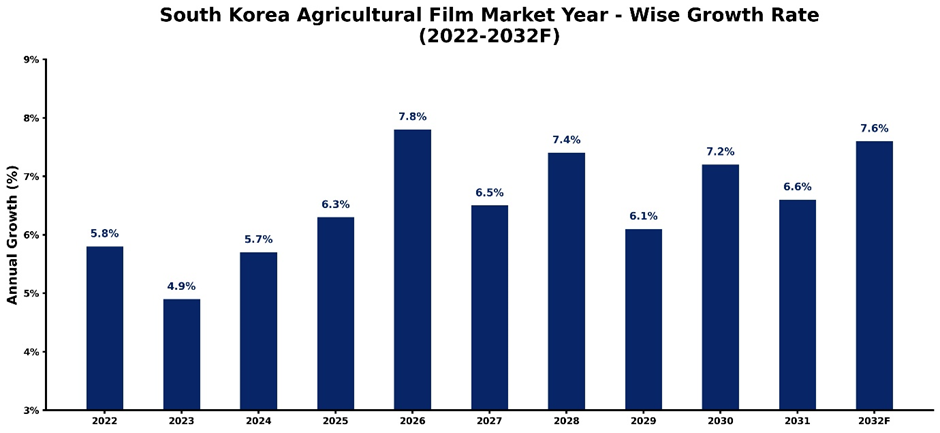 The following table presents the estimated annual growth rate for each year together with the principal factor influencing market performance. The values are intended to highlight year-specific drivers rather than to provide a direct comparison between individual years.
|
Year |
Estimated Annual Growth (%) |
Market Rationale |
|
2022 |
5.8% |
Surging resin and energy costs lifted film prices, supporting value growth even as greenhouse acreage remained largely flat. |
|
2023 |
4.9% |
Easing resin prices and thinner farm margins after fertiliser and energy cost spikes led growers to defer film replacement. |
|
2024 |
5.7% |
Expansion of smart farm innovation valleys and facility modernisation raised demand for multilayer greenhouse covering films. |
|
2025 |
6.3% |
Wider adoption of degradable mulch among vegetable growers, backed by local subsidy schemes, increased premium film uptake. |
|
2026 |
7.8% |
New smart greenhouse capacity under regional agriculture innovation programmes is expected to lift demand for high-transmission and thermal films. |
|
2027 |
6.5% |
Petrochemical feedstock prices are expected to normalise, moderating film price increases and slowing replacement cycles on conventional farms. |
|
2028 |
7.4% |
Mechanised laying and cooperative machinery rental services are expected to spread, raising demand for uniform, high-strength mulch and stretch films. |
|
2029 |
6.1% |
A shrinking and ageing farm population is expected to limit cultivated area and restrain additional film consumption. |
|
2030 |
7.2% |
Commercial scale-up of domestic degradable resin capacity is expected to improve availability and reduce prices of degradable films. |
|
2031 |
6.6% |
Maturing greenhouse clusters are expected to shift demand towards replacement purchases rather than new installations, tempering expansion. |
|
2032 |
7.6% |
Climate-smart farming requirements and recycled-content product standards are expected to support energy-saving covers and film take-back systems. |
Note: Market size estimations and growth projections presented in this report are based on 6Wresearch's proprietary forecasting methodology, utilizing the latest available industry data, government publications, and primary research inputs.
South Korea Agricultural Film Market Synopsis
Driven by expanding protected cultivation and evolving agricultural practices, the South Korea Agricultural Film Market is witnessing demand across polyethylene, polypropylene, EVA and biodegradable films used in greenhouses, mulching, silage storage and shed coverings. More than 50,000 hectares of facility horticulture, the expansion of smart farm clusters and stricter regulations on agricultural plastic waste are further strengthening market demand.
Additionally, domestic petrochemical producers ensure readily available resin and film inputs, reducing lead times for growers. Meanwhile, demand for biodegradable mulch is gaining traction as farmers seek to reduce retrieval labour amid an ageing rural workforce.
Market Dynamics Impact Analysis (2026–2032)
|
Factor |
Type |
Impact |
Primary Segment Affected |
|
Expansion of climate-controlled greenhouse capacity |
Driver |
High |
Greenhouse Films |
|
Intensive field cropping with labour-saving practices |
Driver |
High |
Mulch Films |
|
Rising demand for certified degradable products |
Opportunity |
High |
Biodegradable Films |
|
Growth in beef and dairy feed storage |
Opportunity |
Medium |
Silage Films |
|
Volatile resin and energy costs |
Restraint |
High |
Polyethylene Films |
|
Ageing farm population and declining acreage |
Restraint |
Medium |
Farmers |
|
Fragmented small-holding purchasing |
Challenge |
Medium |
Farmers |
|
Certification and recycling compliance |
Challenge |
High |
Biodegradable Films |
Evaluation of Drivers in the South Korea Agricultural Film Market (2026–2032)
Below mentioned are some major drivers and their influence on the market dynamics:
|
Drivers |
Primary Segment Affected |
Why It Matters (Evidence) |
|
Expansion of climate-controlled greenhouse capacity |
Greenhouse Films |
Climate-controlled houses depend on light-diffusing, multi-year covering films, so each new facility creates both installation and periodic replacement demand. Strawberry, paprika and tomato clusters in South Gyeongsang and South Jeolla are the largest buyers of these films. |
|
Intensive cultivation on small field plots |
Mulch Films |
Mulching suppresses weeds, retains soil moisture and raises early-season yields, so it is applied to chilli pepper, garlic and onion crops grown across a cultivated area of roughly 1.5 million hectares. |
|
Livestock herd feed security |
Silage Films |
Wrapped silage preserves forage nutrition through the year and reduces reliance on imported feed, so herd expansion lifts film use. Hanwoo cattle numbers exceeding 3 million head create steady demand for bale wrap and bunker covers. |
|
Integrated domestic petrochemical base |
Polyethylene Films |
Local resin supply shortens lead times and supports price competitiveness for converters, which keeps polyethylene the default material choice. Petrochemical complexes at Yeosu, Daesan and Ulsan form one of Asia's largest resin supply bases. |
|
Heat stress on livestock and storage structures |
Shed Covers |
Record summer heat in 2024 showed that livestock and storage sheds need reflective, UV-stabilised covers, so owners are upgrading roofing and wall films to protect animals and stored inputs. |
Looking ahead, the South Korea Agricultural Film Market is set to benefit from greater consumer willingness to pay for year-round fresh produce, encouraging protected and extended season cultivation. With internet penetration exceeding 95%, expanding online grocery channels are shortening the route from farm to household while increasing the emphasis on consistent produce quality.
Furthermore, rising corporate and venture investment in agri technology is introducing climate sensing and data driven crop planning into rural operations. Alongside this, improved cold chain and logistics capacity is strengthening export oriented fruit and vegetable value chains, while higher farm asset investments by rural enterprises are supporting regular replacement of agricultural consumables.
Evaluation of Restraints in the South Korea Agricultural Film Market
Below mentioned are some major restraints and their influence on the market dynamics:
|
Market Restraint |
Primary Segment Affected |
Why It Matters (Evidence) |
|
Volatile resin and energy costs |
Polyethylene Films |
South Korea imports virtually all of its crude oil, so film prices follow global crude swings, which compresses converter margins and delays purchases when farm incomes are weak. |
|
Ageing farm population and shrinking acreage |
Farmers |
More than half of farm residents are aged 65 or above and cultivated land continues to decline, which limits the number of buyers and the area requiring film each season. |
|
Higher price of degradable products |
Biodegradable Films |
Degradable mulch films typically cost more than conventional polyethylene while offering similar field performance, so price-sensitive buyers use them only where subsidies cover the difference. |
|
Soil contamination and collection burden of used film |
Mulch Films |
Used mulch film carries soil and crop residue that raises cleaning costs and lowers recycling value, so collection systems struggle to reach economic scale and discourage thicker film choices. |
|
Lower-priced imported films |
Polypropylene Films |
Imported films from neighbouring producing countries enter at lower prices, which pressures domestic converters on standard grades and limits the room to pass on resin cost increases. |
South Korea Agricultural Film Market Challenges
The South Korea Agricultural Film Market faces structural purchasing constraints as average farm holdings remain around 1.5 hectares, fragmenting demand into smaller orders and increasing distribution costs across dispersed provinces. Moreover, approximately three typhoons affect the peninsula in a typical year, reducing film durability and encouraging buyers to favour lower cost alternatives over premium grades.
However, soil burial test regulations for the degradable products have increased certification time frame and costs involved in product development. Adhering to the national objective of achieving a 40% reduction in emissions by 2030 also increases the cost of reporting and energy in extrusion plants. Besides, insufficient capability to do multi-layer extrusion among small converters limits advanced covering options in large facilities.
Trends in the South Korea Agricultural Film Market
Emerging market dynamics reshaping the South Korea agricultural film industry are presented below:
- Move from Traditional Polyethylene Film to Degradable Film: Farmers are using degradable films that can be incorporated back into the ground after the crops have been harvested.
- Film Recycling Becoming a Factor of Film Procurement: Used film is being recycled through governmental and cooperative networks, not burnt and buried, in line with national policies of resource circulation.
- Switch from Manual to Mechanised Mulch Application: Labour shortage in rural villages of farmers is making farmers use mechanical film application equipment attached to a tractor.
Investment Opportunities in the South Korea Agricultural Film Market
Key areas offering investment potential in the South Korea agricultural film market are highlighted below:
- Multilayer Covering Film for Smart Farm Clusters: Government-backed clusters at Sangju, Gimje, Goheung and Miryang need high-specification covers for new and retrofitted houses. Investment in five-layer co-extrusion lines producing light-diffusing, anti-drip and thermal films addresses this need.
- Used Film Collection and Recycling: Rising collection volumes and stricter treatment of agricultural plastic waste create steady feedstock for recyclers. Washing, shredding and pelletising lines near farm belts in Jeolla and Gyeongsang provinces can convert used film into recycled resin for non-food products.
- High-Barrier Silage Wrap Production: Beef and dairy farms in Chungcheong and Gyeongbuk provinces increasingly store forage as wrapped bales, which supports local production of multilayer stretch film. Investors can install co-extrusion lines for UV-stabilised, high-tack wrap and bunker covers.
Leading Players in South Korea Agricultural Film Market
The following section provides an overview of notable manufacturers and suppliers in the South Korea agricultural film market:
1. LOTTE Chemical
| Company Name | LOTTE Chemical |
|---|---|
| Established Year | 1976 |
| Headquarters | Seoul, South Korea |
| Official Website | Click Here |
LOTTE Chemical is a major South Korean petrochemical company producing polyethylene, polypropylene and related resins. It supplies resin to domestic film converters and indirectly supports the availability of agricultural film in the country.
2. Hanwha Solutions
| Company Name | Hanwha Solutions |
|---|---|
| Established Year | 1965 |
| Headquarters | Seoul, South Korea |
| Official Website | Click Here |
Hanwha Solutions operates a chemicals business that produces polyethylene and EVA resins used in film manufacturing. It supports domestic converters serving horticulture and general farm applications.
3. LG Chem
| Company Name | LG Chem |
|---|---|
| Established Year | 1947 |
| Headquarters | Seoul, South Korea |
| Official Website | Click Here |
LG Chem is a diversified chemicals producer supplying polyolefin and specialty resins, including EVA and degradable materials. Its materials are used by domestic film makers serving agricultural users.
4. SKC
| Company Name | SKC |
|---|---|
| Established Year | 1976 |
| Headquarters | Seoul, South Korea |
| Official Website | Click Here |
SKC is a South Korean materials company with a portfolio of polymer films and degradable materials. It participates in the market through specialty film technology and sustainable material development.
5. CJ CheilJedang
| Company Name | CJ CheilJedang |
|---|---|
| Established Year | 1953 |
| Headquarters | Seoul, South Korea |
| Official Website | Click Here |
CJ CheilJedang is a South Korean bio and food company that produces PHA biodegradable resins. It contributes to the market through bio-based material supply for degradable film applications.
Government Initiatives in the South Korea Agricultural Film Market
The South Korea Agricultural Film Market is increasingly influenced by government climate and sustainability commitments, particularly the 2050 Carbon Neutrality declaration introduced in 2020 and the Framework Act on Carbon Neutrality and Green Growth enacted in 2021. The framework establishes a 40% greenhouse gas reduction target by 2030 against 2018 levels. To advance these objectives, the Ministry of Agriculture, Food and Rural Affairs promotes smart agriculture, agricultural waste reduction and sustainable input policies, while the Ministry of Environment oversees waste film collection and resource circulation regulations.
Further government initiatives are strengthening the South Korea Agricultural Film Market through the establishment of four Smart Farm Innovation Valleys in Sangju, Gimje, Goheung and Miryang, integrating greenhouse demonstrations, rental farms and research facilities. In parallel, the Rural Development Administration advances crop and facility research, while provincial governments across the country's nine provinces, together with local cooperatives, implement subsidised degradable mulch distribution and used film collection programmes for farm households.
Future Insights of the South Korea Agricultural Film Market
The South Korea Agricultural Film Market is expected to gain new growth opportunities as reclaimed land at Saemangeum, covering approximately 28,300 hectares with around 30% designated for agricultural use, creates additional cultivation areas. Furthermore, advances in artificial intelligence and sensor-based climate control will increase performance expectations for agricultural covering materials.
Alongside these developments, domestic chemical groups are expanding research into advanced resin formulations, broadening material options for converters. Growing international interest in Korean agricultural technology and turnkey farm systems will also strengthen demand for high specification materials meeting global certification standards.
Market Segmentation Analysis
The report offers a comprehensive study of the market across its key segments. The chart below highlights the leading segment by market share in 2025 and the fastest-growing segment by CAGR over 2026–2032, followed by a detailed analysis of each segment.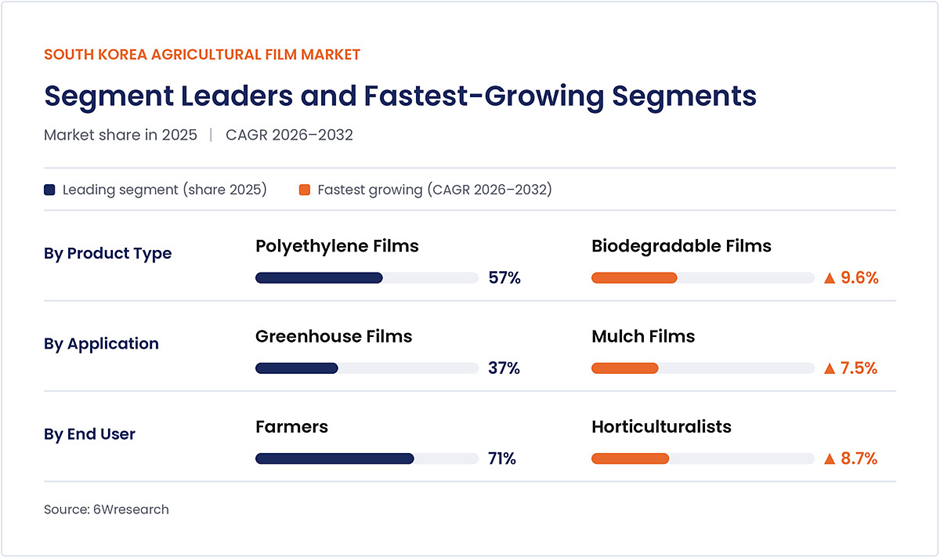
By Product Type – Polyethylene Films Leads, Biodegradable Films Expected to Grow Fastest
According to Sachin Kumar Rai, Senior Research Analyst at 6Wresearch, Polyethylene Films led the market with a 57% share in 2025, primarily supported by low-density and linear low-density resin supply from petrochemical complexes at Yeosu, Daesan and Ulsan, along with their cost-effective use across farm structures and field crops. Meanwhile, Biodegradable Films are expected to record the fastest CAGR of 9.6% during 2026–2032, as provincial subsidies and waste reduction rules increasingly reduce reliance on retrieving used film.
By Application – Greenhouse Films Leads, Mulch Films Expected to Grow Fastest
Greenhouse Films held the largest share of 37% in 2025, largely because intensive cultivation of strawberries, tomatoes and paprika in the southern provinces, coupled with the build-out of smart farm clusters, sustains regular replacement of covering films. Meanwhile, Mulch Films are projected to expand at the fastest CAGR of 7.5% over 2026–2032, driven by labour-saving mulching practices in chilli pepper, garlic and onion cultivation, as well as growing use of tractor-mounted laying equipment.
By End User – Farmers Leads, Horticulturalists Expected to Grow Fastest
Farmers accounted for 71% of demand in 2025, primarily reflecting South Korea's base of small family holdings that purchase covering and ground films directly through agricultural cooperatives and local input suppliers each season. In contrast, the strongest CAGR of 8.7% over 2026–2032 is expected for Horticulturalists, as export-oriented fruit, flower and vegetable producers increasingly invest in high-specification covers to secure consistent crop quality.
Key Attractiveness of the Report
- 10 Years of Market Numbers
- Historical Data Starting from 2022 to 2025
- Base Year 2025
- Forecast Data until 2032
- Key Performance Indicators Impacting the Market
- Major Upcoming Developments and Projects
Key Highlights of the Report:
- Market Size of South Korea Agricultural Film Market, 2025
- Forecast of South Korea Agricultural Film Market, 2032
- Historical Data and Forecast of South Korea Agricultural Film Revenues & Volume for the Period 2022-2032
- South Korea Agricultural Film Market Trend Evolution
- South Korea Agricultural Film Market Drivers and Challenges
- South Korea Agricultural Film Price Trends
- South Korea Agricultural Film Porter's Five Forces
- South Korea Agricultural Film Industry Life Cycle
- Historical Data and Forecast of South Korea Agricultural Film Market Revenues & Volume By Product Type for the Period 2022-2032
- Historical Data and Forecast of South Korea Agricultural Film Market Revenues & Volume By Polyethylene Films for the Period 2022-2032
- Historical Data and Forecast of South Korea Agricultural Film Market Revenues & Volume By Polypropylene Films for the Period 2022-2032
- Historical Data and Forecast of South Korea Agricultural Film Market Revenues & Volume By EVA (Ethylene-Vinyl Acetate) Films for the Period 2022-2032
- Historical Data and Forecast of South Korea Agricultural Film Market Revenues & Volume By Biodegradable Films for the Period 2022-2032
- Historical Data and Forecast of South Korea Agricultural Film Market Revenues & Volume By Application for the Period 2022-2032
- Historical Data and Forecast of South Korea Agricultural Film Market Revenues & Volume By Greenhouse Films for the Period 2022-2032
- Historical Data and Forecast of South Korea Agricultural Film Market Revenues & Volume By Mulch Films for the Period 2022-2032
- Historical Data and Forecast of South Korea Agricultural Film Market Revenues & Volume By Silage Films for the Period 2022-2032
- Historical Data and Forecast of South Korea Agricultural Film Market Revenues & Volume By Shed Covers for the Period 2022-2032
- Historical Data and Forecast of South Korea Agricultural Film Market Revenues & Volume By End User for the Period 2022-2032
- Historical Data and Forecast of South Korea Agricultural Film Market Revenues & Volume By Farmers for the Period 2022-2032
- Historical Data and Forecast of South Korea Agricultural Film Market Revenues & Volume By Agricultural Contractors for the Period 2022-2032
- Historical Data and Forecast of South Korea Agricultural Film Market Revenues & Volume By Horticulturalists for the Period 2022-2032
- South Korea Agricultural Film Import Export Trade Statistics
- Market Opportunity Assessment By Product Type
- Market Opportunity Assessment By Application
- Market Opportunity Assessment By End User
- South Korea Agricultural Film Top Companies Market Share
- South Korea Agricultural Film Competitive Benchmarking By Technical and Operational Parameters
- South Korea Agricultural Film Company Profiles
- South Korea Agricultural Film Key Strategic Recommendations
Market Covered
The report offers an extensive study of the following market segments.
By Product Type
- Polyethylene Films
- Polypropylene Films
- EVA (Ethylene-Vinyl Acetate) Films
- Biodegradable Films
By Application
- Greenhouse Films
- Mulch Films
- Silage Films
- Shed Covers
By End User
- Farmers
- Agricultural Contractors
- Horticulturalists






































