South Korea Cybersecurity Market Growth Rate
According to 6Wresearch internal database and industry insights, the South Korea Cybersecurity Market is projected to grow at a compound annual growth rate (CAGR) of 12.45% during the forecast period (2026-2032).
South Korea Cybersecurity Market Year-wise Growth Rate and Key Drivers (2022-2032)
This graph illustrates the annual growth rates of the South Korea Cybersecurity Market from 2022 to 2032, highlighting a steady upward trajectory and projected market expansion over the forecast period.
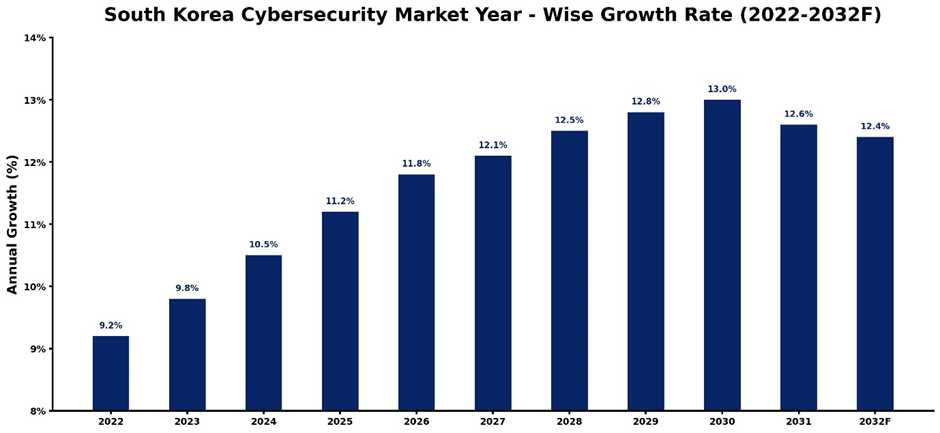 The following table summarizes the historical and forecasted growth rates of the South Korea Cybersecurity Market, along with the rationale behind each year’s performance.
| Year | Estimated Growth (%) | Market Rationale |
| 2022 | 9.2% | Post-pandemic digital transformation initiatives driving initial security spend. |
| 2023 | 9.8% | Rise in remote work security needs and surge in ransomware targeting SMEs. |
| 2024 | 10.5% | Escalation in state-sponsored cyber-espionage prompts increased defense spending. |
| 2025 | 11.2% | Expansion of 5G infrastructure necessitates robust edge security deployments. |
| 2026 | 11.8% | Implementation of AI Framework Act mandates stringent security for AI operators. |
| 2027 | 12.1% | Widespread adoption of zero-trust architecture across financial sectors. |
| 2028 | 12.5% | Increased demand for quantum-resistant encryption in government communications. |
| 2029 | 12.8% | Growing focus on industrial IoT and smart factory security integration. |
| 2030 | 13% | Government-backed initiative to create homegrown security technology giants. |
| 2031 | 12.6% | Market maturity in cloud-based security leads to consolidation of services. |
| 2032 | 12.4% | Continued integration of security-by-design in national public services. |
Topics Covered in the South Korea Cybersecurity Market Report
The South Korea Cybersecurity Market report thoroughly covers the market by Security Type, Deployment and End-User. The market report provides an unbiased and detailed analysis of ongoing market trends, opportunities/high growth areas, and market drivers, which help stakeholders devise and align their market strategies according to the current and future market dynamics.
South Korea Cybersecurity Market Highlights
| Report Name | South Korea Cybersecurity Market |
| Forecast period | 2026-2032 |
| CAGR | 12.45% |
| Growing Sector | Managed Security Services |
South Korea Cybersecurity Market Synopsis
South Korea Cybersecurity Market is witnessing fast growth due to increasing digital transformation and cloud services, which is creating a demand for modern approaches toward data protection. Moreover, the rising number of cyber-attacks by state sponsors and government laws on personal data protection have compelled businesses to adopt modern cybersecurity architecture.
Evaluation of Growth Drivers in the South Korea Cybersecurity Market (2026-2032)
Below mentioned are some prominent drivers and their influence on the market dynamics:
| Drivers | Primary Segments Affected | Why it Matters (Evidence) |
| State-sponsored Cyber Threats | Defense, Government, BFSI | High risk of espionage forces government-led investment in national security. |
| Digital New Deal & Cloud Adoption | Cloud Security, Infrastructure | Mandates for cloud-first infrastructure increase demand for virtualized security. |
| Rise of AI and Automation | Identity Access Management | AI integration requires new layers of model security and automated threat response. |
| Smart Factory/IoT Expansion | Network Security, Infrastructure | Industrial automation creates larger attack surfaces in the manufacturing sector. |
| Stricter Regulatory Compliance | Data Security, Consulting | PIPA and Network Act fines drive corporate spending on compliance solutions. |
South Korea Cybersecurity Market is expected to grow at the CAGR of 12.45% during the forecast period of 2026-2032. Growth is driven by the urgent need to secure critical 5G infrastructure, increasing reliance on cloud-native security models, and state initiatives to foster domestic cybersecurity champions. Additional contributions come from the private sector's response to rising ransomware attacks and the necessity to comply with evolving national data protection laws that target both large enterprises and emerging small to medium-sized businesses.
Evaluation of Restraints in the South Korea Cybersecurity Market
Below mentioned are some major restraints and their influence on the market dynamics:
| Restraints | Primary Segments Affected | What This Means (Evidence) |
| Cyber-talent Deficit | All Segments, Managed Services | Lack of skilled security professionals leads to higher costs and slower implementation. |
| High Cost of Imported Tools | Software, Infrastructure | Heavy reliance on foreign vendors increases total cost of ownership for firms. |
| Budget Issues for SMEs | Consumer Safety, etc. | Limited budgets of SMEs prevent them from investing in expensive security systems. |
| Resistance to Threat Intelligence Reporting | Consulting Services, Incident Handling | Service organizations are less effective because of non-reporting of threats. |
| Salary Inflation | All Segments | Rising compensation costs for security experts stress operational budgets. |
South Korea Cybersecurity Market Challenges
Regardless of South Korea cybersecurity market growth, there are some constant hindrances such as lack of qualified professionals working in the field of cybersecurity and the industry’s dependence on expensive foreign security products. Furthermore, small and medium companies do not have sufficient funds for establishing security systems in their organizations, thus becoming exposed to emerging threats. In addition, the culture of keeping security incidents confidential prevents the creation of a collective approach to securing the industry.
South Korea Cybersecurity Market Trends
Given below is a list of strategic trends reshaping the South Korea Cybersecurity Market:
- Zero-Trust and SASE Adoption: Organizations are shifting away from traditional perimeter-based defenses toward identity-centric, zero-trust architectures to secure remote and hybrid work environments.
- AI-Powered Threat Detection: Increasing use of machine learning tools to study traffic flows in order to predict threats before they occur in enterprise environments.
- Managed Detection and Response (MDR): Growing preference for managed security services to cope with a lack of specialists in house due to the local market situation.
- Quantum-Resistant Encryption: Rising interest in developing cryptographic standards capable of defending against future threats posed by advanced quantum computing.
Investment Areas for South Korea Cybersecurity Market
Lucrative investment prospects in the South Korea Cybersecurity Market are presented below:
- Quantum-Resistant Security Solutions: Development of encryption technology solutions to protect the national data from future attacks using computing capabilities.
- AI Security Solutions: Development of specific products that will be able to provide protection to large language models and automated AI operations used in governmental institutions.
- SME Managed Services: Development of security-as-a-service solutions that are cost-efficient and scalable for small businesses.
- Cybersecurity Academy: Development of cybersecurity academies with the purpose of closing the existing talent gap in the country.
Top 5 Leading Players in the South Korea Cybersecurity Market
Some prominent and highly influential players operating in the South Korea Cybersecurity Market include:
1. AhnLab Inc.
| Company Name | AhnLab Inc. |
|---|---|
| Established Year | 1995 |
| Headquarters | Seongnam, South Korea |
| Official Website | Click Here |
AhnLab provides endpoint, network, and cloud security solutions, strengthening South Korea’s cybersecurity infrastructure and enterprise protection capabilities.
2. SK Shieldus Co., Ltd.
| Company Name | SK Shieldus Co., Ltd. |
|---|---|
| Established Year | 1971 |
| Headquarters | Seoul, South Korea |
| Official Website | Click Here |
SK Shieldus delivers managed security services and AI-driven surveillance solutions, integrating physical and cyber protection for enterprises and critical infrastructure.
3. Samsung SDS Co., Ltd.
| Company Name | Samsung SDS Co., Ltd. |
|---|---|
| Established Year | 1985 |
| Headquarters | Seoul, South Korea |
| Official Website | Click Here |
Samsung SDS offers enterprise security platforms focusing on cloud security, identity management, and secure digital transformation for large-scale organizations.
4. Palo Alto Networks Inc.
| Company Name | Palo Alto Networks Inc. |
|---|---|
| Established Year | 2005 |
| Headquarters | Santa Clara, USA |
| Official Website | Click Here |
Palo Alto Networks provides advanced cybersecurity solutions including SASE and next-generation firewalls widely used for enterprise network security worldwide.
5. Cisco Systems, Inc.
| Company Name | Cisco Systems, Inc. |
|---|---|
| Established Year | 1984 |
| Headquarters | San Jose, USA |
| Official Website | Click Here |
Cisco delivers global networking and cybersecurity solutions, ensuring secure access, threat intelligence, and visibility across complex enterprise IT environments.
Government Initiatives Being Implemented in the South Korea Cybersecurity Market
According to South Korean Government Data, major initiatives that are being implemented are mentioned below:
National AI Infrastructure Strategy: A comprehensive plan involving the procurement of thousands of high-performance GPUs and the launch of 'World's Best LLM' projects to secure national digital sovereignty.
Security-Tech Champion Program: Government initiative to encourage the development of 50 indigenous security companies that generate sales revenue of more than 100 billion won each year by 2030 to minimize dependence on foreign technologies.
Artificial Intelligence Framework Act: Law set to take effect from January 2026 to ensure that AI operators abide by rigorous safety and cybersecurity regulations.
Future Insights of the South Korea Cybersecurity Market
The South Korea Cybersecurity Industry stands to see substantial improvement due to the efforts being made by the government towards ensuring digital sovereignty, which coincide with efforts by private enterprises to invest in cloud security and AI. The development of the country’s cybersecurity policies along with an increased concern towards safeguarding the critical 5G and AI based infrastructure will be the perfect foundation for continued growth. Additionally, the development of national champions within the field of security will transform the industry from one based on imports into a strong local ecosystem.
Market Segmentation Analysis
The report offers a comprehensive study of the subsequent market segments and their leading categories:
By Security Type - Market Dominated by Identity Access Management, Cloud Security Set for Rapid Expansion
According to Vasudha, Senior Research Analyst, 6Wresearch, Identity Access Management (IAM) secured a dominant 28.50% of the South Korea cybersecurity market share in 2025, driven by the critical need to secure mobile endpoints and verify user identities in complex corporate environments. Conversely, cloud security solutions are projected to advance at a stellar CAGR of 15.42% during 2026–2032, fueled by rapid enterprise migration to multi-cloud platforms and the shift toward cloud-first mandates.
By Deployment - Cloud Models Lead Market, On-Premise Solutions Show Stable Growth
Through deployment, cloud-based models contributed to 52.27% of the revenue of South Korea’s cybersecurity market in 2025 due to the fact that it is scalable, cost-effective, and easy to deploy for remote workers. On the other hand, on-premise cybersecurity systems will continue to have a stable demand until 2032, especially among defence and government departments that need air-gapped systems and total control over their data infrastructure.
By End-User - BFSI Sector Dominates, Healthcare Set for Rapid Expansion
Based on the end user segment, BFSI had the largest market share of 31.40% in 2025 owing to stringent regulations regarding financial information security as well as protection from numerous expensive cyberattacks. At the same time, the healthcare sector is expected to experience the highest rate of growth, 15.28% CAGR up to 2031, because of the increased digitization of the industry and the usage of artificial intelligence-based diagnostic systems.
Note: Market size estimations and growth projections presented in this report are based on 6Wresearch’s advanced forecasting approach, validated with industry datasets as of June 2026.
Key Attractiveness of the Report
- 10 Years of Market Numbers.
- Historical Data Starting from 2022 to 2025.
- Base Year: 2025.
- Forecast Data until 2032.
- Key Performance Indicators Impacting the Market.
- Major Upcoming Developments and Projects.
Key Highlights of the Report:
- South Korea Cybersecurity Market Outlook
- Market Size of South Korea Cybersecurity Market, 2025
- Forecast of South Korea Cybersecurity Market, 2032
- Historical Data and Forecast of South Korea Cybersecurity Revenues & Volume for the Period 2022-2032
- South Korea Cybersecurity Market Trend Evolution
- South Korea Cybersecurity Market Drivers and Challenges
- South Korea Cybersecurity Price Trends
- South Korea Cybersecurity Porter's Five Forces
- South Korea Cybersecurity Industry Life Cycle
- Historical Data and Forecast of South Korea Cybersecurity Market Revenues & Volume By Security Type for the Period 2022-2032
- Historical Data and Forecast of South Korea Cybersecurity Market Revenues & Volume By Cloud Security for the Period 2022-2032
- Historical Data and Forecast of South Korea Cybersecurity Market Revenues & Volume By Data Security for the Period 2022-2032
- Historical Data and Forecast of South Korea Cybersecurity Market Revenues & Volume By Identity Access Management for the Period 2022-2032
- Historical Data and Forecast of South Korea Cybersecurity Market Revenues & Volume By Network Security for the Period 2022-2032
- Historical Data and Forecast of South Korea Cybersecurity Market Revenues & Volume By Consumer Security for the Period 2022-2032
- Historical Data and Forecast of South Korea Cybersecurity Market Revenues & Volume By Infrastructure Protection for the Period 2022-2032
- Historical Data and Forecast of South Korea Cybersecurity Market Revenues & Volume By Others for the Period 2022-2032
- Historical Data and Forecast of South Korea Cybersecurity Market Revenues & Volume By Deployment for the Period 2022-2032
- Historical Data and Forecast of South Korea Cybersecurity Market Revenues & Volume By Cloud for the Period 2022-2032
- Historical Data and Forecast of South Korea Cybersecurity Market Revenues & Volume By On-Premise for the Period 2022-2032
- Historical Data and Forecast of South Korea Cybersecurity Market Revenues & Volume By End-User for the Period 2022-2032
- Historical Data and Forecast of South Korea Cybersecurity Market Revenues & Volume By BFSI for the Period 2022-2032
- Historical Data and Forecast of South Korea Cybersecurity Market Revenues & Volume By Healthcare for the Period 2022-2032
- Historical Data and Forecast of South Korea Cybersecurity Market Revenues & Volume By Manufacturing for the Period 2022-2032
- Historical Data and Forecast of South Korea Cybersecurity Market Revenues & Volume By Government and Defense for the Period 2022-2032
- Historical Data and Forecast of South Korea Cybersecurity Market Revenues & Volume By IT and Telecommunication for the Period 2022-2032
- Historical Data and Forecast of South Korea Cybersecurity Market Revenues & Volume By Others for the Period 2022-2032
- South Korea Cybersecurity Import Export Trade Statistics
- Market Opportunity Assessment By Security Type
- Market Opportunity Assessment By Deployment
- Market Opportunity Assessment By End-User
- South Korea Cybersecurity Top Companies Market Share
- South Korea Cybersecurity Competitive Benchmarking By Technical and Operational Parameters
- South Korea Cybersecurity Company Profiles
- South Korea Cybersecurity Key Strategic Recommendations
Market Covered
The report offers a comprehensive study of the subsequent market segments:
By Security Type
- Cloud Security
- Data Security
- Identity Access Management
- Network Security
- Consumer Security
- Infrastructure Protection
- Others
By Deployment
- Cloud
- On-Premise
By End-User
- BFSI
- Healthcare
- Manufacturing
- Government and Defense
- IT and Telecommunication
- Others






































