South Korea Energy Efficient Lighting Market Size, Share & Growth Rate
The South Korea Energy Efficient Lighting Market was estimated at USD 328 Million in 2025 and is projected to reach USD 458 Million by 2032, growing at a CAGR of 4.9% from 2026 to 2032. This upward trajectory is primarily driven by the widespread adoption of LED technology, which offers significant energy savings and longer lifespans compared to traditional lighting. Additionally, proactive government policies aimed at enhancing energy efficiency and increasing consumer environmental awareness are further propelling market growth.
South Korea Energy Efficient Lighting Market Year-wise Growth Rate and Key Drivers
This graph highlights how the South Korea Energy Efficient Lighting Market has steadily grown over the years, supported by major growth factors.
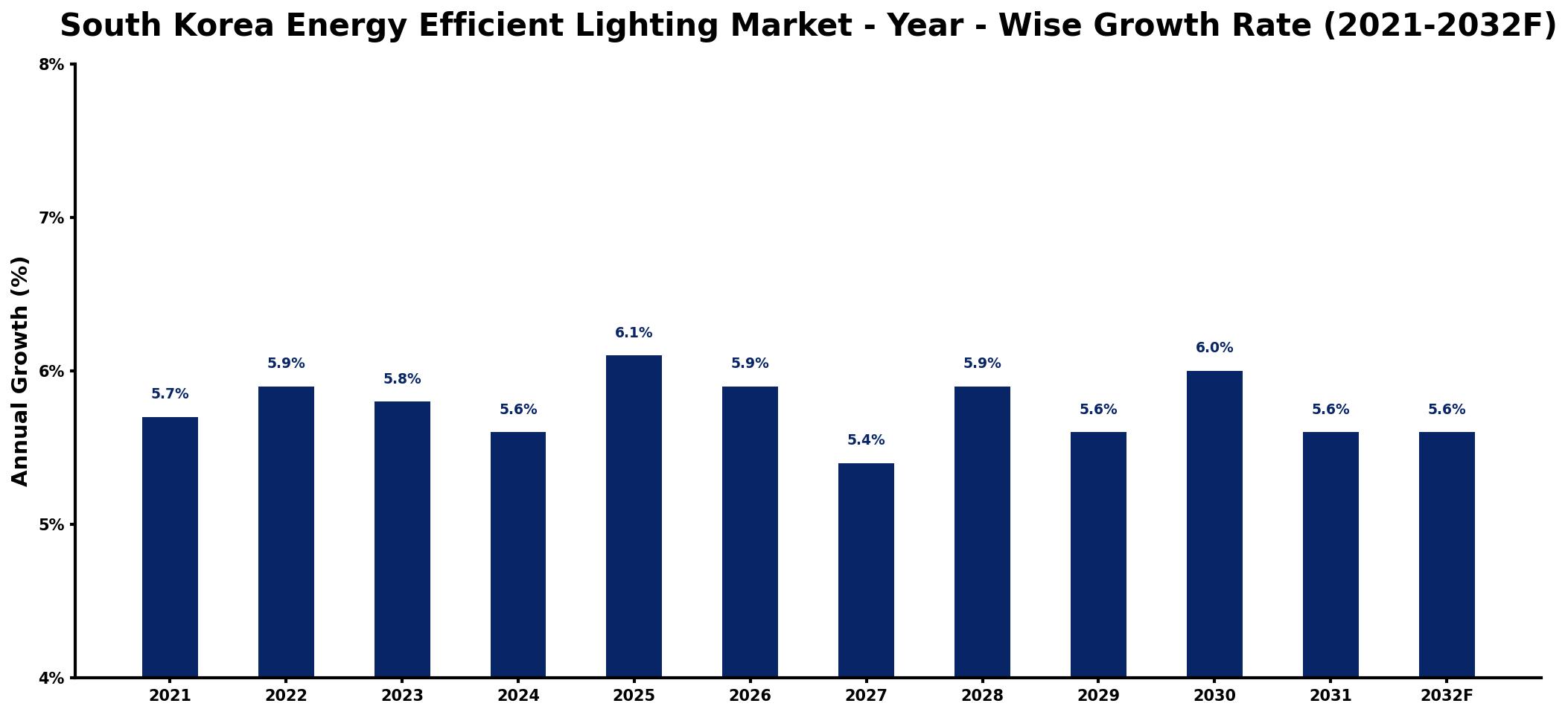
The table below presents the year‑wise growth rates along with the key drivers influencing the market
| Year | Growth Rate | Major Drivers |
| 2021 | 5.7% | Rising consumer sustainability awareness |
| 2022 | 5.9% | Government incentives for green technology |
| 2023 | 5.8% | Corporate responsibility initiatives increasing |
| 2024 | 5.6% | Growing demand for smart solutions |
| 2025 | 6.1% | stronger distribution network expansion |
| 2026 | 5.9% | Technological advancements in production |
| 2027 | 5.4% | Shift towards urban development projects |
| 2028 | 5.9% | Increased focus on residential upgrades |
| 2029 | 5.6% | Expansion of commercial building regulations |
| 2030 | 6.0% | Enhanced public transportation infrastructure |
| 2031 | 5.6% | Development of eco-friendly certifications |
| 2032 | 5.6% | Rising awareness of climate change |
Note: Market size estimations and growth projections presented in this report are based on 6Wresearch's proprietary forecasting methodology, utilizing the latest available industry data, government publications, and primary research inputs.
South Korea Energy Efficient Lighting Market Synopsis
The most powerful force currently shaping the South Korea Energy Efficient Lighting Market is the rapid adoption of LED technology. As both consumers and businesses increasingly recognize the long-term cost savings and environmental benefits associated with LED lighting, the market is seeing a substantial shift towards these eco-friendly alternatives.
In addition, government initiatives promoting energy conservation and sustainability are significantly contributing to market dynamics. Policies that enforce energy efficiency labeling and standards play a crucial role in guiding consumer choices, ensuring that more households and enterprises opt for energy-efficient lighting solutions.
South Korea Energy Efficient Lighting Market Key Takeaways
- Steady market growth driven by LED adoption and government initiatives.
- Rising awareness among consumers regarding the benefits of energy-efficient lighting.
- Increased demand for smart lighting systems in residential and commercial sectors.
- Investment opportunities in manufacturing and innovative technology development.
- Focus on environmental sustainability and reduced carbon emissions is shaping market strategies.
Evaluation of Restraints in South Korea Energy Efficient Lighting Market
Despite its promising growth, the South Korea Energy Efficient Lighting Market grapples with several restraints. A significant barrier is the relatively high initial cost associated with energy-efficient lighting products compared to traditional options, which can deter adoption among cost-sensitive consumers. Furthermore, a lack of understanding regarding the long-term savings and environmental benefits of these technologies poses an additional challenge. The market is also hindered by the prevalence of counterfeit or substandard products, which can undermine consumer trust and deter genuine investment in quality solutions. Regulatory complexities surrounding standards and certifications add to the confusion, impacting overall market growth.
South Korea Energy Efficient Lighting Market Trends
The shift towards LED technology remains the leading trend in the South Korea Energy Efficient Lighting Market. This trend is complemented by the growing popularity of smart lighting systems that utilize automation and sensors to enhance energy efficiency and user convenience. There is also a notable increase in retrofitting traditional lighting systems with energy-efficient solutions, driven by both cost-effectiveness and a heightened environmental consciousness among consumers. As sustainability becomes a priority in consumer choices and corporate policies, these trends are likely to accelerate further.
South Korea Energy Efficient Lighting Market Opportunities
Opportunities for growth within the South Korea Energy Efficient Lighting Market are abundant, particularly for companies involved in the development and distribution of LED products. With the governments ongoing support for energy conservation initiatives, investment in energy-efficient lighting solutions across various sectors—including commercial, industrial, and residential—is anticipated to increase. Furthermore, emerging technologies such as IoT integration in lighting systems present lucrative avenues for innovation and market expansion, attracting stakeholders looking to capitalize on evolving consumer demands.
Government Initiatives in the South Korea Energy Efficient Lighting Market
The South Korean government is actively promoting energy-efficient lighting through several initiatives aimed at reducing energy consumption and carbon emissions. Key policies include the Energy Efficiency Labeling Program, which mandates that manufacturers label their products with energy efficiency ratings, enabling consumers to make informed decisions. Furthermore, financial incentives and rebates are offered to encourage the transition to energy-efficient lighting technologies. By establishing energy efficiency standards for lighting products, the government is fostering a marketplace that prioritizes sustainability and quality, ultimately driving growth in the energy-efficient lighting sector.
Future Insights of the South Korea Energy Efficient Lighting Market
Looking ahead to 2026-2032, the South Korea Energy Efficient Lighting Market is poised for significant expansion. The anticipated increase in demand for LED lighting products, coupled with advancements in smart lighting technologies, will likely dominate the market landscape. As sustainability takes center stage in corporate strategies and consumer choices, the focus on energy-efficient solutions will intensify. With strong government support and evolving consumer awareness, the market is set to transform, providing avenues for innovation and investment opportunities that align with energy efficiency goals.
South Korea Energy Efficient Lighting Market Latest Developments (2025 - 2026)
Recent developments in the South Korea Energy Efficient Lighting Market indicate a continued push towards more innovative lighting solutions. There has been a marked increase in research and development aimed at enhancing the efficacy and functionality of LED and smart lighting systems. Additionally, industry stakeholders are focusing on partnerships that promote sustainability and energy efficiency, while regulatory frameworks continue to adapt to support the growing demand for energy-efficient lighting technologies. This environment is fostering a culture of innovation, driving the market forward.
South Korea Energy Efficient Lighting Market - Key Attractiveness of the Report
- 10 Years of Market Numbers
- Historical Data Starting from 2022 to 2025
- Base Year: 2025
- Forecast Data until 2032
- Key Performance Indicators Impacting the Market
- Major Upcoming Developments and Projects
Key Highlights of the Report:
- South Korea Energy Efficient Lighting Market Outlook
- Market Size of South Korea Energy Efficient Lighting Market, 2025
- Forecast of South Korea Energy Efficient Lighting Market, 2032
- Historical Data and Forecast of South Korea Energy Efficient Lighting Revenues & Volume for the Period 2022-2032F
- South Korea Energy Efficient Lighting Market Trend Evolution
- South Korea Energy Efficient Lighting Market Drivers and Challenges
- South Korea Energy Efficient Lighting Price Trends
- South Korea Energy Efficient Lighting Porter's Five Forces
- South Korea Energy Efficient Lighting Industry Life Cycle
- Historical Data and Forecast of South Korea Energy Efficient Lighting Market Revenues & Volume By Product Type for the Period 2022-2032F
- Historical Data and Forecast of South Korea Energy Efficient Lighting Market Revenues & Volume By Incandescent Lamp for the Period 2022-2032F
- Historical Data and Forecast of South Korea Energy Efficient Lighting Market Revenues & Volume By Light Emitting Diode for the Period 2022-2032F
- Historical Data and Forecast of South Korea Energy Efficient Lighting Market Revenues & Volume By Arc Lamp for the Period 2022-2032F
- Historical Data and Forecast of South Korea Energy Efficient Lighting Market Revenues & Volume By Gas Discharge Lamps for the Period 2022-2032F
- Historical Data and Forecast of South Korea Energy Efficient Lighting Market Revenues & Volume By Application for the Period 2022-2032F
- Historical Data and Forecast of South Korea Energy Efficient Lighting Market Revenues & Volume By Commercial for the Period 2022-2032F
- Historical Data and Forecast of South Korea Energy Efficient Lighting Market Revenues & Volume By Residential for the Period 2022-2032F
- Historical Data and Forecast of South Korea Energy Efficient Lighting Market Revenues & Volume By Government for the Period 2022-2032F
- Historical Data and Forecast of South Korea Energy Efficient Lighting Market Revenues & Volume By Correlated Color Temperature for the Period 2022-2032F
- Historical Data and Forecast of South Korea Energy Efficient Lighting Market Revenues & Volume By 2700K-3000K for the Period 2022-2032F
- Historical Data and Forecast of South Korea Energy Efficient Lighting Market Revenues & Volume By 3500K??4000K for the Period 2022-2032F
- Historical Data and Forecast of South Korea Energy Efficient Lighting Market Revenues & Volume By 4000K-5000K for the Period 2022-2032F
- Historical Data and Forecast of South Korea Energy Efficient Lighting Market Revenues & Volume By 5000K-6500K for the Period 2022-2032F
- Historical Data and Forecast of South Korea Energy Efficient Lighting Market Revenues & Volume By More Than 6500K for the Period 2022-2032F
- South Korea Energy Efficient Lighting Import Export Trade Statistics
- Market Opportunity Assessment By Product Type
- Market Opportunity Assessment By Application
- Market Opportunity Assessment By Correlated Color Temperature
- South Korea Energy Efficient Lighting Top Companies Market Share
- South Korea Energy Efficient Lighting Competitive Benchmarking By Technical and Operational Parameters
- South Korea Energy Efficient Lighting Company Profiles
- South Korea Energy Efficient Lighting Key Strategic Recommendations






































