South Korea Filament Led Bulb Market Size, Share & Growth Rate
The South Korea Filament Led Bulb Market was estimated at USD 369 Million in 2025 and is projected to reach USD 484 Million by 2032, growing at a CAGR of 4.0% from 2026 to 2032. This growth trajectory is fueled by an increasing consumer preference for energy-efficient lighting solutions, as traditional incandescent bulbs are phased out. Furthermore, regulatory measures promoting energy conservation and advancements in LED technology are enhancing the appeal of filament LED bulbs, making them a preferred choice across various sectors.
South Korea Filament Led Bulb Market Year-wise Growth Rate and Key Drivers
This graph highlights how the South Korea Filament Led Bulb Market has steadily grown over the years, supported by major growth factors.
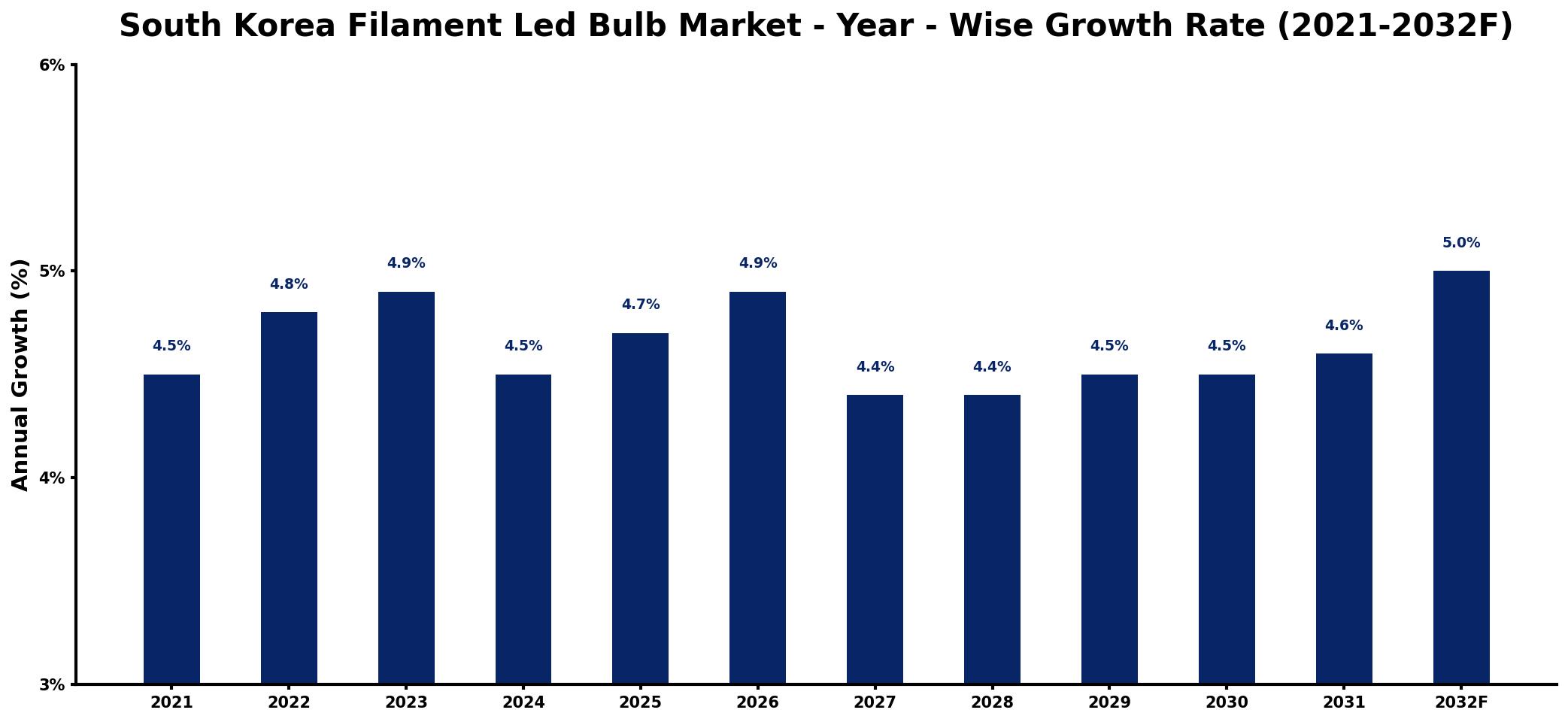
The table below presents the year‑wise growth rates along with the key drivers influencing the market
| Year | Growth Rate | Major Drivers |
| 2021 | 4.5% | Growing interest in energy efficiency |
| 2022 | 4.8% | Increased consumer awareness sustainability |
| 2023 | 4.9% | Rising demand for smart lighting |
| 2024 | 4.5% | Expansion of home automation technology |
| 2025 | 4.7% | Higher investments in renewable energy |
| 2026 | 4.9% | Strengthening regulations on energy consumption |
| 2027 | 4.4% | Emerging trends in interior design |
| 2028 | 4.4% | Advancements in lighting technology innovation |
| 2029 | 4.5% | Increased focus on health benefits |
| 2030 | 4.5% | Growth in commercial sector applications |
| 2031 | 4.6% | Rising popularity of eco-friendly solutions |
| 2032 | 5.0% | Enhanced government incentives for adoption |
Note: Market size estimations and growth projections presented in this report are based on 6Wresearch's proprietary forecasting methodology, utilizing the latest available industry data, government publications, and primary research inputs.
South Korea Filament Led Bulb Market Synopsis
The most significant force shaping the South Korea Filament LED Bulb Market is the shift towards energy-efficient lighting solutions driven by both consumer demand and regulatory mandates. As consumers seek stylish yet sustainable lighting options, filament LED bulbs—offering a vintage aesthetic—are rising in popularity.
Moreover, the emphasis on eco-friendly products is further supported by technological advancements that enhance the efficiency and performance of these bulbs. As a result, manufacturers are increasingly focusing on product innovation to meet the diverse aesthetic and functional needs of consumers.
South Korea Filament Led Bulb Market Key Takeaways
- The South Korea Filament LED Bulb Market is projected to grow to USD 484 Million by 2032, reflecting a robust consumer shift toward energy efficiency.
- Regulatory initiatives play a crucial role in promoting eco-friendly lighting alternatives, driving market growth.
- Advancements in LED technology are enhancing the performance and aesthetic appeal of filament LED bulbs.
- Consumer preferences for vintage-style lighting are significantly influencing product design and market dynamics.
- Collaboration among stakeholders is essential for fostering innovation and ensuring compliance with stringent energy efficiency standards.
Evaluation of Restraints in South Korea Filament Led Bulb Market
Despite the promising growth prospects, the South Korea Filament LED Bulb Market faces several restraints. Compliance with rigorous energy efficiency standards, such as K-STAR and Energy Efficiency Grade, places pressure on manufacturers to innovate continually. Additionally, varying consumer preferences for aesthetic design and functionality complicate market entry and acceptance. These factors necessitate a strategic approach to product differentiation and extensive research and development investment to meet evolving customer demands effectively.
South Korea Filament Led Bulb Market Trends
The market is witnessing significant trends that are reshaping demand and technology. One prominent trend is the increasing adoption of smart lighting solutions, as consumers seek integrated systems that enhance home automation. Additionally, the preference for warm color temperatures and dimmable features is steering manufacturers to develop versatile products that cater to diverse lighting needs. Eco-friendly practices are also becoming a focal point, as manufacturers prioritize sustainability in their production processes.
South Korea Filament Led Bulb Market Opportunities
There are genuine growth opportunities for investors and manufacturers in the South Korea Filament LED Bulb Market, particularly in expanding product lines that align with current consumer trends. Targeting the residential, commercial, and hospitality sectors with tailored solutions can create substantial market share. Additionally, as smart technology integrates further into daily life, investing in smart filament LED bulbs represents a forward-looking opportunity for growth.
Government Initiatives in the South Korea Filament Led Bulb Market
The South Korean government is actively promoting energy efficiency and sustainability through various regulations and initiatives. Policies surrounding energy efficiency labeling and performance standards for lighting products guide manufacturers toward compliance. Furthermore, public spending on energy-efficient lighting projects bolsters market potential, encouraging innovations that meet environmental sustainability goals while prioritizing consumer safety.
Future Insights of the South Korea Filament Led Bulb Market
Looking ahead to 2026-2032, the South Korea Filament LED Bulb Market is poised for substantial growth. With ongoing regulatory support and increasing consumer awareness about energy efficiency, demand for these bulbs will likely escalate. As manufacturers invest in technological advancements, we can expect improvements in performance, longevity, and design aesthetics, fostering further market expansion. Additionally, the integration of smart technologies will be pivotal, as consumers seek more control over their lighting environments.
South Korea Filament Led Bulb Market Latest Developments (2025 - 2026)
Recent developments in the South Korea filament LED bulb market indicate a strong trend towards innovation and collaboration. Manufacturers are exploring partnerships to enhance product offerings, emphasizing design versatility and energy efficiency. Regulatory updates are also prompting market players to refine their strategies, ensuring compliance while adapting to consumer preferences for sustainable lighting solutions. This dynamic period is characterized by a heightened focus on both performance and aesthetic appeal.
South Korea Filament Led Bulb Market - Key Attractiveness of the Report
- 10 Years of Market Numbers
- Historical Data Starting from 2022 to 2025
- Base Year: 2025
- Forecast Data until 2032
- Key Performance Indicators Impacting the Market
- Major Upcoming Developments and Projects
Key Highlights of the Report:
- South Korea Filament Led Bulb Market Outlook
- Market Size of South Korea Filament Led Bulb Market, 2025
- Forecast of South Korea Filament Led Bulb Market, 2032
- Historical Data and Forecast of South Korea Filament Led Bulb Revenues & Volume for the Period 2022-2032F
- South Korea Filament Led Bulb Market Trend Evolution
- South Korea Filament Led Bulb Market Drivers and Challenges
- South Korea Filament Led Bulb Price Trends
- South Korea Filament Led Bulb Porter's Five Forces
- South Korea Filament Led Bulb Industry Life Cycle
- Historical Data and Forecast of South Korea Filament Led Bulb Market Revenues & Volume By Product for the Period 2022-2032F
- Historical Data and Forecast of South Korea Filament Led Bulb Market Revenues & Volume By 25-Watt Type for the Period 2022-2032F
- Historical Data and Forecast of South Korea Filament Led Bulb Market Revenues & Volume By 40-Watt Type for the Period 2022-2032F
- Historical Data and Forecast of South Korea Filament Led Bulb Market Revenues & Volume By 60-Watt Type for the Period 2022-2032F
- Historical Data and Forecast of South Korea Filament Led Bulb Market Revenues & Volume By Others for the Period 2022-2032F
- Historical Data and Forecast of South Korea Filament Led Bulb Market Revenues & Volume By Application for the Period 2022-2032F
- Historical Data and Forecast of South Korea Filament Led Bulb Market Revenues & Volume By Restaurants for the Period 2022-2032F
- Historical Data and Forecast of South Korea Filament Led Bulb Market Revenues & Volume By Bars for the Period 2022-2032F
- Historical Data and Forecast of South Korea Filament Led Bulb Market Revenues & Volume By Hotels for the Period 2022-2032F
- Historical Data and Forecast of South Korea Filament Led Bulb Market Revenues & Volume By Cafes & Homes for the Period 2022-2032F
- Historical Data and Forecast of South Korea Filament Led Bulb Market Revenues & Volume By Others for the Period 2022-2032F
- South Korea Filament Led Bulb Import Export Trade Statistics
- Market Opportunity Assessment By Product
- Market Opportunity Assessment By Application
- South Korea Filament Led Bulb Top Companies Market Share
- South Korea Filament Led Bulb Competitive Benchmarking By Technical and Operational Parameters
- South Korea Filament Led Bulb Company Profiles
- South Korea Filament Led Bulb Key Strategic Recommendations






































