South Korea Nuclear Fuel Market Size, Share & Growth Rate
The South Korea Nuclear Fuel Market was estimated at USD 428 Million in 2025 and is projected to reach USD 601 Million by 2032, growing at a CAGR of 5.0% from 2026 to 2032. This trajectory is fueled by a solid commitment from the South Korean government to expand its nuclear power capacity, which forms a crucial part of its energy portfolio. Furthermore, advancements in nuclear fuel technology and a growing focus on sustainability are also significant factors driving this growth.
South Korea Nuclear Fuel Market Year-wise Growth Rate and Key Drivers
This graph highlights how the South Korea Nuclear Fuel Market has steadily grown over the years, supported by major growth factors.
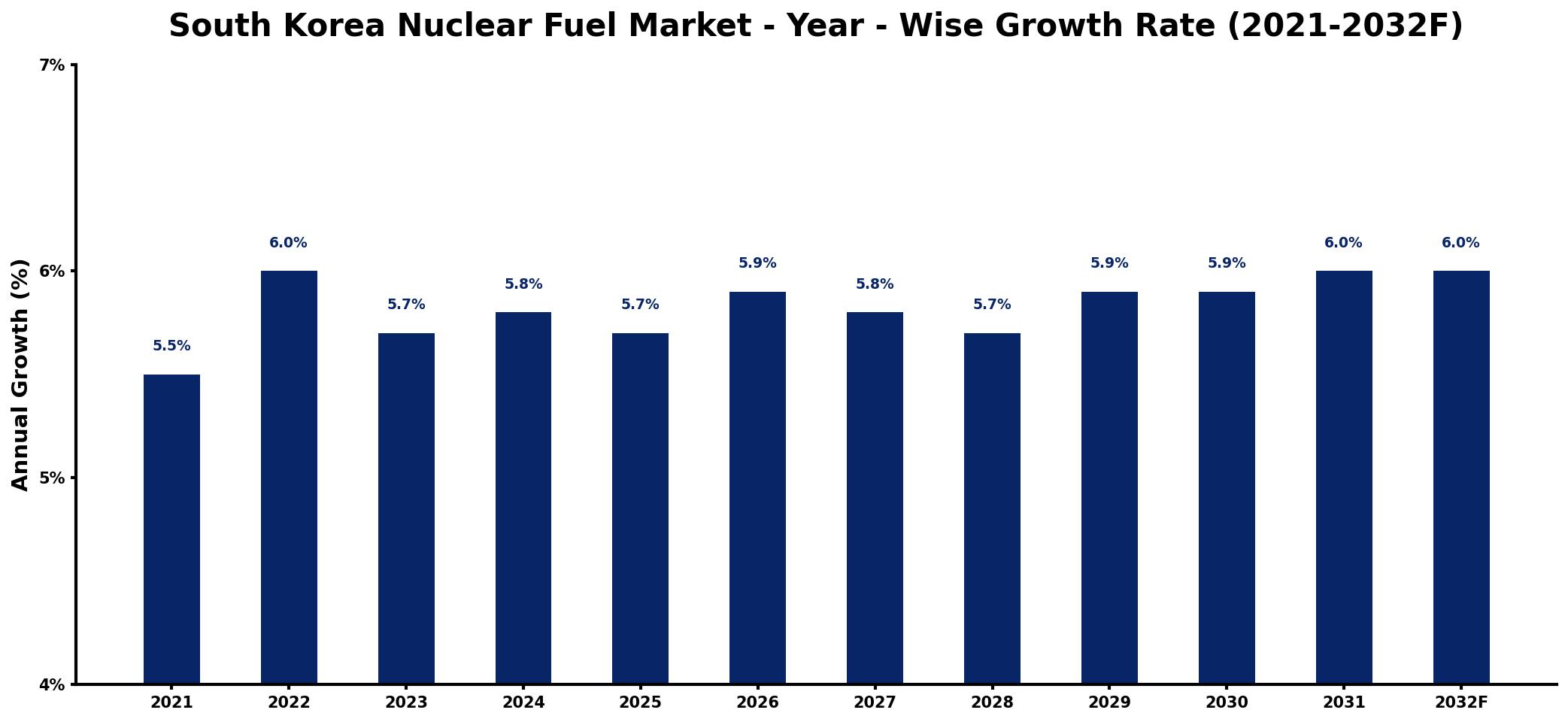
The table below presents the year‑wise growth rates along with the key drivers influencing the market
| Year | Growth Rate | Major Drivers |
| 2021 | 5.5% | Rising energy demand globally |
| 2022 | 6.0% | Increased investments in technology |
| 2023 | 5.7% | Growing focus on energy security |
| 2024 | 5.8% | Expansion of renewable integration |
| 2025 | 5.7% | growing downstream application demand |
| 2026 | 5.9% | Advancements in safety protocols |
| 2027 | 5.8% | Emergence of new market players |
| 2028 | 5.7% | Development of advanced reactors |
| 2029 | 5.9% | Increased international collaboration efforts |
| 2030 | 5.9% | Enhanced public awareness initiatives |
| 2031 | 6.0% | Growing demand for clean energy |
| 2032 | 6.0% | Strengthening supply chain resilience |
Note: Market size estimations and growth projections presented in this report are based on 6Wresearch's proprietary forecasting methodology, utilizing the latest available industry data, government publications, and primary research inputs.
South Korea Nuclear Fuel Market Synopsis
The South Korea nuclear fuel market is experiencing a period of robust growth as the nation strives to meet its energy demands through nuclear power. With 24 nuclear reactors currently operational, South Korea stands as a leading force in global nuclear energy production. However, this momentum faces hurdles as public concerns about safety and regulatory scrutiny shape the future landscape of the market.
Looking ahead, the market is anticipated to evolve significantly as the government enacts reforms to enhance nuclear safety and efficiency. The potential for integrating advanced nuclear fuel technologies presents an exciting avenue for further market expansion, even as the sector navigates public sentiment and regulatory challenges.
South Korea Nuclear Fuel Market Key Takeaways
- South Korea's nuclear reactors are pivotal to its energy mix, driving consistent demand for nuclear fuel.
- Advanced technologies such as accident-tolerant fuels are gaining traction, emphasizing safety and efficiency.
- Public perception remains a critical factor influencing regulatory policies and project approvals in the nuclear sector.
- Investment opportunities abound in uranium mining and fuel fabrication, supported by government initiatives.
- The government is actively fostering international partnerships to ensure a stable and secure fuel supply chain.
Evaluation of Restraints in South Korea Nuclear Fuel Market
Despite the optimistic growth trajectory of the South Korea nuclear fuel market, several restraints may limit its potential. Regulatory uncertainties stemming from shifting government policies can result in project delays and affect investor confidence. Furthermore, public opposition to nuclear power, particularly following historical incidents like the Fukushima disaster, creates additional barriers. Concerns surrounding safety, environmental impact, and the substantial capital required for plant construction and maintenance contribute to the complexity of navigating this market landscape.
South Korea Nuclear Fuel Market Trends
The South Korea nuclear fuel market is currently witnessing several transformative trends. One notable trend is the transition towards advanced nuclear fuel technologies designed to enhance safety and operational efficiency. This includes a focus on accident-tolerant fuels and the development of small modular reactors. Additionally, the increasing emphasis on sustainability is driving interest in the recycling and reprocessing of nuclear fuel, which aims to minimize waste and maximize resource utilization. Another trend is the pursuit of international collaborations aimed at stabilizing the nuclear fuel supply chain, reinforcing South Korea's long-term energy security.
South Korea Nuclear Fuel Market Opportunities
Opportunities for investment and growth in the South Korea nuclear fuel market are abundant. As the nation continues to rely heavily on nuclear energy, there is a sustained demand for uranium mining and fuel fabrication services. Companies engaged in the development of advanced nuclear technologies are likely to see significant interest as the government promotes research and development initiatives. The potential for partnerships and collaborations with international entities also stands as a compelling avenue for investment, supporting the market's strategic growth objectives.
Government Initiatives in the South Korea Nuclear Fuel Market
The South Korean government has implemented a series of strategic initiatives to bolster the nuclear fuel market while ensuring safety and sustainability. Key policies focus on the establishment of a comprehensive nuclear fuel cycle strategy, encouraging advancements in nuclear fuel technology, and fostering international cooperation for a secure fuel supply. Additionally, the government emphasizes stringent safety regulations for nuclear facilities and waste management, aiming to balance the benefits of nuclear energy with public concerns regarding safety and environmental impacts.
Future Insights of the South Korea Nuclear Fuel Market
The future outlook for the South Korea nuclear fuel market is promising, driven by ongoing governmental support for nuclear power generation and a commitment to reducing reliance on fossil fuels. As the country plans to enhance the proportion of nuclear energy in its overall energy portfolio, investments in cutting-edge nuclear technologies will likely open doors for market expansion. Given South Korea's established position in the global nuclear landscape and its focus on innovation, the market is poised for sustained growth and advancement in the coming years.
South Korea Nuclear Fuel Market Latest Developments (2025 - 2026)
In recent months, the South Korea nuclear fuel market has seen increased activity focused on enhancing nuclear safety and efficiency. Regulatory reforms aimed at simplifying the approval process for new projects are gaining traction, as public discourse shifts towards acknowledging the importance of nuclear energy in achieving energy security. Collaborative efforts between domestic entities and international partners have intensified, with a shared focus on innovation in nuclear fuel technologies and sustainable practices within the industry.
South Korea Nuclear Fuel Market - Key Attractiveness of the Report
- 10 Years of Market Numbers
- Historical Data Starting from 2022 to 2025
- Base Year: 2025
- Forecast Data until 2032
- Key Performance Indicators Impacting the Market
- Major Upcoming Developments and Projects
Key Highlights of the Report:
- South Korea Nuclear Fuel Market Outlook
- Market Size of South Korea Nuclear Fuel Market, 2025
- Forecast of South Korea Nuclear Fuel Market, 2032
- Historical Data and Forecast of South Korea Nuclear Fuel Revenues & Volume for the Period 2022-2032F
- South Korea Nuclear Fuel Market Trend Evolution
- South Korea Nuclear Fuel Market Drivers and Challenges
- South Korea Nuclear Fuel Price Trends
- South Korea Nuclear Fuel Porter's Five Forces
- South Korea Nuclear Fuel Industry Life Cycle
- Historical Data and Forecast of South Korea Nuclear Fuel Market Revenues & Volume By Fuel Type for the Period 2022-2032F
- Historical Data and Forecast of South Korea Nuclear Fuel Market Revenues & Volume By Uranium Fuel for the Period 2022-2032F
- Historical Data and Forecast of South Korea Nuclear Fuel Market Revenues & Volume By Mixed Oxidenuclear Fuel for the Period 2022-2032F
- Historical Data and Forecast of South Korea Nuclear Fuel Market Revenues & Volume By Reactor Type for the Period 2022-2032F
- Historical Data and Forecast of South Korea Nuclear Fuel Market Revenues & Volume By Boiling Water Reactor for the Period 2022-2032F
- Historical Data and Forecast of South Korea Nuclear Fuel Market Revenues & Volume By Pressurized Water Reactor for the Period 2022-2032F
- South Korea Nuclear Fuel Import Export Trade Statistics
- Market Opportunity Assessment By Fuel Type
- Market Opportunity Assessment By Reactor Type
- South Korea Nuclear Fuel Top Companies Market Share
- South Korea Nuclear Fuel Competitive Benchmarking By Technical and Operational Parameters
- South Korea Nuclear Fuel Company Profiles
- South Korea Nuclear Fuel Key Strategic Recommendations






































