South Korea Prefabricated Building Market Size Growth Rate
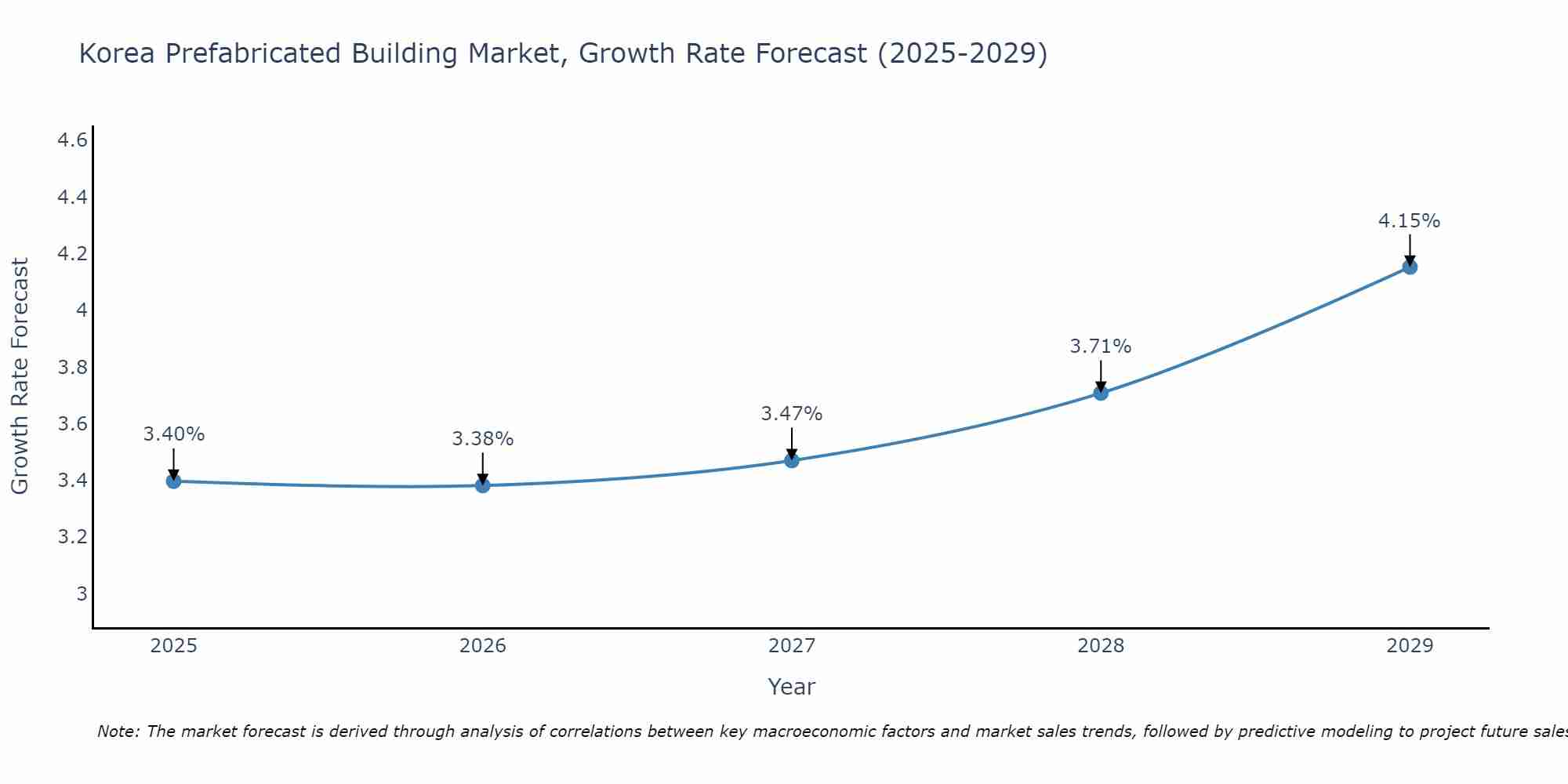
The South Korea Prefabricated Building Market is projected to witness mixed growth rate patterns during 2025 to 2029. Commencing at 3.40% in 2025, growth builds up to 4.15% by 2029.
South Korea Prefabricated Building Market Overview
The South Korea Prefabricated Building Market is witnessing significant growth driven by factors such as rapid urbanization, increasing population density, and the need for sustainable construction practices. Prefabricated buildings offer advantages such as faster construction timelines, cost-effectiveness, and reduced environmental impact. The market is experiencing a shift towards innovative prefabricated solutions that cater to diverse sectors including residential, commercial, and industrial developments. Key players in the market are focusing on technological advancements, design flexibility, and customization options to meet the evolving needs of the construction industry in South Korea. Government initiatives promoting the use of prefabricated buildings for affordable housing and infrastructure projects are also contributing to the market`s expansion, making it a lucrative sector for investors and stakeholders.
South Korea Prefabricated Building Market Trends
The South Korea Prefabricated Building Market is experiencing a significant growth trend driven by factors such as increasing urbanization, a need for sustainable construction practices, and a focus on cost efficiency and speed of construction. The market is witnessing a rise in demand for prefabricated buildings across various sectors including residential, commercial, and industrial due to their benefits of reduced construction time, lower labor costs, and improved quality control. Additionally, advancements in technology and design innovations are further driving the adoption of prefabricated buildings in South Korea. The market is expected to continue expanding as more construction companies and developers recognize the advantages of prefabricated construction methods in meeting the country`s growing infrastructure needs while addressing environmental concerns.
South Korea Prefabricated Building Market Challenges
In the South Korea Prefabricated Building Market, challenges include navigating complex regulations and standards, ensuring quality control and safety compliance throughout the construction process, managing the logistics of transportation and installation of prefabricated components, as well as overcoming cultural preferences for traditional construction methods. Additionally, there may be a need to educate the market on the benefits and long-term value of prefabricated buildings compared to conventional construction, in order to increase acceptance and adoption. Competition from traditional construction companies and the need for skilled labor to work with prefabricated materials are also key challenges that companies in this market need to address to succeed and grow in South Korea.
South Korea Prefabricated Building Market Investment Opportunities
The South Korea Prefabricated Building Market offers promising investment opportunities due to the increasing demand for quick and cost-effective construction solutions in the country. With a growing emphasis on sustainability and efficiency in the construction industry, prefabricated buildings are gaining traction for their reduced construction time, minimal waste generation, and energy efficiency. Investors can capitalize on this trend by investing in companies specializing in prefabricated building materials, technology, and construction services. Additionally, the government of South Korea has been promoting the use of prefabricated buildings as part of its urban development initiatives, providing further incentives for investment in this sector. Overall, the South Korea Prefabricated Building Market presents a lucrative opportunity for investors looking to tap into the growing demand for innovative construction solutions in the country.
South Korea Prefabricated Building Market Government Policy
In South Korea, the government has been actively promoting the use of prefabricated building technology to address housing shortages and improve construction efficiency. The Ministry of Land, Infrastructure and Transport has implemented policies to incentivize the adoption of prefabricated buildings, such as providing financial support for research and development, offering tax benefits for companies using prefabricated construction methods, and streamlining the regulatory approval process for prefabricated building projects. Additionally, the government has set targets for increasing the percentage of prefabricated buildings in the overall construction industry, with the aim of boosting sustainability and reducing construction costs. Overall, government policies in South Korea are focused on encouraging the growth of the prefabricated building market as a key strategy for advancing the construction sector.
South Korea Prefabricated Building Market Future Outlook
The South Korea Prefabricated Building Market is expected to witness steady growth in the coming years due to the increasing demand for cost-effective and sustainable construction solutions. Factors such as rapid urbanization, government initiatives promoting green building practices, and the need for quick and efficient construction methods are driving the market growth. Additionally, the rising adoption of prefabricated buildings in various sectors including residential, commercial, and industrial is further fueling market expansion. Technological advancements in prefabrication techniques, such as 3D printing and modular construction, are also contributing to the market`s positive outlook. With a growing emphasis on efficient and environmentally friendly construction practices, the South Korea Prefabricated Building Market is poised for sustained growth in the foreseeable future.
Key Highlights of the Report:
- South Korea Prefabricated Building Market Outlook
- Market Size of South Korea Prefabricated Building Market, 2021
- Forecast of South Korea Prefabricated Building Market, 2031
- Historical Data and Forecast of South Korea Prefabricated Building Revenues & Volume for the Period 2018 - 2031
- South Korea Prefabricated Building Market Trend Evolution
- South Korea Prefabricated Building Market Drivers and Challenges
- South Korea Prefabricated Building Price Trends
- South Korea Prefabricated Building Porter's Five Forces
- South Korea Prefabricated Building Industry Life Cycle
- Historical Data and Forecast of South Korea Prefabricated Building Market Revenues & Volume By Dimensions for the Period 2018 - 2031
- Historical Data and Forecast of South Korea Prefabricated Building Market Revenues & Volume By Skeleton System for the Period 2018 - 2031
- Historical Data and Forecast of South Korea Prefabricated Building Market Revenues & Volume By Panel System for the Period 2018 - 2031
- Historical Data and Forecast of South Korea Prefabricated Building Market Revenues & Volume By Cellular System for the Period 2018 - 2031
- Historical Data and Forecast of South Korea Prefabricated Building Market Revenues & Volume By Combined System for the Period 2018 - 2031
- Historical Data and Forecast of South Korea Prefabricated Building Market Revenues & Volume By Application for the Period 2018 - 2031
- Historical Data and Forecast of South Korea Prefabricated Building Market Revenues & Volume By Residential for the Period 2018 - 2031
- Historical Data and Forecast of South Korea Prefabricated Building Market Revenues & Volume By Non-Residential for the Period 2018 - 2031
- South Korea Prefabricated Building Import Export Trade Statistics
- Market Opportunity Assessment By Dimensions
- Market Opportunity Assessment By Application
- South Korea Prefabricated Building Top Companies Market Share
- South Korea Prefabricated Building Competitive Benchmarking By Technical and Operational Parameters
- South Korea Prefabricated Building Company Profiles
- South Korea Prefabricated Building Key Strategic Recommendations






































