South Korea Tourism Market Growth Rate
According to 6Wresearch internal database and industry insights, the South Korea Tourism Market is projected to grow at a compound annual growth rate (CAGR) of 7.8% during the forecast period (2026-2032).
South Korea Tourism Market Year-wise Growth Rate and Key Drivers
This graph highlights how the South Korea Tourism Market has steadily grown over the past five years, supported by major growth factors.
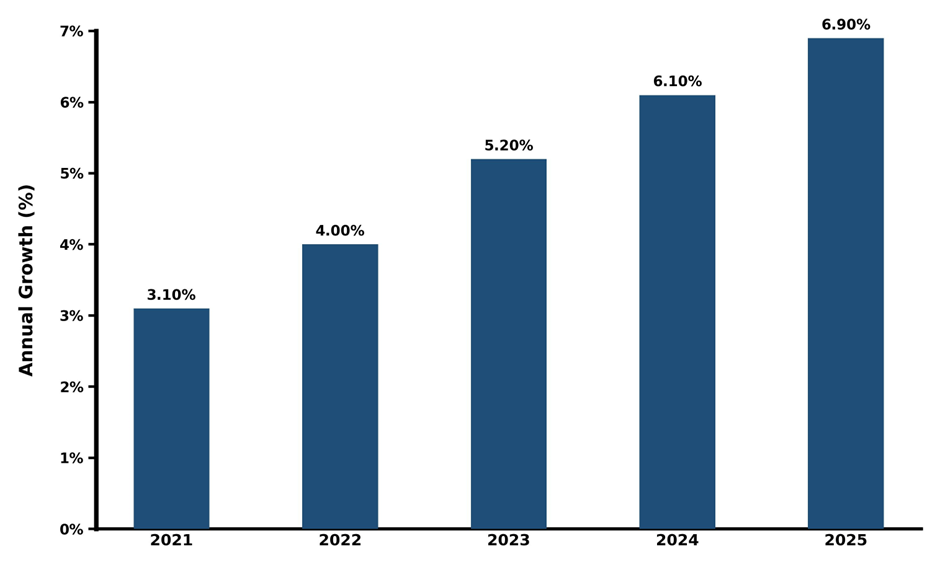
The table below presents the year‑wise growth rates along with the key drivers influencing the market
| Year | Est. Annual Growth (%) | Growth Drivers |
| 2021 | 3.1% | Recovery in domestic travel demand and revival of cultural tourism |
| 2022 | 4% | Rebound in international arrivals and easing travel restrictions |
| 2023 | 5.2% | Expansion of K-culture tourism and entertainment-driven travel |
| 2024 | 6.1% | Infrastructure upgrades and premium hospitality expansion |
| 2025 | 6.9% | Digital booking growth and experiential tourism demand |
Topics Covered in the South Korea Tourism Market Report
The South Korea Tourism Market report thoroughly covers the market by type and Purpose. The market report provides an unbiased and detailed analysis of ongoing market trends, opportunities/high growth areas, and market drivers, which help stakeholders devise and align their market strategies according to the current and future market dynamics.
South Korea Tourism Market Highlights
| Report Name | South Korea Tourism Market |
| Forecast period | 2026-2032 |
| CAGR | 7.8% |
| Growing Sector | Travel & Hospitality Sector |
South Korea Tourism Market Synopsis
The South Korea Tourism Market will witness significant growth on account of growing international demand for Korean culture, more foreign tourists visiting the country, and constant development of modern facilities in the tourism sector. The tourism market in South Korea is witnessing growth due to increased connectivity via flights, advanced travel technology, and tourism activities ranging from cultural tourism, entertainment tourism, medical tourism, to adventure tourism.
Evaluation of Growth Drivers in the South Korea Tourism Market (2026-2032)
Below mentioned are some prominent drivers and their influence on the market dynamics:
| Drivers | Primary Segments Affected | Why it Matters (Evidence) |
| K-Culture Global Expansion | International Tourism | Strong demand driven by K-pop and Korean entertainment |
| Transport Infrastructure Development | Domestic & International Tourism | High-speed rail and airports improve connectivity |
| Government Tourism Campaigns | International Tourism | Boost global tourist inflow through promotions |
| Digital Travel Platforms | Hospitality & Booking Services | Enhances personalization and ease of travel |
| Tourism Diversification | Medical & Cultural Tourism | Expands visitor base and spending patterns |
South Korea Tourism Market is expected to grow at a CAGR of 7.8% during 2026-2032, driven by increased international arrivals, cultural tourism growth, and robust development of hospitality infrastructure. Digitalisation within travel services and tourism promotion programs backed by the government has also improved accessibility and guest experience. The increasing trend within medical, wellness, and experiential tourism is improving future market potential.
Evaluation of Restraints in the South Korea Tourism Market
Below mentioned are some major restraints and their influence on the market dynamics:
| Restraints | Primary Segments Affected | What This Means (Evidence) |
| Seasonal Tourism Concentration | Domestic & International Tourism | Tourist arrivals fluctuate significantly across peak holiday seasons and off-peak months, creating uneven revenue generation for hospitality and travel service providers. |
| Travel Expenses | Holidaying Abroad | The high costs of traveling by air, staying in hotel rooms, and other luxurious facilities make it hard for economically conservative international tourists to afford. |
| Congestion in Cities | Vacations in the Urban Areas | Cities like Seoul become highly congested due to a high population of tourists, thus making vacationing less pleasant. |
| Language Barriers | Holidaying in the Rural Areas | A lack of multi-language capabilities is an obstacle for tourists in rural and developing areas of tourism. |
| Geopolitical Risks | International Tourism | Regional geopolitical uncertainties and diplomatic sensitivities can influence traveller confidence and temporarily impact inbound tourism flows and booking patterns. |
South Korea Tourism Market Challenges
South Korea Tourism Market Growth is affected by various structural obstacles, such as the uneven distribution of tourism within the country, with large urban centers like Seoul drawing most of the tourists, whereas the rural and smaller areas lack development and resources. Moreover, the high cost of hospitality and travel hinders affordability for some travelers, whereas seasonality issues affect the flow of tourists across different seasons. Besides, the problem of language barrier and congestion in major sites in distant areas poses serious demands on infrastructure.
South Korea Tourism Market Trends
Key trends evaluating the landscape of the South Korea Tourism Market are:
- K-Culture Driven Tourism Boom: The global popularity of K-pop, K-dramas, and Korean cinema is significantly increasing inbound tourism demand, especially among younger international travelers.
- Use of AI in Smart Tourism: The integration of AI-powered travel apps, navigation tools, and concierge services has enhanced the convenience of tourists and personalized their experience.
- Emergence of Experiential Travel: It has been observed that tourists have become increasingly interested in gaining new experiences by taking part in workshops and traditional village travel and by visiting theme parks.
- Medical and Wellness Travel Becoming Popular: In recent times, the popularity of medical tourism has gained momentum, especially in South Korea, where state-of-the-art medical services are available.
Investment Opportunities in the South Korea Tourism Market
The major investment areas in the South Korean Tourism Market are:
- Luxury Tourism Investments – Building of luxury hotels, resorts and unique stay concepts to meet the demands of increasing affluent tourists from abroad.
- AI Tourism Services – Building of advanced services related to bookings, virtual tours and recommendations for visitors through the use of artificial intelligence.
- K Culture Tourism Attraction – Building of tourism infrastructure such as theme parks and entertainment zones related to K culture.
- Regional Tourism Areas – Development of tourism centres in rural and coastal areas of South Korea.
Top 5 Leading Players in the South Korea Tourism Market
Some of the leading companies in the South Korea Tourism Market include:
Korean Air
| Company Name | Korean Air |
| Established Year | 1969 |
| Headquarters | Seoul, South Korea |
| Official Website | Click Here |
Korean Air plays a major role in tourism connectivity by enabling global passenger movement and supporting inbound and outbound travel demand across leisure, business, and cultural tourism segments.
Asiana Airlines
| Company Name | Asiana Airlines |
| Established Year | 1988 |
| Headquarters | Seoul, South Korea |
| Official Website | Click Here |
Asiana Airlines strengthens tourism growth through extensive international and regional connectivity, supporting rising inbound travel demand.
Hana Tour
| Company Name | Hana Tour |
| Established Year | 1993 |
| Headquarters | Seoul, South Korea |
| Official Website | Click Here |
Hana Tour provides comprehensive travel packages and guided tours supporting both inbound and domestic tourism expansion.
Mode Tour
| Company Name | Mode Tour |
| Established Year | 1989 |
| Headquarters | Seoul, South Korea |
| Official Website | Click Here |
Mode Tour delivers integrated travel services including bookings and customized tourism solutions, boosting market growth.
Hyundai Travel
| Company Name | Hyundai Travel |
| Established Year | 1974 |
| Headquarters | Seoul, South Korea |
| Official Website | - |
Hyundai Travel supports tourism development through curated travel packages and business travel solutions.
Government Regulations Introduced in the South Korea Tourism Market
According to South Korean Government Data, tourism development policies such as “Tourism Vision 2030” are focused on strengthening digital transformation, promoting sustainable tourism practices, and improving balanced regional tourism development across the country.
In addition, visa facilitation measures for selected countries, the expansion of international promotional campaigns, such as Korea's tourism branding programs, and targeted regional tourism support initiatives are improving inbound visitor flows. Cooperation between the public and private sectors is contributing to the improvement of tourism infrastructure, increasing accessibility, and guaranteeing that tourists engage in their activities in locations outside of major cities such as Seoul.
Future Insights of the South Korea Tourism Market
The South Korea Tourism Industry would benefit from an extensive phase of robust growth due to rising cultural influence in the world, the emergence of digitalization in the travel services sector, and the continued expansion of tourism facilities in different destinations. ]
The growing popularity of customized and experiential travel, facilitated by AI-enabled booking services and smart tourism applications, is set to redefine the dynamics of the travel industry. Government-led efforts towards the diversification of the tourism market with emphasis on regional tourism and sustainable practices in travel would be highly significant for future market growth.
Market Segmentation Analysis
The report offers a comprehensive study of the subsequent market segments and their leading categories:
By Type – International Tourism to Dominate the Market
According to Nikita, Senior Research Analyst, 6Wresearch, the International Tourism segment dominates the South Korea Tourism Market Share due to strong global demand for K-culture experiences, improved connectivity, and rising inbound arrivals from global regions.
By Purpose – Adventure & Cultural Tourism to Dominate the Market
Adventure and cultural tourism dominate, driven by high demand for hiking, heritage exploration, and K-content experiences. Business and medical tourism also contribute significantly to market expansion across urban hubs.
Key Attractiveness of the Report
- 10 Years of Market Numbers.
- Historical Data Starting from 2022 to 2025.
- Base Year: 2025.
- Forecast Data until 2032.
- Key Performance Indicators Impacting the Market.
- Major Upcoming Developments and Projects.
Key Highlights of the Report:
- South Korea Tourism Market Outlook
- Market Size of South Korea Tourism Market, 2025
- Forecast of South Korea Tourism Market, 2032
- Historical Data and Forecast of South Korea Tourism Revenues & Volume for the Period 2022- 2032
- South Korea Tourism Market Trend Evolution
- South Korea Tourism Market Drivers and Challenges
- South Korea Tourism Price Trends
- South Korea Tourism Porter's Five Forces
- South Korea Tourism Industry Life Cycle
- Historical Data and Forecast of South Korea Tourism Market Revenues & Volume By Type for the Period 2022- 2032
- Historical Data and Forecast of South Korea Tourism Market Revenues & Volume By Local/domestic for the Period 2022- 2032
- Historical Data and Forecast of South Korea Tourism Market Revenues & Volume By International for the Period 2022- 2032
- Historical Data and Forecast of South Korea Tourism Market Revenues & Volume By Purpose for the Period 2022- 2032
- Historical Data and Forecast of South Korea Tourism Market Revenues & Volume By Adventure for the Period 2022- 2032
- Historical Data and Forecast of South Korea Tourism Market Revenues & Volume By Business for the Period 2022- 2032
- Historical Data and Forecast of South Korea Tourism Market Revenues & Volume By Medical for the Period 2022- 2032
- Historical Data and Forecast of South Korea Tourism Market Revenues & Volume By Sea Farming for the Period 2022- 2032
- Historical Data and Forecast of South Korea Tourism Market Revenues & Volume By Others for the Period 2022- 2032
- South Korea Tourism Import Export Trade Statistics
- Market Opportunity Assessment By Type
- Market Opportunity Assessment By Purpose
- South Korea Tourism Top Companies Market Share
- South Korea Tourism Competitive Benchmarking By Technical and Operational Parameters
- South Korea Tourism Company Profiles
- South Korea Tourism Key Strategic Recommendations
Market Covered
The report offers a comprehensive study of the subsequent market segments:
By Type
- Local/Domestic
- International
By Purpose
- Adventure
- Business
- Medical
- Sea Farming
- Others






































