Spain Chlorine Market Size (2020-2030)
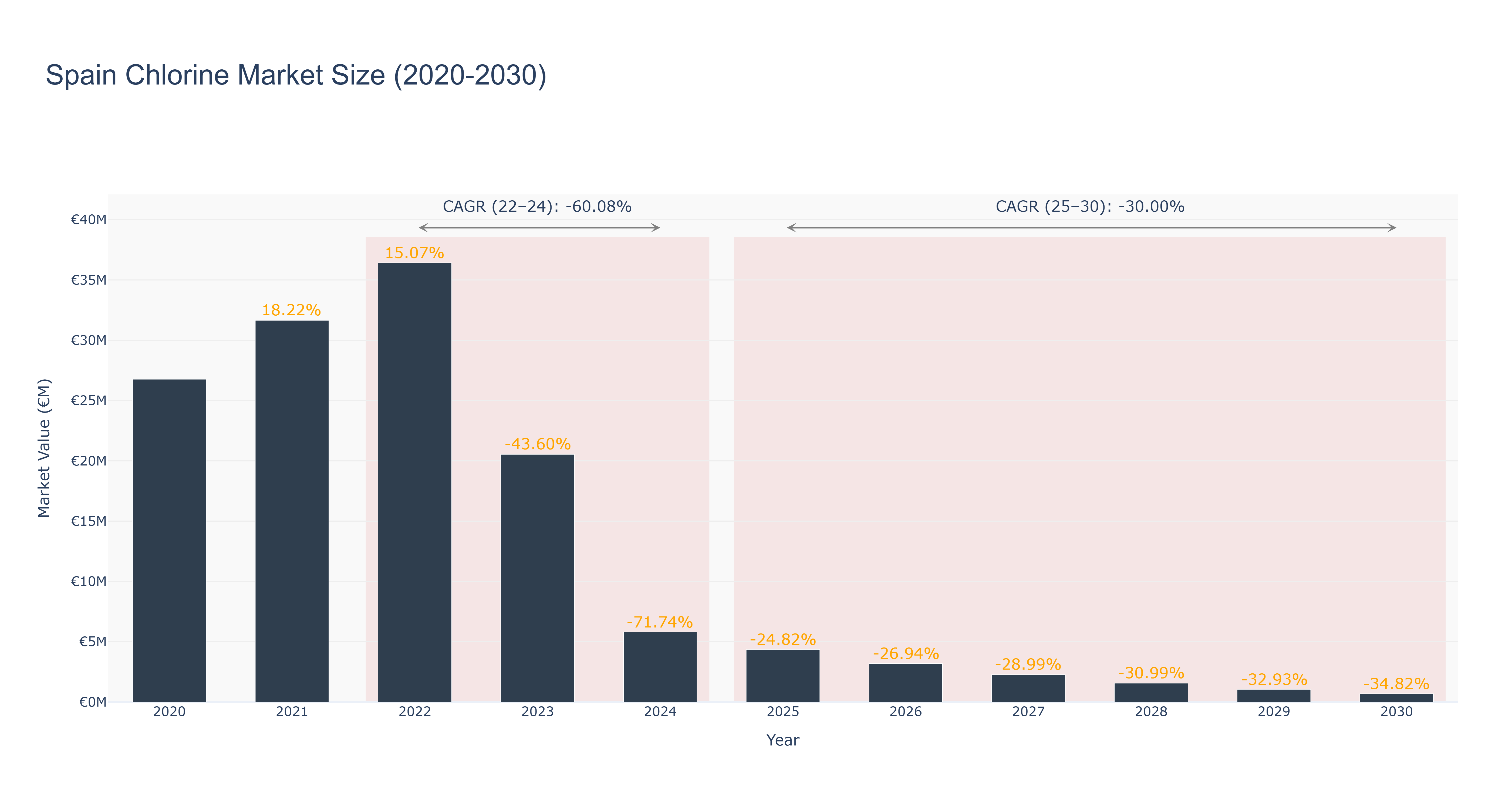
Spain Chlorine Market has experienced a significant decline in market size over the past decade. The peak market size of €36.42 million was recorded in 2022, followed by a drastic drop to €5.80 million in 2024. The forecasted market size continues to decrease, with an estimated value of €0.68 million in 2030. The CAGR for the period 2022-24 was -60.08%, reflecting a sharp downturn, while the CAGR for 2025-30 is projected at -30.0%. The market's decline can be attributed to factors such as evolving environmental regulations, technological advancements leading to reduced chlorine usage, and shifting consumer preferences towards eco-friendly alternatives. Despite the challenging market conditions, Spain is set to invest in sustainable water treatment projects to enhance environmental protection and public health in the near future. Industry drivers include the growing focus on sustainability and stringent regulatory requirements.
Spain Chlorine Market: Production & Trade Performance (2019-2025)
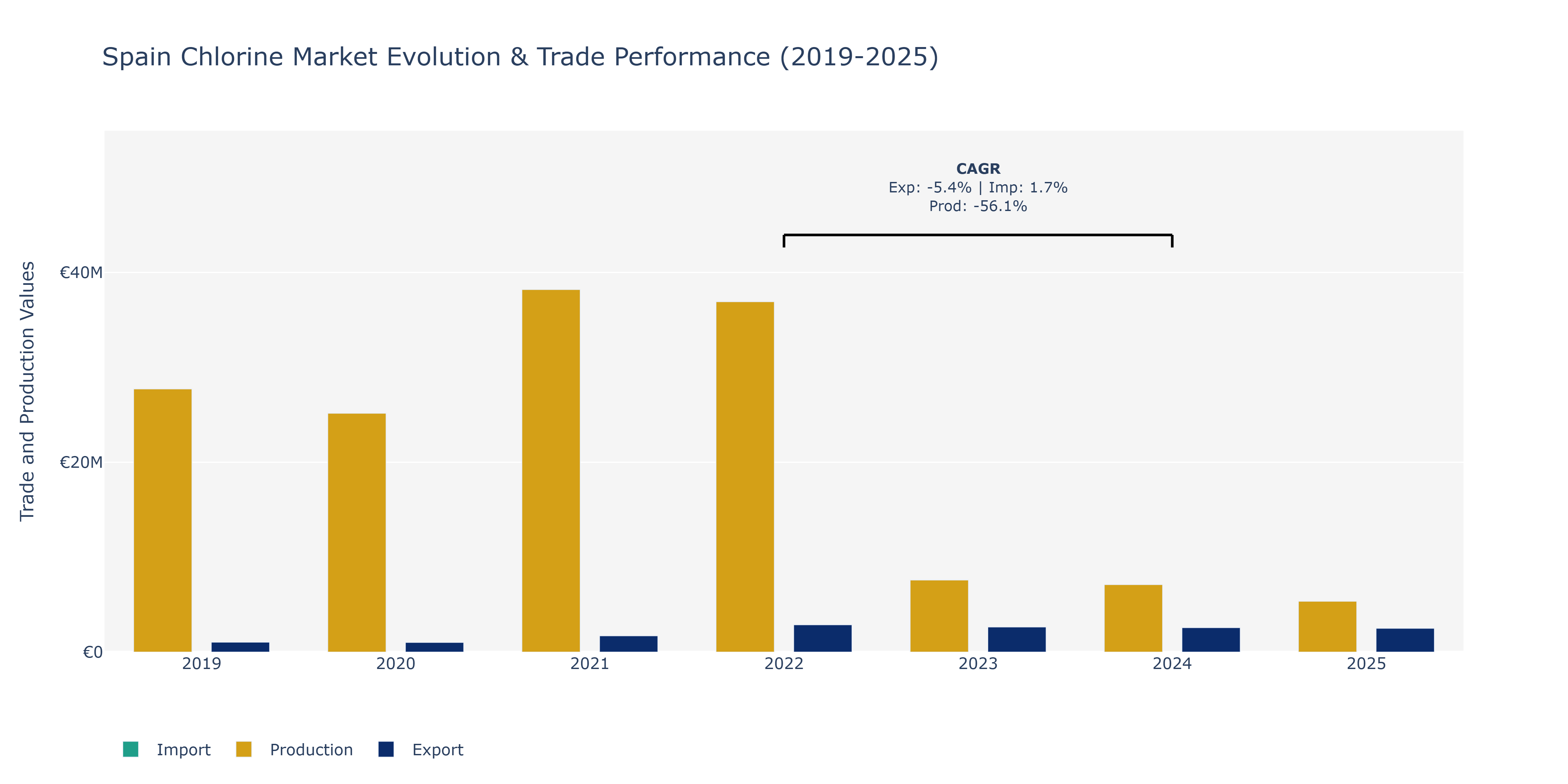
In the Spain Chlorine Market, exports experienced a downward trend from 2019 to 2025, with a peak value of €2.87 million in 2022, followed by a moderate decline. Imports, on the other hand, fluctuated over the years, reaching their highest point in 2020 at €1.17 million before decreasing slightly by 2025. Production in the market exhibited a significant decline from €38.19 million in 2021 to €5.34 million in 2025, reflecting a challenging period for domestic manufacturing. The fluctuations in exports and imports could be attributed to global demand shifts, trade agreements, and economic conditions impacting Spain's competitiveness in the chlorine market. The substantial production drop might be influenced by environmental regulations, technological advancements, or changes in consumer preferences towards more sustainable alternatives, as seen in the industry reports highlighting the transition towards greener chemicals production methods.
Spain Chlorine Market Overview
The chlorine market in Spain is pivotal for industries such as water treatment, chemicals, and pharmaceuticals. As environmental regulations tighten, the market is witnessing a shift towards more sustainable chlorine production methods. The increasing focus on water quality and safety is driving demand for chlorine in municipal and industrial applications, reinforcing its significance in public health.
Drivers of the market
The chlorine market in Spain is propelled by its critical role in the production of various chemicals, including PVC and disinfectants. The growth of the construction and healthcare sectors fuels the demand for chlorine-based products. Additionally, increasing environmental regulations encourage the use of chlorine in water treatment processes, further driving market growth.
Challenges of the market
The Spain chlorine market is impacted by environmental concerns related to the use and disposal of chlorine products. Regulatory challenges, including compliance with safety standards, can increase operational complexities for manufacturers. Additionally, the emergence of alternative disinfecting technologies poses competitive threats.
Government Policy of the market
The chlorine market in Spain is influenced by environmental policies aimed at reducing chemical pollution. Regulatory frameworks govern the production, distribution, and use of chlorine, ensuring that safety standards are met. Additionally, the government promotes the development of safer chemical alternatives.
Key Highlights of the Report:
- Spain Chlorine Market Outlook
- Market Size of Spain Chlorine Market, 2024
- Forecast of Spain Chlorine Market, 2031
- Historical Data and Forecast of Spain Chlorine Revenues & Volume for the Period 2018 - 2031
- Spain Chlorine Market Trend Evolution
- Spain Chlorine Market Drivers and Challenges
- Spain Chlorine Price Trends
- Spain Chlorine Porter's Five Forces
- Spain Chlorine Industry Life Cycle
- Historical Data and Forecast of Spain Chlorine Market Revenues & Volume By Application for the Period 2018 - 2031
- Historical Data and Forecast of Spain Chlorine Market Revenues & Volume By EDC/PVC for the Period 2018 - 2031
- Historical Data and Forecast of Spain Chlorine Market Revenues & Volume By Isocyanates and Oxygenates for the Period 2018 - 2031
- Historical Data and Forecast of Spain Chlorine Market Revenues & Volume By Chloromethanes for the Period 2018 - 2031
- Historical Data and Forecast of Spain Chlorine Market Revenues & Volume By Solvents and Epichlorohydrin for the Period 2018 - 2031
- Historical Data and Forecast of Spain Chlorine Market Revenues & Volume By Inorganic Chemicals for the Period 2018 - 2031
- Historical Data and Forecast of Spain Chlorine Market Revenues & Volume By Other Applications for the Period 2018 - 2031
- Historical Data and Forecast of Spain Chlorine Market Revenues & Volume By End-user Industry for the Period 2018 - 2031
- Historical Data and Forecast of Spain Chlorine Market Revenues & Volume By Water Treatment for the Period 2018 - 2031
- Historical Data and Forecast of Spain Chlorine Market Revenues & Volume By Pharmaceutical for the Period 2018 - 2031
- Historical Data and Forecast of Spain Chlorine Market Revenues & Volume By Chemicals for the Period 2018 - 2031
- Historical Data and Forecast of Spain Chlorine Market Revenues & Volume By Paper and Pulp for the Period 2018 - 2031
- Historical Data and Forecast of Spain Chlorine Market Revenues & Volume By Plastic for the Period 2018 - 2031
- Historical Data and Forecast of Spain Chlorine Market Revenues & Volume By Pesticides for the Period 2018 - 2031
- Historical Data and Forecast of Spain Chlorine Market Revenues & Volume By Other End-user Industries for the Period 2018 - 2031
- Spain Chlorine Import Export Trade Statistics
- Market Opportunity Assessment By Application
- Market Opportunity Assessment By End-user Industry
- Spain Chlorine Top Companies Market Share
- Spain Chlorine Competitive Benchmarking By Technical and Operational Parameters
- Spain Chlorine Company Profiles
- Spain Chlorine Key Strategic Recommendations






































