Spain Food Packaging Market Summary
The spain food packaging market was estimated at USD 112 Million in 2025 and is projected to reach USD 132 Million by 2032, growing at a CAGR of 3.4% from 2026 to 2032.
Spain Food Packaging Market Year-wise Growth Rate and Key Drivers
This graph highlights how the Spain Food Packaging Market has steadily grown over the past five years, supported by major growth factors.
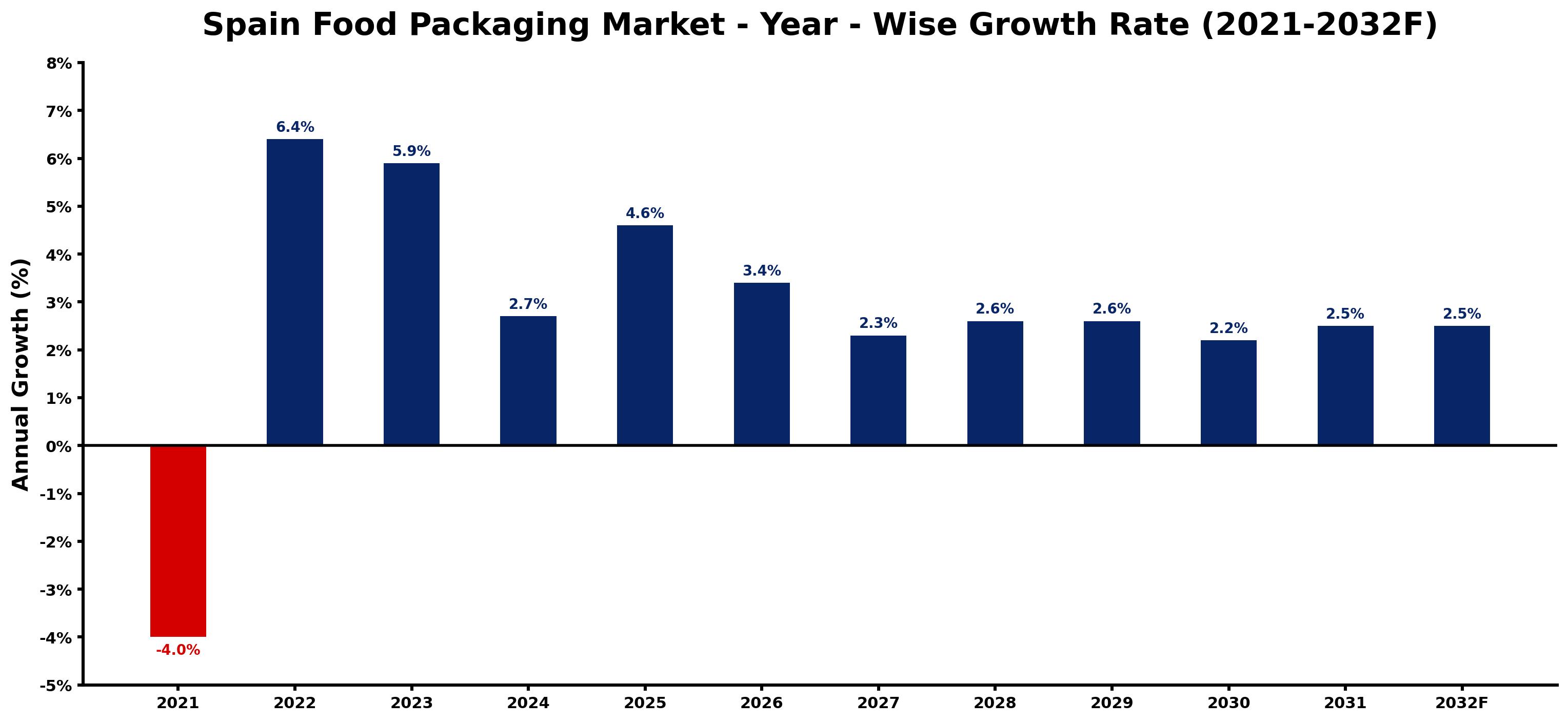
The table below presents the year wise growth rates along with the key drivers influencing the market
| Year | Growth Rate | Major Drivers |
| 2021 | -4.0% | Increased environmental regulations prompted manufacturers to seek costly compliance, stifling operational scalability and innovation. |
| 2022 | 6.4% | Sustainability concerns prompted a shift towards biodegradable packaging materials industry-wide. |
| 2023 | 5.9% | Consumer preferences increasingly favor eco-friendly options over traditional plastic packaging solutions. |
| 2024 | 2.7% | Technological innovations enhance packaging efficiency, reducing waste and production costs significantly. |
| 2025 | 4.6% | E-commerce expansion drives demand for secure, lightweight, and protective food packaging solutions. |
| 2026 | 3.4% | Rising health awareness leads to an uptick in demand for tamper-evident packaging types. |
| 2027 | 2.3% | Local producers leverage packaging trends to enhance product visibility on retail shelves. |
| 2028 | 2.6% | Competition pressures companies to invest in smart packaging technologies and traceability solutions. |
| 2029 | 2.6% | Collaborations between packaging suppliers and food manufacturers foster innovative product development initiatives. |
| 2030 | 2.2% | Consumer education campaigns highlight the importance of sustainable packaging in food safety. |
| 2031 | 2.5% | Economic recovery phases bolster disposable income, increasing premium food packaging demand. |
| 2032 | 2.5% | Advanced recycling technologies create closed-loop systems, enhancing sustainability across the packaging sector. |
Note - Market size estimations and growth projections presented in this report are based on 6Wresearch's advanced forecasting approach, validated with industry datasets as of June 2026.
Spain Food Packaging Market Synopsis
The Spain Food Packaging Market is projected to reach 3.4% and witness significant growth during the forecast period (2026-2032). This growth is primarily driven by a heightened demand for sustainable and convenient packaging solutions, as consumers increasingly seek to reduce food waste and enhance food preservation. As the industry adapts to evolving consumer preferences, there is a notable shift towards innovative materials and technologies that cater to environmentally conscious demands.
Spain Food Packaging Market Growth Drivers
Several key factors are propelling the Spain Food Packaging Market forward. Firstly, the growing consumer emphasis on sustainability is a major driver, with eco-friendly packaging gaining popularity. Secondly, the rise in online grocery shopping has increased the demand for packaging solutions that offer convenience and portability. Thirdly, regulatory pressures aimed at reducing plastic waste and encouraging recycling practices have prompted manufacturers to innovate their packaging techniques. Fourthly, advancements in packaging technologies, including smart packaging, are enhancing consumer engagement and product transparency. Lastly, the increasing demand for convenience foods has necessitated the development of packaging solutions that can meet the needs of busy lifestyles.
Spain Food Packaging Market Trends and Opportunities
The trends within the Spain Food Packaging Market reflect a broader shift towards sustainability and convenience. One significant trend is the implementation of sustainable packaging materials, such as biodegradable plastics and recyclable designs, responding to consumer demand for environmentally friendly options. Another noteworthy trend is the focus on convenience, with features like resealable packets and microwave-safe containers gaining traction. The personalization of packaging is also becoming prominent, as brands seek to differentiate themselves on store shelves. Furthermore, the integration of smart packaging technologies, including QR codes and freshness indicators, is expected to enhance consumer experiences by providing real-time information about products. Collectively, these trends present ample opportunities for innovation and growth in the sector.
Spain Food Packaging Market Challenges and Restraints
Despite the opportunities available, the Spain Food Packaging Market faces several challenges. One primary challenge is the increasing pressure to meet consumer expectations for sustainable packaging, which often requires significant investment in new materials and technologies. Stringent government regulations regarding packaging waste further complicate compliance efforts for manufacturers. Additionally, fluctuation in raw material costs can impact production budgets and pricing strategies, especially as local companies contend with competitive pricing pressures from international markets. The industry's shift towards convenience packaging formats also necessitates rapid adaptation to changing consumer behaviors, which can strain existing processes and systems. Addressing these challenges requires companies to strike a balance between innovation, sustainability, and cost-effectiveness.
Spain Food Packaging Market Government Investment and Initiatives
Government policies in Spain are increasingly focused on promoting sustainable practices within the food packaging sector. Recent initiatives aim to reduce plastic waste through stringent regulations that limit the use of single-use plastics. The Spanish government has enacted various laws to bolster recycling efforts and encourage the utilization of eco-friendly materials in packaging production. Investments are being made to enhance recycling infrastructure, ensuring that consumers are aware of and have access to sustainable packaging options. Additionally, public funds are being allocated to support research and innovation in biodegradable and compostable packaging technologies, fostering a more sustainable food packaging industry. These policies signify a commitment to creating a framework conducive to sustainable practices and responsible consumption.
Spain Food Packaging Market Latest Developments (May 2025 - June 2026)
Developments within the Spain Food Packaging Market from May 2025 to June 2026 reflect a strong emphasis on sustainability and consumer engagement. The industry has seen increased collaborations between research institutions and manufacturers, aiming to develop advanced materials that minimize environmental impact. There is a growing trend toward adopting digital technologies in packaging, enhancing traceability and transparency for consumers regarding product sourcing and sustainability practices. Furthermore, the launch of several initiatives to educate consumers on recycling practices has heightened awareness and participation in sustainable packaging programs. Companies have also begun to explore new business models that incorporate circular economy principles, showcasing a commitment to long-term sustainability in packaging design.
Spain Food Packaging Market Future Outlook
The Spain Food Packaging Market is projected to continue its upward trajectory through 2032, driven by an ongoing demand for innovative, sustainable, and convenient packaging solutions. The rise of online food delivery services and heightened consumer awareness regarding food safety and hygiene are expected to further fuel market growth. As companies invest in developing packaging solutions that not only extend product shelf life but also align with environmental goals, the emphasis on sustainable practices will shape the industry's landscape. Regulatory frameworks aimed at promoting eco-friendly materials will likely accelerate the transition towards recyclable and biodegradable packaging options. Overall, the market's future is characterized by a clear commitment to sustainability and convenience, positioning it for substantial growth.
Spain Food Packaging Market - Key Attractiveness of the Report
- 10 Years of Market Numbers
- Historical Data Starting from 2022 to 2025
- Base Year: 2025
- Forecast Data until 2032
- Key Performance Indicators Impacting the Market
- Major Upcoming Developments and Projects
Key Highlights of the Report:
- Spain Food Packaging Market Outlook
- Market Size of Spain Food Packaging Market, 2025
- Forecast of Spain Food Packaging Market, 2032F
- Historical Data and Forecast of Spain Food Packaging Revenues & Volume for the Period 2022-2032F
- Spain Food Packaging Market Trend Evolution
- Spain Food Packaging Market Drivers and Challenges
- Spain Food Packaging Price Trends
- Spain Food Packaging Porter's Five Forces
- Spain Food Packaging Industry Life Cycle
- Historical Data and Forecast of Spain Food Packaging Market Revenues & Volume By Material Types for the Period 2022-2032F
- Historical Data and Forecast of Spain Food Packaging Market Revenues & Volume By Paper & board for the Period 2022-2032F
- Historical Data and Forecast of Spain Food Packaging Market Revenues & Volume By Plastic for the Period 2022-2032F
- Historical Data and Forecast of Spain Food Packaging Market Revenues & Volume By Metal for the Period 2022-2032F
- Historical Data and Forecast of Spain Food Packaging Market Revenues & Volume By Glass for the Period 2022-2032F
- Historical Data and Forecast of Spain Food Packaging Market Revenues & Volume By Others for the Period 2022-2032F
- Historical Data and Forecast of Spain Food Packaging Market Revenues & Volume By Product Types for the Period 2022-2032F
- Historical Data and Forecast of Spain Food Packaging Market Revenues & Volume By Rigid for the Period 2022-2032F
- Historical Data and Forecast of Spain Food Packaging Market Revenues & Volume By Semi-Rigid for the Period 2022-2032F
- Historical Data and Forecast of Spain Food Packaging Market Revenues & Volume By Flexible for the Period 2022-2032F
- Historical Data and Forecast of Spain Food Packaging Market Revenues & Volume By Applications for the Period 2022-2032F
- Historical Data and Forecast of Spain Food Packaging Market Revenues & Volume By Bakery & Confectionary for the Period 2022-2032F
- Historical Data and Forecast of Spain Food Packaging Market Revenues & Volume By Dairy Products for the Period 2022-2032F
- Historical Data and Forecast of Spain Food Packaging Market Revenues & Volume By Fruits & Vegetables for the Period 2022-2032F
- Historical Data and Forecast of Spain Food Packaging Market Revenues & Volume By Meat, Poultry, & Seafood for the Period 2022-2032F
- Historical Data and Forecast of Spain Food Packaging Market Revenues & Volume By Sauces & Dressings for the Period 2022-2032F
- Historical Data and Forecast of Spain Food Packaging Market Revenues & Volume By Others for the Period 2022-2032F
- Spain Food Packaging Import Export Trade Statistics
- Market Opportunity Assessment By Material Types
- Market Opportunity Assessment By Product Types
- Market Opportunity Assessment By Applications
- Spain Food Packaging Top Companies Market Share
- Spain Food Packaging Competitive Benchmarking By Technical and Operational Parameters
- Spain Food Packaging Company Profiles
- Spain Food Packaging Key Strategic Recommendations






































