Spain Metal Recycling Market Summary
The spain metal recycling market was estimated at USD 171 Million in 2025 and is projected to reach USD 203 Million by 2032, growing at a CAGR of 3.3% from 2026 to 2032.
Spain Metal Recycling Market Year-wise Growth Rate and Key Drivers
This graph highlights how the Spain Metal Recycling Market has steadily grown over the past five years, supported by major growth factors.
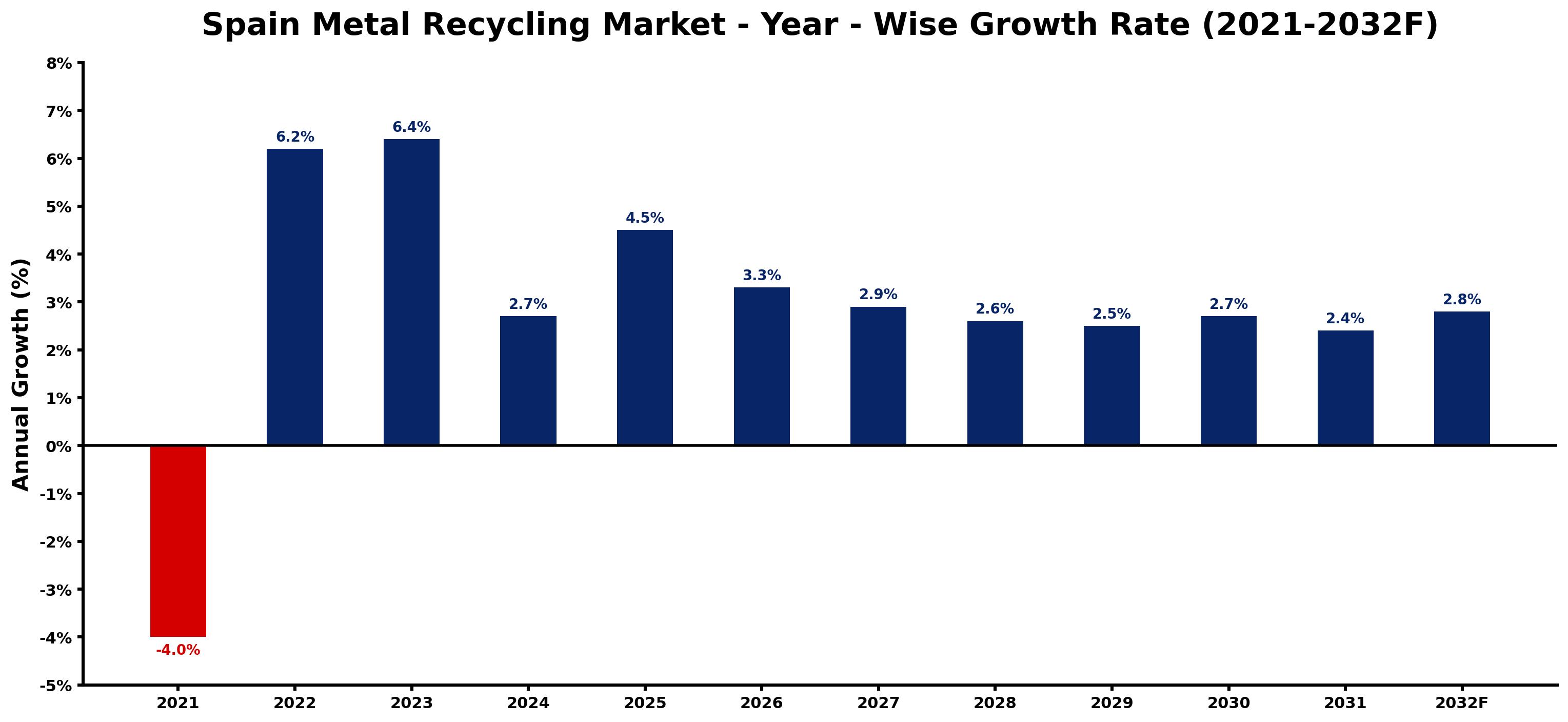
The table below presents the year wise growth rates along with the key drivers influencing the market
| Year | Growth Rate | Major Drivers |
| 2021 | -4.0% | Decreased industrial output amid economic uncertainties led to diminished scrap metal availability for recycling. |
| 2022 | 6.2% | Local municipalities increasingly focused on implementing efficient recycling programs for metals. |
| 2023 | 6.4% | Consumer awareness around sustainability prompted businesses to adopt eco-friendly practices. |
| 2024 | 2.7% | Investment in technology to streamline metal sorting processes gained significant traction among firms. |
| 2025 | 4.5% | Corporate responsibility initiatives reshaped operational strategies towards enhanced recycling efforts. |
| 2026 | 3.3% | Partnerships between private sectors and municipalities emerged to optimize recycling operations significantly. |
| 2027 | 2.9% | International trade agreements facilitated easier export of recycled metals to other economies. |
| 2028 | 2.6% | Technological innovations improved the quality and yield of recycled metal products consistently. |
| 2029 | 2.5% | Urbanization trends in Spain increased the volume of metals available for recycling. |
| 2030 | 2.7% | Pressure from environmental organizations drove companies to publish comprehensive recycling reports. |
| 2031 | 2.4% | Advanced analytics enabled better forecasting of metal recycling trends and consumer behavior. |
| 2032 | 2.8% | Circular economy principles fully integrated into national policies, reinforcing metal recycling's importance. |
Note - Market size estimations and growth projections presented in this report are based on 6Wresearch's advanced forecasting approach, validated with industry datasets as of June 2026.
Spain Metal Recycling Market Synopsis
The Spain Metal Recycling Market is projected to reach 3.3% and witness significant growth during the forecast period (2026-2032). This burgeoning sector is underpinned by an increasing societal focus on sustainability and resource conservation. The recycling of key metals such as steel, aluminum, and copper is not only instrumental in minimizing environmental footprints but also plays a vital role in advancing the circular economy. Furthermore, the market is shaped by stringent regulations surrounding waste management and a marked increase in demand for recycled materials across manufacturing and construction industries.
Spain Metal Recycling Market Growth Drivers
Several factors are catalyzing the growth of the Spain Metal Recycling Market. These include:
- Increased emphasis on sustainable practices as industries and consumers become more environmentally conscious.
- Government initiatives and regulations designed to promote recycling, which provide both direct and indirect support for recycling operations.
- Rising prices of raw materials, creating a more favorable economic environment for the recycling of metals.
- Growing awareness among consumers about the benefits of using recycled materials, leading to higher demand in various sectors.
- Technological advancements in recycling processes, enhancing efficiency and profitability in recycling operations.
Spain Metal Recycling Market Challenges and Restraints
Despite its promising outlook, the Spain Metal Recycling Market faces several challenges that could hinder its growth. These challenges include:
- Fluctuating prices of scrap metal, which create uncertainty and impact the profitability of recycling enterprises.
- High operational costs associated with the collection, sorting, and processing of scrap metal, which may deter investment in recycling infrastructure.
- Intense competition from low-cost imports of raw metals, affecting the market demand for recycled alternatives.
- Stringent environmental regulations governing recycling operations, which increase operational complexity and compliance costs.
- Insufficient public awareness and infrastructure for recycling in certain regions, limiting the overall effectiveness of recycling initiatives.
Spain Metal Recycling Market Government Investment and Initiatives
Government policies play a crucial role in shaping the Spain Metal Recycling Market. Various initiatives are aimed at enhancing recycling efforts through financial support and regulatory frameworks. Key areas of government involvement include:
- Investment in recycling infrastructure to enhance collection and processing capabilities across the nation.
- Development of legislation promoting sustainable waste management practices and circular economy principles.
- Incentives for businesses that utilize recycled materials in their operations, encouraging a shift towards more sustainable production methods.
- Public awareness campaigns designed to educate citizens about the importance of recycling and proper waste management.
- Collaboration with industry stakeholders to create a cohesive strategy that promotes recycling activities at all levels.
Spain Metal Recycling Market Latest Developments (May 2025 - June 2026)
Recent developments in the metal recycling sector in Spain indicate a continued commitment to sustainability and innovation. Key trends observed in this period include:
- Enhanced regulatory frameworks that further incentivize recycling activities, leading to increased participation from both businesses and consumers.
- Technological advancements in recycling operations, focusing on efficiency and the reduction of environmental impacts.
- Collaborative efforts among governmental organizations and private sectors to address the rising challenges posed by fluctuating raw material prices.
- Expansion of recycling networks, facilitating easier access for consumers and enhancing overall recycling rates across various regions.
- Growing investment in research and development aimed at improving recycling technologies and processes, leading to better resource recovery rates.
Spain Metal Recycling Market - Key Attractiveness of the Report
- 10 Years of Market Numbers
- Historical Data Starting from 2022 to 2025
- Base Year: 2025
- Forecast Data until 2032
- Key Performance Indicators Impacting the Market
- Major Upcoming Developments and Projects
Key Highlights of the Report:
- Spain Metal Recycling Market Outlook
- Market Size of Spain Metal Recycling Market, 2025
- Forecast of Spain Metal Recycling Market, 2032
- Historical Data and Forecast of Spain Metal Recycling Revenues & Volume for the Period 2022-2032F
- Spain Metal Recycling Market Trend Evolution
- Spain Metal Recycling Market Drivers and Challenges
- Spain Metal Recycling Price Trends
- Spain Metal Recycling Porter's Five Forces
- Spain Metal Recycling Industry Life Cycle
- Historical Data and Forecast of Spain Metal Recycling Market Revenues & Volume By Metal Type for the Period 2022-2032F
- Historical Data and Forecast of Spain Metal Recycling Market Revenues & Volume By Ferrous Metal for the Period 2022-2032F
- Historical Data and Forecast of Spain Metal Recycling Market Revenues & Volume By Non-ferrous Metal for the Period 2022-2032F
- Historical Data and Forecast of Spain Metal Recycling Market Revenues & Volume By Scrap Types for the Period 2022-2032F
- Historical Data and Forecast of Spain Metal Recycling Market Revenues & Volume By Old Scrap for the Period 2022-2032F
- Historical Data and Forecast of Spain Metal Recycling Market Revenues & Volume By New Scrap for the Period 2022-2032F
- Historical Data and Forecast of Spain Metal Recycling Market Revenues & Volume By Equipment Types for the Period 2022-2032F
- Historical Data and Forecast of Spain Metal Recycling Market Revenues & Volume By Shears for the Period 2022-2032F
- Historical Data and Forecast of Spain Metal Recycling Market Revenues & Volume By Shredders for the Period 2022-2032F
- Historical Data and Forecast of Spain Metal Recycling Market Revenues & Volume By Briquette Machines for the Period 2022-2032F
- Historical Data and Forecast of Spain Metal Recycling Market Revenues & Volume By Granulating Machines for the Period 2022-2032F
- Historical Data and Forecast of Spain Metal Recycling Market Revenues & Volume By Others for the Period 2022-2032F
- Historical Data and Forecast of Spain Metal Recycling Market Revenues & Volume By End-users for the Period 2022-2032F
- Historical Data and Forecast of Spain Metal Recycling Market Revenues & Volume By Building & Construction for the Period 2022-2032F
- Historical Data and Forecast of Spain Metal Recycling Market Revenues & Volume By Packaging for the Period 2022-2032F
- Historical Data and Forecast of Spain Metal Recycling Market Revenues & Volume By Automotive for the Period 2022-2032F
- Historical Data and Forecast of Spain Metal Recycling Market Revenues & Volume By Industrial Machinery for the Period 2022-2032F
- Historical Data and Forecast of Spain Metal Recycling Market Revenues & Volume By Electronics & Electrical Equipment for the Period 2022-2032F
- Historical Data and Forecast of Spain Metal Recycling Market Revenues & Volume By Shipbuilding for the Period 2022-2032F
- Historical Data and Forecast of Spain Metal Recycling Market Revenues & Volume By Others for the Period 2022-2032F
- Spain Metal Recycling Import Export Trade Statistics
- Market Opportunity Assessment By Metal Type
- Market Opportunity Assessment By Scrap Types
- Market Opportunity Assessment By Equipment Types
- Market Opportunity Assessment By End-users
- Spain Metal Recycling Top Companies Market Share
- Spain Metal Recycling Competitive Benchmarking By Technical and Operational Parameters
- Spain Metal Recycling Company Profiles
- Spain Metal Recycling Key Strategic Recommendations






































