Spain Precast Concrete Market Size (2020-2030)
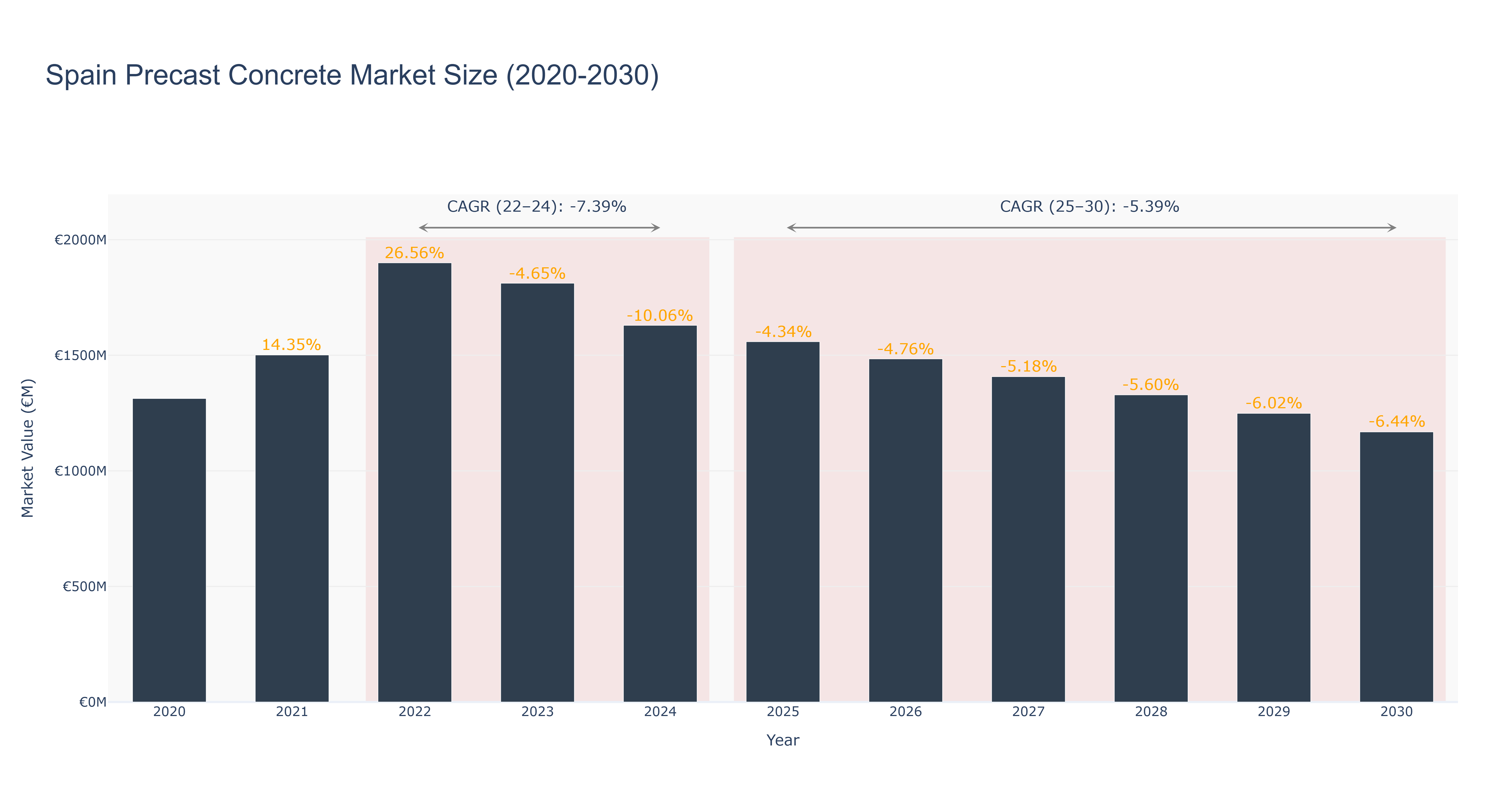
Spain Precast Concrete Market has shown a declining trend over the past decade. The market peaked at €1899.89 million in 2022 before experiencing a steady decrease in size. Actual market size decreased to €1629.33 million in 2024, with a negative CAGR of -7.39% during 2022-2024. Forecasted market size is expected to continue decreasing, reaching €1168.23 million in 2030, with a CAGR of -5.39% from 2025 to 2030. The decline in market size can be attributed to factors such as economic downturns, reduced construction activity, and changing consumer preferences towards alternative building materials. Looking ahead, Spain is set to witness increased investment in sustainable construction practices, with a focus on eco-friendly precast concrete solutions to align with environmental regulations and meet growing demand for green buildings.
Spain Precast Concrete Market: Production & Trade Performance (2019-2025)
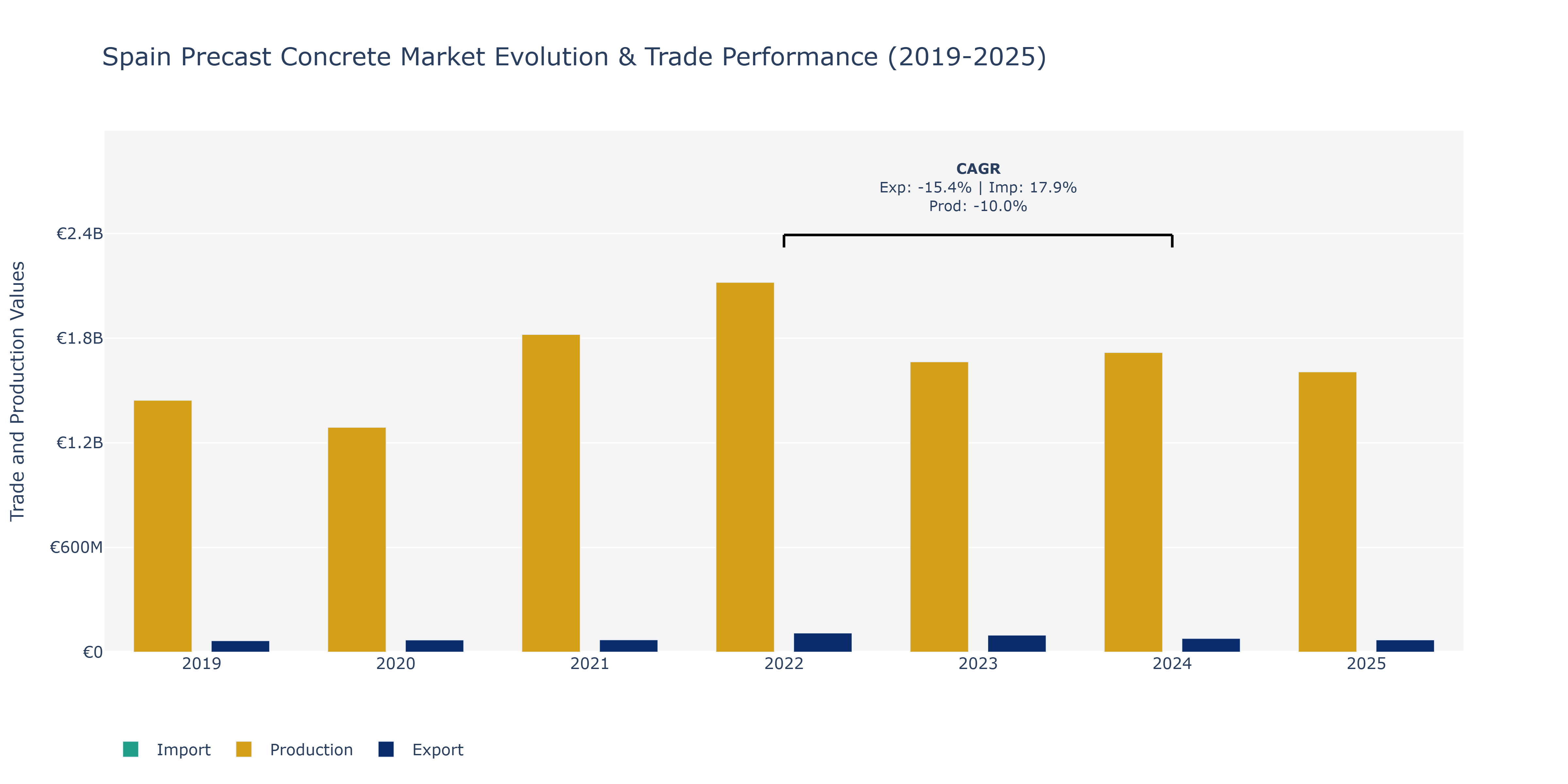
In the Spain Precast Concrete Market, exports experienced fluctuations over the years, reaching a peak in 2022 at approximately €108.56 million before decreasing in the following years. Imports, on the other hand, saw a steady increase from 2019 to 2025, culminating in around €25.37 million. Production levels were highest in 2022, valued at around €2.12 billion, before declining consistently to about €1.61 billion in 2025. The fluctuations in exports could be attributed to global economic conditions affecting demand for precast concrete products. Increasing imports may indicate a growing need for specific raw materials or technologies not readily available domestically. The decline in production could be a result of market saturation or shifts towards more sustainable construction practices. To capitalize on the rising import demand, local manufacturers may need to explore partnerships for technology transfer or invest in research to enhance product offerings and quality.
Spain Precast Concrete Market Synopsis
The Spain precast concrete market is experiencing steady growth driven by factors such as increasing construction activities in residential, commercial, and infrastructure sectors. The demand for precast concrete products like beams, columns, slabs, and walls is rising due to benefits such as faster construction, cost-effectiveness, and improved quality control. Key players in the market are focusing on product innovation, technological advancements, and sustainability to stay competitive. Government initiatives promoting green building practices and infrastructure development projects further contribute to market growth. The market is characterized by intense competition, with companies investing in expanding their production capacity and distribution networks to cater to the growing demand. Overall, the Spain precast concrete market is poised for continued expansion in the coming years.
Spain Precast Concrete Market Trends
In the Spain precast concrete market, several key trends are emerging. One significant trend is the increasing demand for sustainable and eco-friendly building materials, leading to a rise in the use of precast concrete due to its durability and energy efficiency. Another trend is the growing adoption of advanced technologies such as Building Information Modeling (BIM) and automated production processes, which enhance efficiency and precision in precast concrete manufacturing. Additionally, there is a rising focus on innovation and customization in precast concrete products to meet the diverse design requirements of construction projects. Overall, these trends indicate a shift towards more sustainable practices, technological advancements, and tailored solutions in the Spain precast concrete market.
Spain Precast Concrete Market Challenges
In the Spain Precast Concrete Market, challenges such as increasing competition from traditional construction methods, fluctuating raw material prices, and stringent regulatory requirements pose significant hurdles for market players. Additionally, the market is impacted by factors like economic instability, labor shortages, and the need for continuous innovation to meet evolving customer demands. To remain competitive and sustainable in this market, companies need to invest in technology, streamline production processes, enhance product quality, and adapt to changing market trends. Overall, navigating these challenges requires a strategic approach, strong industry knowledge, and a proactive mindset to capitalize on opportunities for growth and success in the Spain Precast Concrete Market.
Spain Precast Concrete Market Investment Opportunities
The Spain Precast Concrete Market presents lucrative investment opportunities due to the growing construction industry in the country. With increasing urbanization and infrastructure development projects, there is a rising demand for precast concrete products such as beams, columns, walls, and slabs. Investing in precast concrete manufacturing companies or construction projects utilizing precast concrete can be profitable. Additionally, the adoption of advanced technologies in precast concrete production, such as 3D printing and automation, offers further growth potential in the market. As sustainability and efficiency become key priorities in the construction sector, precast concrete, known for its durability, cost-effectiveness, and environmental benefits, is expected to witness continued demand, making it an attractive investment opportunity in Spain.
Jordan Agar Market Government Policies
The Spanish government has implemented various policies to regulate the precast concrete market. These policies focus on ensuring quality and safety standards, environmental sustainability, and promoting innovation within the sector. The government has established building codes and standards that precast concrete manufacturers must adhere to, in order to guarantee the structural integrity of buildings and infrastructure projects. Additionally, there are regulations in place to reduce the environmental impact of precast concrete production, such as promoting the use of recycled materials and energy-efficient practices. The government also supports research and development initiatives to drive technological advancements and improve the competitiveness of the precast concrete industry in Spain.
Spain Precast Concrete Market Future Outlook
The future outlook for the Spain Precast Concrete Market appears promising, driven by increasing urbanization, infrastructure development projects, and the growing trend towards sustainable construction practices. The demand for precast concrete products is expected to rise due to their advantages in terms of cost-efficiency, durability, and faster construction times. Additionally, the Spanish government`s focus on boosting investments in transportation, residential, and commercial construction sectors is likely to further fuel the market growth. Innovations in precast concrete technology, such as the development of lightweight and high-strength materials, are anticipated to enhance market opportunities. Overall, the Spain Precast Concrete Market is forecasted to experience steady growth in the coming years, presenting opportunities for market players to capitalize on the evolving construction landscape.
Key Highlights of the Report:
- Spain Precast Concrete Market Outlook
- Market Size of Spain Precast Concrete Market, 2021
- Forecast of Spain Precast Concrete Market, 2031
- Historical Data and Forecast of Spain Precast Concrete Revenues & Volume for the Period 2018 - 2031
- Spain Precast Concrete Market Trend Evolution
- Spain Precast Concrete Market Drivers and Challenges
- Spain Precast Concrete Price Trends
- Spain Precast Concrete Porter's Five Forces
- Spain Precast Concrete Industry Life Cycle
- Historical Data and Forecast of Spain Precast Concrete Market Revenues & Volume By Product for the Period 2018 - 2031
- Historical Data and Forecast of Spain Precast Concrete Market Revenues & Volume By Structural Building Components for the Period 2018 - 2031
- Historical Data and Forecast of Spain Precast Concrete Market Revenues & Volume By Architectural Building Components for the Period 2018 - 2031
- Historical Data and Forecast of Spain Precast Concrete Market Revenues & Volume By Transportation Products for the Period 2018 - 2031
- Historical Data and Forecast of Spain Precast Concrete Market Revenues & Volume By Water & Waste Handling Products for the Period 2018 - 2031
- Historical Data and Forecast of Spain Precast Concrete Market Revenues & Volume By Others for the Period 2018 - 2031
- Historical Data and Forecast of Spain Precast Concrete Market Revenues & Volume By End-use for the Period 2018 - 2031
- Historical Data and Forecast of Spain Precast Concrete Market Revenues & Volume By Residential for the Period 2018 - 2031
- Historical Data and Forecast of Spain Precast Concrete Market Revenues & Volume By Non-residential for the Period 2018 - 2031
- Historical Data and Forecast of Spain Precast Concrete Market Revenues & Volume By Infrastructure for the Period 2018 - 2031
- Spain Precast Concrete Import Export Trade Statistics
- Market Opportunity Assessment By Product
- Market Opportunity Assessment By End-use
- Spain Precast Concrete Top Companies Market Share
- Spain Precast Concrete Competitive Benchmarking By Technical and Operational Parameters
- Spain Precast Concrete Company Profiles
- Spain Precast Concrete Key Strategic Recommendations






































