Sri Lanka 5G NTN Market Size, Share & Growth Rate
The Sri Lanka 5G NTN Market was estimated at USD 457 Million in 2025 and is projected to reach USD 627 Million by 2032, growing at a CAGR of 4.6% from 2026 to 2032. This growth is largely driven by the country's urgent need for enhanced connectivity, particularly in remote regions where traditional networks have faltered. Furthermore, increasing governmental support for digital infrastructure and the escalating adoption of IoT applications across various sectors are contributing to the market's robust trajectory.
Sri Lanka 5G NTN Market Year-wise Growth Rate and Key Drivers
This graph highlights how the Sri Lanka 5G NTN Market has steadily grown over the years, supported by major growth factors.
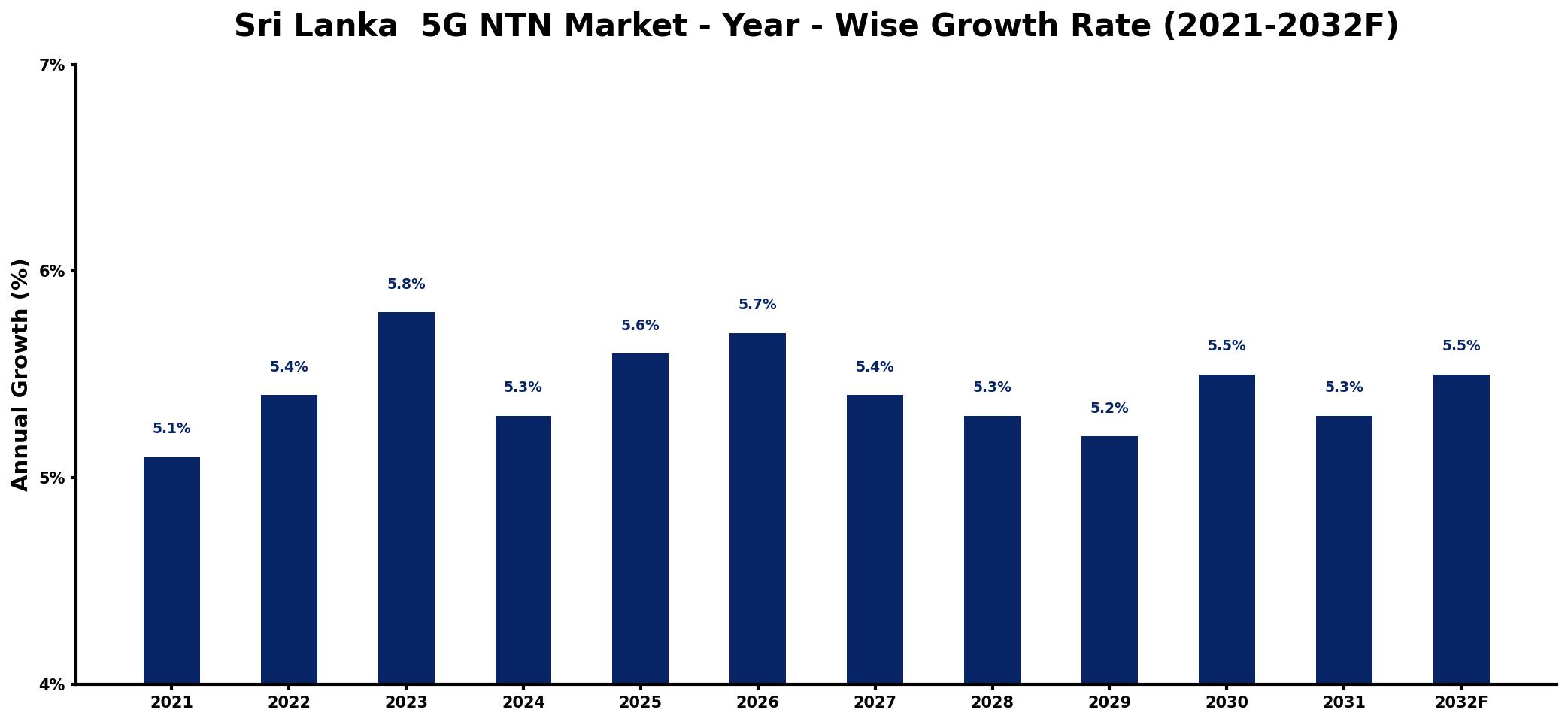
The table below presents the year‑wise growth rates along with the key drivers influencing the market
| Year | Growth Rate | Major Drivers |
| 2021 | 5.1% | increased investment in infrastructure |
| 2022 | 5.4% | growing demand for connectivity solutions |
| 2023 | 5.8% | expansion of digital services market |
| 2024 | 5.3% | rising adoption of smart technologies |
| 2025 | 5.6% | enhanced mobile data consumption trends |
| 2026 | 5.7% | growing interest in IoT applications |
| 2027 | 5.4% | improvement in telecom regulatory environment |
| 2028 | 5.3% | increased focus on urban connectivity |
| 2029 | 5.2% | rising end-use demand growth |
| 2030 | 5.5% | increased production capacity utilization |
| 2031 | 5.3% | increase in digital transformation initiatives |
| 2032 | 5.5% | rising procurement volume requirements |
Note: Market size estimations and growth projections presented in this report are based on 6Wresearch's proprietary forecasting methodology, utilizing the latest available industry data, government publications, and primary research inputs.
Sri Lanka 5G NTN Market Synopsis
The Sri Lanka 5G NTN market is emerging as a pivotal component in the nation's telecommunications landscape. With a focus on bridging the digital divide, this sector aims to deliver high-speed connectivity, especially to underserved and remote communities, enhancing overall accessibility to digital services.
As telecommunications companies ramp up investments in 5G NTN technologies, the landscape is evolving rapidly. Enhanced connectivity opens doors for innovative applications, including autonomous vehicles and IoT, fueling demand for next-generation communication solutions across various industries.
Sri Lanka 5G NTN Market Key Takeaways
- The market is poised for significant expansion, with investments from both government and private sectors.
- Innovative services leveraging 5G NTN technology are on the rise, promising to enhance user experiences.
- Emerging applications in healthcare, manufacturing, and entertainment sectors are driving demand for robust connectivity.
- Government policies are increasingly supportive of infrastructure development and public-private partnerships.
- Overcoming initial infrastructure investment barriers will be crucial for market growth.
Evaluation of Restraints in Sri Lanka 5G NTN Market
Despite the promising outlook, the Sri Lanka 5G NTN market faces significant barriers that could impede its growth. One of the primary challenges is the high initial investment required for deploying and maintaining non-terrestrial network infrastructure, which may deter smaller companies from entering the market. Regulatory hurdles also add a layer of complexity, as compliance with local laws and licensing issues can slow down progress. Additionally, the susceptibility of satellite signals to environmental factors raises concerns over reliability and performance, especially in adverse weather conditions. Addressing these challenges will be vital for ensuring the successful adoption of 5G NTN technologies.
Sri Lanka 5G NTN Market Trends
The Sri Lanka 5G NTN market is witnessing several key trends that are shaping its evolution. There is an increasing demand for seamless, high-speed internet connectivity among consumers and businesses alike, particularly as remote work and digital services become more prevalent. The integration of IoT devices across various industries further amplifies this demand, as businesses strive to enhance operational efficiency. In parallel, streaming services and immersive media are gaining traction, which drives the need for lower latency and higher bandwidth. Such trends indicate a significant shift in the digital landscape, laying a strong foundation for the 5G NTN market.
Sri Lanka 5G NTN Market Opportunities
The Sri Lanka 5G NTN market is replete with opportunities for investors and technology providers. With the ongoing shift towards digital connectivity, there is a robust need for infrastructure development in satellite communication and high-altitude platforms, essential for complementing traditional terrestrial networks. Investors can explore partnerships with telecom operators and government initiatives to foster infrastructure expansion. Additionally, businesses that offer innovative services leveraging non-terrestrial networks stand to benefit significantly, as they can fill existing service gaps and cater to the burgeoning demand for reliable connectivity.
Government Initiatives in the Sri Lanka 5G NTN Market
The Sri Lankan government is actively facilitating the development of the 5G NTN market through a series of supportive policies and initiatives. The Telecommunications Regulatory Commission of Sri Lanka (TRCSL) is involved in allocating spectrum for 5G deployment, promoting robust infrastructure development, and ensuring adherence to international standards. Furthermore, the government emphasizes public-private partnerships as a means to spur innovation and investment. A national policy framework seeks to foster a competitive environment, encouraging advancements in telecommunications while promoting digital inclusion across the island.
Future Insights of the Sri Lanka 5G NTN Market
Looking ahead to 2026-2032, the Sri Lanka 5G NTN market is expected to experience substantial growth driven by increased demand for advanced connectivity solutions. As the deployment of non-terrestrial networks expands, these technologies will play a crucial role in reaching remote areas, ensuring that all citizens have access to reliable communication services. Continued investment in satellite communication and high-altitude platform technology will enhance overall network capabilities, while advancements in IoT applications will further drive market expansion. Collectively, these developments are anticipated to transform Sri Lankas digital landscape significantly.
Sri Lanka 5G NTN Market Latest Developments (2025 - 2026)
Recent developments in the Sri Lanka 5G NTN market indicate an increasing pace of investment and deployment activities. Telecommunications companies are collaborating with technology providers to enhance infrastructure and extend 5G coverage. Innovations in satellite communication technologies are emerging, reflecting a global trend towards more reliable and expansive network solutions. Additionally, governmental support continues to play a crucial role in creating a conducive environment for market growth, signaling a robust trajectory for the sector in the coming years.
Sri Lanka 5G NTN Market - Key Attractiveness of the Report
- 10 Years of Market Numbers
- Historical Data Starting from 2022 to 2025
- Base Year: 2025
- Forecast Data until 2032
- Key Performance Indicators Impacting the Market
- Major Upcoming Developments and Projects
Key Highlights of the Report:
- Sri Lanka 5G NTN Market Outlook
- Market Size of Sri Lanka 5G NTN Market, 2025
- Forecast of Sri Lanka 5G NTN Market, 2032
- Historical Data and Forecast of Sri Lanka 5G NTN Revenues & Volume for the Period 2022-2032F
- Sri Lanka 5G NTN Market Trend Evolution
- Sri Lanka 5G NTN Market Drivers and Challenges
- Sri Lanka 5G NTN Price Trends
- Sri Lanka 5G NTN Porter's Five Forces
- Sri Lanka 5G NTN Industry Life Cycle
- Historical Data and Forecast of Sri Lanka 5G NTN Market Revenues & Volume By Component for the Period 2022-2032F
- Historical Data and Forecast of Sri Lanka 5G NTN Market Revenues & Volume By Hardware for the Period 2022-2032F
- Historical Data and Forecast of Sri Lanka 5G NTN Market Revenues & Volume By Solutions for the Period 2022-2032F
- Historical Data and Forecast of Sri Lanka 5G NTN Market Revenues & Volume By Services for the Period 2022-2032F
- Historical Data and Forecast of Sri Lanka 5G NTN Market Revenues & Volume By End-Use Industry for the Period 2022-2032F
- Historical Data and Forecast of Sri Lanka 5G NTN Market Revenues & Volume By Maritime for the Period 2022-2032F
- Historical Data and Forecast of Sri Lanka 5G NTN Market Revenues & Volume By Aerospace for the Period 2022-2032F
- Historical Data and Forecast of Sri Lanka 5G NTN Market Revenues & Volume By Defense for the Period 2022-2032F
- Historical Data and Forecast of Sri Lanka 5G NTN Market Revenues & Volume By Government for the Period 2022-2032F
- Historical Data and Forecast of Sri Lanka 5G NTN Market Revenues & Volume By Mining for the Period 2022-2032F
- Historical Data and Forecast of Sri Lanka 5G NTN Market Revenues & Volume By Application for the Period 2022-2032F
- Historical Data and Forecast of Sri Lanka 5G NTN Market Revenues & Volume By EMBB for the Period 2022-2032F
- Historical Data and Forecast of Sri Lanka 5G NTN Market Revenues & Volume By URLLC for the Period 2022-2032F
- Historical Data and Forecast of Sri Lanka 5G NTN Market Revenues & Volume By MMTC for the Period 2022-2032F
- Sri Lanka 5G NTN Import Export Trade Statistics
- Market Opportunity Assessment By Component
- Market Opportunity Assessment By End-Use Industry
- Market Opportunity Assessment By Application
- Sri Lanka 5G NTN Top Companies Market Share
- Sri Lanka 5G NTN Competitive Benchmarking By Technical and Operational Parameters
- Sri Lanka 5G NTN Company Profiles
- Sri Lanka 5G NTN Key Strategic Recommendations






































