Sri Lanka Anthracite Market: Import Trend Analysis
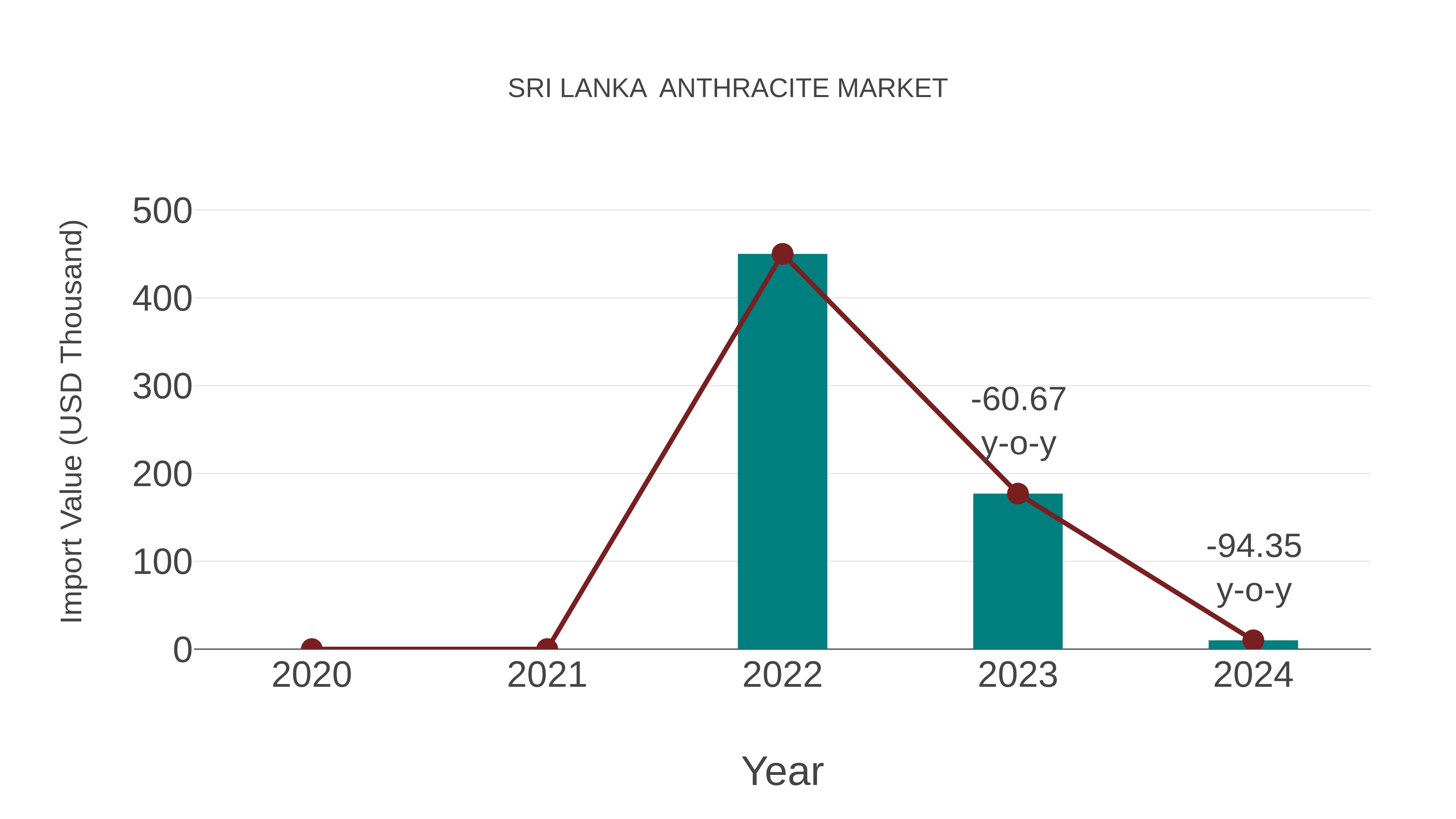
Sri Lanka import trend for anthracite in 2023-2024 experienced a significant decline of -94.35%, with a compound annual growth rate (CAGR) of -85.09% from 2020-2024. This sharp decrease could be attributed to shifts in demand or changes in trade policies impacting the market.
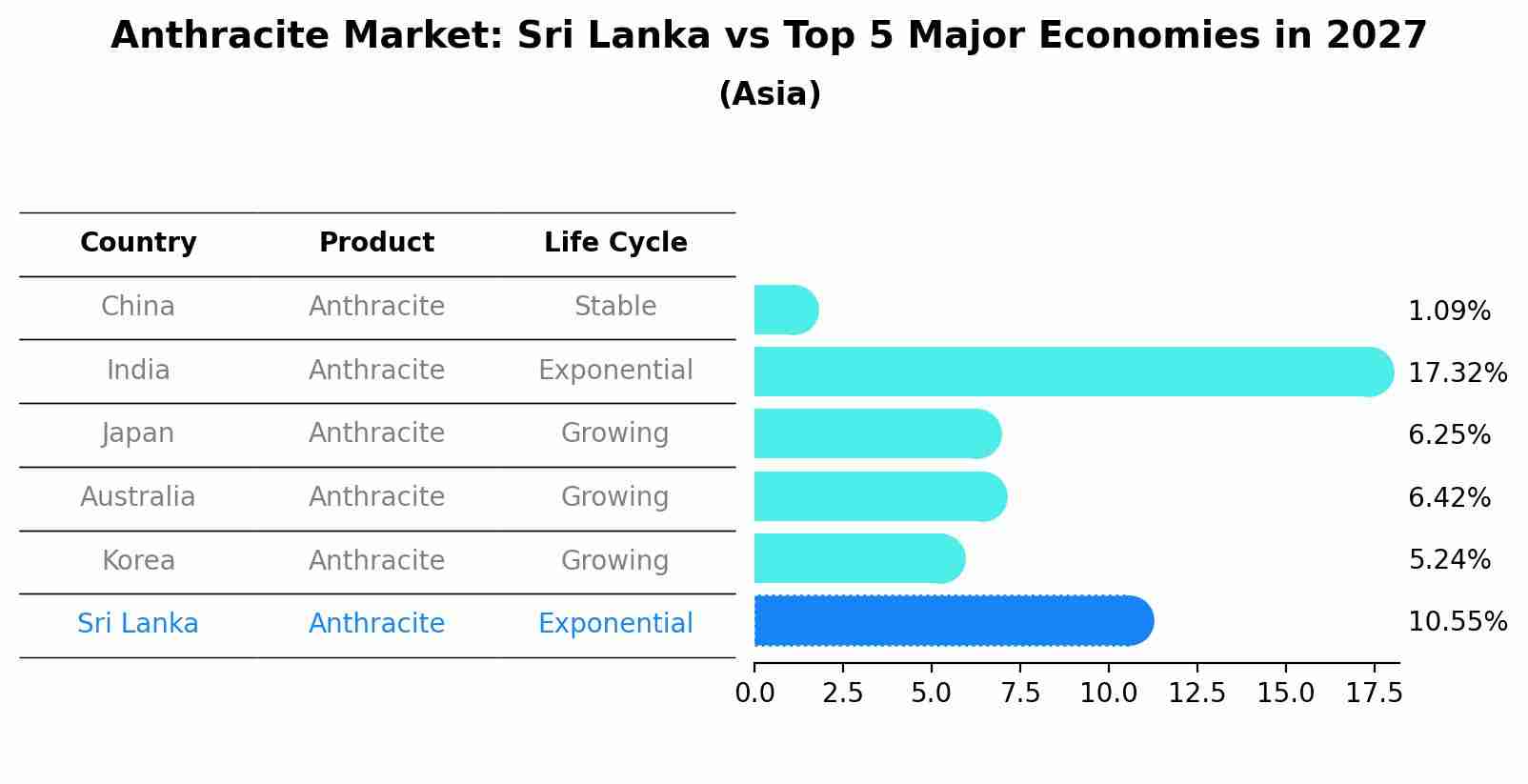
Anthracite Market: Sri Lanka vs Top 5 Major Economies in 2027 (Asia)
Sri Lanka's Anthracite market is anticipated to experience a high growth rate of 10.55% by 2027, reflecting trends observed in the largest economy China, followed by India, Japan, Australia and South Korea.
Sri Lanka Anthracite Market Overview
The Sri Lanka anthracite market is experiencing steady growth driven by increasing demand from various industries such as steel, cement, and power generation. Anthracite, known for its high carbon content and low volatile matter, is preferred for its efficiency and cost-effectiveness in these sectors. The market is primarily supplied by imports from countries like Vietnam, Russia, and China. Key players in the Sri Lanka anthracite market include both international and domestic suppliers, with a focus on quality standards and sustainable sourcing practices. The market is expected to continue growing due to ongoing industrial development projects in the country, coupled with the increasing emphasis on cleaner energy sources. However, challenges such as fluctuating prices and environmental concerns related to anthracite usage may impact market dynamics in the near future.
Sri Lanka Anthracite Market Trends
The Sri Lanka Anthracite Market is currently experiencing growth due to the increasing demand for high-quality anthracite coal in industries such as steel, cement, and power generation. Anthracite is being favored for its superior qualities such as high carbon content, low sulfur content, and high energy efficiency, making it an attractive option for various industrial applications. The market is also witnessing investments in infrastructure development and industrial projects, further driving the demand for anthracite in the country. Additionally, the government`s focus on promoting clean energy sources and reducing reliance on traditional coal is expected to propel the growth of the anthracite market in Sri Lanka in the coming years.
Sri Lanka Anthracite Market Challenges
In the Sri Lanka Anthracite Market, some of the key challenges include limited domestic production capacity, leading to a heavy reliance on imports which can be affected by global market dynamics and price fluctuations. Infrastructure constraints in terms of transportation and logistics also pose challenges in the efficient distribution of anthracite within the country. Additionally, the lack of widespread awareness and understanding of the benefits of anthracite compared to other types of coal or fuel sources hinders its adoption in various industries. Regulatory uncertainties and policies related to environmental concerns and sustainability further impact the market dynamics. Overall, addressing these challenges through investments in infrastructure, education, and policy frameworks will be crucial for the sustainable growth of the anthracite market in Sri Lanka.
Sri Lanka Anthracite Market Investment Opportunities
Investment opportunities in the Sri Lanka Anthracite Market are promising due to the growing demand for high-quality anthracite coal in various industries such as steel, cement, and power generation. Anthracite is valued for its high carbon content, low volatile matter, and superior energy efficiency compared to other types of coal. With Sri Lanka`s focus on infrastructure development and industrial growth, there is a consistent demand for anthracite as a key raw material. Investors can consider opportunities in anthracite mining, processing, and trading, as well as infrastructure development to support the supply chain. Additionally, investing in technologies for cleaner production and environmental sustainability in the anthracite sector can also be lucrative given the increasing importance of sustainability practices in the market.
Sri Lanka Anthracite Market Government Policy
The Sri Lankan government has implemented several policies related to the anthracite market to promote sustainable development and ensure environmental protection. One key policy is the regulation of anthracite mining activities to minimize negative impacts on the environment and local communities. The government also encourages the use of anthracite in industries such as steel manufacturing by providing incentives and support for companies adopting cleaner production methods. Additionally, there are regulations in place to monitor and control the import and export of anthracite to maintain a balance in the market and prevent any monopolistic practices. Overall, these policies aim to promote the responsible utilization of anthracite resources in Sri Lanka while safeguarding the environment and supporting economic growth.
Sri Lanka Anthracite Market Future Outlook
The future outlook for the Sri Lanka Anthracite Market appears promising due to the increasing demand for high-quality anthracite in various industries such as steel production, power generation, and water filtration. Anthracite`s superior qualities, including high carbon content, low volatile matter, and excellent combustion properties, make it a preferred choice for these applications. Additionally, the government`s focus on infrastructure development and industrial growth is expected to drive the demand for anthracite in the coming years. However, challenges such as fluctuating prices of raw materials and environmental concerns regarding anthracite mining and usage may impact the market growth. Overall, with strategic investments, technological advancements, and sustainable practices, the Sri Lanka Anthracite Market is anticipated to witness steady growth and development in the foreseeable future.
Key Highlights of the Report:
- Sri Lanka Anthracite Market Outlook
- Market Size of Sri Lanka Anthracite Market, 2025
- Forecast of Sri Lanka Anthracite Market, 2032
- Historical Data and Forecast of Sri Lanka Anthracite Revenues & Volume for the Period 2022 - 2032F
- Sri Lanka Anthracite Market Trend Evolution
- Sri Lanka Anthracite Market Drivers and Challenges
- Sri Lanka Anthracite Price Trends
- Sri Lanka Anthracite Porter's Five Forces
- Sri Lanka Anthracite Industry Life Cycle
- Historical Data and Forecast of Sri Lanka Anthracite Market Revenues & Volume By Application for the Period 2022 - 2032F
- Historical Data and Forecast of Sri Lanka Anthracite Market Revenues & Volume By Fuel for the Period 2022 - 2032F
- Historical Data and Forecast of Sri Lanka Anthracite Market Revenues & Volume By Steel Making for the Period 2022 - 2032F
- Historical Data and Forecast of Sri Lanka Anthracite Market Revenues & Volume By Sinter Plants for the Period 2022 - 2032F
- Historical Data and Forecast of Sri Lanka Anthracite Market Revenues & Volume By Indurating Furnaces for the Period 2022 - 2032F
- Historical Data and Forecast of Sri Lanka Anthracite Market Revenues & Volume By Furnace Coal Replacement for the Period 2022 - 2032F
- Historical Data and Forecast of Sri Lanka Anthracite Market Revenues & Volume By Others for the Period 2022 - 2032F
- Historical Data and Forecast of Sri Lanka Anthracite Market Revenues & Volume By End-user for the Period 2022 - 2032F
- Historical Data and Forecast of Sri Lanka Anthracite Market Revenues & Volume By Steel for the Period 2022 - 2032F
- Historical Data and Forecast of Sri Lanka Anthracite Market Revenues & Volume By Energy & Power for the Period 2022 - 2032F
- Historical Data and Forecast of Sri Lanka Anthracite Market Revenues & Volume By Bricks for the Period 2022 - 2032F
- Historical Data and Forecast of Sri Lanka Anthracite Market Revenues & Volume By Silicon & Glass for the Period 2022 - 2032F
- Historical Data and Forecast of Sri Lanka Anthracite Market Revenues & Volume By Synthetic Fuels for the Period 2022 - 2032F
- Historical Data and Forecast of Sri Lanka Anthracite Market Revenues & Volume By Others for the Period 2022 - 2032F
- Sri Lanka Anthracite Import Export Trade Statistics
- Market Opportunity Assessment By Application
- Market Opportunity Assessment By End-user
- Sri Lanka Anthracite Top Companies Market Share
- Sri Lanka Anthracite Competitive Benchmarking By Technical and Operational Parameters
- Sri Lanka Anthracite Company Profiles
- Sri Lanka Anthracite Key Strategic Recommendations






































