Sri Lanka Automotive Wheel Rims Market Size, Share & Growth Rate
The Sri Lanka Automotive Wheel Rims Market was estimated at USD 349 Million in 2025 and is projected to reach USD 472 Million by 2032, growing at a CAGR of 4.4% from 2026 to 2032. This growth trajectory is primarily fueled by the surging demand for both passenger and commercial vehicles. Rising disposable incomes, improved road infrastructure, and the thriving automotive aftermarket are additional factors driving market expansion in the region.
Sri Lanka Automotive Wheel Rims Market Year-wise Growth Rate and Key Drivers
This graph highlights how the Sri Lanka Automotive Wheel Rims Market has steadily grown over the years, supported by major growth factors.
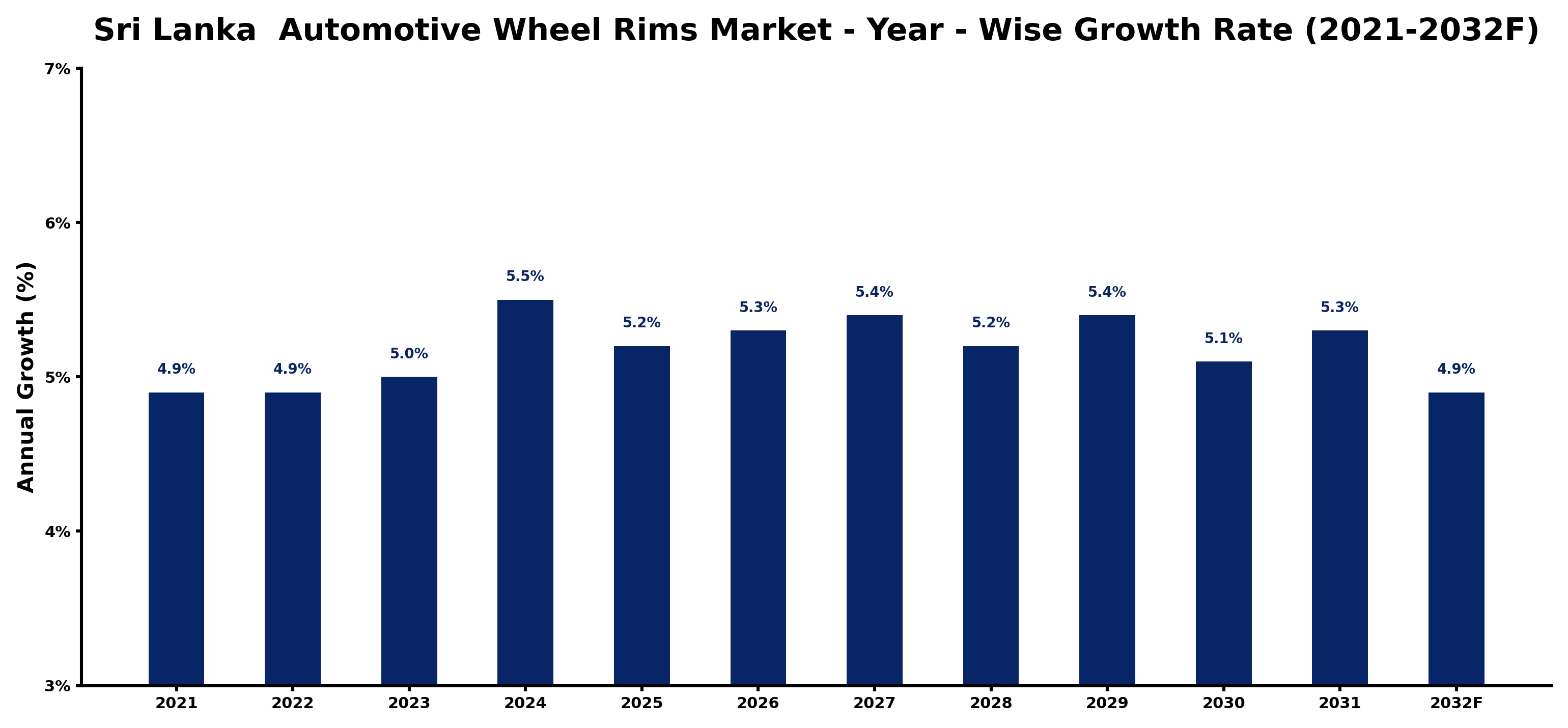
The table below presents the year‑wise growth rates along with the key drivers influencing the market
| Year | Growth Rate | Major Drivers |
| 2021 | 4.9% | Increased vehicle production demand |
| 2022 | 4.9% | Rising consumer disposable income |
| 2023 | 5.0% | Expansion of automotive manufacturing |
| 2024 | 5.5% | Growing popularity of SUVs |
| 2025 | 5.2% | Technological advancements in materials |
| 2026 | 5.3% | Enhanced distribution network efficiency |
| 2027 | 5.4% | Increased focus on sustainability |
| 2028 | 5.2% | Rising demand for custom rims |
| 2029 | 5.4% | Growth in electric vehicle market |
| 2030 | 5.1% | Improved aftermarket service offerings |
| 2031 | 5.3% | Industrial activity supported growth |
| 2032 | 4.9% | Increased investment in infrastructure |
Note - Market size estimations and growth projections presented in this report are based on 6Wresearch's advanced forecasting approach, validated with industry datasets as of June 2026.
Sri Lanka Automotive Wheel Rims Market Synopsis
A pivotal force influencing the Sri Lanka Automotive Wheel Rims Market is the notable demand for lightweight materials. Consumers are increasingly recognizing the benefits of fuel efficiency and enhanced vehicle performance, propelling manufacturers to innovate and adapt their offerings. This trend aligns with a broader global push toward sustainability and advanced engineering practices.
Moreover, the competitive landscape is being reshaped by the emergence of local manufacturers who are beginning to carve out their niche. Their focus on product quality, innovative designs, and cost-effective solutions is key to meeting the diverse preferences of the Sri Lankan consumer base. The integration of modern manufacturing processes is also notable, setting the stage for a dynamic market environment.
Sri Lanka Automotive Wheel Rims Market Key Takeaways
- The market is poised for robust growth, driven by increasing vehicle sales and consumer preferences for high-quality wheel rims.
- Lightweight materials such as aluminum alloys and carbon fiber are gaining traction, enhancing performance and sustainability.
- Customization and design personalization are emerging as significant consumer demands in the automotive sector.
- Challenges such as fluctuating raw material prices and competition are reshaping operational strategies for manufacturers.
- Government initiatives to support local manufacturing are enhancing the competitive landscape of the market.
Evaluation of Restraints in Sri Lanka Automotive Wheel Rims Market
Despite its promising growth, the Sri Lanka Automotive Wheel Rims Market faces several restraints that could hinder its trajectory. Intense competition among manufacturers often results in aggressive pricing strategies, exerting pressure on profit margins. Additionally, fluctuating raw material prices can complicate cost management for local producers. There's also an evident need for continuous innovation to keep up with evolving consumer preferences and regulatory standards. Furthermore, the presence of counterfeit products poses risks to quality assurance, while limited technological infrastructure can impede the adoption of advanced manufacturing processes.
Sri Lanka Automotive Wheel Rims Market Trends
Current trends in the Sri Lanka Automotive Wheel Rims Market point toward a significant demand for lightweight and durable products. The need for fuel efficiency is driving consumers toward wheel rims that offer better strength-to-weight ratios. Additionally, the market is seeing a heightened interest in customization, where consumers seek unique designs to reflect their personal style. Technological advancements in manufacturing processes are also paving the way for eco-friendly production methods, aligning with global sustainability goals. The transition towards smarter, more innovative rim designs is expected to gain momentum in the coming years.
Sri Lanka Automotive Wheel Rims Market Opportunities
Investment opportunities within the Sri Lanka Automotive Wheel Rims Market are increasingly appealing, particularly for stakeholders looking to capitalize on the rise of vehicle ownership. As demand for high-quality and bespoke wheel rim designs increases, manufacturers can explore niches focused on customization and innovative materials. Partnering with local automotive manufacturers or introducing globally recognized brands to the Sri Lankan market can serve as a strategic avenue for growth. Moreover, as awareness of sustainability grows, eco-conscious manufacturing practices present an additional opportunity for investment.
Government Initiatives in the Sri Lanka Automotive Wheel Rims Market
The Sri Lankan government has introduced several initiatives to foster growth within the automotive sector, including the Automotive Industry Development Policy Framework aimed at enhancing local manufacturing and attracting investment. Import restrictions and tariffs are designed to protect local manufacturers, while the National Automotive Policy emphasizes sustainability in automotive practices. These governmental efforts are expected to bolster local production and enhance the competitive stance of domestic manufacturers in the automotive wheel rims market.
Future Insights of the Sri Lanka Automotive Wheel Rims Market
Looking ahead, the Sri Lanka Automotive Wheel Rims Market is projected to experience steady growth from 2026 to 2032. The increasing disposable income levels are likely to encourage higher vehicle sales, which in turn will elevate the demand for quality wheel rims. As consumers become more concerned with aesthetics and performance, the trend towards lightweight and innovative designs will likely intensify. While fluctuations in raw material prices and global economic uncertainties could pose challenges, the overall outlook remains optimistic, fueled by continuous innovation and a robust automotive sector.
Sri Lanka Automotive Wheel Rims Market Latest Developments (May 2025 - June 2026)
In recent months, the Sri Lanka Automotive Wheel Rims Market has seen a heightened emphasis on technological advancements, with manufacturers increasingly adopting advanced materials and manufacturing processes. The trend towards customized wheel designs has also gained momentum, prompting local producers to innovate in response to changing consumer preferences. Collaboration between local manufacturers and international entities has emerged as a strategic focus, aiming to leverage expertise and expand product offerings. Furthermore, initiatives to promote eco-friendly practices within the manufacturing process are becoming more prevalent.
Sri Lanka Automotive Wheel Rims Market - Key Attractiveness of the Report
- 10 Years of Market Numbers
- Historical Data Starting from 2022 to 2025
- Base Year: 2025
- Forecast Data until 2032
- Key Performance Indicators Impacting the Market
- Major Upcoming Developments and Projects
Key Highlights of the Report:
- Sri Lanka Automotive Wheel Rims Market Outlook
- Market Size of Sri Lanka Automotive Wheel Rims Market, 2025
- Forecast of Sri Lanka Automotive Wheel Rims Market, 2032
- Historical Data and Forecast of Sri Lanka Automotive Wheel Rims Revenues & Volume for the Period 2022-2032F
- Sri Lanka Automotive Wheel Rims Market Trend Evolution
- Sri Lanka Automotive Wheel Rims Market Drivers and Challenges
- Sri Lanka Automotive Wheel Rims Price Trends
- Sri Lanka Automotive Wheel Rims Porter's Five Forces
- Sri Lanka Automotive Wheel Rims Industry Life Cycle
- Historical Data and Forecast of Sri Lanka Automotive Wheel Rims Market Revenues & Volume By Material Type for the Period 2022-2032F
- Historical Data and Forecast of Sri Lanka Automotive Wheel Rims Market Revenues & Volume By Alloy for the Period 2022-2032F
- Historical Data and Forecast of Sri Lanka Automotive Wheel Rims Market Revenues & Volume By Steel for the Period 2022-2032F
- Historical Data and Forecast of Sri Lanka Automotive Wheel Rims Market Revenues & Volume By Carbon Fiber for the Period 2022-2032F
- Historical Data and Forecast of Sri Lanka Automotive Wheel Rims Market Revenues & Volume By Sales Channel for the Period 2022-2032F
- Historical Data and Forecast of Sri Lanka Automotive Wheel Rims Market Revenues & Volume By OEM for the Period 2022-2032F
- Historical Data and Forecast of Sri Lanka Automotive Wheel Rims Market Revenues & Volume By Aftermarket for the Period 2022-2032F
- Historical Data and Forecast of Sri Lanka Automotive Wheel Rims Market Revenues & Volume By Vehicle Type for the Period 2022-2032F
- Historical Data and Forecast of Sri Lanka Automotive Wheel Rims Market Revenues & Volume By Passenger Cars for the Period 2022-2032F
- Historical Data and Forecast of Sri Lanka Automotive Wheel Rims Market Revenues & Volume By Commercial Vehicles for the Period 2022-2032F
- Sri Lanka Automotive Wheel Rims Import Export Trade Statistics
- Market Opportunity Assessment By Material Type
- Market Opportunity Assessment By Sales Channel
- Market Opportunity Assessment By Vehicle Type
- Sri Lanka Automotive Wheel Rims Top Companies Market Share
- Sri Lanka Automotive Wheel Rims Competitive Benchmarking By Technical and Operational Parameters
- Sri Lanka Automotive Wheel Rims Company Profiles
- Sri Lanka Automotive Wheel Rims Key Strategic Recommendations






































