Sri Lanka Billiards and Snooker Equipment Market Size, Share & Growth Rate
The Sri Lanka Billiards and Snooker Equipment Market was estimated at USD 207 Million in 2025 and is projected to reach USD 288 Million by 2032, growing at a CAGR of 4.8% from 2026 to 2032. This growth trajectory is driven by a rising interest in cue sports, particularly as more billiards and snooker clubs emerge throughout the country. Additionally, increased disposable incomes and the expanding e-commerce landscape enable more consumers to invest in quality equipment, further propelling market momentum.
Sri Lanka Billiards and Snooker Equipment Market Year-wise Growth Rate and Key Drivers
This graph highlights how the Sri Lanka Billiards and Snooker Equipment Market has steadily grown over the years, supported by major growth factors.
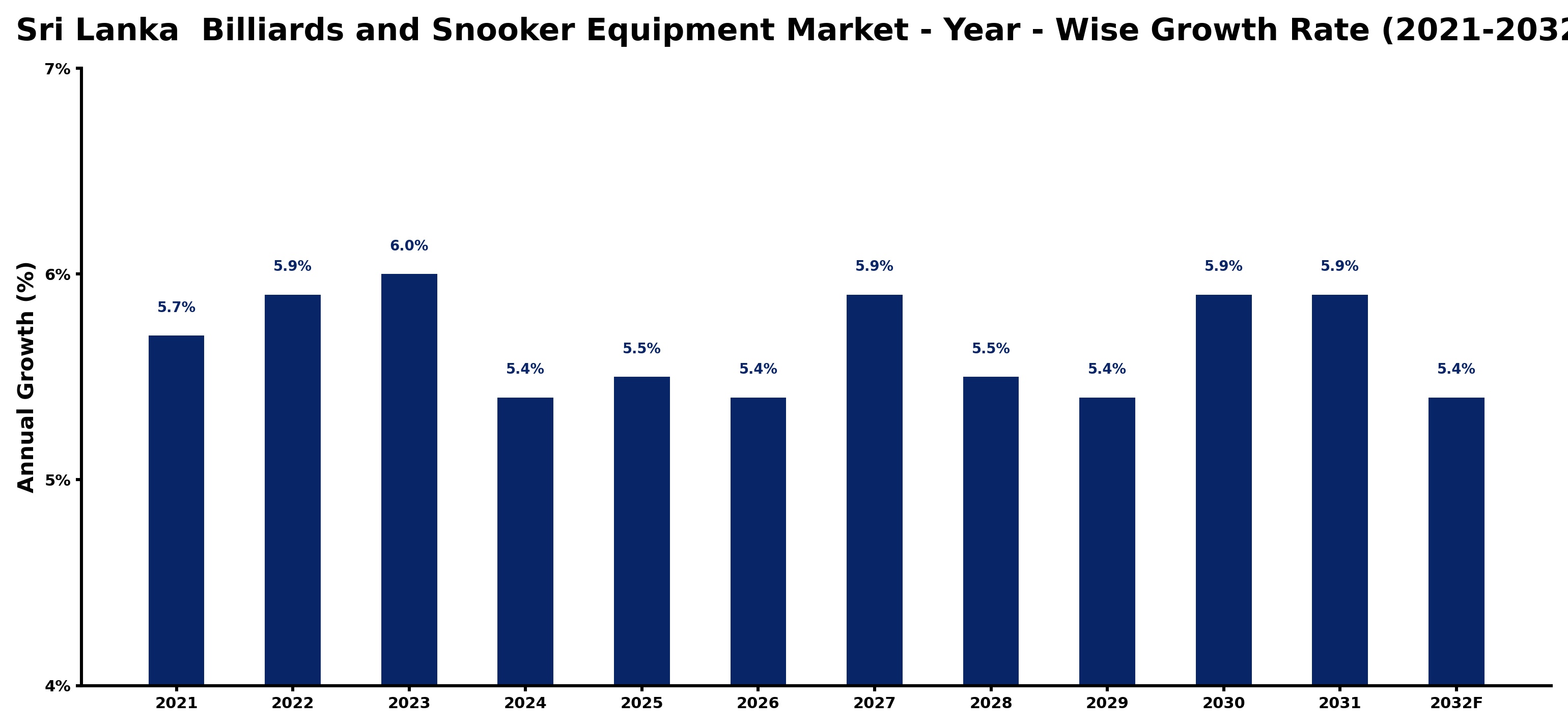
The table below presents the year‑wise growth rates along with the key drivers influencing the market
| Year | Growth Rate | Major Drivers |
| 2021 | 5.7% | Expansion of transportation and logistics networks |
| 2022 | 5.9% | Increasing smart city development projects |
| 2023 | 6.0% | Expansion of manufacturing activities |
| 2024 | 5.4% | Growing renewable energy integration projects |
| 2025 | 5.5% | Increasing industrial infrastructure investments |
| 2026 | 5.4% | Rising electricity demand across industries |
| 2027 | 5.9% | Increasing industrial automation investments |
| 2028 | 5.5% | Rapid growth in telecom and data center sectors |
| 2029 | 5.4% | Increasing smart city development projects |
| 2030 | 5.9% | Rising electricity demand across industries |
| 2031 | 5.9% | Expansion of manufacturing activities |
| 2032 | 5.4% | Expansion of manufacturing activities |
Note - Market size estimations and growth projections presented in this report are based on 6Wresearch's advanced forecasting approach, validated with industry datasets as of June 2026.
Sri Lanka Billiards and Snooker Equipment Market Synopsis
Recently, the Sri Lanka Billiards and Snooker Equipment Market has enjoyed growth, buoyed by the rising popularity of recreational sports among the youth and an influx of clubs. However, as it looks ahead, the market must address key challenges like limited consumer awareness and competition from alternative entertainment options to realize its full potential.
The current momentum indicates a strong inclination toward high-quality equipment among both casual players and professionals. This evolving consumer preference highlights a shift towards innovation in product offerings, paving the way for manufacturers to capitalize on trends like customization and sustainable materials.
Sri Lanka Billiards and Snooker Equipment Market Key Takeaways
- The market is experiencing significant growth, driven by increased interest in billiards and snooker.
- Emerging trends focus on technology, quality enhancement, and sustainable practices.
- Consumers are seeking personalized equipment options to enhance their gameplay experience.
- Accessibility challenges remain but present opportunities for market expansion.
- The government's support for sports development is fostering a conducive environment for growth.
Evaluation of Restraints in Sri Lanka Billiards and Snooker Equipment Market
The Sri Lanka Billiards and Snooker Equipment Market faces several restraints that may hinder its growth trajectory. Primarily, the lack of awareness about cue sports limits the consumer base, making it challenging for manufacturers and distributors to reach potential customers. Additionally, the relatively high price points for quality equipment can deter entry-level players from making a purchase. The competitive landscape is further complicated by the allure of other recreational activities that dominate the leisure space, making it essential for stakeholders to focus on education and awareness campaigns to broaden their market reach.
Sri Lanka Billiards and Snooker Equipment Market Trends
Several trends are shaping the Sri Lanka Billiards and Snooker Equipment Market. There is a growing demand for technologically advanced equipment that enhances performance, such as cues with improved grip and stability. Additionally, consumers increasingly prefer customizable products, allowing them to select specifications that match their unique playing styles. As sustainability gains traction, manufacturers are exploring eco-friendly materials in their equipment, positioning themselves as responsible producers while appealing to environmentally conscious buyers.
Sri Lanka Billiards and Snooker Equipment Market Opportunities
The market is ripe with opportunities for growth and investment. As more clubs and recreational centers emerge, there is an increasing need for high-quality billiards and snooker equipment tailored to both beginners and seasoned players. Additionally, organizing tournaments and coaching centers could attract further investment, capitalizing on the growing interest in cue sports. The rise of online retail platforms also provides an avenue for businesses to reach a wider audience, enhancing accessibility to products.
Government Initiatives in the Sri Lanka Billiards and Snooker Equipment Market
The Sri Lankan government is actively promoting sports development, including billiards and snooker. Initiatives such as funding for training programs and organizing national tournaments are encouraging participation in these sports. Import regulations are also designed to ensure that only high-quality equipment enters the market, fostering consumer trust while simultaneously promoting local manufacturers through tax incentives and other support measures. These policies aim to elevate the standard of cue sports in the country and enhance market accessibility.
Future Insights of the Sri Lanka Billiards and Snooker Equipment Market
Looking ahead to 2026-2032, the Sri Lanka Billiards and Snooker Equipment Market is poised for sustained growth. A deepening sports culture, driven by government initiatives and rising disposable incomes, will likely fuel demand. Consumers' increasing preference for high-quality, innovative equipment will push manufacturers to adapt and evolve their product lines. Overall, the combination of market dynamics and supportive policies positions the sector for a promising future, attracting investment from both local and international stakeholders.
Sri Lanka Billiards and Snooker Equipment Market Latest Developments (May 2025 - June 2026)
In recent months, the Sri Lanka Billiards and Snooker Equipment Market has seen a notable uptick in activities, including the launch of various local tournaments aimed at increasing player participation. This has been complemented by the introduction of new retail outlets specializing in snooker and billiards supplies, enhancing accessibility for consumers. Moreover, manufacturers are increasingly focusing on product innovation, integrating advanced materials and technology into their equipment to cater to the evolving needs of players.
Sri Lanka Billiards and Snooker Equipment Market - Key Attractiveness of the Report
- 10 Years of Market Numbers
- Historical Data Starting from 2022 to 2025
- Base Year: 2025
- Forecast Data until 2032
- Key Performance Indicators Impacting the Market
- Major Upcoming Developments and Projects
Key Highlights of the Report:
- Sri Lanka Billiards and Snooker Equipment Market Outlook
- Market Size of Sri Lanka Billiards and Snooker Equipment Market, 2025
- Forecast of Sri Lanka Billiards and Snooker Equipment Market, 2032
- Historical Data and Forecast of Sri Lanka Billiards and Snooker Equipment Revenues & Volume for the Period 2022-2032F
- Sri Lanka Billiards and Snooker Equipment Market Trend Evolution
- Sri Lanka Billiards and Snooker Equipment Market Drivers and Challenges
- Sri Lanka Billiards and Snooker Equipment Price Trends
- Sri Lanka Billiards and Snooker Equipment Porter's Five Forces
- Sri Lanka Billiards and Snooker Equipment Industry Life Cycle
- Historical Data and Forecast of Sri Lanka Billiards and Snooker Equipment Market Revenues & Volume By Type for the Period 2022-2032F
- Historical Data and Forecast of Sri Lanka Billiards and Snooker Equipment Market Revenues & Volume By Carom for the Period 2022-2032F
- Historical Data and Forecast of Sri Lanka Billiards and Snooker Equipment Market Revenues & Volume By Pool for the Period 2022-2032F
- Historical Data and Forecast of Sri Lanka Billiards and Snooker Equipment Market Revenues & Volume By Snooker for the Period 2022-2032F
- Historical Data and Forecast of Sri Lanka Billiards and Snooker Equipment Market Revenues & Volume By Equipment for the Period 2022-2032F
- Historical Data and Forecast of Sri Lanka Billiards and Snooker Equipment Market Revenues & Volume By Table for the Period 2022-2032F
- Historical Data and Forecast of Sri Lanka Billiards and Snooker Equipment Market Revenues & Volume By Ball for the Period 2022-2032F
- Historical Data and Forecast of Sri Lanka Billiards and Snooker Equipment Market Revenues & Volume By Cue for the Period 2022-2032F
- Historical Data and Forecast of Sri Lanka Billiards and Snooker Equipment Market Revenues & Volume By Other equipment for the Period 2022-2032F
- Historical Data and Forecast of Sri Lanka Billiards and Snooker Equipment Market Revenues & Volume By Distribution Channel for the Period 2022-2032F
- Historical Data and Forecast of Sri Lanka Billiards and Snooker Equipment Market Revenues & Volume By Offline channel for the Period 2022-2032F
- Historical Data and Forecast of Sri Lanka Billiards and Snooker Equipment Market Revenues & Volume By Online channel for the Period 2022-2032F
- Sri Lanka Billiards and Snooker Equipment Import Export Trade Statistics
- Market Opportunity Assessment By Type
- Market Opportunity Assessment By Equipment
- Market Opportunity Assessment By Distribution Channel
- Sri Lanka Billiards and Snooker Equipment Top Companies Market Share
- Sri Lanka Billiards and Snooker Equipment Competitive Benchmarking By Technical and Operational Parameters
- Sri Lanka Billiards and Snooker Equipment Company Profiles
- Sri Lanka Billiards and Snooker Equipment Key Strategic Recommendations






































