Sri Lanka Electric AC Motors Market Size Growth Rate
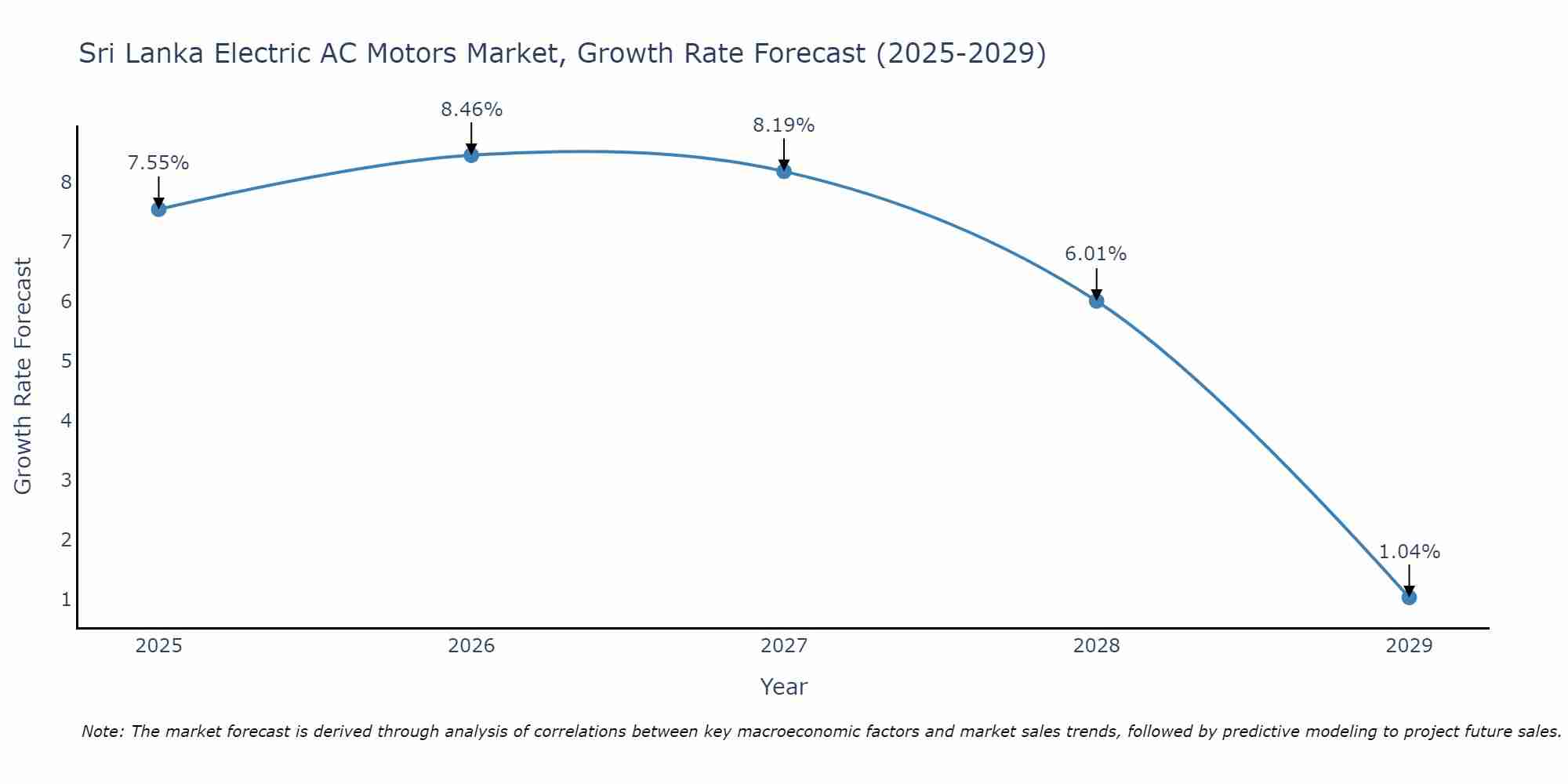
The Sri Lanka Electric AC Motors Market is projected to witness mixed growth rate patterns during 2025 to 2029. The growth rate begins at 7.55% in 2025, climbs to a high of 8.46% in 2026, and moderates to 1.04% by 2029.
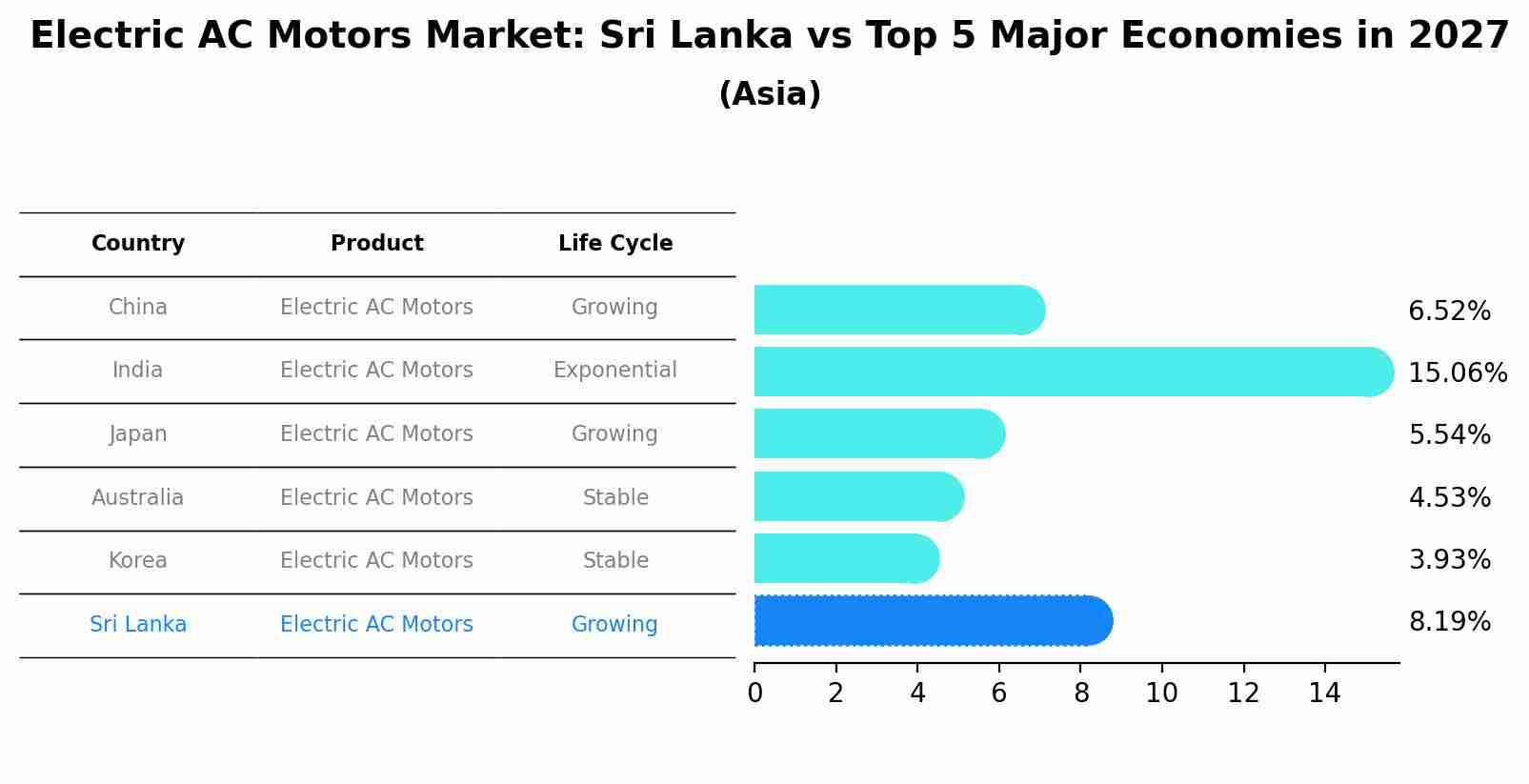
Electric AC Motors Market: Sri Lanka vs Top 5 Major Economies in 2027 (Asia)
By 2027, Sri Lanka's Electric AC Motors market is forecasted to achieve a growing growth rate of 8.19%, with China leading the Asia region, followed by India, Japan, Australia and South Korea.
Sri Lanka Electric AC Motors Market Overview
The Sri Lanka Electric AC Motors Market is experiencing steady growth driven by increasing industrialization and infrastructure development in the country. The market is primarily dominated by small and medium-sized enterprises that require electric AC motors for various applications such as pumps, compressors, fans, and conveyors. The demand for energy-efficient motors is on the rise due to the government`s focus on sustainable development and energy conservation initiatives. Key players in the market offer a wide range of electric AC motors with varying capacities and efficiency levels to cater to diverse customer needs. Additionally, technological advancements such as the integration of IoT and smart features in electric motors are expected to further propel market growth in Sri Lanka.
Sri Lanka Electric AC Motors Market Trends
In the Sri Lanka Electric AC Motors Market, there is a noticeable shift towards more energy-efficient and environmentally friendly motor options. This trend is driven by increasing awareness of the importance of sustainability and energy conservation. Additionally, there is a growing demand for variable speed motors that offer improved control and efficiency in various industrial applications. The market is also witnessing a rise in the adoption of smart motors integrated with IoT technology for remote monitoring and predictive maintenance purposes. Local manufacturers are focusing on developing innovative motor solutions to meet the evolving needs of industries such as manufacturing, agriculture, and transportation. Overall, the Sri Lanka Electric AC Motors Market is experiencing a transition towards greener and smarter motor technologies to enhance operational efficiency and reduce carbon footprint.
Sri Lanka Electric AC Motors Market Challenges
In the Sri Lanka Electric AC Motors Market, some challenges faced include the dependency on imported motors leading to cost implications due to fluctuating exchange rates, inadequate domestic manufacturing capabilities hindering the growth of the local market, and limited technological advancements resulting in lower efficiency and performance compared to international standards. Additionally, the lack of awareness and education among consumers about the benefits of electric AC motors poses a challenge in driving adoption rates. Furthermore, the inconsistent power supply in certain regions of Sri Lanka may impact the overall performance and reliability of electric AC motors, leading to concerns about their effectiveness in such environments. Addressing these challenges will require investments in local manufacturing capabilities, education campaigns, and infrastructure improvements to support the growth of the electric AC motors market in Sri Lanka.
Sri Lanka Electric AC Motors Market Investment Opportunities
The Sri Lanka Electric AC Motors Market offers promising investment opportunities due to increasing industrialization, infrastructure development, and growing adoption of electric vehicles in the country. With the government`s initiatives to promote renewable energy and sustainable practices, there is a rising demand for energy-efficient electric motors for various applications such as industrial machinery, HVAC systems, and electric vehicles. Investing in the manufacturing, distribution, or servicing of electric AC motors in Sri Lanka can be lucrative, especially considering the potential for growth in sectors like manufacturing, agriculture, transportation, and construction. Additionally, partnerships with local businesses and leveraging technological advancements in motor efficiency and control systems can further enhance the market position and profitability of investments in the Sri Lankan Electric AC Motors Market.
Sri Lanka Electric AC Motors Market Government Policy
The Sri Lankan government has implemented several policies to support the Electric AC Motors Market in the country. These include incentives such as tax breaks and subsidies for manufacturers and consumers investing in electric motors. Additionally, the government has introduced regulations to encourage the adoption of energy-efficient technologies, including electric motors, to reduce the country`s carbon footprint and dependency on fossil fuels. Sri Lanka has also been focusing on developing a comprehensive infrastructure for electric vehicles, which would further drive the demand for electric AC motors. Overall, the government`s policies aim to promote sustainable practices and drive the growth of the Electric AC Motors Market in Sri Lanka.
Sri Lanka Electric AC Motors Market Future Outlook
The Sri Lanka Electric AC Motors market is expected to witness steady growth in the coming years due to increasing industrialization, infrastructure development, and the government`s focus on energy efficiency. The demand for electric AC motors is projected to rise across various sectors such as manufacturing, automotive, agriculture, and consumer appliances. Technological advancements leading to improved efficiency and performance of electric AC motors, along with the shift towards sustainable energy solutions, will drive market growth. Additionally, the growing awareness about environmental concerns and the benefits of using electric motors over traditional combustion engines will further propel the market. Overall, the Sri Lanka Electric AC Motors market is poised for expansion driven by factors such as increasing investments in infrastructure and sustainable energy initiatives.
Key Highlights of the Report:
- Sri Lanka Electric AC Motors Market Outlook
- Market Size of Sri Lanka Electric AC Motors Market, 2021
- Forecast of Sri Lanka Electric AC Motors Market, 2031
- Historical Data and Forecast of Sri Lanka Electric AC Motors Revenues & Volume for the Period 2018 - 2031
- Sri Lanka Electric AC Motors Market Trend Evolution
- Sri Lanka Electric AC Motors Market Drivers and Challenges
- Sri Lanka Electric AC Motors Price Trends
- Sri Lanka Electric AC Motors Porter's Five Forces
- Sri Lanka Electric AC Motors Industry Life Cycle
- Historical Data and Forecast of Sri Lanka Electric AC Motors Market Revenues & Volume By Type for the Period 2018 - 2031
- Historical Data and Forecast of Sri Lanka Electric AC Motors Market Revenues & Volume By Synchronous AC Motors for the Period 2018 - 2031
- Historical Data and Forecast of Sri Lanka Electric AC Motors Market Revenues & Volume By Induction AC Motors for the Period 2018 - 2031
- Historical Data and Forecast of Sri Lanka Electric AC Motors Market Revenues & Volume By Voltage for the Period 2018 - 2031
- Historical Data and Forecast of Sri Lanka Electric AC Motors Market Revenues & Volume By Integral HP Output for the Period 2018 - 2031
- Historical Data and Forecast of Sri Lanka Electric AC Motors Market Revenues & Volume By Fractional HP Output for the Period 2018 - 2031
- Historical Data and Forecast of Sri Lanka Electric AC Motors Market Revenues & Volume By End-Use for the Period 2018 - 2031
- Historical Data and Forecast of Sri Lanka Electric AC Motors Market Revenues & Volume By Industrial Machinery for the Period 2018 - 2031
- Historical Data and Forecast of Sri Lanka Electric AC Motors Market Revenues & Volume By Motor Vehicles for the Period 2018 - 2031
- Historical Data and Forecast of Sri Lanka Electric AC Motors Market Revenues & Volume By HVAC Equipment for the Period 2018 - 2031
- Historical Data and Forecast of Sri Lanka Electric AC Motors Market Revenues & Volume By Aerospace & Transportation for the Period 2018 - 2031
- Historical Data and Forecast of Sri Lanka Electric AC Motors Market Revenues & Volume By Household Appliances for the Period 2018 - 2031
- Historical Data and Forecast of Sri Lanka Electric AC Motors Market Revenues & Volume By Others for the Period 2018 - 2031
- Sri Lanka Electric AC Motors Import Export Trade Statistics
- Market Opportunity Assessment By Type
- Market Opportunity Assessment By Voltage
- Market Opportunity Assessment By End-Use
- Sri Lanka Electric AC Motors Top Companies Market Share
- Sri Lanka Electric AC Motors Competitive Benchmarking By Technical and Operational Parameters
- Sri Lanka Electric AC Motors Company Profiles
- Sri Lanka Electric AC Motors Key Strategic Recommendations






































