Sri Lanka ENT Devices Market (2026-2032) Outlook | Trends, Revenue, Industry, Size, Value, Analysis, Forecast, Companies, Share & Growth
Market Forecast By Product (Diagnostic Devices, Surgical Devices, Hearing Aids, Hearing Implants, Co2 Lasers, Image-Guided Surgery Systems), By Type Diagnostic Devices (Endoscopes, Hearing Screening Devices), By Type Surgical Devices (Powered Surgical Instruments, Radiofrequency (RF) Handpieces, Handheld Instruments, Balloon Sinus Dilation Devices, ENT Supplies, Ear Tubes, Voice Prosthesis Devices), By End User (Home Use, Hospitals and Ambulatory Settings, ENT Clinics) And Competitive Landscape
| Product Code: ETC363931 | Publication Date: Aug 2022 | Updated Date: Jul 2026 | Product Type: Market Research Report | |
| Publisher: 6Wresearch | Author: Vasudha | No. of Pages: 75 | No. of Figures: 35 | No. of Tables: 20 |
Sri Lanka ENT Devices Market Size, Share & Growth Rate
The Sri Lanka ENT Devices Market was estimated at USD 1220 Million in 2025 and is projected to reach USD 2023 Million by 2032, growing at a CAGR of 7.5% from 2026 to 2032. This upward trajectory is primarily fueled by an increasing prevalence of ear, nose, and throat disorders among the population, particularly in the aging demographic. Additionally, heightened awareness regarding ENT health, coupled with advancements in medical technology, is driving the demand for innovative diagnostic and treatment solutions.
Sri Lanka ENT Devices Market Year-wise Growth Rate and Key Drivers
This graph highlights how the Sri Lanka ENT Devices Market has steadily grown over the years, supported by major growth factors.
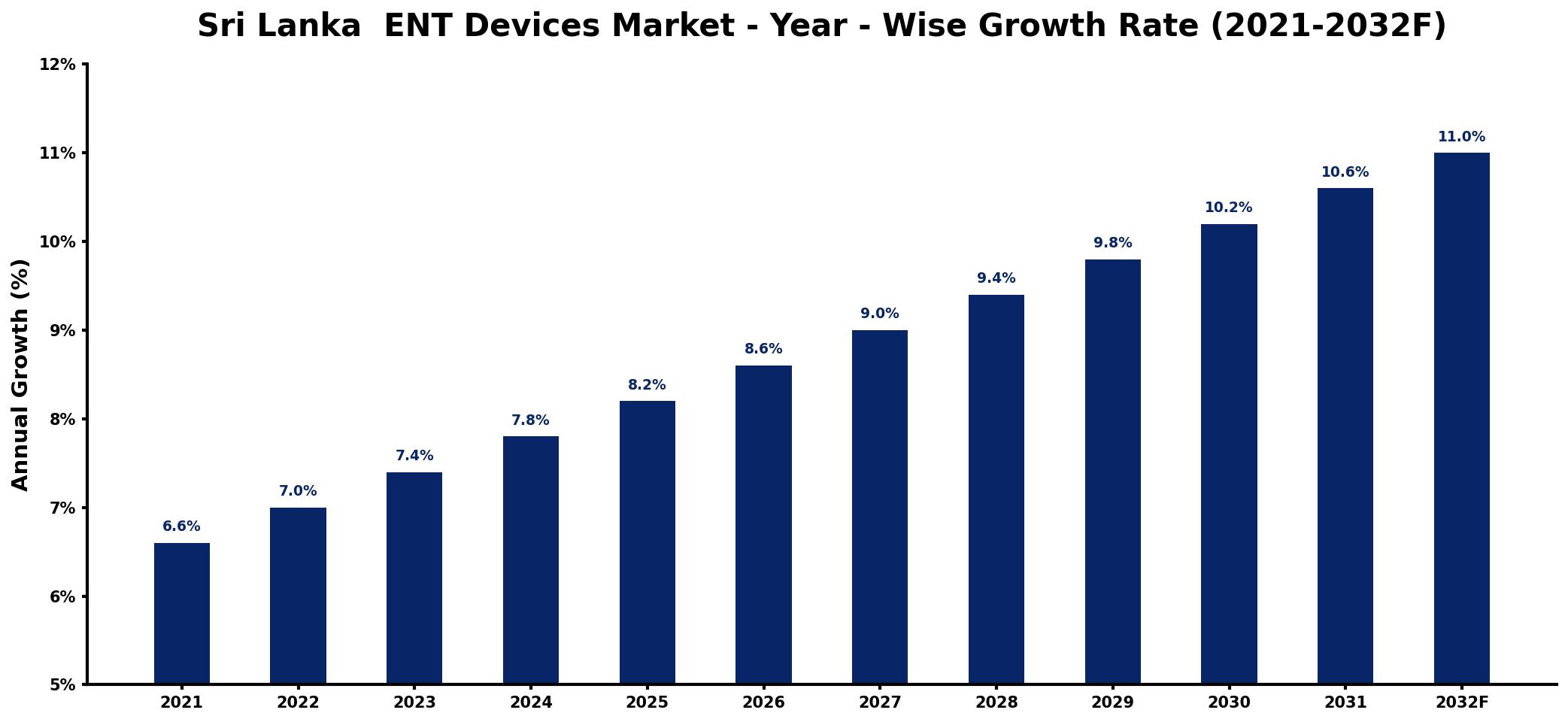
The table below presents the year‑wise growth rates along with the key drivers influencing the market
| Year | Growth Rate | Major Drivers |
| 2021 | 6.6% | Rising healthcare expenditure in region |
| 2022 | 7.0% | Growing aging population requiring services |
| 2023 | 7.4% | increased production capacity utilization |
| 2024 | 7.8% | growing downstream application demand |
| 2025 | 8.2% | Expansion of healthcare infrastructure projects |
| 2026 | 8.6% | growing commercial sector adoption |
| 2027 | 9.0% | increased overall sector activity |
| 2028 | 9.4% | expanding manufacturing base activity |
| 2029 | 9.8% | Enhanced training for healthcare professionals |
| 2030 | 10.2% | strengthening international trade flows |
| 2031 | 10.6% | Collaboration between private sectors |
| 2032 | 11.0% | stronger distribution network expansion |
Note: Market size estimations and growth projections presented in this report are based on 6Wresearch's proprietary forecasting methodology, utilizing the latest available industry data, government publications, and primary research inputs.
Sri Lanka ENT Devices Market Synopsis
The demand for ENT devices in Sri Lanka is notably increasing due to the rising incidence of conditions such as hearing loss, sinusitis, and throat disorders. This surge in demand is supported by a growing elderly population that is more susceptible to these health issues, thereby necessitating improved access to diagnostic and surgical ENT solutions.
The market is characterized by a mix of multinational and local manufacturers, providing a diverse array of products ranging from diagnostic devices like endoscopes to surgical instruments. Despite these advancements, challenges such as limited healthcare access in rural regions and varying levels of healthcare expenditure per capita remain pressing concerns for market growth.
Sri Lanka ENT Devices Market Key Takeaways
- The market is expanding rapidly due to increasing rates of ENT disorders and heightened demand for treatment options.
- Technological advancements, such as minimally invasive procedures, are reshaping the landscape of ENT treatments.
- Government initiatives aimed at enhancing healthcare infrastructure are expected to boost the adoption of ENT devices.
- Investment opportunities abound, particularly in innovative device technology and local manufacturing collaborations.
- Growing awareness about ENT health among the population is fueling market expansion and consumer interest.
Evaluation of Restraints in Sri Lanka ENT Devices Market
Several constraints are affecting the growth of the Sri Lanka ENT Devices Market. One significant limitation is the insufficient healthcare infrastructure in rural areas, which often lacks access to advanced diagnostic and surgical options. Moreover, the high cost associated with modern ENT devices can be a barrier for both healthcare providers and patients, limiting the widespread adoption of innovative solutions. Regulatory hurdles can also delay the introduction of new products, further restricting market potential. The shortage of skilled ENT professionals in certain regions exacerbates these challenges, as a lack of expertise can hinder the effective use of advanced devices.
Sri Lanka ENT Devices Market Trends
Current trends in the Sri Lanka ENT Devices Market reflect a growing emphasis on technological innovation. The development of advanced imaging technologies and minimally invasive surgical instruments is revolutionizing treatment options. Additionally, there is a marked increase in healthcare expenditure, indicating a shift toward investing in modern medical technologies. Public awareness campaigns focused on ENT health are also emerging, which encourage patients to seek timely medical advice, thus driving demand for ENT devices.
Sri Lanka ENT Devices Market Opportunities
The market offers substantial investment opportunities, particularly in sectors that enhance accessibility to ENT devices and treatments. As the population continues to age, there will be an escalating demand for hearing aids and cochlear implants. Moreover, collaboration with local healthcare providers can facilitate the introduction of state-of-the-art devices tailored to meet the specific needs of the Sri Lankan populace. As the government prioritizes healthcare infrastructure improvements, the potential for profitable investments remains robust.
Government Initiatives in the Sri Lanka ENT Devices Market
The Sri Lankan government has enacted policies to regulate the ENT devices sector, emphasizing compliance with international standards to ensure product safety and efficacy. These regulations also support local manufacturing initiatives aimed at fostering self-sufficiency and decreasing reliance on imports. By incentivizing the development of domestic production capabilities, the government seeks to improve availability and affordability of ENT devices, thereby enhancing overall healthcare quality.
Future Insights of the Sri Lanka ENT Devices Market
Looking ahead to 2026-2032, the Sri Lanka ENT Devices Market is expected to maintain its growth momentum. With a rising elderly population and the concomitant increase in ENT-related health issues, the demand for sophisticated ENT devices will continue to escalate. Advancements in device technology and increasing healthcare investment will likely drive the market further. However, addressing rural access and affordability challenges will be crucial to maximizing the markets potential, ensuring that innovative solutions reach all segments of the population.
Sri Lanka ENT Devices Market Latest Developments (2025 - 2026)
Recent developments in the Sri Lanka ENT Devices Market suggest a shift towards incorporating more advanced technologies. There has been a notable uptick in the introduction of minimally invasive surgical techniques and enhanced diagnostic tools, aimed at improving patient outcomes. Furthermore, various public and private partnerships are emerging to facilitate the distribution and accessibility of ENT devices, reflecting a collaborative approach to enhancing healthcare services in the country.
Sri Lanka ENT Devices Market - Key Attractiveness of the Report
- 10 Years of Market Numbers
- Historical Data Starting from 2022 to 2025
- Base Year: 2025
- Forecast Data until 2032
- Key Performance Indicators Impacting the Market
- Major Upcoming Developments and Projects
Key Highlights of the Report:
- Sri Lanka ENT Devices Market Outlook
- Market Size of Sri Lanka ENT Devices Market, 2025
- Forecast of Sri Lanka ENT Devices Market, 2032
- Historical Data and Forecast of Sri Lanka ENT Devices Revenues & Volume for the Period 2022-2032F
- Sri Lanka ENT Devices Market Trend Evolution
- Sri Lanka ENT Devices Market Drivers and Challenges
- Sri Lanka ENT Devices Price Trends
- Sri Lanka ENT Devices Porter's Five Forces
- Sri Lanka ENT Devices Industry Life Cycle
- Historical Data and Forecast of Sri Lanka ENT Devices Market Revenues & Volume By Product for the Period 2022-2032F
- Historical Data and Forecast of Sri Lanka ENT Devices Market Revenues & Volume By Diagnostic Devices for the Period 2022-2032F
- Historical Data and Forecast of Sri Lanka ENT Devices Market Revenues & Volume By Surgical Devices for the Period 2022-2032F
- Historical Data and Forecast of Sri Lanka ENT Devices Market Revenues & Volume By Hearing Aids for the Period 2022-2032F
- Historical Data and Forecast of Sri Lanka ENT Devices Market Revenues & Volume By Hearing Implants for the Period 2022-2032F
- Historical Data and Forecast of Sri Lanka ENT Devices Market Revenues & Volume By Co2 Lasers for the Period 2022-2032F
- Historical Data and Forecast of Sri Lanka ENT Devices Market Revenues & Volume By Image-Guided Surgery Systems for the Period 2022-2032F
- Historical Data and Forecast of Sri Lanka ENT Devices Market Revenues & Volume By Type Diagnostic Devices for the Period 2022-2032F
- Historical Data and Forecast of Sri Lanka ENT Devices Market Revenues & Volume By Endoscopes for the Period 2022-2032F
- Historical Data and Forecast of Sri Lanka ENT Devices Market Revenues & Volume By Hearing Screening Devices for the Period 2022-2032F
- Historical Data and Forecast of Sri Lanka ENT Devices Market Revenues & Volume By Type Surgical Devices for the Period 2022-2032F
- Historical Data and Forecast of Sri Lanka ENT Devices Market Revenues & Volume By Powered Surgical Instruments for the Period 2022-2032F
- Historical Data and Forecast of Sri Lanka ENT Devices Market Revenues & Volume By Radiofrequency (RF) Handpieces for the Period 2022-2032F
- Historical Data and Forecast of Sri Lanka ENT Devices Market Revenues & Volume By Handheld Instruments for the Period 2022-2032F
- Historical Data and Forecast of Sri Lanka ENT Devices Market Revenues & Volume By Balloon Sinus Dilation Devices for the Period 2022-2032F
- Historical Data and Forecast of Sri Lanka ENT Devices Market Revenues & Volume By ENT Supplies for the Period 2022-2032F
- Historical Data and Forecast of Sri Lanka ENT Devices Market Revenues & Volume By Ear Tubes for the Period 2022-2032F
- Historical Data and Forecast of Sri Lanka ENT Devices Market Revenues & Volume By Voice Prosthesis Devices for the Period 2022-2032F
- Historical Data and Forecast of Sri Lanka ENT Devices Market Revenues & Volume By End User for the Period 2022-2032F
- Historical Data and Forecast of Sri Lanka ENT Devices Market Revenues & Volume By Home Use for the Period 2022-2032F
- Historical Data and Forecast of Sri Lanka ENT Devices Market Revenues & Volume By Hospitals and Ambulatory Settings for the Period 2022-2032F
- Historical Data and Forecast of Sri Lanka ENT Devices Market Revenues & Volume By ENT Clinics for the Period 2022-2032F
- Sri Lanka ENT Devices Import Export Trade Statistics
- Market Opportunity Assessment By Product
- Market Opportunity Assessment By Type Diagnostic Devices
- Market Opportunity Assessment By Type Surgical Devices
- Market Opportunity Assessment By End User
- Sri Lanka ENT Devices Top Companies Market Share
- Sri Lanka ENT Devices Competitive Benchmarking By Technical and Operational Parameters
- Sri Lanka ENT Devices Company Profiles
- Sri Lanka ENT Devices Key Strategic Recommendations
Frequently Asked Questions About the Market Study (FAQs):
The market was estimated at USD 1220 Million in 2025 and is projected to reach USD 2023 Million by 2032, growing at a CAGR of 7.5% from 2026 to 2032.
The increase in the elderly demographic leads to a higher incidence of ENT disorders, thereby driving up the demand for devices such as hearing aids and surgical instruments tailored to this age group.
Innovations like minimally invasive surgical techniques and advanced imaging technologies are revolutionizing diagnosis and treatment, making procedures safer and more efficient.
Yes, the government has introduced policies to promote local manufacturing of ENT devices and ensure compliance with international safety standards, thereby improving quality and accessibility.
Increased public awareness of ENT disorders has led to more patients seeking medical help, thereby boosting the demand for diagnostic and treatment options, which in turn stimulates market growth.
6Wresearch actively monitors the Sri Lanka ENT Devices Market and publishes its comprehensive annual report, highlighting emerging trends, growth drivers, revenue analysis, and forecast outlook. Our insights help businesses to make data-backed strategic decisions with ongoing market dynamics. Our analysts track relevent industries related to the Sri Lanka ENT Devices Market, allowing our clients with actionable intelligence and reliable forecasts tailored to emerging regional needs.
Yes, we provide customisation as per your requirements. To learn more, feel free to contact us on sales@6wresearch.com
Global Go To Market Strategy - 2030
Export potential enables firms to identify high-growth global markets with greater confidence by combining advanced trade intelligence with a structured quantitative methodology. The framework analyzes emerging demand trends and country-level import patterns while integrating macroeconomic and trade datasets such as GDP and population forecasts, bilateral import–export flows, tariff structures, elasticity differentials between developed and developing economies, geographic distance, and import demand projections. Using weighted trade values from 2020–2024 as the base period to project country-to-country export potential for 2030, these inputs are operationalized through calculated drivers such as gravity model parameters, tariff impact factors, and projected GDP per-capita growth. Through an analysis of hidden potentials, demand hotspots, and market conditions that are most favorable to success, this method enables firms to focus on target countries, maximize returns, and global expansion with data, backed by accuracy.
By factoring in the projected importer demand gap that is currently unmet and could be potential opportunity, it identifies the potential for the Exporter (Country) among 190 countries, against the general trade analysis, which identifies the biggest importer or exporter.
To discover high-growth global markets and optimize your business strategy:
Click Here
Pricing
- Single User License$ 1,995
- Department License$ 2,400
- Site License$ 3,120
- Global License$ 3,795

Leadership Perspectives from Industry Events
Search
Thought Leadership and Analyst Meet





Our Clients








6WResearch In News
- India Air Conditioner Market Set for Strong Rebound in 2026 After Weather-Led Correction and GST-Driven Recovery: 6Wresearch
- ADAS in India: How Automatic Emergency Braking, Blind Spot Detection & Driver Monitoring are Transforming Road Safety
- Doha a strategic location for EV manufacturing hub: IPA Qatar
- Demand for luxury TVs surging in the GCC, says Samsung
- Empowering Growth: The Thriving Journey of Bangladesh’s Cable Industry
- Demand for luxury TVs surging in the GCC, says Samsung
Latest Reports
- Nicaragua RPG Gaming Market (2026-2032)
- New Zealand RPG Gaming Market (2026-2032)
- Netherlands RPG Gaming Market (2026-2032)
- Nauru RPG Gaming Market (2026-2032)
- Namibia RPG Gaming Market (2026-2032)
- Mozambique RPG Gaming Market (2026-2032)
- Montenegro RPG Gaming Market (2026-2032)
- Mongolia RPG Gaming Market (2026-2032)
- Monaco RPG Gaming Market (2026-2032)
- Micronesia RPG Gaming Market (2026-2032)
Industry Events and Analyst Meet

EV India Expo 2026

HIMTEX 2026

India Refining Summit 2026

India EV Show 2026

EV tech India Expo 2026
Whitepaper
- Middle East & Africa Commercial Security Market Click here to view more.
- Middle East & Africa Fire Safety Systems & Equipment Market Click here to view more.
- GCC Drone Market Click here to view more.
- Middle East Lighting Fixture Market Click here to view more.
- GCC Physical & Perimeter Security Market Click here to view more.


