Sri Lanka Flower and Ornamental Plants Market Summary
The sri lanka flower and ornamental plants market was estimated at USD 409 Million in 2025 and is projected to reach USD 567 Million by 2032, growing at a CAGR of 5.7% from 2026 to 2032.
Sri Lanka Flower and Ornamental Plants Market Year-wise Growth Rate and Key Drivers
This graph highlights how the Sri Lanka Flower and Ornamental Plants Market has steadily grown over the past five years, supported by major growth factors.
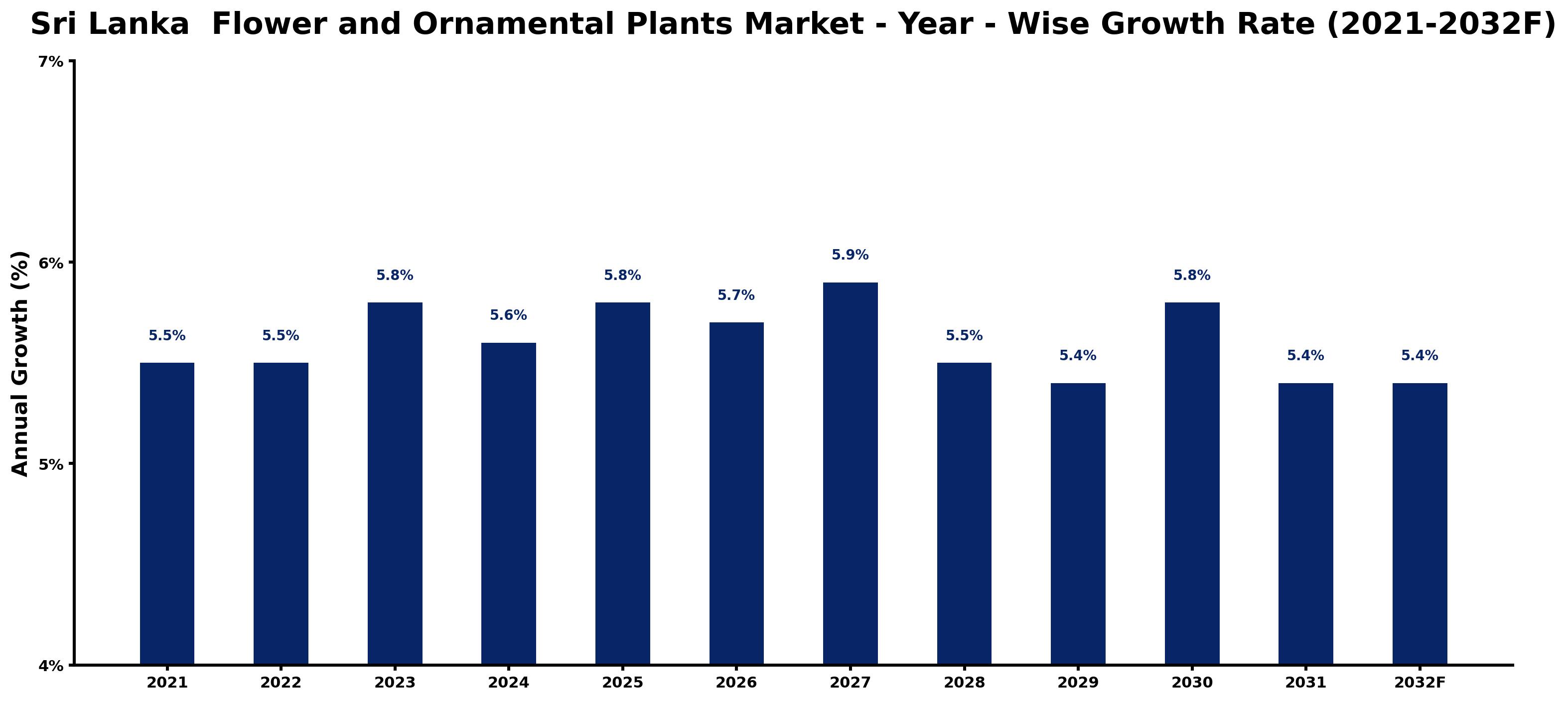
The table below presents the year wise growth rates along with the key drivers influencing the market
| Year | Growth Rate | Major Drivers |
| 2021 | 5.5% | Market recovery from COVID-19 encourages increased interest in home gardening. |
| 2022 | 5.5% | Local floriculture associations promote sustainable practices to attract eco-conscious consumers. |
| 2023 | 5.8% | Urbanization trends lead to greater demand for landscaping and ornamental plants. |
| 2024 | 5.6% | Online sales platforms expand reach for local flower nurseries and growers. |
| 2025 | 5.8% | Horticultural education programs boost knowledge and skills among aspiring growers. |
| 2026 | 5.7% | Export opportunities emerge as Sri Lanka's unique flora gains international attention. |
| 2027 | 5.9% | Climate resilience strategies inform planting choices in response to extreme weather events. |
| 2028 | 5.5% | Emerging luxury markets favor exotic flowers for events and high-end decor. |
| 2029 | 5.4% | Collaboration between farmers and tech firms yields innovative farming solutions. |
| 2030 | 5.8% | Consumer preference shifts towards organic and pesticide-free floral products. |
| 2031 | 5.4% | Cultural festivals emphasize local floral traditions, enhancing market visibility. |
| 2032 | 5.4% | Investment in public green spaces bolsters demand for ornamental landscaping plants. |
Note - Market size estimations and growth projections presented in this report are based on 6Wresearch's advanced forecasting approach, validated with industry datasets as of June 2026.
Sri Lanka Flower and Ornamental Plants Market Synopsis
The Sri Lanka Flower and Ornamental Plants Market is projected to reach 5.7% and witness significant growth during the forecast period (2026-2032). With a compound annual growth rate (CAGR) of 5.2%, this market is poised for expansion, driven by several key factors. The rising popularity of flowers as gifts and increasing demand for fresh cut flowers are noteworthy trends reflecting changing consumer preferences toward decorative items. Moreover, the growing awareness regarding the health benefits associated with ornamental plants, particularly in terms of stress reduction and improved air quality, is further bolstering the market's trajectory. Additionally, the enhancement in disposable incomes and rapid urbanization in Sri Lanka are expected to provide further impetus to the market's growth during this period.
Sri Lanka Flower and Ornamental Plants Market Growth Drivers
Several factors are contributing to the robust growth of the Sri Lanka Flower and Ornamental Plants Market. The foremost driver is the escalating disposable incomes, which empower consumers to invest in premium floral products and decorative plants. Furthermore, as urban living continues to prevail, the desire for aesthetic enhancement in living spaces has intensified, making ornamental plants an attractive choice for consumers seeking to beautify their environments.
- Increased interest in gardening among the urban population has led to a surge in demand for both indoor and outdoor plants, as consumers seek to create personal green spaces.
- Growing health awareness has driven consumers to recognize the mental and physical benefits associated with plants, particularly their qualities of enhancing air quality and reducing stress.
- The floriculture sector's contribution to local economies through job creation and income diversification is fostering community participation and engagement in plant production.
- Cultural practices in Sri Lanka often involve the gifting of flowers during festivals and ceremonies, leading to sustained demand throughout the year.
- Technological advancements in cultivation and production techniques are enhancing the efficiency of flower and ornamental plant production, further supporting market growth.
Sri Lanka Flower and Ornamental Plants Market Challenges and Restraints
Despite the positive growth outlook, the Sri Lanka Flower and Ornamental Plants Market is not without its challenges. The primary restraint includes environmental factors such as climate variability, which poses threats to flower and plant cultivation cycles. Additionally, the prevalence of pests and diseases can significantly impact yields and product quality, creating challenges for producers.
- Logistical hurdles related to supply chain management may hinder timely delivery of flowers and plants to market, particularly during peak seasons.
- Competition from imported flowers, which may be available at lower prices, can disrupt local market dynamics and pressure domestic producers.
- Rising costs of production inputs, such as fertilizers and seeds, could squeeze profit margins for growers, affecting overall market stability.
- Awareness about sustainable practices is gaining traction; producers may face pressure to adopt environmentally friendly methods, which require additional investments.
- Limited access to modern agricultural technologies and resources may inhibit small-scale farmers from scaling their production effectively.
Sri Lanka Flower and Ornamental Plants Market Government Investment and Initiatives
The Sri Lankan government has recognized the importance of the flower and ornamental plants market and is actively investing in initiatives to bolster the industry. Various programs aimed at promoting sustainable floriculture practices are being introduced, alongside subsidies for seeds and fertilizers to support local growers. Additionally, technical assistance in plantation activities is being provided, enabling farmers to enhance productivity and market their products more effectively.
- The government's policy frameworks are increasingly focusing on strengthening the floriculture value chain, from cultivation through to marketing, in an effort to improve competitiveness.
- Investments in infrastructure, including the development of nurseries and research stations, are designed to support innovation and growth within the sector.
- Training programs for farmers are being implemented to educate them on best practices for plant care, pest management, and sustainable farming techniques.
- Trade fairs and exhibitions are being organized to promote Sri Lankan floral products internationally, aiming to open new export markets.
- Supportive regulatory frameworks are being established to facilitate easier access to funding and resources for smallholder farmers within the floriculture sector.
Sri Lanka Flower and Ornamental Plants Market Latest Developments (May 2025 - June 2026)
The period from May 2025 to June 2026 has been marked by several notable developments in the Sri Lanka Flower and Ornamental Plants Market. Industry stakeholders are increasingly prioritizing sustainability, with many producers adopting eco-friendly methods of cultivation to meet consumer demand for sustainable products. Efforts to enhance exports have also gained momentum, with initiatives aimed at expanding market access to international buyers.
- Strategic partnerships between stakeholders in the sector have emerged, focusing on knowledge sharing and resource pooling to tackle common challenges.
- Innovative marketing strategies, including digital platforms for direct-to-consumer sales, are being explored to enhance reach and customer engagement.
- Research initiatives focusing on developing disease-resistant ornamental varieties are underway to improve resilience against pests and environmental stressors.
- Participation in international trade fairs has increased, allowing local producers to showcase their products and connect with a global audience.
- Consumer preferences are shifting towards locally sourced flowers and plants, prompting producers to highlight the uniqueness of Sri Lankan offerings.
Sri Lanka Flower and Ornamental Plants Market - Key Attractiveness of the Report
- 10 Years of Market Numbers
- Historical Data Starting from 2022 to 2025
- Base Year: 2025
- Forecast Data until 2032
- Key Performance Indicators Impacting the Market
- Major Upcoming Developments and Projects
Key Highlights of the Report:
- Sri Lanka Flower and Ornamental Plants Market Outlook
- Market Size of Sri Lanka Flower and Ornamental Plants Market, 2025
- Forecast of Sri Lanka Flower and Ornamental Plants Market, 2032F
- Historical Data and Forecast of Sri Lanka Flower and Ornamental Plants Revenues & Volume for the Period 2022-2032F
- Sri Lanka Flower and Ornamental Plants Market Trend Evolution
- Sri Lanka Flower and Ornamental Plants Market Drivers and Challenges
- Sri Lanka Flower and Ornamental Plants Price Trends
- Sri Lanka Flower and Ornamental Plants Porter's Five Forces
- Sri Lanka Flower and Ornamental Plants Industry Life Cycle
- Historical Data and Forecast of Sri Lanka Flower and Ornamental Plants Market Revenues & Volume By Product Type for the Period 2022-2032F
- Historical Data and Forecast of Sri Lanka Flower and Ornamental Plants Market Revenues & Volume By Potted Plants for the Period 2022-2032F
- Historical Data and Forecast of Sri Lanka Flower and Ornamental Plants Market Revenues & Volume By Cut Flowers for the Period 2022-2032F
- Historical Data and Forecast of Sri Lanka Flower and Ornamental Plants Market Revenues & Volume By Application for the Period 2022-2032F
- Historical Data and Forecast of Sri Lanka Flower and Ornamental Plants Market Revenues & Volume By Home for the Period 2022-2032F
- Historical Data and Forecast of Sri Lanka Flower and Ornamental Plants Market Revenues & Volume By Commercial for the Period 2022-2032F
- Sri Lanka Flower and Ornamental Plants Import Export Trade Statistics
- Market Opportunity Assessment By Product Type
- Market Opportunity Assessment By Application
- Sri Lanka Flower and Ornamental Plants Top Companies Market Share
- Sri Lanka Flower and Ornamental Plants Competitive Benchmarking By Technical and Operational Parameters
- Sri Lanka Flower and Ornamental Plants Company Profiles
- Sri Lanka Flower and Ornamental Plants Key Strategic Recommendations






































