Sri Lanka Hepatitis Vaccine Market Size, Share & Growth Rate
The Sri Lanka Hepatitis Vaccine Market was estimated at USD 252 Million in 2025 and is projected to reach USD 340 Million by 2032, growing at a CAGR of 4.4% from 2026 to 2032. This steady growth trajectory is being driven by an increase in public awareness surrounding the significance of hepatitis vaccination as a critical preventive health measure. Complemented by government initiatives aimed at curbing hepatitis outbreaks and bolstering public health, the market is positioned for robust expansion.
Sri Lanka Hepatitis Vaccine Market Year-wise Growth Rate and Key Drivers
This graph highlights how the Sri Lanka Hepatitis Vaccine Market has steadily grown over the years, supported by major growth factors.
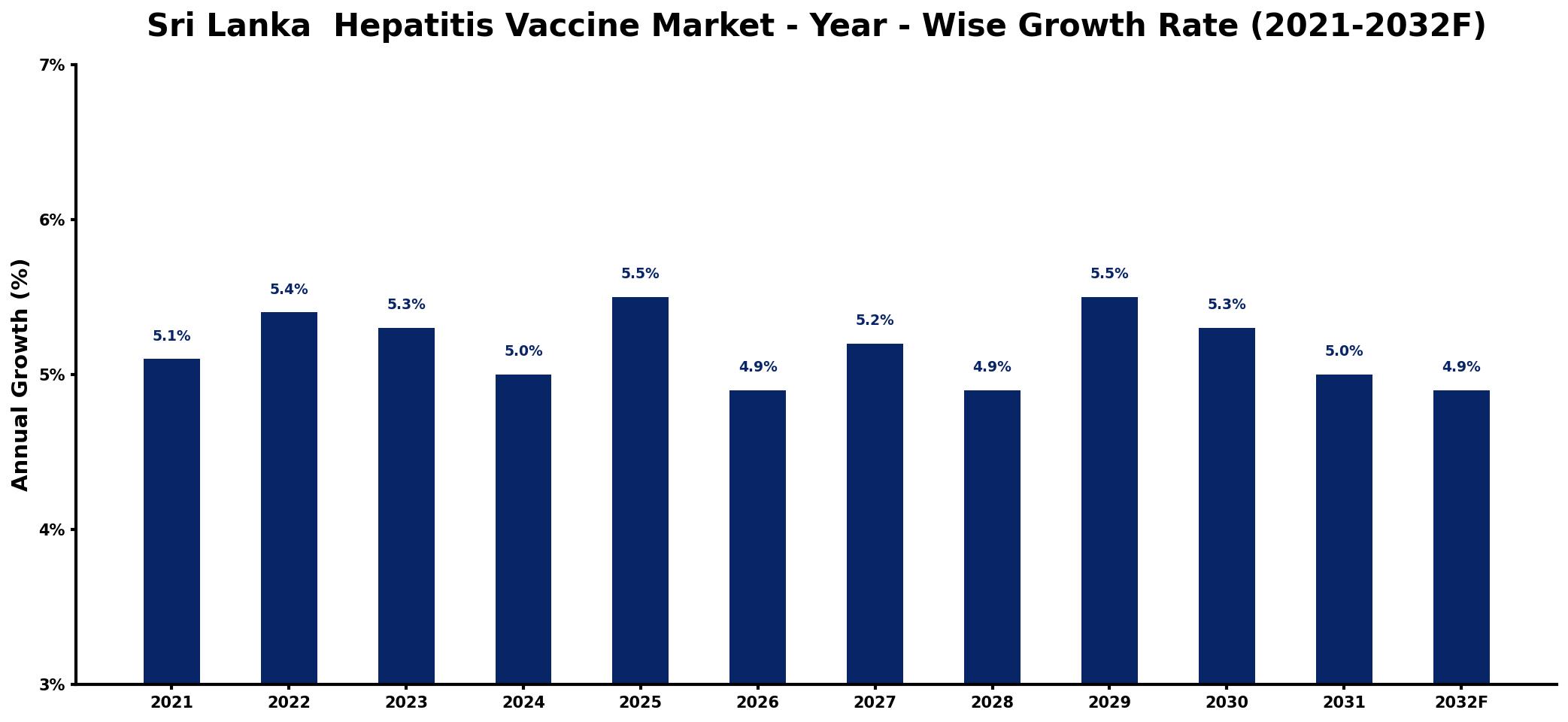
The table below presents the year‑wise growth rates along with the key drivers influencing the market
| Year | Growth Rate | Major Drivers |
| 2021 | 5.1% | Increased public health awareness campaigns |
| 2022 | 5.4% | Expansion of healthcare infrastructure investments |
| 2023 | 5.3% | Growing demand for preventive healthcare |
| 2024 | 5.0% | Rise in government health initiatives |
| 2025 | 5.5% | Boost in international funding allocations |
| 2026 | 4.9% | Development of new distribution channels |
| 2027 | 5.2% | Enhanced collaboration between stakeholders |
| 2028 | 4.9% | Increase in health insurance coverage |
| 2029 | 5.5% | Strengthening of supply chain networks |
| 2030 | 5.3% | Focus on community health programs |
| 2031 | 5.0% | Emergence of private sector partnerships |
| 2032 | 4.9% | Advancements in healthcare technology adoption |
Note: Market size estimations and growth projections presented in this report are based on 6Wresearch's proprietary forecasting methodology, utilizing the latest available industry data, government publications, and primary research inputs.
Sri Lanka Hepatitis Vaccine Market Synopsis
In Sri Lanka, a notable surge in vaccination programs has significantly increased access to hepatitis vaccines, especially in rural and underserved areas. This demand is further fueled by the governments commitment to reducing the incidence of hepatitis infections and improving healthcare standards across the nation.
As the healthcare sector continues to grow, both local and international vaccine manufacturers are tailoring their offerings to meet the diverse needs of the population. The emphasis on preventive healthcare and the rising prevalence of hepatitis infections are key factors that are enhancing the overall market landscape.
Sri Lanka Hepatitis Vaccine Market Key Takeaways
- Growing public awareness of hepatitis vaccination is positively impacting vaccination rates.
- Government initiatives are crucial in promoting and subsidizing hepatitis vaccination efforts.
- Investments in healthcare infrastructure are enhancing vaccine accessibility in remote areas.
- Domestic and international manufacturers are expanding their portfolios to include advanced vaccine options.
- Ongoing educational campaigns are vital to increasing the overall uptake of hepatitis vaccines.
Evaluation of Restraints in Sri Lanka Hepatitis Vaccine Market
Despite the positive outlook, certain constraints remain. Limited awareness of hepatitis vaccination among the general public and healthcare providers can lead to lower-than-desired vaccination rates. Additionally, the cost of hepatitis vaccines remains a significant barrier for segments of the population, limiting access to this essential preventive measure. The existing healthcare infrastructure, particularly in rural regions, poses challenges in the efficient distribution and administration of vaccines, potentially dampening vaccination efforts and resulting in suboptimal coverage.
Sri Lanka Hepatitis Vaccine Market Trends
The Sri Lanka Hepatitis Vaccine Market is undergoing transformative trends, including a growing preference for advanced vaccine formulations that offer enhanced protection against multiple strains of the virus. Additionally, there is a notable shift toward integrated immunization programs that are being supported by governmental and non-governmental organizations, effectively promoting greater vaccination coverage. As healthcare infrastructure expands, particularly in rural areas, improved access to vaccines is facilitating a higher adoption rate.
Sri Lanka Hepatitis Vaccine Market Opportunities
The market presents substantial investment opportunities, particularly in the production and distribution of innovative hepatitis vaccines. Stakeholders can explore collaborations with healthcare providers to develop targeted vaccination campaigns aimed at high-risk populations. Moreover, investing in research and development for vaccine formulations that cater specifically to local demographics could provide a competitive edge. Strategic partnerships with public health organizations are also crucial for fostering market entry and expansion.
Government Initiatives in the Sri Lanka Hepatitis Vaccine Market
The Sri Lankan government has established a comprehensive approach to tackling hepatitis through its National Immunization Program, overseen by the Ministry of Health, Nutrition, and Indigenous Medicine. This initiative focuses on providing hepatitis B vaccines to high-risk groups, such as healthcare professionals and vulnerable populations. The government has also formed partnerships with international bodies like the World Health Organization and UNICEF to enhance vaccine availability and affordability, thereby promoting public trust in immunization efforts.
Future Insights of the Sri Lanka Hepatitis Vaccine Market
Looking ahead to 2026-2032, the Sri Lanka Hepatitis Vaccine Market is poised for significant growth driven by a heightened focus on public health and expanded immunization programs. The increasing prevalence of hepatitis infections, coupled with rising healthcare expenditures, is expected to further stimulate market demand. Innovative vaccine technologies and emerging products are anticipated to revolutionize the landscape, although challenges such as cost and access disparities remain pivotal factors influencing growth.
Sri Lanka Hepatitis Vaccine Market Latest Developments (2025 - 2026)
In recent months, the Sri Lanka Hepatitis Vaccine Market has seen a notable increase in public health campaigns aimed at raising awareness about hepatitis prevention. Collaborative efforts between the government and healthcare organizations have led to more community outreach programs, facilitating greater access to vaccines. Additionally, there have been advancements in distribution networks, enhancing the efficiency of vaccine delivery to both urban and rural regions.
Sri Lanka Hepatitis Vaccine Market - Key Attractiveness of the Report
- 10 Years of Market Numbers
- Historical Data Starting from 2022 to 2025
- Base Year: 2025
- Forecast Data until 2032
- Key Performance Indicators Impacting the Market
- Major Upcoming Developments and Projects
Key Highlights of the Report:
- Sri Lanka Hepatitis Vaccine Market Outlook
- Market Size of Sri Lanka Hepatitis Vaccine Market, 2025
- Forecast of Sri Lanka Hepatitis Vaccine Market, 2032
- Historical Data and Forecast of Sri Lanka Hepatitis Vaccine Revenues & Volume for the Period 2022-2032F
- Sri Lanka Hepatitis Vaccine Market Trend Evolution
- Sri Lanka Hepatitis Vaccine Market Drivers and Challenges
- Sri Lanka Hepatitis Vaccine Price Trends
- Sri Lanka Hepatitis Vaccine Porter's Five Forces
- Sri Lanka Hepatitis Vaccine Industry Life Cycle
- Historical Data and Forecast of Sri Lanka Hepatitis Vaccine Market Revenues & Volume By Indication for the Period 2022-2032F
- Historical Data and Forecast of Sri Lanka Hepatitis Vaccine Market Revenues & Volume By Hepatitis A for the Period 2022-2032F
- Historical Data and Forecast of Sri Lanka Hepatitis Vaccine Market Revenues & Volume By Hepatitis B for the Period 2022-2032F
- Historical Data and Forecast of Sri Lanka Hepatitis Vaccine Market Revenues & Volume By Vaccine Type for the Period 2022-2032F
- Historical Data and Forecast of Sri Lanka Hepatitis Vaccine Market Revenues & Volume By Recombinant Vaccine for the Period 2022-2032F
- Historical Data and Forecast of Sri Lanka Hepatitis Vaccine Market Revenues & Volume By Inactivated Vaccine for the Period 2022-2032F
- Historical Data and Forecast of Sri Lanka Hepatitis Vaccine Market Revenues & Volume By Distribution Channel for the Period 2022-2032F
- Historical Data and Forecast of Sri Lanka Hepatitis Vaccine Market Revenues & Volume By Hospitals for the Period 2022-2032F
- Historical Data and Forecast of Sri Lanka Hepatitis Vaccine Market Revenues & Volume By Retail Pharmacy for the Period 2022-2032F
- Historical Data and Forecast of Sri Lanka Hepatitis Vaccine Market Revenues & Volume By Online Pharmacy for the Period 2022-2032F
- Sri Lanka Hepatitis Vaccine Import Export Trade Statistics
- Market Opportunity Assessment By Indication
- Market Opportunity Assessment By Vaccine Type
- Market Opportunity Assessment By Distribution Channel
- Sri Lanka Hepatitis Vaccine Top Companies Market Share
- Sri Lanka Hepatitis Vaccine Competitive Benchmarking By Technical and Operational Parameters
- Sri Lanka Hepatitis Vaccine Company Profiles
- Sri Lanka Hepatitis Vaccine Key Strategic Recommendations






































