Sri Lanka High Strength Steel Market Size, Share & Growth Rate
The Sri Lanka High Strength Steel Market was estimated at USD 669 Million in 2025 and is projected to reach USD 977 Million by 2032, growing at a CAGR of 5.6% from 2026 to 2032. This growth trajectory is significantly influenced by the burgeoning demand from the construction and automotive sectors, both of which are increasingly prioritizing lightweight materials that do not compromise on strength and durability. Moreover, the government's push for infrastructure development and the rising need for more fuel-efficient vehicles are further driving the adoption of high strength steel across various applications.
Sri Lanka High Strength Steel Market Year-wise Growth Rate and Key Drivers
This graph highlights how the Sri Lanka High Strength Steel Market has steadily grown over the years, supported by major growth factors.
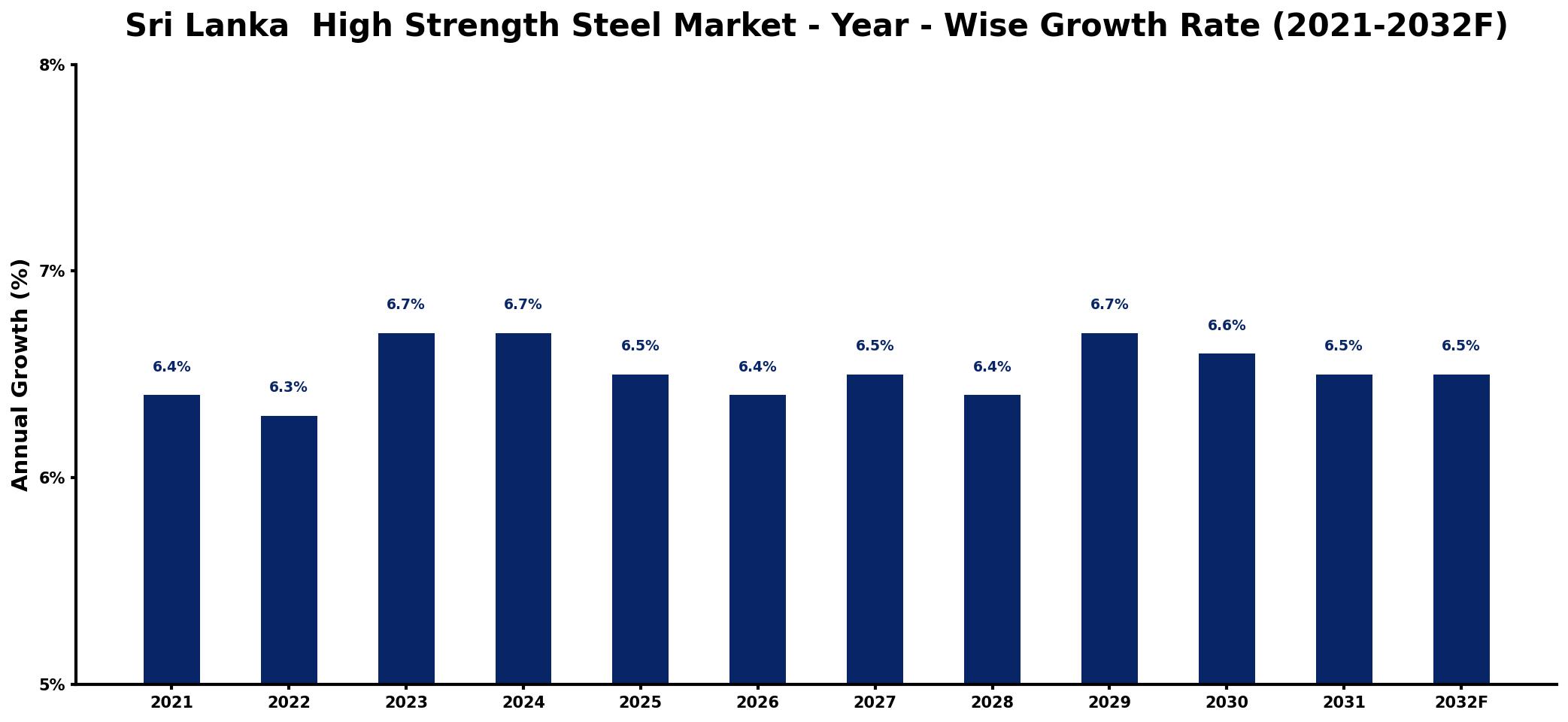
The table below presents the year‑wise growth rates along with the key drivers influencing the market
| Year | Growth Rate | Major Drivers |
| 2021 | 6.4% | Infrastructure projects drive demand |
| 2022 | 6.3% | Automotive sector expansion increases consumption |
| 2023 | 6.7% | Renewable energy investments rise significantly |
| 2024 | 6.7% | Construction boom fuels material needs |
| 2025 | 6.5% | Government initiatives support industrial growth |
| 2026 | 6.4% | Technological advancements enhance production efficiency |
| 2027 | 6.5% | International trade agreements boost exports |
| 2028 | 6.4% | Urbanization trends increase material requirements |
| 2029 | 6.7% | Defense sector procurement escalates sharply |
| 2030 | 6.6% | Mining operations expand investment opportunities |
| 2031 | 6.5% | Manufacturing sector shows robust recovery |
| 2032 | 6.5% | Research and development initiatives grow |
Note: Market size estimations and growth projections presented in this report are based on 6Wresearch's proprietary forecasting methodology, utilizing the latest available industry data, government publications, and primary research inputs.
Sri Lanka High Strength Steel Market Synopsis
In recent years, the Sri Lanka high strength steel market has been on a solid upward trajectory, reflecting a global trend toward using advanced materials that deliver performance and efficiency. Particularly in the construction and automotive sectors, there is an ever-increasing demand for materials that offer superior strength while minimizing weight, thus enhancing the overall project sustainability.
As Sri Lanka continues to invest in infrastructure, the adoption of high strength steel is becoming more prevalent. This strategic shift not only aligns with global sustainability goals but also supports local manufacturers in enhancing their product offerings to meet contemporary market demands, paving the way for innovation and technological advancement.
Sri Lanka High Strength Steel Market Key Takeaways
- The market is projected to grow significantly due to rising applications in construction and automotive sectors.
- Technological advancements in manufacturing processes are essential for maximizing market potential.
- Government initiatives are fostering an environment conducive to adopting high strength steel in key industries.
- Quality assurance and material certification are crucial factors affecting market dynamics.
- Infrastructure development projects are key drivers behind increased demand for high strength steel.
Evaluation of Restraints in Sri Lanka High Strength Steel Market
Despite the promising growth, the Sri Lanka high strength steel market contends with certain restraints that could hinder its expansion. One of the primary challenges is the technological barriers in manufacturing processes, which necessitate advanced metallurgical expertise that may not be widely available. This skills gap can impede the quality and consistency of high strength steel production. Moreover, issues with material certification and quality assurance standards can further complicate the market landscape, creating skepticism among potential users and limiting broader adoption across critical sectors.
Sri Lanka High Strength Steel Market Trends
Current trends in the Sri Lanka high strength steel market reflect a strong inclination towards sustainability and innovative manufacturing technologies. There is an observable shift towards using high strength steel in green building initiatives, where the emphasis is on reducing material waste while ensuring structural integrity. Additionally, with an increased focus on electric and hybrid vehicles, high strength steel is becoming vital for manufacturers seeking to optimize vehicle performance and fuel efficiency.
Sri Lanka High Strength Steel Market Opportunities
As the demand for high strength steel continues to surge, numerous growth opportunities are emerging, particularly in infrastructure projects backed by government funding. Companies that invest in research and development to innovate in high strength steel applications will likely capture significant market share. Moreover, collaboration between steel manufacturers and construction firms can lead to customized solutions that enhance structural performance while minimizing overall costs.
Government Initiatives in the Sri Lanka High Strength Steel Market
The Sri Lankan government plays an active role in promoting the use of high strength steel through various initiatives aimed at bolstering the construction and manufacturing sectors. These policies include subsidies for steel production, stringent quality control measures, and the prioritization of high-strength materials in public infrastructure development projects. By encouraging the adoption of high strength steel, the government is not only driving industrial growth but also fostering a more resilient economy.
Future Insights of the Sri Lanka High Strength Steel Market
Looking ahead to 2026-2032, the Sri Lanka high strength steel market is poised for notable advancements, driven by technological innovations and a sustained focus on sustainability. As the construction sector increasingly integrates smart technologies, the demand for high-performance materials like high strength steel will remain robust. Additionally, with the global shift towards greener manufacturing practices, local industries are likely to adopt high strength steel more widely to meet both national and international standards, ensuring significant market growth.
Sri Lanka High Strength Steel Market Latest Developments (2025 - 2026)
In the recent months leading up to June 2026, the Sri Lanka high strength steel market has witnessed a surge in collaborative projects aimed at enhancing the production capabilities of local manufacturers. These initiatives focus on integrating advanced technologies to streamline production processes while ensuring compliance with international quality standards. Furthermore, government infrastructure projects have increasingly emphasized the need for high strength materials, paving the way for expanded market applications.
Sri Lanka High Strength Steel Market - Key Attractiveness of the Report
- 10 Years of Market Numbers
- Historical Data Starting from 2022 to 2025
- Base Year: 2025
- Forecast Data until 2032
- Key Performance Indicators Impacting the Market
- Major Upcoming Developments and Projects
Key Highlights of the Report:
- Sri Lanka High Strength Steel Market Outlook
- Market Size of Sri Lanka High Strength Steel Market, 2025
- Forecast of Sri Lanka High Strength Steel Market, 2032
- Historical Data and Forecast of Sri Lanka High Strength Steel Revenues & Volume for the Period 2022-2032F
- Sri Lanka High Strength Steel Market Trend Evolution
- Sri Lanka High Strength Steel Market Drivers and Challenges
- Sri Lanka High Strength Steel Price Trends
- Sri Lanka High Strength Steel Porter's Five Forces
- Sri Lanka High Strength Steel Industry Life Cycle
- Historical Data and Forecast of Sri Lanka High Strength Steel Market Revenues & Volume By Product Type for the Period 2022-2032F
- Historical Data and Forecast of Sri Lanka High Strength Steel Market Revenues & Volume By Dual Phase Steel for the Period 2022-2032F
- Historical Data and Forecast of Sri Lanka High Strength Steel Market Revenues & Volume By Bake Hardenable Steel for the Period 2022-2032F
- Historical Data and Forecast of Sri Lanka High Strength Steel Market Revenues & Volume By Carbon Manganese Steel for the Period 2022-2032F
- Historical Data and Forecast of Sri Lanka High Strength Steel Market Revenues & Volume By Other Product Types for the Period 2022-2032F
- Historical Data and Forecast of Sri Lanka High Strength Steel Market Revenues & Volume By Application for the Period 2022-2032F
- Historical Data and Forecast of Sri Lanka High Strength Steel Market Revenues & Volume By Automotive for the Period 2022-2032F
- Historical Data and Forecast of Sri Lanka High Strength Steel Market Revenues & Volume By Construction for the Period 2022-2032F
- Historical Data and Forecast of Sri Lanka High Strength Steel Market Revenues & Volume By Yellow Goods and Mining Equipment for the Period 2022-2032F
- Historical Data and Forecast of Sri Lanka High Strength Steel Market Revenues & Volume By Aviation and Marine for the Period 2022-2032F
- Historical Data and Forecast of Sri Lanka High Strength Steel Market Revenues & Volume By Other Applications for the Period 2022-2032F
- Sri Lanka High Strength Steel Import Export Trade Statistics
- Market Opportunity Assessment By Product Type
- Market Opportunity Assessment By Application
- Sri Lanka High Strength Steel Top Companies Market Share
- Sri Lanka High Strength Steel Competitive Benchmarking By Technical and Operational Parameters
- Sri Lanka High Strength Steel Company Profiles
- Sri Lanka High Strength Steel Key Strategic Recommendations






































