Sri Lanka Life Science Reagents Market Size, Share & Growth Rate
The Sri Lanka Life Science Reagents Market was estimated at USD 463 Million in 2025 and is projected to reach USD 638 Million by 2032, growing at a CAGR of 4.7% from 2026 to 2032. This growth trajectory is primarily fueled by heightened investments in pharmaceutical and biotechnology research, which are critical sectors for the nation. As research endeavors expand, the demand for high-quality reagents becomes increasingly vital, positioning this market for significant advancement.
Sri Lanka Life Science Reagents Market Year-wise Growth Rate and Key Drivers
This graph highlights how the Sri Lanka Life Science Reagents Market has steadily grown over the years, supported by major growth factors.
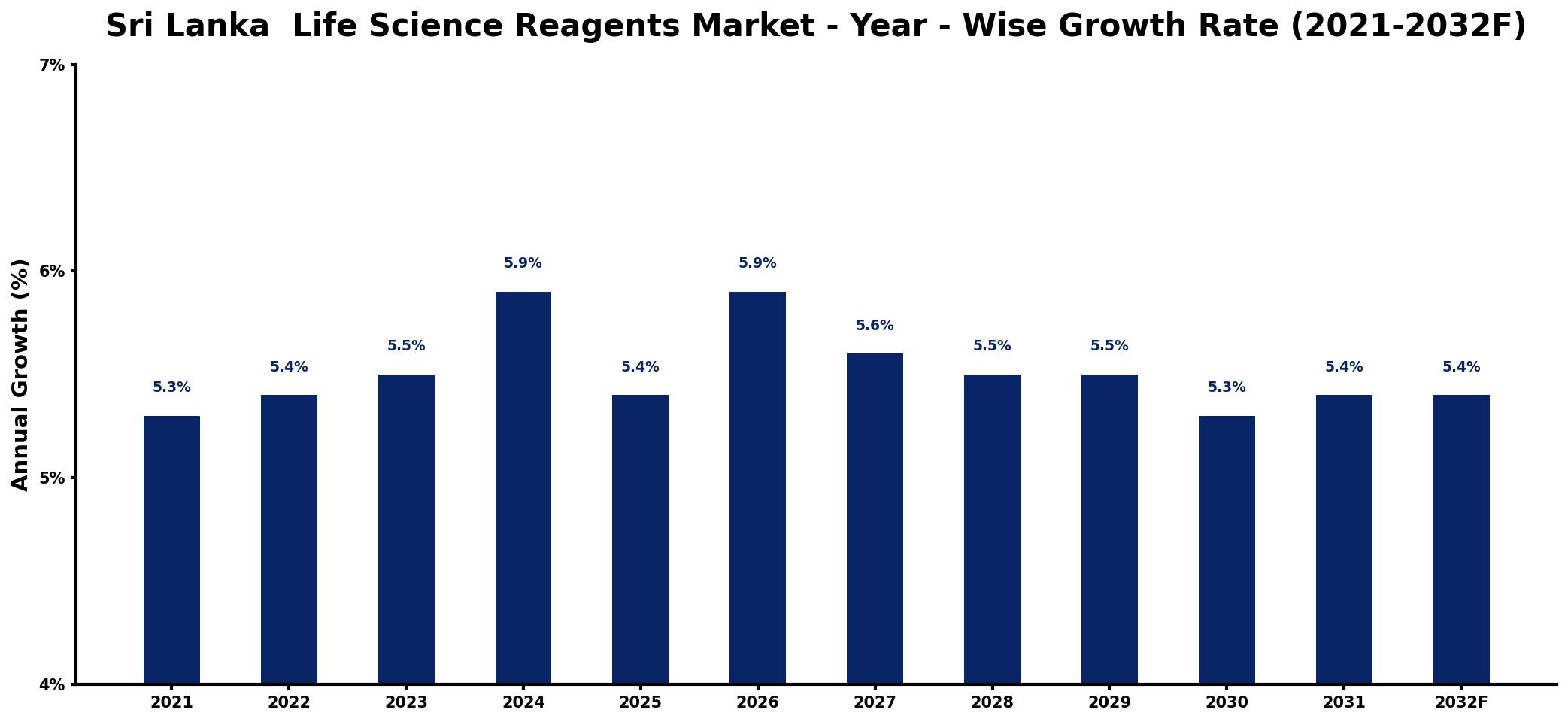
The table below presents the year‑wise growth rates along with the key drivers influencing the market
| Year | Growth Rate | Major Drivers |
| 2021 | 5.3% | Rising biotech research funding influx |
| 2022 | 5.4% | Increased healthcare diagnostics demand surge |
| 2023 | 5.5% | Growing pharmaceutical development activities rise |
| 2024 | 5.9% | Expansion of educational research institutions |
| 2025 | 5.4% | Enhanced regulatory support for innovation |
| 2026 | 5.9% | Advancements in molecular biology techniques |
| 2027 | 5.6% | Growing public health initiatives increase |
| 2028 | 5.5% | Investment in clinical trials expands |
| 2029 | 5.5% | Emerging technologies driving research growth |
| 2030 | 5.3% | Demand from environmental testing increases |
| 2031 | 5.4% | Strengthening partnerships in research collaboration |
| 2032 | 5.4% | Focus on personalized medicine innovations |
Note: Market size estimations and growth projections presented in this report are based on 6Wresearch's proprietary forecasting methodology, utilizing the latest available industry data, government publications, and primary research inputs.
Sri Lanka Life Science Reagents Market Synopsis
The most influential factor shaping the Sri Lanka Life Science Reagents Market is the surge in research and development activities within the pharmaceutical and biotechnology sectors. This momentum is being complemented by a growing focus on personalized medicine, pushing the demand for innovative reagents that support molecular biology and genomics.
Furthermore, the market is responding to a critical need for high-quality diagnostic tools, especially in light of the COVID-19 pandemic. As rapid testing becomes a cornerstone of healthcare strategy, the demand for reagents utilized in diagnostic kits is steadily increasing, ensuring that the life sciences sector remains at the forefront of public health solutions.
Sri Lanka Life Science Reagents Market Key Takeaways
- Steady growth projected with a market size expected to reach USD 638 Million by 2032.
- Heightened investments in life sciences R&D driving the need for high-quality reagents.
- Personalized medicine and diagnostics emerging as a significant focus area for researchers.
- Government initiatives promoting healthcare infrastructure support market expansion.
- Collaboration with local research institutions is critical for accessing skilled talent.
Evaluation of Restraints in Sri Lanka Life Science Reagents Market
Despite promising growth, the Sri Lanka Life Science Reagents Market faces several constraints. One major barrier is the high cost associated with life science reagents, which can restrict access for smaller research facilities and startups. Import restrictions and regulatory hurdles may limit the availability of advanced reagents, further complicating the research landscape. Additionally, the absence of a well-trained workforce in specialized areas may stifle innovation and efficient reagent utilization, thereby impacting overall market performance.
Sri Lanka Life Science Reagents Market Trends
Several trends are shaping the Sri Lanka Life Science Reagents Market. Notably, there is a growing emphasis on sustainability, with many stakeholders seeking eco-friendly reagent options to minimize environmental impact. Additionally, advancements in technology are facilitating new product developments tailored to specific life science applications, particularly in genomics and proteomics. Furthermore, the demand for rapid diagnostic testing remains strong, continuing to fuel investments in reagents that support these emerging healthcare needs.
Sri Lanka Life Science Reagents Market Opportunities
Investment opportunities within the Sri Lanka Life Science Reagents Market are plentiful. Companies can focus on supplying specialized reagents that cater to the increasing needs of genomics, proteomics, and other life sciences applications. Engaging in strategic collaborations with local universities and research institutions can lead to innovation and access to a skilled workforce. As the life sciences sector evolves, there's significant potential for businesses to introduce groundbreaking reagents that address specific market needs and consumer demands.
Government Initiatives in the Sri Lanka Life Science Reagents Market
The Sri Lankan government has taken proactive measures to regulate the life science reagents market, emphasizing quality, safety, and efficacy. This includes stringent licensing requirements for importing and selling reagents and guidelines for ensuring adherence to labeling and packaging regulations. The government also aims to foster an environment conducive to research and development by monitoring pricing practices, ensuring affordability and accessibility for consumers while supporting overall market growth.
Future Insights of the Sri Lanka Life Science Reagents Market
Looking ahead, the Sri Lanka Life Science Reagents Market is anticipated to maintain its growth momentum through 2032. With increasing investments in personalized healthcare solutions and advancements in research methodologies, the market will likely witness the emergence of innovative reagents that align with global scientific trends. Furthermore, government support for healthcare infrastructure and collaborative ventures will play a pivotal role in propelling market expansion, allowing both local and international firms to capitalize on the burgeoning opportunities within the sector.
Sri Lanka Life Science Reagents Market Latest Developments (2025 - 2026)
Recent developments in the Sri Lanka Life Science Reagents Market highlight a strong focus on enhancing research capabilities and product offerings. Stakeholders are increasingly investing in R&D initiatives to develop specialized reagents tailored for emerging applications. Furthermore, partnerships between local institutions and international companies have begun to materialize, aiming to boost technological transfer and innovation. This shift reflects a dynamic market environment, where adaptability and collaboration are essential for success.
Sri Lanka Life Science Reagents Market - Key Attractiveness of the Report
- 10 Years of Market Numbers
- Historical Data Starting from 2022 to 2025
- Base Year: 2025
- Forecast Data until 2032
- Key Performance Indicators Impacting the Market
- Major Upcoming Developments and Projects
Key Highlights of the Report:
- Sri Lanka Life Science Reagents Market Outlook
- Market Size of Sri Lanka Life Science Reagents Market, 2025
- Forecast of Sri Lanka Life Science Reagents Market, 2032
- Historical Data and Forecast of Sri Lanka Life Science Reagents Revenues & Volume for the Period 2022-2032F
- Sri Lanka Life Science Reagents Market Trend Evolution
- Sri Lanka Life Science Reagents Market Drivers and Challenges
- Sri Lanka Life Science Reagents Price Trends
- Sri Lanka Life Science Reagents Porter's Five Forces
- Sri Lanka Life Science Reagents Industry Life Cycle
- Historical Data and Forecast of Sri Lanka Life Science Reagents Market Revenues & Volume By Product for the Period 2022-2032F
- Historical Data and Forecast of Sri Lanka Life Science Reagents Market Revenues & Volume By Chromatography Reagents for the Period 2022-2032F
- Historical Data and Forecast of Sri Lanka Life Science Reagents Market Revenues & Volume By Molecular Diagnostics Reagents for the Period 2022-2032F
- Historical Data and Forecast of Sri Lanka Life Science Reagents Market Revenues & Volume By Immunoassay Reagents for the Period 2022-2032F
- Historical Data and Forecast of Sri Lanka Life Science Reagents Market Revenues & Volume By Clinical Chemistry Reagents for the Period 2022-2032F
- Historical Data and Forecast of Sri Lanka Life Science Reagents Market Revenues & Volume By Flow Cytometry Reagents for the Period 2022-2032F
- Historical Data and Forecast of Sri Lanka Life Science Reagents Market Revenues & Volume By Cell & Tissue Culture Reagents for the Period 2022-2032F
- Historical Data and Forecast of Sri Lanka Life Science Reagents Market Revenues & Volume By Hematology & Hemostasis Reagents for the Period 2022-2032F
- Historical Data and Forecast of Sri Lanka Chromatography Reagents Life Science Reagents Market Revenues & Volume By Microbiology Reagents for the Period 2022-2032F
- Historical Data and Forecast of Sri Lanka Life Science Reagents Market Revenues & Volume By End-user for the Period 2022-2032F
- Historical Data and Forecast of Sri Lanka Life Science Reagents Market Revenues & Volume By Hospitals & Diagnostics Laboratories for the Period 2022-2032F
- Historical Data and Forecast of Sri Lanka Life Science Reagents Market Revenues & Volume By Commercial & Contract Research Manufacturers for the Period 2022-2032F
- Historical Data and Forecast of Sri Lanka Life Science Reagents Market Revenues & Volume By Academic & Research Institutes for the Period 2022-2032F
- Historical Data and Forecast of Sri Lanka Life Science Reagents Market Revenues & Volume By Others for the Period 2022-2032F
- Sri Lanka Life Science Reagents Import Export Trade Statistics
- Market Opportunity Assessment By Product
- Market Opportunity Assessment By End-user
- Sri Lanka Life Science Reagents Top Companies Market Share
- Sri Lanka Life Science Reagents Competitive Benchmarking By Technical and Operational Parameters
- Sri Lanka Life Science Reagents Company Profiles
- Sri Lanka Life Science Reagents Key Strategic Recommendations






































