Sri Lanka Railway Maintenance Machinery Market Size, Share & Growth Rate
The Sri Lanka Railway Maintenance Machinery Market was estimated at USD 561 Million in 2025 and is projected to reach USD 972 Million by 2032, growing at a CAGR of 8.2% from 2026 to 2032. This growth trajectory is significantly influenced by the Sri Lankan government's commitment to modernizing railway infrastructure, with increased funding for both maintenance and expansion projects. Additionally, the ongoing demand for safer and more efficient railway operations drives investments in advanced maintenance technologies.
Sri Lanka Railway Maintenance Machinery Market Year-wise Growth Rate and Key Drivers
This graph highlights how the Sri Lanka Railway Maintenance Machinery Market has steadily grown over the years, supported by major growth factors.
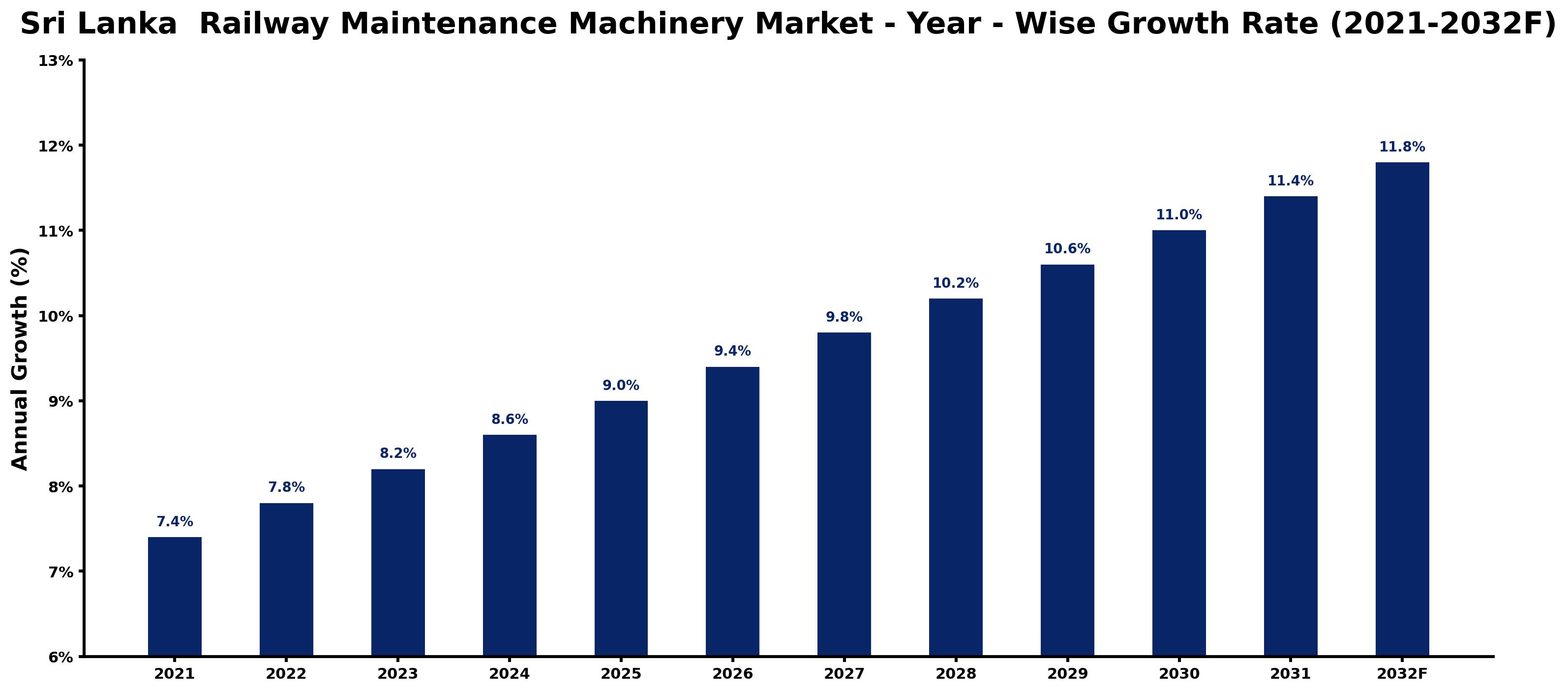
The table below presents the year‑wise growth rates along with the key drivers influencing the market
| Year | Growth Rate | Major Drivers |
| 2021 | 7.4% | Increasing adoption of advanced technologies |
| 2022 | 7.8% | Expansion of transportation and logistics networks |
| 2023 | 8.2% | Growing urbanization and commercial development |
| 2024 | 8.6% | Rapid growth in telecom and data center sectors |
| 2025 | 9.0% | Expansion of manufacturing activities |
| 2026 | 9.4% | Increasing smart city development projects |
| 2027 | 9.8% | Increasing smart city development projects |
| 2028 | 10.2% | Expansion of manufacturing activities |
| 2029 | 10.6% | Rapid growth in telecom and data center sectors |
| 2030 | 11.0% | Growing urbanization and commercial development |
| 2031 | 11.4% | Increasing adoption of advanced technologies |
| 2032 | 11.8% | Growing renewable energy integration projects |
Note - Market size estimations and growth projections presented in this report are based on 6Wresearch’s advanced forecasting approach, validated with industry datasets as of June 2026.
Sri Lanka Railway Maintenance Machinery Market Synopsis
The most influential factor currently shaping the Sri Lanka Railway Maintenance Machinery Market is the government's strategic focus on enhancing railway infrastructure. This initiative not only aims to improve connectivity but also addresses the need for efficient maintenance solutions that can handle the growing demands of the railway network.
As investments flow into the sector, international firms are keen to introduce their state-of-the-art maintenance machinery. This influx is critical as it helps to overcome existing limitations in technology and offers opportunities for the adoption of modern practices in rail maintenance.
Sri Lanka Railway Maintenance Machinery Market Key Takeaways
- The market is driven by substantial governmental investment aimed at railway modernization.
- Technological advancements, particularly automation and IoT integration, are reshaping maintenance processes.
- Growing emphasis on eco-friendly and energy-efficient machinery aligns with sustainable development goals.
- Private sector involvement is enhancing competition and innovation within the market.
- The need for real-time monitoring and predictive maintenance is increasing, boosting demand for advanced machinery.
Evaluation of Restraints in Sri Lanka Railway Maintenance Machinery Market
Despite the promising growth, several constraints are hindering the Sri Lanka Railway Maintenance Machinery Market. Limited access to cutting-edge technology presents a substantial barrier, as does the shortage of skilled professionals trained to operate and maintain advanced machinery. Moreover, funding limitations often stall the upgrade of outdated equipment, hampering the overall efficiency of railway maintenance operations. Compounding these issues, inconsistent government policies and lengthy approval processes can delay crucial projects, affecting timely execution. Additionally, disruptions in supply chains, particularly for spare parts, pose further challenges that need addressing to unlock the full potential of the market.
Sri Lanka Railway Maintenance Machinery Market Trends
Several key trends are emerging within the Sri Lanka Railway Maintenance Machinery Market. The integration of computerized maintenance management systems (CMMS) has gained traction, allowing operators to streamline scheduling and maintenance tracking. Furthermore, the implementation of IoT technologies enables real-time monitoring of equipment health, which is critical for predictive maintenance. This proactive approach minimizes downtime and enhances reliability across the rail network. Additionally, there is a marked shift towards sustainable machinery, with demand for eco-friendly equipment increasing as operators aim to comply with evolving environmental regulations.
Sri Lanka Railway Maintenance Machinery Market Opportunities
The Sri Lanka Railway Maintenance Machinery Market is ripe with investment opportunities, particularly as the government intensifies efforts to upgrade railway infrastructure. There is a growing need for advanced maintenance machinery, such as ballast regulators and rail grinders, driven by the expansion of the rail network and an uptick in railway transportation demand. The prospect of private sector participation further enriches this market landscape, offering avenues for innovative solutions and technologies that can elevate operational efficiency. Investors and stakeholders who understand the specific dynamics of the local railway sector will find substantial long-term growth potential.
Government Initiatives in the Sri Lanka Railway Maintenance Machinery Market
The Sri Lankan government has taken proactive measures to bolster the railway maintenance machinery sector. Initiatives include investments directed towards upgrading and expanding the existing railway infrastructure, with a focus on incorporating advanced machinery and technologies. Furthermore, regulations have been instituted to align operations with international standards, fostering a more competitive environment. These policies are designed to attract foreign investments and ultimately support the sustainable growth of the railway sector.
Future Insights of the Sri Lanka Railway Maintenance Machinery Market
Looking ahead to 2026-2032, the Sri Lanka Railway Maintenance Machinery Market is poised for sustained growth, primarily fueled by ongoing modernization initiatives and an emphasis on enhancing operational safety and efficiency. The increasing push for environmentally sustainable solutions will likely drive the adoption of innovative, eco-friendly machinery. With escalating investments in railway projects and an urgent need for reliable maintenance, this market presents numerous opportunities for stakeholders aiming to capitalize on the expanding railway network across Sri Lanka.
Sri Lanka Railway Maintenance Machinery Market Latest Developments (May 2025 - June 2026)
Recent developments in the Sri Lanka Railway Maintenance Machinery Market indicate a growing alignment between public and private sectors to enhance maintenance capabilities. Collaborative efforts are underway to introduce cutting-edge maintenance solutions aimed at boosting efficiency. Additionally, the focus on sustainability is becoming increasingly paramount, with new eco-friendly machinery being integrated into maintenance operations to meet regulatory requirements and market demands.
Sri Lanka Railway Maintenance Machinery Market - Key Attractiveness of the Report
- 10 Years of Market Numbers
- Historical Data Starting from 2022 to 2025
- Base Year: 2025
- Forecast Data until 2032
- Key Performance Indicators Impacting the Market
- Major Upcoming Developments and Projects
Key Highlights of the Report:
- Sri Lanka Railway Maintenance Machinery Market Outlook
- Market Size of Sri Lanka Railway Maintenance Machinery Market, 2025
- Forecast of Sri Lanka Railway Maintenance Machinery Market, 2032
- Historical Data and Forecast of Sri Lanka Railway Maintenance Machinery Revenues & Volume for the Period 2022-2032F
- Sri Lanka Railway Maintenance Machinery Market Trend Evolution
- Sri Lanka Railway Maintenance Machinery Market Drivers and Challenges
- Sri Lanka Railway Maintenance Machinery Price Trends
- Sri Lanka Railway Maintenance Machinery Porter's Five Forces
- Sri Lanka Railway Maintenance Machinery Industry Life Cycle
- Historical Data and Forecast of Sri Lanka Railway Maintenance Machinery Market Revenues & Volume By Type for the Period 2022-2032F
- Historical Data and Forecast of Sri Lanka Railway Maintenance Machinery Market Revenues & Volume By Tamping Machine for the Period 2022-2032F
- Historical Data and Forecast of Sri Lanka Railway Maintenance Machinery Market Revenues & Volume By Stabilizing Machinery for the Period 2022-2032F
- Historical Data and Forecast of Sri Lanka Railway Maintenance Machinery Market Revenues & Volume By Rail Handling Machinery for the Period 2022-2032F
- Historical Data and Forecast of Sri Lanka Railway Maintenance Machinery Market Revenues & Volume By Ballast Cleaning Machine for the Period 2022-2032F
- Historical Data and Forecast of Sri Lanka Railway Maintenance Machinery Market Revenues & Volume By Other for the Period 2022-2032F
- Historical Data and Forecast of Sri Lanka Railway Maintenance Machinery Market Revenues & Volume By Applications for the Period 2022-2032F
- Historical Data and Forecast of Sri Lanka Railway Maintenance Machinery Market Revenues & Volume By Ballast Track for the Period 2022-2032F
- Historical Data and Forecast of Sri Lanka Railway Maintenance Machinery Market Revenues & Volume By Ballastless Track for the Period 2022-2032F
- Sri Lanka Railway Maintenance Machinery Import Export Trade Statistics
- Market Opportunity Assessment By Type
- Market Opportunity Assessment By Applications
- Sri Lanka Railway Maintenance Machinery Top Companies Market Share
- Sri Lanka Railway Maintenance Machinery Competitive Benchmarking By Technical and Operational Parameters
- Sri Lanka Railway Maintenance Machinery Company Profiles
- Sri Lanka Railway Maintenance Machinery Key Strategic Recommendations






































