Sri Lanka Window Covering Market Size, Share & Growth Rate
The Sri Lanka Window Covering Market was estimated at USD 150 Million in 2025 and is projected to reach USD 199 Million by 2032, growing at a CAGR of 4.1% from 2026 to 2032. This growth trajectory is largely driven by a surge in residential and commercial construction activities, which are propelling the demand for aesthetically pleasing and functional window coverings. Additionally, the rising awareness of energy efficiency and the inclination towards smart home technologies are further contributing to the markets expansion.
Sri Lanka Window Covering Market Growth Rate Analysis (2021-2032)
The Sri Lanka window covering market has shown resilient growth, with annual increases ranging from 4.6% to 5.2% over the past few years. In 2021, growth stood at 4.6%, while 2022 saw a slight uptick to 5.1%. This upward trend is attributed to rising consumer demand for energy-efficient solutions and an increasing focus on eco-friendly materials, aligning with global sustainability trends. The forecasted growth of 5.0% in both 2024 and 2025 indicates a stable market environment, supported by investments in infrastructure and digitalization in retail channels. Fluctuations in growth, such as the drop to 4.8% in 2026, reflect periodic supply chain challenges but remain within a healthy range as domestic manufacturers adapt to market needs. Overall, the sector is set to thrive, driven by evolving consumer preferences and continued commitment to modernizing home environments.
Sri Lanka Window Covering Market Year-wise Growth Rate and Key Drivers
This graph highlights how the Sri Lanka Window Covering Market has steadily grown over the past five years, supported by major growth factors.
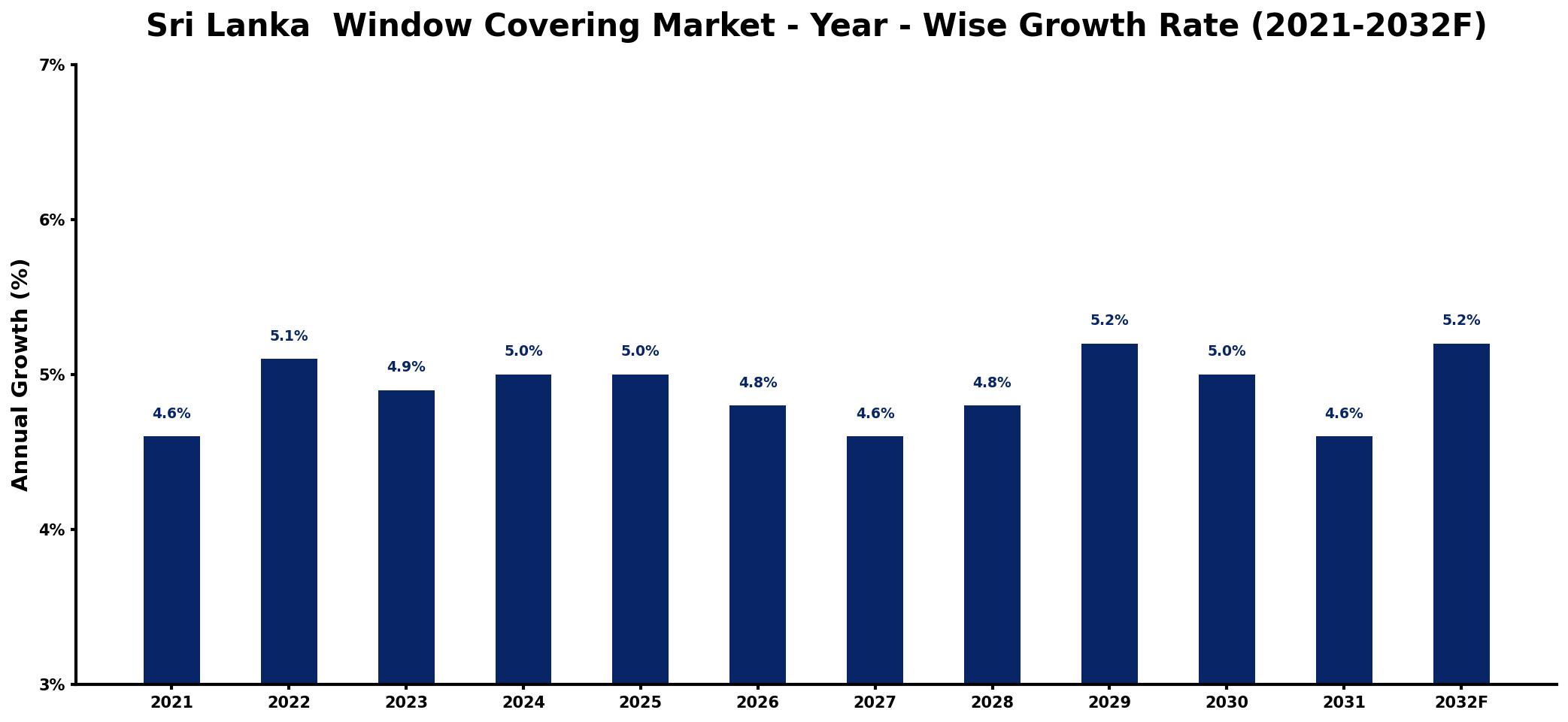
The table below presents the year‑wise growth rates along with the key drivers influencing the market
| Year | Growth Rate | Major Drivers |
| 2021 | 4.6% | Rising urban residential projects |
| 2022 | 5.1% | Increased construction sector investments |
| 2023 | 4.9% | Growing demand for energy efficiency |
| 2024 | 5.0% | Expansion of hospitality industry |
| 2025 | 5.0% | Surge in interior design trends |
| 2026 | 4.8% | Growth in DIY home improvement |
| 2027 | 4.6% | Technological advancements in materials |
| 2028 | 4.8% | Increase in eco-friendly products |
| 2029 | 5.2% | Rising disposable income levels |
| 2030 | 5.0% | increased capital investment inflows |
| 2031 | 4.6% | Emergence of smart home technology |
| 2032 | 5.2% | increased production capacity utilization |
Note: Market size estimations and growth projections presented in this report are based on 6Wresearch's proprietary forecasting methodology, utilizing the latest available industry data, government publications, and primary research inputs.
Sri Lanka Window Covering Market Synopsis
The Sri Lanka window covering market is characterized by a growing preference for customizable designs that cater to individual tastes and modern living requirements. This demand is complemented by a notable shift towards eco-friendly materials, aligning with global sustainability trends.
With increasing interior design sophistication, both residential and commercial spaces are adopting innovative window covering solutions. Motorized and smart options are gaining traction, reflecting a broader move towards technology-enhanced living and working environments in Sri Lanka.
Sri Lanka Window Covering Market Key Takeaways
- Robust market growth driven by ongoing construction and interior design trends.
- Increasing preference for customizable and eco-friendly window covering solutions.
- Emergence of smart window coverings catering to modern lifestyle demands.
- Government policies promoting quality standards bolster market confidence.
- Heightened awareness about energy efficiency benefits among consumers.
Evaluation of Restraints in Sri Lanka Window Covering Market
While the Sri Lanka window covering market shows promising growth potential, several restraints need to be considered. High production costs associated with advanced materials and technology limit price competitiveness. Furthermore, the specialized skills required for proper installation and maintenance of modern window coverings present challenges to widespread adoption. The general lack of awareness regarding the benefits of innovative window solutions further hinders market growth, as does competition from traditional window covering options. Economic instability also poses risks that could affect consumer spending and investment in this sector.
Sri Lanka Window Covering Market Trends
Current trends in the Sri Lanka window covering market highlight a growing inclination towards automation, with smart window coverings becoming increasingly popular. These innovations not only offer convenience but also align with the energy efficiency goals of many consumers. Additionally, theres a rising demand for products that combine style with functionality, emphasizing the need for innovative designs and eco-conscious materials.
Moreover, as urbanization continues to rise, the need for versatile window solutions that provide privacy and aesthetics in limited spaces is becoming more pronounced. This shift is pushing manufacturers to develop products that cater specifically to urban consumers needs.
Sri Lanka Window Covering Market Opportunities
The Sri Lanka window covering market offers numerous opportunities for growth and investment. As urbanization accelerates, there is a significant opportunity for products tailored for compact living spaces. Additionally, the increasing popularity of green building practices presents a market for energy-efficient window coverings that contribute to overall sustainability goals. Manufacturers who invest in innovative technologies and materials stand to gain substantial market share, particularly as consumers become more conscious of eco-friendly options.
Government Initiatives in the Sri Lanka Window Covering Market
Government initiatives aimed at promoting construction innovation and enhancing product quality are crucial for the window covering market. Policies that support the adoption of advanced window solutions in both residential and commercial settings foster an environment conducive to growth. Regulatory frameworks focusing on building standards and energy efficiency also play a pivotal role in shaping market dynamics, encouraging manufacturers to improve their offerings to meet these standards.
Future Insights of the Sri Lanka Window Covering Market
Looking ahead to the period from 2026 to 2032, the Sri Lanka window covering market is set to witness continued growth fueled by ongoing urbanization and evolving consumer preferences. As technology advances, the integration of smart solutions will likely redefine how consumers interact with window coverings. Moreover, increased focus on energy efficiency and eco-friendly materials will further drive market dynamics. The sector is poised to become an integral part of modern architectural design, making it essential for stakeholders to stay ahead of trends to capitalize on emerging opportunities.
Sri Lanka Window Covering Market Latest Developments (2025 - 2026)
Recent developments in the Sri Lanka window covering market indicate a robust push towards integrating smart technology into products. Companies are exploring advanced automation features, enhancing user experience and energy efficiency. Additionally, there is a noticeable shift in consumer preference towards eco-conscious products, prompting manufacturers to innovate with sustainable materials. These trends are expected to shape the market's future direction and align with global sustainability goals.
Sri Lanka Window Covering Market - Key Attractiveness of the Report
- 10 Years of Market Numbers
- Historical Data Starting from 2022 to 2025
- Base Year: 2025
- Forecast Data until 2032
- Key Performance Indicators Impacting the Market
- Major Upcoming Developments and Projects
Key Highlights of the Report:
- Sri Lanka Window Covering Market Outlook
- Market Size of Sri Lanka Window Covering Market, 2025
- Forecast of Sri Lanka Window Covering Market, 2032
- Historical Data and Forecast of Sri Lanka Window Covering Revenues & Volume for the Period 2022-2032F
- Sri Lanka Window Covering Market Trend Evolution
- Sri Lanka Window Covering Market Drivers and Challenges
- Sri Lanka Window Covering Price Trends
- Sri Lanka Window Covering Porter's Five Forces
- Sri Lanka Window Covering Industry Life Cycle
- Historical Data and Forecast of Sri Lanka Window Covering Market Revenues & Volume By Type for the Period 2022-2032F
- Historical Data and Forecast of Sri Lanka Window Covering Market Revenues & Volume By Blinds & Shades for the Period 2022-2032F
- Historical Data and Forecast of Sri Lanka Window Covering Market Revenues & Volume By Curtains for the Period 2022-2032F
- Historical Data and Forecast of Sri Lanka Window Covering Market Revenues & Volume By Shutters for the Period 2022-2032F
- Historical Data and Forecast of Sri Lanka Window Covering Market Revenues & Volume By Others for the Period 2022-2032F
- Historical Data and Forecast of Sri Lanka Window Covering Market Revenues & Volume By Application for the Period 2022-2032F
- Historical Data and Forecast of Sri Lanka Window Covering Market Revenues & Volume By Residential for the Period 2022-2032F
- Historical Data and Forecast of Sri Lanka Window Covering Market Revenues & Volume By Commercial for the Period 2022-2032F
- Historical Data and Forecast of Sri Lanka Window Covering Market Revenues & Volume By Distribution Channel for the Period 2022-2032F
- Historical Data and Forecast of Sri Lanka Window Covering Market Revenues & Volume By Online for the Period 2022-2032F
- Historical Data and Forecast of Sri Lanka Window Covering Market Revenues & Volume By Offline for the Period 2022-2032F
- Historical Data and Forecast of Sri Lanka Window Covering Market Revenues & Volume By Supermarkets/Hypermarkets for the Period 2022-2032F
- Historical Data and Forecast of Sri Lanka Window Covering Market Revenues & Volume By Specialty Stores for the Period 2022-2032F
- Historical Data and Forecast of Sri Lanka Window Covering Market Revenues & Volume By Multi Brand Stores for the Period 2022-2032F
- Sri Lanka Window Covering Import Export Trade Statistics
- Market Opportunity Assessment By Type
- Market Opportunity Assessment By Application
- Market Opportunity Assessment By Distribution Channel
- Sri Lanka Window Covering Top Companies Market Share
- Sri Lanka Window Covering Competitive Benchmarking By Technical and Operational Parameters
- Sri Lanka Window Covering Company Profiles
- Sri Lanka Window Covering Key Strategic Recommendations






































