Eswatini Synthetic Rope Market Growth Rate Analysis (2025 - 2031)
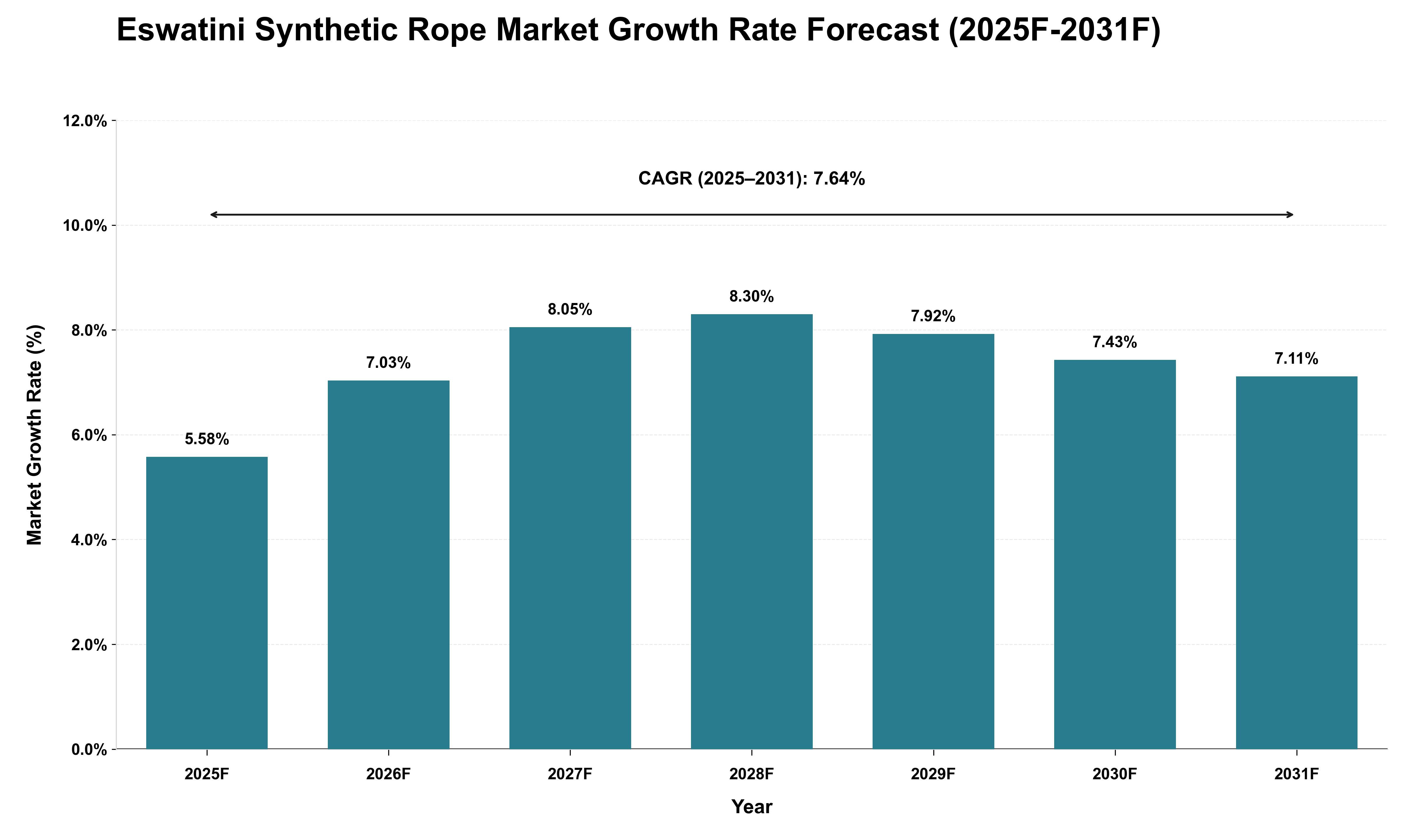
The Eswatini synthetic rope market will experience robust growth driven by increasing demand for durable and lightweight materials across various sectors, including construction, marine, and agriculture. The forecasted CAGR of 7.64% reflects a strong trajectory, with annual growth rates peaking at 8.30% in 2028, indicating heightened consumption patterns as industries increasingly prioritize efficiency and safety. This growth will be supported by the availability of raw materials such as polypropylene and nylon, which are expected to remain competitively priced due to stable global supply chains and advancements in production technologies. Additionally, import dependencies on these materials may influence pricing dynamics; fluctuations in global oil prices could impact synthetic fiber costs. As a result, the market will likely navigate cyclical trends influenced by both domestic industrial activity and international commodity markets throughout the forecast period.
Key Highlights of the Report:
- Swaziland Synthetic Rope Market Outlook
- Market Size of Swaziland Synthetic Rope Market, 2024
- Forecast of Swaziland Synthetic Rope Market, 2031
- Historical Data and Forecast of Swaziland Synthetic Rope Revenues & Volume for the Period 2021-2031
- Swaziland Synthetic Rope Market Trend Evolution
- Swaziland Synthetic Rope Market Drivers and Challenges
- Swaziland Synthetic Rope Price Trends
- Swaziland Synthetic Rope Porter`s Five Forces
- Swaziland Synthetic Rope Industry Life Cycle
- Historical Data and Forecast of Swaziland Synthetic Rope Market Revenues & Volume By Material for the Period 2021-2031
- Historical Data and Forecast of Swaziland Synthetic Rope Market Revenues & Volume By Polypropylene for the Period 2021-2031
- Historical Data and Forecast of Swaziland Synthetic Rope Market Revenues & Volume By Polyester for the Period 2021-2031
- Historical Data and Forecast of Swaziland Synthetic Rope Market Revenues & Volume By Nylon for the Period 2021-2031
- Historical Data and Forecast of Swaziland Synthetic Rope Market Revenues & Volume By Polyethylene for the Period 2021-2031
- Historical Data and Forecast of Swaziland Synthetic Rope Market Revenues & Volume By Specialty Fibers for the Period 2021-2031
- Historical Data and Forecast of Swaziland Synthetic Rope Market Revenues & Volume By End Use Industry for the Period 2021-2031
- Historical Data and Forecast of Swaziland Synthetic Rope Market Revenues & Volume By Marine & Fishing for the Period 2021-2031
- Historical Data and Forecast of Swaziland Synthetic Rope Market Revenues & Volume By Oil & Gas for the Period 2021-2031
- Historical Data and Forecast of Swaziland Synthetic Rope Market Revenues & Volume By Sports & Leisure for the Period 2021-2031
- Historical Data and Forecast of Swaziland Synthetic Rope Market Revenues & Volume By Construction for the Period 2021-2031
- Historical Data and Forecast of Swaziland Synthetic Rope Market Revenues & Volume By Others for the Period 2021-2031
- Swaziland Synthetic Rope Import Export Trade Statistics
- Market Opportunity Assessment By Material
- Market Opportunity Assessment By End Use Industry
- Swaziland Synthetic Rope Top Companies Market Share
- Swaziland Synthetic Rope Competitive Benchmarking By Technical and Operational Parameters
- Swaziland Synthetic Rope Company Profiles
- Swaziland Synthetic Rope Key Strategic Recommendations






































