Switzerland Electrical Equipment Market Growth Rate Analysis (2025 - 2031)
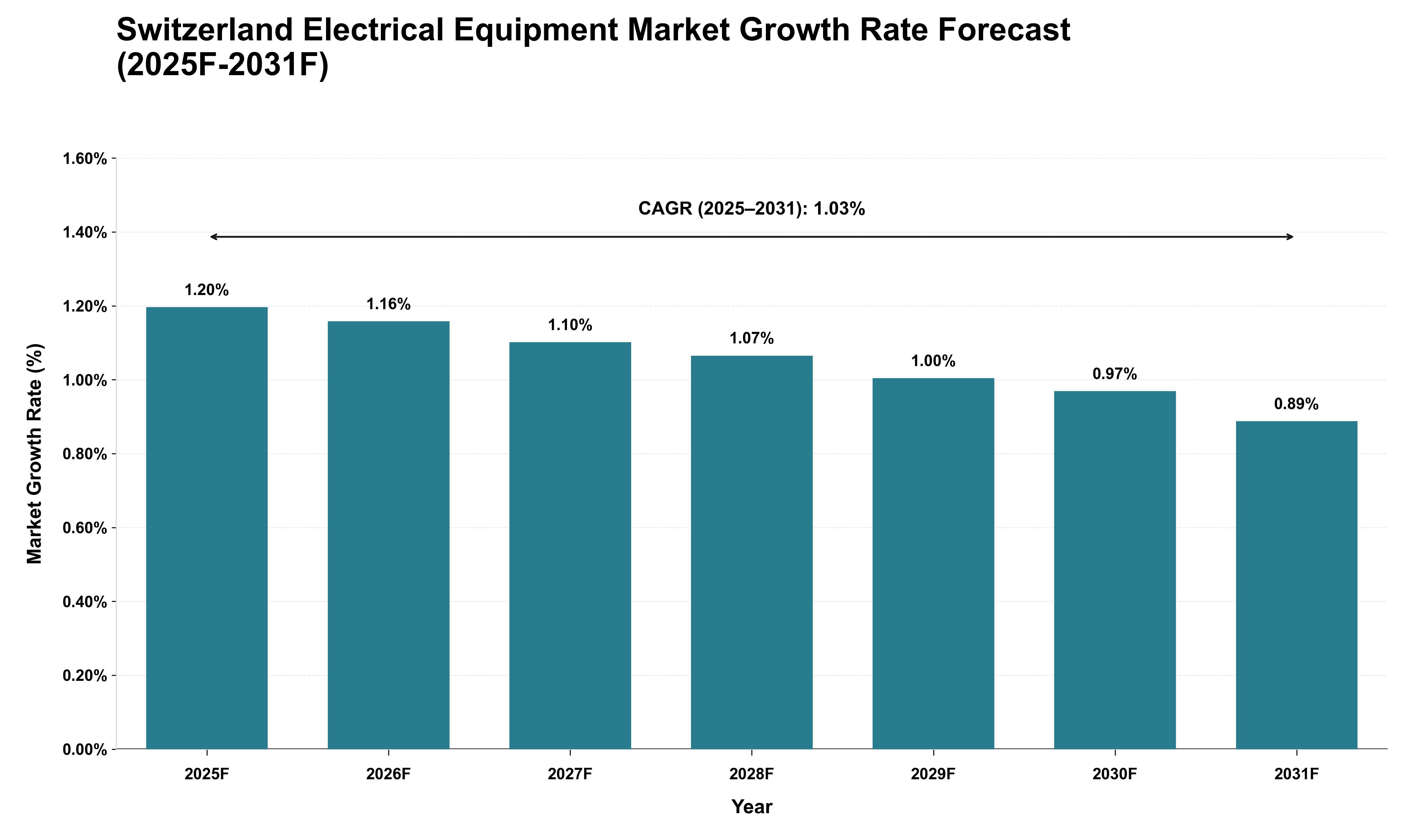
The outlook for Switzerland's electrical equipment market will be shaped by several macroeconomic factors, particularly the availability and pricing of raw materials essential for production. As global supply chains stabilize post-pandemic, fluctuations in commodity prices—such as copper and aluminum—will significantly influence manufacturing costs. The forecasted CAGR of 1.03% from 2025 to 2031 suggests a gradual deceleration in growth rates, with annual increases declining from 1.20% in 2025 to 0.89% by 2031. This trend may reflect tightening import dependencies as Switzerland seeks to enhance local sourcing capabilities amidst geopolitical tensions affecting trade routes. Additionally, cyclical trends in technology adoption and energy efficiency regulations will likely drive demand for innovative electrical solutions, albeit at a slower pace as market dynamics evolve. Overall, the interplay between raw material costs and regulatory frameworks will be pivotal in shaping the future trajectory of this sector.
Key Highlights of the Report:
- Switzerland Electrical Equipment Market Outlook
- Market Size of Switzerland Electrical Equipment Market, 2024
- Forecast of Switzerland Electrical Equipment Market, 2031
- Historical Data and Forecast of Switzerland Electrical Equipment Revenues & Volume for the Period 2021-2031
- Switzerland Electrical Equipment Market Trend Evolution
- Switzerland Electrical Equipment Market Drivers and Challenges
- Switzerland Electrical Equipment Price Trends
- Switzerland Electrical Equipment Porter`s Five Forces
- Switzerland Electrical Equipment Industry Life Cycle
- Historical Data and Forecast of Switzerland Electrical Equipment Market Revenues & Volume By Types for the Period 2021-2031
- Historical Data and Forecast of Switzerland Electrical Equipment Market Revenues & Volume By Electronic and electrical wires and cables for the Period 2021-2031
- Historical Data and Forecast of Switzerland Electrical Equipment Market Revenues & Volume By Batteries and accumulators for the Period 2021-2031
- Historical Data and Forecast of Switzerland Electrical Equipment Market Revenues & Volume By Wiring devices for the Period 2021-2031
- Historical Data and Forecast of Switzerland Electrical Equipment Market Revenues & Volume By Electric lighting equipment for the Period 2021-2031
- Historical Data and Forecast of Switzerland Electrical Equipment Market Revenues & Volume By Others for the Period 2021-2031
- Historical Data and Forecast of Switzerland Electrical Equipment Market Revenues & Volume By Applications for the Period 2021-2031
- Historical Data and Forecast of Switzerland Electrical Equipment Market Revenues & Volume By Residential end-users for the Period 2021-2031
- Historical Data and Forecast of Switzerland Electrical Equipment Market Revenues & Volume By Non-residential end-users for the Period 2021-2031
- Switzerland Electrical Equipment Import Export Trade Statistics
- Market Opportunity Assessment By Types
- Market Opportunity Assessment By Applications
- Switzerland Electrical Equipment Top Companies Market Share
- Switzerland Electrical Equipment Competitive Benchmarking By Technical and Operational Parameters
- Switzerland Electrical Equipment Company Profiles
- Switzerland Electrical Equipment Key Strategic Recommendations






































