Romania Electrical Equipment Market Summary
The romania electrical equipment market was estimated at USD 157 Million in 2025 and is projected to reach USD 205 Million by 2032, growing at a CAGR of 4.6% from 2026 to 2032.
Romania Electrical Equipment Market Year-wise Growth Rate and Key Drivers
This graph highlights how the Romania Electrical Equipment Market has steadily grown over the past five years, supported by major growth factors.
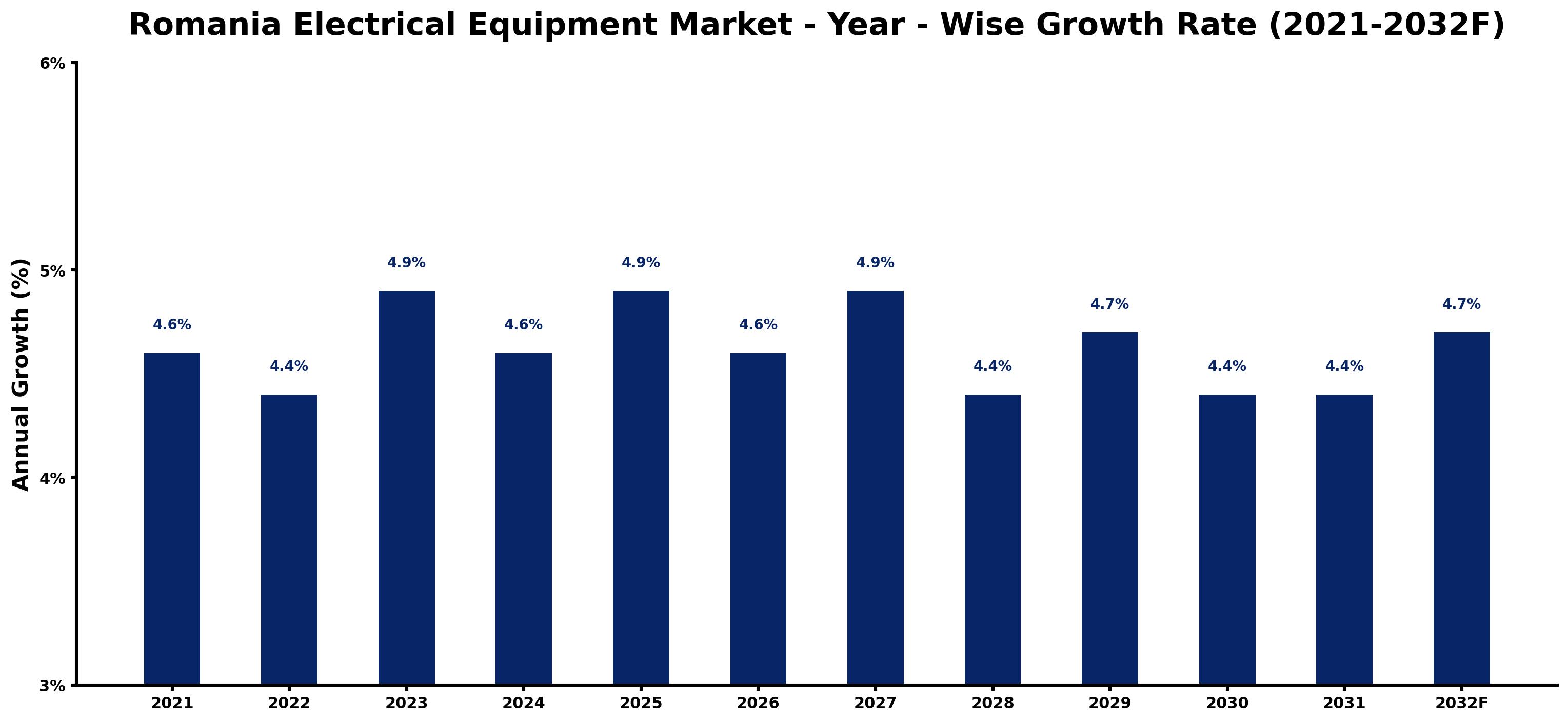
The table below presents the year wise growth rates along with the key drivers influencing the market
| Year | Growth Rate | Major Drivers |
| 2021 | 4.6% | Post-lockdown retail projects fostered innovation in electrical equipment sourcing and distribution. |
| 2022 | 4.4% | Interest in renewable energy sources led to increased investment in solar technologies. |
| 2023 | 4.9% | Urban expansion in Bucharest necessitated more efficient electrical infrastructure upgrades. |
| 2024 | 4.6% | Local manufacturing initiatives shifted focus towards energy-efficient electrical products. |
| 2025 | 4.9% | Emerging trends in smart home technologies created a niche market for electrical equipment. |
| 2026 | 4.6% | Infrastructure upgrades funded by EU initiatives improved overall market accessibility and reliability. |
| 2027 | 4.9% | Technological partnerships between firms enhanced product offerings in automation and control systems. |
| 2028 | 4.4% | Supply chain transformations reduced dependence on imported electrical components significantly. |
| 2029 | 4.7% | Electric vehicle infrastructure expansion drove demand for specialized electrical charging solutions. |
| 2030 | 4.4% | Consumer awareness about energy conservation prompted a shift towards high-efficiency devices. |
| 2031 | 4.4% | Investment in educational programs increased workforce skills in electrical engineering and technology. |
| 2032 | 4.7% | Sustainability practices among businesses catalyzed greener electrical equipment production methods. |
Note - Market size estimations and growth projections presented in this report are based on 6Wresearch's advanced forecasting approach, validated with industry datasets as of June 2026.
Romania Electrical Equipment Market Synopsis
The Romania Electrical Equipment Market is projected to reach 4.6% and witness significant growth during the forecast period (2026-2032). This market is characterized by a broad range of products, including power generation systems, transformers, electrical motors, wiring devices, and lighting solutions. The growth is primarily driven by factors such as increasing infrastructure investments, the rise in demand for energy-efficient technologies, and the heightened adoption of smart solutions across various sectors.
Romania Electrical Equipment Market Growth Drivers
Several factors are contributing to the positive momentum of the Romania Electrical Equipment Market. Firstly, substantial investments in infrastructure development, particularly in urban areas, have created a demand for advanced electrical systems. Secondly, the shift towards energy efficiency has led to the increased adoption of LED lighting, energy-efficient appliances, and smart home technology. Furthermore, the shift towards renewable energy sources, such as solar and wind, has surged interest in solar panels and related equipment.
- The ongoing modernization of electrical grids and networks facilitates better distribution and utilization of electricity, enhancing market growth.
- Government initiatives promoting sustainable energy solutions are driving investments in renewable energy infrastructure.
- Increased public awareness about energy conservation has resulted in a surge in demand for energy-efficient products.
- Technological advancements in automation and connectivity are transforming product offerings in the electrical equipment sector.
- The rising necessity for reliable and uninterrupted power supply in various industries propels the demand for high-quality electrical equipment.
Romania Electrical Equipment Market Trends and Opportunities
The Romania Electrical Equipment Market is evolving, highlighting trends that are shaping its future. One critical trend is the integration of smart technology into electrical systems, which allows for automation and remote management, thus enhancing operational efficiency. Moreover, the demand for customized electrical solutions is on the rise, as consumers seek unique products tailored to specific needs. Additionally, there is a visible shift towards sustainable practices, with manufacturers investing in eco-friendly product lines that align with global environmental standards.
- The acceleration of digital transformation in the sector has led to increased connectivity within electrical devices, driving innovation.
- Smart home solutions, including intelligent lighting and HVAC systems, are becoming increasingly popular among consumers.
- Investment in research and development is crucial for companies to remain competitive and innovate in response to market demands.
- As competition intensifies, the focus on customer experience and satisfaction is becoming central to market strategies.
- Cross-industry collaborations will play a significant role as companies combine expertise to create innovative solutions.
Romania Electrical Equipment Market Challenges and Restraints
Despite the promising growth trajectory, the Romania Electrical Equipment Market faces several challenges. Increased competition from foreign manufacturers who offer lower-priced alternatives has intensified market pressure. Additionally, fluctuations in raw material costs can impact profit margins significantly, posing a challenge to sustaining pricing strategies. Regulatory uncertainties, particularly related to energy efficiency standards, can complicate investment decisions. Furthermore, the industry is grappling with a shortage of skilled labor, which makes innovation in product development more difficult.
- Economic instabilities and political uncertainties in the region could affect market demand and consumer confidence.
- Compliance with stringent environmental regulations raises production costs for manufacturers.
- Limited access to advanced technologies can hinder the ability of companies to innovate effectively.
- Consumer preferences are shifting rapidly, requiring companies to adapt quickly to maintain market relevance.
- The risk of market saturation in certain product categories may pose additional barriers to sustained growth.
Romania Electrical Equipment Market Investment Opportunities
The Romania Electrical Equipment Market presents substantial investment opportunities, primarily fueled by the country's increasing focus on infrastructure improvements and industrial expansion. The demand for energy-efficient electrical solutions, alongside advancements in automation technology, opens avenues for investment in electrical machinery, lighting products, and renewable energy systems. Collaborations with local entities and engaging in research and development projects can yield strategic benefits for investors aiming to penetrate the market effectively.
- Investment in renewable energy infrastructure aligns with the country's policies promoting sustainable development.
- Upgrading power transmission and distribution networks is critical, offering high-return investment prospects.
- The increasing popularity of smart technologies creates demand for innovative electrical solutions.
- Public-private partnerships can enhance project viability and access to funding sources.
- Investing in local manufacturing capabilities supports long-term sustainability and reduces dependency on imports.
Romania Electrical Equipment Market Government Investment and Initiatives
The Romanian government has implemented several policies and initiatives aimed at regulating the Electrical Equipment Market effectively. These include compliance with European Union standards on product safety and efficiency, along with incentives to promote renewable energy sources. By encouraging energy efficiency in electrical equipment, the government aims to reduce overall energy consumption while supporting domestic manufacturing through tax breaks and grants for companies investing in this sector. Furthermore, regulations are in place to ensure fair competition, preventing monopolistic practices and fostering a competitive landscape.
Romania Electrical Equipment Market Latest Developments (May 2025 - June 2026)
Recent developments in the Romania Electrical Equipment Market from May 2025 to June 2026 indicate a continued trajectory towards modernization and sustainability. The integration of smart technology in electrical products has been accelerated as companies respond to consumer demand for enhanced connectivity and automation. Government initiatives focused on infrastructure investment are also gaining momentum, leading to a significant uptick in projects aimed at upgrading the electrical grid. Concurrently, industry players are increasingly exploring partnerships to enhance product offerings and innovate within the renewable energy segment.
Romania Electrical Equipment Market - Key Attractiveness of the Report
- 10 Years of Market Numbers
- Historical Data Starting from 2022 to 2025
- Base Year: 2025
- Forecast Data until 2032
- Key Performance Indicators Impacting the Market
- Major Upcoming Developments and Projects
Key Highlights of the Report:
- Romania Electrical Equipment Market Outlook
- Market Size of Romania Electrical Equipment Market, 2025
- Forecast of Romania Electrical Equipment Market, 2032F
- Historical Data and Forecast of Romania Electrical Equipment Revenues & Volume for the Period 2022-2032F
- Romania Electrical Equipment Market Trend Evolution
- Romania Electrical Equipment Market Drivers and Challenges
- Romania Electrical Equipment Price Trends
- Romania Electrical Equipment Porter's Five Forces
- Romania Electrical Equipment Industry Life Cycle
- Historical Data and Forecast of Romania Electrical Equipment Market Revenues & Volume By Types for the Period 2022-2032F
- Historical Data and Forecast of Romania Electrical Equipment Market Revenues & Volume By Electronic and electrical wires and cables for the Period 2022-2032F
- Historical Data and Forecast of Romania Electrical Equipment Market Revenues & Volume By Batteries and accumulators for the Period 2022-2032F
- Historical Data and Forecast of Romania Electrical Equipment Market Revenues & Volume By Wiring devices for the Period 2022-2032F
- Historical Data and Forecast of Romania Electrical Equipment Market Revenues & Volume By Electric lighting equipment for the Period 2022-2032F
- Historical Data and Forecast of Romania Electrical Equipment Market Revenues & Volume By Others for the Period 2022-2032F
- Historical Data and Forecast of Romania Electrical Equipment Market Revenues & Volume By Applications for the Period 2022-2032F
- Historical Data and Forecast of Romania Electrical Equipment Market Revenues & Volume By Residential end-users for the Period 2022-2032F
- Historical Data and Forecast of Romania Electrical Equipment Market Revenues & Volume By Non-residential end-users for the Period 2022-2032F
- Romania Electrical Equipment Import Export Trade Statistics
- Market Opportunity Assessment By Types
- Market Opportunity Assessment By Applications
- Romania Electrical Equipment Top Companies Market Share
- Romania Electrical Equipment Competitive Benchmarking By Technical and Operational Parameters
- Romania Electrical Equipment Company Profiles
- Romania Electrical Equipment Key Strategic Recommendations






































