Taiwan AC Drives Market (2026-2032) | Share, Analysis, Segmentation, Forecast, Industry, Revenue, Size, Companies, Trends, Outlook, Growth & Value
Market Forecast By Voltage (Low , Medium), By Power Rating (Low, Medium, High Power), By Application (Pumps, Fans, Compressors, Conveyors, Extruders) And Competitive Landscape
| Product Code: ETC5777479 | Publication Date: Nov 2023 | Updated Date: Jun 2026 | Product Type: Market Research Report | |
| Publisher: 6Wresearch | Author: Ravi Bhandari | No. of Pages: 70 | No. of Figures: 35 | No. of Tables: 5 |
Taiwan AC Drives Market Growth Rate
According to 6Wresearch internal databases and industry insights, the Taiwan AC Drives Market is projected to grow at a steady compound annual growth rate (CAGR) of 4.6% during the forecast period 2026–2032.
Taiwan AC Drives Market Year-wise Growth Rate and Key Drivers
This graph illustrates the annual growth rates of the Taiwan AC Drives Market from 2021 to 2032, highlighting a steady upward trajectory and projected market expansion over the forecast period.
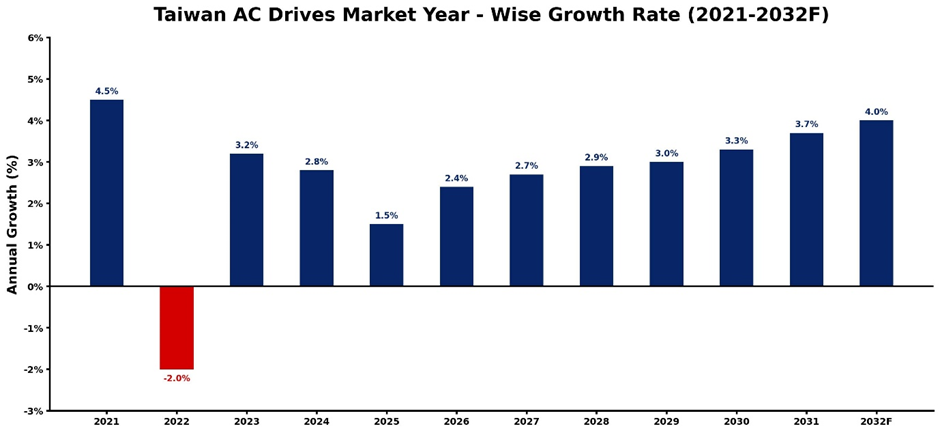
The following table summarises the historical and forecasted growth rates of the Taiwan AC Drives Market, along with the rationale behind each year’s performance.
| Year | Estimated Growth (%) | Market Rationale |
| 2021 | 4.5% | Post-COVID industrial recovery boosted automation trends and increased the use of energy-efficient electric motors. |
| 2022 | -2% | Manufacturing industry growth faced challenges owing to disruptions within the global supply chain. |
| 2023 | 3.2% | Boost in manufacturing & electronic sectors; replacement of old AC drives. |
| 2024 | 2.8% | The trend of growing implementation of energy-efficient systems in commercial buildings and industries. |
| 2025 | 1.5% | Market maturing; moderate growth due to incremental upgrades in industrial plants. |
| 2026 | 2.4% | More growth driven by continued industrial automation and energy-efficiency regulation. |
| 2027 | 2.7% | Growth from the expansion of the semiconductor manufacturing industry and the smart factory. |
| 2028 | 2.9% | Replacement of installed motor systems in industrial and commercial markets. |
| 2029 | 3% | Green initiatives for water and utilities management. |
| 2030 | 3.3% | Incremental adoption of IoT-enabled and intelligent AC drives. |
| 2031 | 3.7% | Steady growth as market approaches maturity; focus on energy optimization. |
| 2032 | 4% | Market stabilizes with balanced replacement and new installations across industries. |
Topics Covered in the Taiwan AC Drives Market Report
Taiwan AC Drives Industry report covers the market by voltage, power rating, and application. The report provides a detailed analysis of ongoing market trends, opportunities/high-growth areas, and market drivers that will help stakeholders align strategies based on current and future market dynamics.
Taiwan AC Drives Market Highlights
| Report Name | Taiwan AC Drives Market |
| Forecast period | 2026-2032 |
| CAGR | 4.6% |
| Growing Sector | Industrial Automation & Semiconductor Manufacturing |
Taiwan AC Drives Market Synopsis
Taiwan AC Drives Market is a rapidly developing segment within the country’s industrial automation and power electronics industry. It is primarily driven by the strong manufacturing base in Taiwan, especially in semiconductors, electronics, machinery, and precision engineering. The AC drives, also referred to as the variable frequency drives (VFDs), are commonly utilized in controlling the speed and torque of electric motors. The global demand for the AC drive market is steadily growing due to the rise in the adoption of smart manufacturing systems, energy savings programs, and automation systems.
Evaluation of Growth Drivers in Taiwan AC Drives Market (2026-2032)
Below are some major drivers and their influence on the market dynamics:
| Drivers | Primary Segment Impacted | Why It Matters |
| Government Incentives on Energy Efficiency | Industrial and Commercial | Subsidies and tax benefits support adoption of energy-efficient AC drives. |
| Expansion of Manufacturing & Smart Factories | Industrial Automation | Semiconductor and electronics industries need precise motor control for efficiency. |
| Electric Vehicle (EV) Adoption | Automotive | Growing EV demand increases use of AC drives in propulsion and motor control systems. |
| Growth of HVAC and Infrastructure Projects | Commercial Buildings | AC drives help reduce energy use in large HVAC and building systems. |
| R&D in Smart and Efficient Drives | OEMs & Research | Innovation in IoT and AI-enabled drives improves performance and efficiency. |
Taiwan AC Drives Market is anticipated to exhibit a CAGR of 4.6% between 2026 and 2032, driven by the nation’s emphasis on its industrial modernization and energy efficient policies through the Ministry of Economic Affairs (Taiwan). The evolution of Industry 4.0 and the concept of smart factory have created a higher requirement for AC drives in various industrial settings, such as manufacturing plants, HVAC systems, wastewater plants, and transportation.
This market will also benefit from the increasing demands for electric mobility and renewable energies through the adoption of AC drives due to their capabilities in motor management and power optimization. Several international firms and local players, including Delta Electronics, Inc., have continued their efforts in innovating their products by combining IoT technologies and high-efficiency features.
Evaluation of Restraints in Taiwan AC Drives Market
Below are some major restraints and their influence on the market dynamics:
| Restraints | Primary Segment Impacted | What This Means (Short) |
| High Cost of Advanced Systems | Industrial & SMEs | High upfront cost limits adoption among smaller firms. |
| Skills Gap in Workforce | Industrial Operations | Lack of skilled technicians slows installation and maintenance. |
| Supply Chain Disruptions | Manufacturing | Dependence on imports causes delays and cost increases. |
| Low Awareness Among SMEs | Small Businesses | Limited knowledge reduces adoption of energy-efficient solutions. |
| Regulatory Compliance Issues | Industrial Users | Changing standards increase upgrade and compliance costs. |
Taiwan AC Drives Market Challenges
There are various challenges faced by Taiwan AC drives market that might affect its growth pattern in spite of increased demand from industrial sectors and technological progress. First and foremost, there is a relatively higher cost of installing new AC drive system which may dissuade SMEs from installing the system. Many SMEs still opt for conventional motor control systems due to financial considerations. Further, another challenge impeding the Taiwan AC Drives Market Growth is the complicated nature of the installation process which demands skilled manpower for installation purposes.
Taiwan AC Drives Market Trends
Emerging trends include:
- Growing demand for energy-efficient motor controls: AC drives have become common in controlling the speed and torque of motors. This is a trend that can help industries save money on electricity in Taiwan where energy usage remains a significant concern.
- Commonly adopted in industry automation and smart factories: The movement towards Industry 4.0 in Taiwan has seen increased adoption of AC drives in automated machines, robotics and other CNC equipment used in manufacturing. Such adoption will increase efficiency in production lines and enhance accuracy.
- Adoption in Internet of Things (IoT) and smart factory technology: With AC drives now featuring digital interfaces, monitoring and controlling operations within the factory has become easy. Such drives enable predictive maintenance and allow for smart factory development and deployment.
- Increasing use in HVACs and commercial building systems: Building owners and managers prefer using such drives to control HVAC operation as they significantly help regulate airflow within the building.
Investment Opportunities in the Taiwan AC Drives Market
Strategic opportunities include:
- HVAC and commercial building systems: Growing construction activity and smart building adoption are increasing demand for AC drives used in ventilation, cooling, and energy management systems.
- Electric vehicle and transportation applications: AC drives are essential in EV power systems, rail transport, and electric buses, offering long-term growth potential in Taiwan’s green mobility transition.
- Smart AC drive technologies (IoT + AI integration): Investment opportunities exist in next-generation AC drives with AI-based control, predictive maintenance, and cloud connectivity for industrial applications.
- Export-oriented manufacturing partnerships: Taiwan serves as a strong export hub, allowing investors to collaborate with local manufacturers to supply AC drive systems globally.
Top 5 Leading Players in Taiwan AC Drives Market
Below is a list of emerging players operating in the Taiwan AC Drives Industry:
1. Delta Electronics, Inc.
| Company Name | Delta Electronics, Inc. |
|---|---|
| Established Year | 1971 |
| Headquarters | Taipei, Taiwan |
| Official Website | Click Here |
Delta Electronics offers high-efficiency AC drives, electric motors, and motion control systems widely used in manufacturing, HVAC, and electric mobility applications.
2. ABB Ltd
| Company Name | ABB Ltd |
|---|---|
| Established Year | 1988 (merger formation) |
| Headquarters | Zürich, Switzerland |
| Official Website | Click Here |
ABB provides a wide range of electric motors, variable frequency drives (VFDs), and motion control systems used in industries such as utilities, manufacturing, transportation, and infrastructure.
3. Siemens AG
| Company Name | Siemens AG |
|---|---|
| Established Year | 1847 |
| Headquarters | Munich, Germany |
| Official Website | Click Here |
Siemens is a global technology powerhouse offering advanced motor systems, AC drives, and automation solutions. Its products are widely used in smart factories, energy systems, rail transport, and industrial automation, with strong emphasis on digitalization and Industry 4.0.
4. Yaskawa Electric Corporation
| Company Name | Yaskawa Electric Corporation |
|---|---|
| Established Year | 1915 |
| Headquarters | Kitakyushu, Japan |
| Official Website | Click Here |
Yaskawa Electric is well known for its precision motion control systems used in automation, semiconductor manufacturing, and robotics applications.
5. Schneider Electric SE
| Company Name | Schneider Electric SE |
|---|---|
| Established Year | 1836 |
| Headquarters | Rueil-Malmaison, France |
| Official Website | Click Here |
Schneider Electric provides AC drives, motor control systems, and industrial automation products widely used in smart buildings, infrastructure, and manufacturing industries with a strong focus on sustainability and energy efficiency.
Government Initiatives Implemented in the Taiwan AC Power Supply Market
The Taiwan government, through the Ministry of Economic Affairs (Taiwan), is actively advocating for energy efficiency and reliable power infrastructure enhancement to accommodate the growing demand for AC power supply systems in industries. Taiwan’s Energy Transition Policy is supporting the adoption of highly energy-efficient electrical machinery such as the AC power supplies and drives to lower power usage and carbon footprint.
In fact, manufacturing plants that are implementing the energy-efficient AC power system and the variable frequency drives can benefit from government subsidies or other forms of incentives for adopting the technologies. Moreover, Taiwan's smart grid technology initiative will enhance the power distribution system, allowing the incorporation of efficient AC drives in industrial automation processes, semiconductor fabrication plants, and data centers.
Future Outlook of Taiwan AC Drives Market
Taiwan AC Drives Market is predicted to have continued growth in the future due to the fast industrial automation process, expansion of semiconductors, and implementation of energy-efficient motor control systems. Smart manufacturing and Industry 4.0 will influence the growth of the market, considering that AC drives will be critical in enhancing motor efficiency and energy consumption reduction.
Moreover, growing investments in electric cars, robotics, and HVAC renovations will also increase the demand for improved AC drives. The application of IoT-based AC drives, predictive maintenance technology, and artificial intelligence will bring about changes in the dynamics of the market, making the AC drives smart and energy-efficient. Generally, it is possible for the market to continue growing at a steady rate owing to the robust industrialization and energy policies in Taiwan.
Market Segmentation Analysis
The report offers a comprehensive study of the following market segments and their leading categories:
By Voltage – Low Voltage Dominates Market, Medium Voltage Shows Stable Growth
According to Ravi Bhandari, Research Head, 6Wresearch, Low voltage AC drives dominated the Taiwan AC Drives Market Share with 62.4% in 2025, driven by widespread use in HVAC systems, pumps, fans, and general industrial automation. Medium voltage drives are projected to grow at a CAGR of 6.9% (2026–2032), supported by demand from heavy industries such as manufacturing, power generation, and large infrastructure projects.
By Power Rating – Medium Power Leads Market, High Power Grows Fastest
Medium power AC drives accounted for 48.7% share in 2025, owing to their strong adoption in industrial machinery, commercial buildings, and automated production systems. High power AC drives are expected to grow at a CAGR of 7.6% (2026–2032), driven by large-scale manufacturing plants, energy-intensive industries, and infrastructure expansion.
By Application – Pumps Lead Market, Compressors Show Strong Growth
Pumps held the largest share of 29.8% in 2025, due to extensive use in water treatment, HVAC systems, and industrial fluid handling. Fans followed with significant adoption in ventilation and cooling applications. Compressors are projected to grow at a CAGR of 7.4% (2026–2032), driven by manufacturing, refrigeration, and industrial processing demand. Conveyors continue steady adoption in automation and logistics, while extruders are expected to grow steadily in plastics, packaging, and material processing industries.
Note: Market size estimations and growth projections presented in this report are based on 6Wresearch’s advanced forecasting approach, validated with industry datasets as of June 2026.
Key Attractiveness of the Report:
- 10 Years of Market Numbers
- Historical Data Starting from 2022 to 2025
- Base Year: 2025
- Forecast Data until 2032
- Key Performance Indicators Impacting the Market
- Major Upcoming Developments and Projects
Key Highlights of the Report:
- Key Highlights of the Report:
- Taiwan AC Drives Market Outlook
- Market Size of Taiwan AC Drives Market, 2025
- Forecast of Taiwan AC Drives Market, 2032
- Historical Data and Forecast of Taiwan AC Drives Revenues & Volume for the Period 2022–2032
- Taiwan AC Drives Market Trend Evolution
- Taiwan AC Drives Market Drivers and Challenges
- Taiwan AC Drives Price Trends
- Taiwan AC Drives Porter`s Five Forces
- Taiwan AC Drives Industry Life Cycle
- Historical Data and Forecast of Taiwan AC Drives Market Revenues & Volume By Voltage for the Period 2022–2032
- Historical Data and Forecast of Taiwan AC Drives Market Revenues & Volume By Low for the Period 2022–2032
- Historical Data and Forecast of Taiwan AC Drives Market Revenues & Volume By Medium for the Period 2022–2032
- Historical Data and Forecast of Taiwan AC Drives Market Revenues & Volume By Power Rating for the Period 2022–2032
- Historical Data and Forecast of Taiwan AC Drives Market Revenues & Volume By Low for the Period 2022–2032
- Historical Data and Forecast of Taiwan AC Drives Market Revenues & Volume By Medium for the Period 2022–2032
- Historical Data and Forecast of Taiwan AC Drives Market Revenues & Volume By High Power for the Period 2022–2032
- Historical Data and Forecast of Taiwan AC Drives Market Revenues & Volume By Application for the Period 2022–2032
- Historical Data and Forecast of Taiwan AC Drives Market Revenues & Volume By Pumps for the Period 2022–2032
- Historical Data and Forecast of Taiwan AC Drives Market Revenues & Volume By Fans for the Period 2022–2032
- Historical Data and Forecast of Taiwan AC Drives Market Revenues & Volume By Compressors for the Period 2022–2032
- Historical Data and Forecast of Taiwan AC Drives Market Revenues & Volume By Conveyors for the Period 2022–2032
- Historical Data and Forecast of Taiwan AC Drives Market Revenues & Volume By Extruders for the Period 2022–2032
- Taiwan AC Drives Import Export Trade Statistics
- Market Opportunity Assessment By Voltage
- Market Opportunity Assessment By Power Rating
- Market Opportunity Assessment By Application
- Taiwan AC Drives Top Companies Market Share
- Taiwan AC Drives Competitive Benchmarking By Technical and Operational Parameters
- Taiwan AC Drives Company Profiles
- Taiwan AC Drives Key Strategic Recommendations
Market Covered
The report offers an extensive study of the following segments:
By Voltage
- Low
- Medium
By Power Rating
- Low
- Medium
- High Power
By Application
- Pumps
- Fans
- Compressors
- Conveyors
- Extruders
Taiwan AC Drives Market (2026-2032): FAQs
Taiwan AC Drives Market is projected to grow at a CAGR of around 4.6% during 2026–2032, driven by rising demand from manufacturing and HVAC sectors.
Key trends include IoT-enabled drives, regenerative drives, and integration with Industry 4.0 platforms for predictive maintenance and efficiency optimization.
High initial installation cost and complexity of integration in legacy systems are key challenges, along with the need for skilled technical expertise.
Major players include companies like Delta Electronics, TECO Electric & Machinery, Siemens, ABB, and Yaskawa Electric, offering advanced AC drive solutions in Taiwan.
The Taiwan AC Drives Market is poised for growth with rising automation, demand for EVs, and energy efficient industrial systems.
6Wresearch actively monitors the Taiwan AC Drives Market and publishes its comprehensive annual report, highlighting emerging trends, growth drivers, revenue analysis, and forecast outlook. Our insights help businesses to make data-backed strategic decisions with ongoing market dynamics. Our analysts track relevent industries related to the Taiwan AC Drives Market, allowing our clients with actionable intelligence and reliable forecasts tailored to emerging regional needs.
Yes, we provide customisation as per your requirements. To learn more, feel free to contact us on sales@6wresearch.com
| 13 Disclaimer |
| 1 Executive Summary |
| 2 Introduction |
| 2.1 Key Highlights of the Report |
| 2.2 Report Description |
| 2.3 Market Scope & Segmentation |
| 2.4 Research Methodology |
| 2.5 Assumptions |
| 3 Taiwan AC Drives Market Overview |
| 3.1 Taiwan Country Macro Economic Indicators |
| 3.2 Taiwan AC Drives Market Revenues & Volume, 2022 & 2032F |
| 3.3 Taiwan AC Drives Market - Industry Life Cycle |
| 3.4 Taiwan AC Drives Market - Porter's Five Forces |
| 3.5 Taiwan AC Drives Market Revenues & Volume Share, By Voltage, 2022 & 2032F |
| 3.6 Taiwan AC Drives Market Revenues & Volume Share, By Power Rating, 2022 & 2032F |
| 3.7 Taiwan AC Drives Market Revenues & Volume Share, By Application, 2022 & 2032F |
| 4 Taiwan AC Drives Market Dynamics |
| 4.1 Impact Analysis |
| 4.2 Market Drivers |
| 4.2.1 Increasing demand for energy-efficient solutions in industrial and commercial sectors |
| 4.2.2 Technological advancements leading to enhanced performance and reliability of AC drives |
| 4.2.3 Government initiatives promoting the adoption of energy-saving technologies in Taiwan |
| 4.3 Market Restraints |
| 4.3.1 High initial investment costs associated with the installation of AC drives |
| 4.3.2 Availability of alternative technologies for motor control applications |
| 4.3.3 Economic uncertainties impacting investment decisions by businesses in Taiwan |
| 5 Taiwan AC Drives Market Trends |
| 6 Taiwan AC Drives Market Segmentations |
| 6.1 Taiwan AC Drives Market, By Voltage |
| 6.1.1 Overview and Analysis |
| 6.1.2 Taiwan AC Drives Market Revenues & Volume, By Low , 2022-2032F |
| 6.1.3 Taiwan AC Drives Market Revenues & Volume, By Medium, 2022-2032F |
| 6.2 Taiwan AC Drives Market, By Power Rating |
| 6.2.1 Overview and Analysis |
| 6.2.2 Taiwan AC Drives Market Revenues & Volume, By Low, 2022-2032F |
| 6.2.3 Taiwan AC Drives Market Revenues & Volume, By Medium, 2022-2032F |
| 6.2.4 Taiwan AC Drives Market Revenues & Volume, By High Power, 2022-2032F |
| 6.3 Taiwan AC Drives Market, By Application |
| 6.3.1 Overview and Analysis |
| 6.3.2 Taiwan AC Drives Market Revenues & Volume, By Pumps, 2022-2032F |
| 6.3.3 Taiwan AC Drives Market Revenues & Volume, By Fans, 2022-2032F |
| 6.3.4 Taiwan AC Drives Market Revenues & Volume, By Compressors, 2022-2032F |
| 6.3.5 Taiwan AC Drives Market Revenues & Volume, By Conveyors, 2022-2032F |
| 6.3.6 Taiwan AC Drives Market Revenues & Volume, By Extruders, 2022-2032F |
| 7 Taiwan AC Drives Market Import-Export Trade Statistics |
| 7.1 Taiwan AC Drives Market Export to Major Countries |
| 7.2 Taiwan AC Drives Market Imports from Major Countries |
| 8 Taiwan AC Drives Market Key Performance Indicators |
| 8.1 Energy savings achieved through the use of AC drives |
| 8.2 Number of new installations or retrofits using AC drives |
| 8.3 Adoption rate of variable frequency drives (VFDs) in key industries in Taiwan |
| 8.4 Percentage increase in efficiency levels of AC drives over time |
| 8.5 Number of training programs conducted to educate users on the benefits of AC drives |
| 9 Taiwan AC Drives Market - Opportunity Assessment |
| 9.1 Taiwan AC Drives Market Opportunity Assessment, By Voltage, 2022 & 2032F |
| 9.2 Taiwan AC Drives Market Opportunity Assessment, By Power Rating, 2022 & 2032F |
| 9.3 Taiwan AC Drives Market Opportunity Assessment, By Application, 2022 & 2032F |
| 10 Taiwan AC Drives Market - Competitive Landscape |
| 10.1 Taiwan AC Drives Market Revenue Share, By Companies, 2025 |
| 10.2 Taiwan AC Drives Market Competitive Benchmarking, By Operating and Technical Parameters |
| 11 Company Profiles |
| 12 Recommendations |
Global Go To Market Strategy - 2030
Export potential enables firms to identify high-growth global markets with greater confidence by combining advanced trade intelligence with a structured quantitative methodology. The framework analyzes emerging demand trends and country-level import patterns while integrating macroeconomic and trade datasets such as GDP and population forecasts, bilateral import–export flows, tariff structures, elasticity differentials between developed and developing economies, geographic distance, and import demand projections. Using weighted trade values from 2020–2024 as the base period to project country-to-country export potential for 2030, these inputs are operationalized through calculated drivers such as gravity model parameters, tariff impact factors, and projected GDP per-capita growth. Through an analysis of hidden potentials, demand hotspots, and market conditions that are most favorable to success, this method enables firms to focus on target countries, maximize returns, and global expansion with data, backed by accuracy.
By factoring in the projected importer demand gap that is currently unmet and could be potential opportunity, it identifies the potential for the Exporter (Country) among 190 countries, against the general trade analysis, which identifies the biggest importer or exporter.
To discover high-growth global markets and optimize your business strategy:
Click Here
Pricing
- Single User License$ 1,995
- Department License$ 2,400
- Site License$ 3,120
- Global License$ 3,795

Leadership Perspectives from Industry Events
Search
Thought Leadership and Analyst Meet





Our Clients








6WResearch In News
- India Export Attractiveness Tracker 2026
- India Air Conditioner Market Set for Strong Rebound in 2026 After Weather-Led Correction and GST-Driven Recovery: 6Wresearch
- ADAS in India: How Automatic Emergency Braking, Blind Spot Detection & Driver Monitoring are Transforming Road Safety
- Doha a strategic location for EV manufacturing hub: IPA Qatar
- Demand for luxury TVs surging in the GCC, says Samsung
- Empowering Growth: The Thriving Journey of Bangladesh’s Cable Industry
Latest Reports
- Nicaragua RPG Gaming Market (2026-2032)
- New Zealand RPG Gaming Market (2026-2032)
- Netherlands RPG Gaming Market (2026-2032)
- Nauru RPG Gaming Market (2026-2032)
- Namibia RPG Gaming Market (2026-2032)
- Mozambique RPG Gaming Market (2026-2032)
- Montenegro RPG Gaming Market (2026-2032)
- Mongolia RPG Gaming Market (2026-2032)
- Monaco RPG Gaming Market (2026-2032)
- Micronesia RPG Gaming Market (2026-2032)
Industry Events and Analyst Meet

EV India Expo 2026

HIMTEX 2026

India Refining Summit 2026

India EV Show 2026

EV tech India Expo 2026
Whitepaper
- Middle East & Africa Commercial Security Market Click here to view more.
- Middle East & Africa Fire Safety Systems & Equipment Market Click here to view more.
- GCC Drone Market Click here to view more.
- Middle East Lighting Fixture Market Click here to view more.
- GCC Physical & Perimeter Security Market Click here to view more.


