Tajikistan Autonomous Trucks Market Size, Share & Growth Rate
The Tajikistan Autonomous Trucks Market was estimated at USD 109 Million in 2025 and is projected to reach USD 119 Million by 2032, growing at a CAGR of 1.3% from 2026 to 2032. This growth trajectory is primarily driven by the pressing need for efficient logistics solutions amid challenging geographical conditions. The rugged terrain of Tajikistan positions autonomous trucks as a viable solution, enhancing both safety and productivity while reducing operational costs.
Tajikistan Autonomous Trucks Market Year-wise Growth Rate and Key Drivers
This graph highlights how the Tajikistan Autonomous Trucks Market has steadily grown over the years, supported by major growth factors.
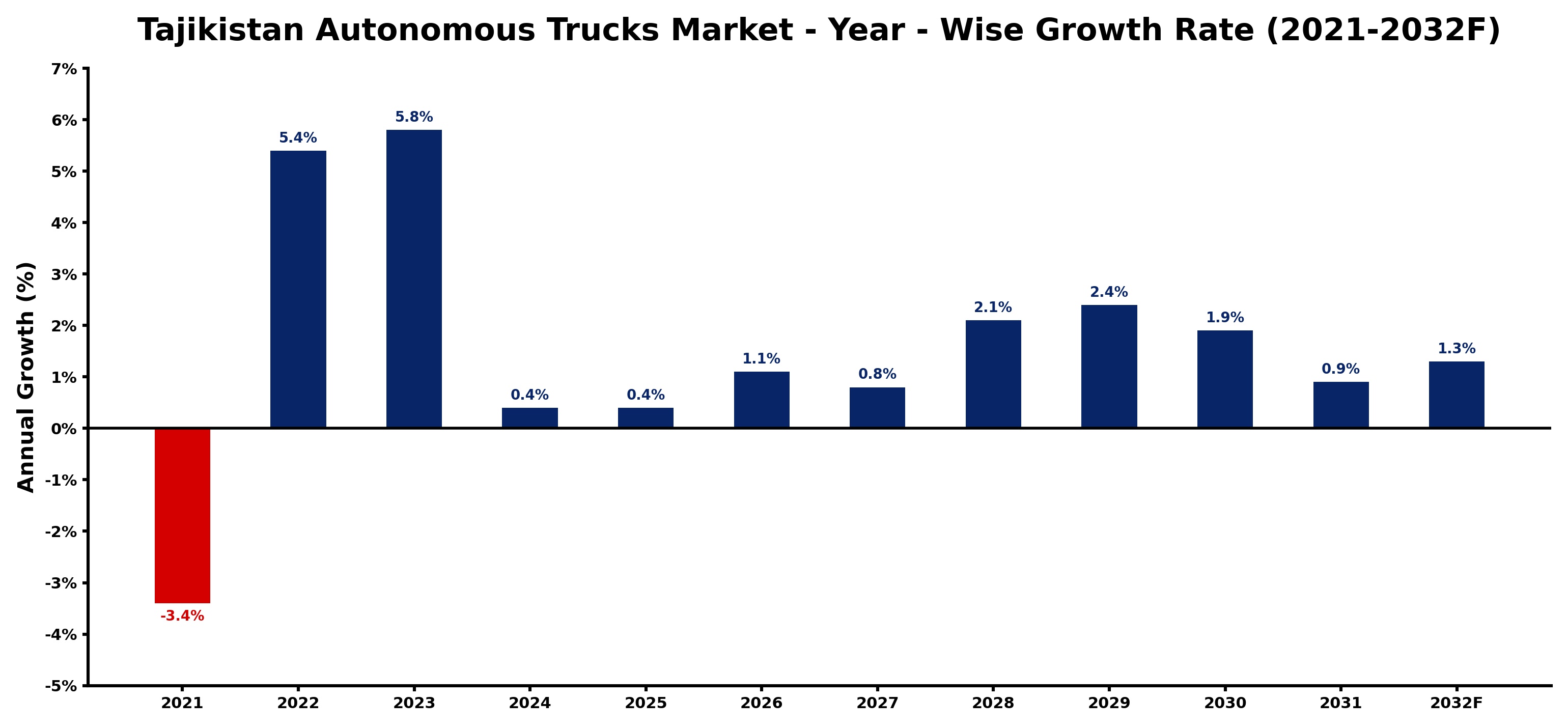
The table below presents the year‑wise growth rates along with the key drivers influencing the market
| Year | Growth Rate | Major Drivers |
| 2021 | -3.4% | Economic uncertainty reduced investments |
| 2022 | 5.4% | Technological advancements enhanced efficiency |
| 2023 | 5.8% | Infrastructure improvements supported logistics |
| 2024 | 0.4% | Increased demand for automation |
| 2025 | 0.4% | Regulatory support encouraged adoption |
| 2026 | 1.1% | Rising fuel prices drove interest |
| 2027 | 0.8% | E-commerce growth expanded delivery needs |
| 2028 | 2.1% | Sustainability trends influenced purchases |
| 2029 | 2.4% | Urbanization increased transportation demands |
| 2030 | 1.9% | Partnerships enhanced market penetration |
| 2031 | 0.9% | Consumer preferences shifted towards automation |
| 2032 | 1.3% | Investment in R&D fostered innovation |
Note - Market size estimations and growth projections presented in this report are based on 6Wresearch's advanced forecasting approach, validated with industry datasets as of June 2026.
Tajikistan Autonomous Trucks Market Synopsis
The most significant force shaping the Tajikistan Autonomous Trucks Market is the government's commitment to modernizing the transportation infrastructure. This initiative fosters an environment conducive to the adoption of autonomous technologies, particularly in the logistics sector. Additionally, advancements in AI and machine learning are further driving innovation and implementation in autonomous truck capabilities.
Furthermore, the increasing awareness and acceptance of autonomous technology among local logistics operators contribute to market expansion. Stakeholders are beginning to recognize the advantages of enhanced safety, reduced human error, and operational efficiency, creating a fertile ground for investment and growth.
Tajikistan Autonomous Trucks Market Key Takeaways
- The market is poised for steady growth due to increasing demand for efficient logistics solutions.
- Government initiatives are key enablers of market expansion, focused on infrastructure improvements.
- Technological advancements in AI and machine learning are significantly enhancing autonomous truck capabilities.
- Investment opportunities exist for companies targeting the unique logistics challenges of Tajikistan.
- Awareness and acceptance of autonomous technology are gradually increasing among stakeholders.
Evaluation of Restraints in Tajikistan Autonomous Trucks Market
Despite the promising outlook, the Tajikistan Autonomous Trucks Market faces several limitations that may hinder its progress. One major restraint is the regulatory environment surrounding autonomous vehicle testing and deployment, which remains underdeveloped. This includes unclear guidelines for operational standards and testing protocols. Additionally, the lack of necessary infrastructure to support autonomous systems, such as charging stations and dedicated lanes, presents a barrier to widespread adoption. Moreover, limited understanding of autonomous technology among key stakeholders complicates its integration into existing logistics frameworks. Overcoming these challenges is crucial for the market's successful development.
Tajikistan Autonomous Trucks Market Trends
The market is witnessing significant trends towards automation and digitalization. Companies are increasingly integrating artificial intelligence and machine learning into their logistics operations to optimize routes and improve efficiency. Furthermore, there is a growing focus on connected truck systems that enable real-time monitoring and data analytics, which can enhance operational decision-making. As investments in smart transportation solutions rise, more organizations are exploring partnerships that integrate autonomous vehicles into their supply chains, further solidifying their role in the logistics ecosystem.
Tajikistan Autonomous Trucks Market Opportunities
Genuine growth opportunities are emerging in the Tajikistan Autonomous Trucks Market as the demand for efficient transportation solutions escalates. Autonomous trucks provide a reliable answer to the logistical challenges posed by the country's rugged terrain and limited infrastructure. Investors can capitalize on this trend by targeting technology companies focused on autonomous systems or fleet management services. Collaborations with local logistics firms can yield significant advantages, allowing for the seamless integration of autonomous solutions into their operations, thus positioning early entrants for success in this evolving landscape.
Government Initiatives in the Tajikistan Autonomous Trucks Market
The Tajikistan government is actively fostering the growth of the autonomous trucks market through a range of policies aimed at ensuring safety and efficiency in operations. These initiatives include establishing testing and certification requirements for autonomous technologies as well as data privacy and cybersecurity standards. Moreover, the government is focused on investing in infrastructure to support the autonomous sector, which encompasses dedicated lanes for autonomous vehicles and charging stations. Promoting research and development in autonomous technology remains a priority, aligning with broader economic growth and innovation objectives.
Future Insights of the Tajikistan Autonomous Trucks Market
Looking ahead to 2026-2032, the Tajikistan Autonomous Trucks Market is expected to continue its upward trajectory. The integration of advanced technologies, alongside the push for more efficient logistics solutions, will play a significant role in shaping the market's future. As the government enhances infrastructure and regulatory frameworks, coupled with increased awareness among local businesses, the adoption of autonomous trucks is likely to rise. However, addressing existing challenges regarding public acceptance and technical readiness will be key in realizing the full potential of this market.
Tajikistan Autonomous Trucks Market Latest Developments (May 2025 - June 2026)
Recent developments in the Tajikistan Autonomous Trucks Market indicate a growing emphasis on infrastructure projects that support autonomous vehicle integration. Initiatives aimed at upgrading road systems and creating dedicated lanes are gaining traction. Furthermore, increasing investments in research and development underscore a commitment to advancing autonomous technologies tailored to the unique logistics needs of Tajikistan. The collaboration between the government and industry stakeholders is expected to drive progress in this emerging sector, setting the stage for enhanced operational efficiency.
Tajikistan Autonomous Trucks Market - Key Attractiveness of the Report
- 10 Years of Market Numbers
- Historical Data Starting from 2022 to 2025
- Base Year: 2025
- Forecast Data until 2032
- Key Performance Indicators Impacting the Market
- Major Upcoming Developments and Projects
Key Highlights of the Report:
- Tajikistan Autonomous Trucks Market Outlook
- Market Size of Tajikistan Autonomous Trucks Market, 2025
- Forecast of Tajikistan Autonomous Trucks Market, 2032
- Historical Data and Forecast of Tajikistan Autonomous Trucks Revenues & Volume for the Period 2022-2032F
- Tajikistan Autonomous Trucks Market Trend Evolution
- Tajikistan Autonomous Trucks Market Drivers and Challenges
- Tajikistan Autonomous Trucks Price Trends
- Tajikistan Autonomous Trucks Porter's Five Forces
- Tajikistan Autonomous Trucks Industry Life Cycle
- Historical Data and Forecast of Tajikistan Autonomous Trucks Market Revenues & Volume By Level of Autonomy for the Period 2022-2032F
- Historical Data and Forecast of Tajikistan Autonomous Trucks Market Revenues & Volume By Level 1 for the Period 2022-2032F
- Historical Data and Forecast of Tajikistan Autonomous Trucks Market Revenues & Volume By Level 2 for the Period 2022-2032F
- Historical Data and Forecast of Tajikistan Autonomous Trucks Market Revenues & Volume By Level 3 for the Period 2022-2032F
- Historical Data and Forecast of Tajikistan Autonomous Trucks Market Revenues & Volume By Level 4 for the Period 2022-2032F
- Historical Data and Forecast of Tajikistan Autonomous Trucks Market Revenues & Volume By Sensor Type for the Period 2022-2032F
- Historical Data and Forecast of Tajikistan Autonomous Trucks Market Revenues & Volume By Ultrasonic for the Period 2022-2032F
- Historical Data and Forecast of Tajikistan Autonomous Trucks Market Revenues & Volume By Radar for the Period 2022-2032F
- Historical Data and Forecast of Tajikistan Autonomous Trucks Market Revenues & Volume By Camera for the Period 2022-2032F
- Historical Data and Forecast of Tajikistan Autonomous Trucks Market Revenues & Volume By LiDAR for the Period 2022-2032F
- Historical Data and Forecast of Tajikistan Autonomous Trucks Market Revenues & Volume By Propulsion for the Period 2022-2032F
- Historical Data and Forecast of Tajikistan Autonomous Trucks Market Revenues & Volume By Diesel for the Period 2022-2032F
- Historical Data and Forecast of Tajikistan Autonomous Trucks Market Revenues & Volume By Electric for the Period 2022-2032F
- Historical Data and Forecast of Tajikistan Autonomous Trucks Market Revenues & Volume By Others for the Period 2022-2032F
- Historical Data and Forecast of Tajikistan Autonomous Trucks Market Revenues & Volume By Truck Type for the Period 2022-2032F
- Historical Data and Forecast of Tajikistan Autonomous Trucks Market Revenues & Volume By Light Duty Truck for the Period 2022-2032F
- Historical Data and Forecast of Tajikistan Autonomous Trucks Market Revenues & Volume By Medium Duty Truck for the Period 2022-2032F
- Historical Data and Forecast of Tajikistan Autonomous Trucks Market Revenues & Volume By Heavy Duty Truck for the Period 2022-2032F
- Tajikistan Autonomous Trucks Import Export Trade Statistics
- Market Opportunity Assessment By Level of Autonomy
- Market Opportunity Assessment By Sensor Type
- Market Opportunity Assessment By Propulsion
- Market Opportunity Assessment By Truck Type
- Tajikistan Autonomous Trucks Top Companies Market Share
- Tajikistan Autonomous Trucks Competitive Benchmarking By Technical and Operational Parameters
- Tajikistan Autonomous Trucks Company Profiles
- Tajikistan Autonomous Trucks Key Strategic Recommendations






































