Tajikistan Diamond Market Size, Share & Growth Rate
The Tajikistan Diamond Market was estimated at USD 431 Million in 2025 and is projected to reach USD 615 Million by 2032, growing at a CAGR of 5.2% from 2026 to 2032. This growth trajectory is primarily driven by the increasing global demand for ethically sourced diamonds, coupled with Tajikistan's untapped reserves and ongoing government initiatives aimed at enhancing infrastructure and attracting foreign investment. As consumer preferences shift towards sustainable and conflict-free diamonds, Tajikistans market stands poised to carve out a niche within the broader global landscape.
Tajikistan Diamond Market Year-wise Growth Rate and Key Drivers
This graph highlights how the Tajikistan Diamond Market has steadily grown over the years, supported by major growth factors.
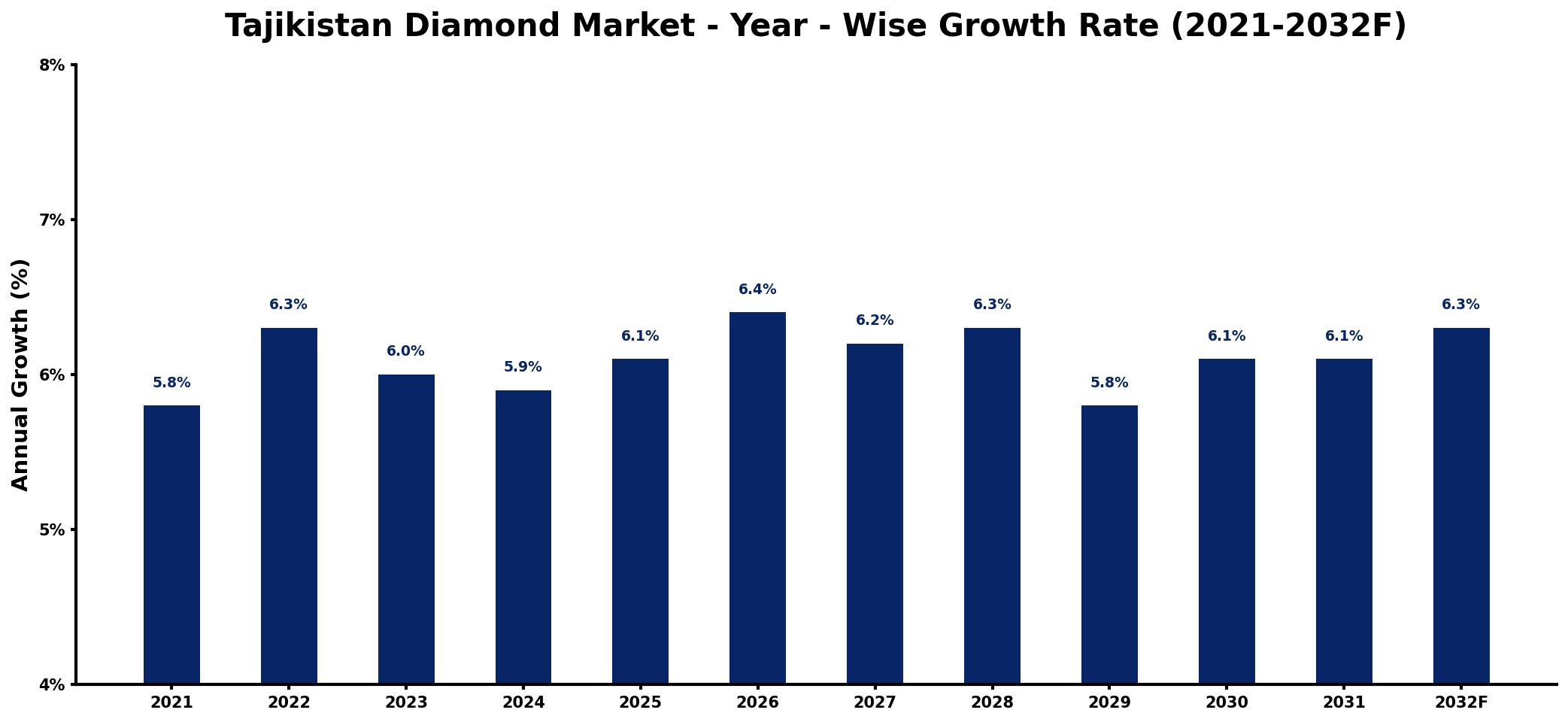
The table below presents the year‑wise growth rates along with the key drivers influencing the market
| Year | Growth Rate | Major Drivers |
| 2021 | 5.8% | Increased luxury consumer spending |
| 2022 | 6.3% | Growing investment in mining |
| 2023 | 6.0% | Rising global gemstone demand |
| 2024 | 5.9% | Expansion of retail distribution |
| 2025 | 6.1% | Emerging market interest rises |
| 2026 | 6.4% | Technological advancements in extraction |
| 2027 | 6.2% | Strengthened international trade agreements |
| 2028 | 6.3% | Enhanced marketing strategies adopted |
| 2029 | 5.8% | Diversification in product offerings |
| 2030 | 6.1% | Growing popularity of bespoke jewelry |
| 2031 | 6.1% | Increased tourism promoting luxury purchases |
| 2032 | 6.3% | Development of sustainable sourcing practices |
Note: Market size estimations and growth projections presented in this report are based on 6Wresearch's proprietary forecasting methodology, utilizing the latest available industry data, government publications, and primary research inputs.
Tajikistan Diamond Market Synopsis
Tajikistans diamond sector, while small, holds potential with known reserves primarily located in the Pamir Mountains. The countrys focus on developing its diamond industry has seen increasing interest from foreign investors, eager to tap into this underexplored market.
Despite its limited current footprint in the global market, the drive towards transparency and ethical sourcing is reshaping the landscape. As consumer demand grows for sustainably sourced diamonds, Tajikistan is strategically positioned to align with these emerging trends, promising a robust market for the future.
Tajikistan Diamond Market Key Takeaways
- Tajikistan is aiming to develop its diamond industry by leveraging known reserves and attracting foreign investments.
- Ethical sourcing and sustainability are becoming major drivers of consumer demand within the market.
- The government's policies include initiatives for transparency and tax incentives to stimulate growth.
- Despite existing challenges, Tajikistan's diamond sector presents valuable investment opportunities.
- Market projections indicate steady growth, with increasing emphasis on unique and custom-designed jewelry pieces.
Evaluation of Restraints in Tajikistan Diamond Market
The Tajikistan Diamond Market faces several restraints that limit its growth potential. A significant barrier is the lack of advanced technology and infrastructure for diamond mining and processing, which hinders efficiency and productivity. Additionally, access to international markets is limited, complicating export opportunities. Coupled with a shortage of skilled labor and regulatory constraints, these factors present considerable challenges. Furthermore, concerns surrounding conflict diamonds and the need for enhanced ethical practices add layers of complexity that must be addressed to unlock the sector's full potential.
Tajikistan Diamond Market Trends
The current trends within the Tajikistan Diamond Market highlight a notable shift towards ethical and sustainable practices. Consumers are increasingly demanding transparency in the diamond supply chain, fueling interest in conflict-free stones. Moreover, the rise of unique and personalized jewelry pieces reflects changing consumer preferences. Retailers are responding by promoting bespoke offerings and enhancing their narratives around ethical sourcing, thus aligning with the global drive towards responsible luxury.
Tajikistan Diamond Market Opportunities
The opportunities for investment within the Tajikistan Diamond Market are compelling, particularly given the country's rich diamond reserves valued at over $1 billion. Investors can capitalize on the underdeveloped nature of this sector by engaging with local mining companies or investing in diamond processing facilities. Additionally, the burgeoning interest in ethical sourcing presents avenues for businesses to innovate and attract discerning consumers. As the government continues to implement supportive policies, the landscape for investment and growth in Tajikistan's diamond industry looks increasingly promising.
Government Initiatives in the Tajikistan Diamond Market
The Tajikistan government is actively working to develop the diamond sector through various initiatives. Establishing the State Committee on Investment and State Property Management has been pivotal in overseeing mining and trading activities. Additionally, the government enforces regulations aimed at ensuring transparency and ethical practices in the diamond market. By providing tax incentives and support for exploration projects, Tajikistan is striving to attract foreign investment, thereby fostering sustainable growth in its diamond industry.
Future Insights of the Tajikistan Diamond Market
Looking ahead to 2026-2032, the Tajikistan Diamond Market is expected to experience substantial growth as investment in infrastructure and technology begins to take shape. With advancements in mining capabilities and an increasing focus on ethical sourcing, Tajikistan could emerge as a significant player on the international diamond stage. The favorable global demand for conflict-free diamonds, combined with the countrys strategic location along key trade routes, positions Tajikistan to attract further investment and enhance its market presence, paving the way for an exciting future.
Tajikistan Diamond Market Latest Developments (2025 - 2026)
Recent developments in the Tajikistan Diamond Market indicate a growing commitment from both the government and private sectors to improve mining practices and infrastructure. There have been discussions surrounding potential partnerships aimed at modernizing the extraction and processing techniques used within the industry. Efforts to promote ethical sourcing are gaining traction, with local retailers increasingly emphasizing their commitment to sustainability, responding effectively to shifting consumer expectations.
Tajikistan Diamond Market - Key Attractiveness of the Report
- 10 Years of Market Numbers
- Historical Data Starting from 2022 to 2025
- Base Year: 2025
- Forecast Data until 2032
- Key Performance Indicators Impacting the Market
- Major Upcoming Developments and Projects
Key Highlights of the Report:
- Tajikistan Diamond Market Outlook
- Market Size of Tajikistan Diamond Market, 2025
- Forecast of Tajikistan Diamond Market, 2032
- Historical Data and Forecast of Tajikistan Diamond Revenues & Volume for the Period 2022-2032F
- Tajikistan Diamond Market Trend Evolution
- Tajikistan Diamond Market Drivers and Challenges
- Tajikistan Diamond Price Trends
- Tajikistan Diamond Porter's Five Forces
- Tajikistan Diamond Industry Life Cycle
- Historical Data and Forecast of Tajikistan Diamond Market Revenues & Volume By Product for the Period 2022-2032F
- Historical Data and Forecast of Tajikistan Diamond Market Revenues & Volume By Natural for the Period 2022-2032F
- Historical Data and Forecast of Tajikistan Diamond Market Revenues & Volume By Synthetic for the Period 2022-2032F
- Historical Data and Forecast of Tajikistan Diamond Market Revenues & Volume By Application for the Period 2022-2032F
- Historical Data and Forecast of Tajikistan Diamond Market Revenues & Volume By Jewelry for the Period 2022-2032F
- Historical Data and Forecast of Tajikistan Diamond Market Revenues & Volume By Industrial for the Period 2022-2032F
- Tajikistan Diamond Import Export Trade Statistics
- Market Opportunity Assessment By Product
- Market Opportunity Assessment By Application
- Tajikistan Diamond Top Companies Market Share
- Tajikistan Diamond Competitive Benchmarking By Technical and Operational Parameters
- Tajikistan Diamond Company Profiles
- Tajikistan Diamond Key Strategic Recommendations






































