Tajikistan Frozen Fish Market Size, Share & Growth Rate
The Tajikistan Frozen Fish Market was estimated at USD 346 Million in 2025 and is projected to reach USD 455 Million by 2032, growing at a CAGR of 4.0% from 2026 to 2032. This growth trajectory is primarily driven by rising consumer demand for convenient and long-lasting food solutions, with frozen fish emerging as a preferred option. The expansion of retail offerings, along with an increase in health consciousness among consumers, is further bolstering market momentum.
Tajikistan Frozen Fish Market Year-wise Growth Rate and Key Drivers
This graph highlights how the Tajikistan Frozen Fish Market has steadily grown over the years, supported by major growth factors.
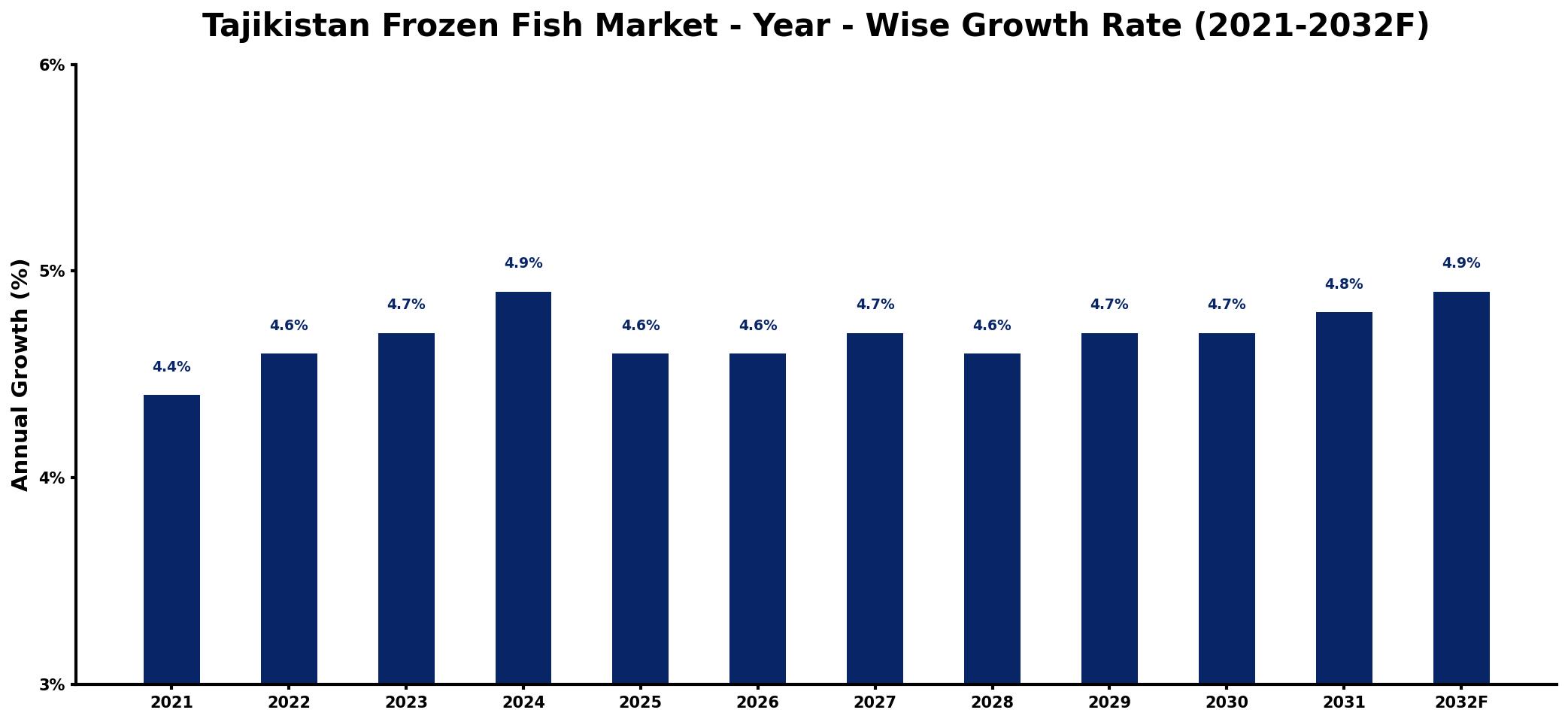
The table below presents the year‑wise growth rates along with the key drivers influencing the market
| Year | Growth Rate | Major Drivers |
| 2021 | 4.4% | Increased consumer demand for seafood |
| 2022 | 4.6% | Expansion of distribution networks |
| 2023 | 4.7% | Rising health consciousness among consumers |
| 2024 | 4.9% | Growth in local processing facilities |
| 2025 | 4.6% | Increased export opportunities emerging |
| 2026 | 4.6% | Investment in cold chain logistics |
| 2027 | 4.7% | Diversification of product offerings |
| 2028 | 4.6% | Strengthening of retail partnerships |
| 2029 | 4.7% | Enhanced marketing strategies implemented |
| 2030 | 4.7% | Technological advancements in preservation |
| 2031 | 4.8% | Improved supply chain efficiencies |
| 2032 | 4.9% | Rising popularity of ready meals |
Note: Market size estimations and growth projections presented in this report are based on 6Wresearch's proprietary forecasting methodology, utilizing the latest available industry data, government publications, and primary research inputs.
Tajikistan Frozen Fish Market Synopsis
The most significant force currently shaping the Tajikistan Frozen Fish Market is the growing consumer preference for ready-to-cook seafood. As more individuals opt for quick meal solutions, frozen fish products such as salmon, tilapia, and pangasius have gained notable traction among local consumers.
Local retailers and supermarkets are expanding their frozen fish selections to meet this demand, while also addressing the challenges of infrastructure limitations. Despite obstacles related to transportation and storage, the market is set for continued growth as consumers increasingly seek high-quality frozen seafood.
Tajikistan Frozen Fish Market Key Takeaways
- Consumer demand for convenient frozen fish products is on the rise.
- Local retailers are diversifying their offerings to include various species and cuts of frozen fish.
- Sustainability and responsible sourcing practices are becoming essential for market competitiveness.
- Cold storage and transportation infrastructure improvements are critical to supporting growth.
- Investment opportunities are available in modern facilities and distribution networks.
Evaluation of Restraints in Tajikistan Frozen Fish Market
The growth of the Tajikistan Frozen Fish Market faces considerable constraints, particularly surrounding inadequate cold storage and transportation facilities. These limitations hinder the preservation of quality and freshness during distribution. Additionally, the absence of advanced processing technology affects operational efficiency, compounding challenges. The fragmented market structure and inconsistent regulatory landscape complicate quality assurance efforts, further constraining market potential. Lastly, fluctuations in exchange rates and import regulations can directly influence the availability and pricing of frozen fish products, creating uncertainty for both suppliers and consumers.
Tajikistan Frozen Fish Market Trends
Several trends are emerging in the Tajikistan Frozen Fish Market, reflecting changing consumer preferences. There's a marked shift toward a wider variety of frozen fish products available in the market, catering to diverse tastes. Alongside this, consumers are becoming increasingly aware of the nutritional benefits and quality advantages associated with frozen fish, which contributes to its growing popularity. Moreover, sustainable sourcing practices are gaining importance, as consumers express heightened concerns regarding environmental responsibility and the impact of their choices on ecosystems.
Tajikistan Frozen Fish Market Opportunities
The Tajikistan Frozen Fish Market presents significant investment opportunities, especially in light of the rising demand for seafood. Investors can capitalize on this trend by developing state-of-the-art cold storage facilities, enhancing distribution networks, and forming partnerships with local suppliers. Furthermore, the introduction of a broad range of frozen fish products that accommodate varying consumer preferences is likely to drive market expansion. Collaborating with local retailers and restaurants to extend the reach of frozen fish could also emerge as a viable strategy, enhancing overall market presence.
Government Initiatives in the Tajikistan Frozen Fish Market
Government policies play a vital role in shaping the Tajikistan Frozen Fish Market, with regulations aimed at improving food safety, quality standards, and business licensing. The government actively supports the fishing industry through various initiatives designed to enhance domestic production capabilities. These efforts include monitoring import and export processes to ensure compliance and prevent market manipulation, fostering a more competitive and equitable landscape for businesses operating within the sector.
Future Insights of the Tajikistan Frozen Fish Market
Looking forward to the years 2026-2032, the Tajikistan Frozen Fish Market is well-positioned for growth, driven by several key factors. The ongoing consumer shift towards convenient food options will likely sustain demand for frozen fish products, complemented by improvements in cold chain logistics. As dietary preferences evolve and disposable incomes increase, more consumers will prioritize high-quality seafood as a healthy protein source. The governments commitment to boosting the seafood industry will also support market expansion, presenting ample opportunities for players in this sector.
Tajikistan Frozen Fish Market Latest Developments (2025 - 2026)
Recent developments in the Tajikistan Frozen Fish Market include a growing emphasis on sustainability, with several local retailers beginning to adopt environmentally responsible sourcing practices. Additionally, discussions around improving cold chain infrastructure have gained momentum, as stakeholders recognize its critical role in maintaining product quality. Collaborative efforts between government agencies and industry players are becoming more prevalent, aimed at enhancing domestic production capabilities and addressing challenges related to transportation and storage.
Tajikistan Frozen Fish Market - Key Attractiveness of the Report
- 10 Years of Market Numbers
- Historical Data Starting from 2022 to 2025
- Base Year: 2025
- Forecast Data until 2032
- Key Performance Indicators Impacting the Market
- Major Upcoming Developments and Projects
Key Highlights of the Report:
- Tajikistan Frozen Fish Market Outlook
- Market Size of Tajikistan Frozen Fish Market, 2025
- Forecast of Tajikistan Frozen Fish Market, 2032
- Historical Data and Forecast of Tajikistan Frozen Fish Revenues & Volume for the Period 2022-2032F
- Tajikistan Frozen Fish Market Trend Evolution
- Tajikistan Frozen Fish Market Drivers and Challenges
- Tajikistan Frozen Fish Price Trends
- Tajikistan Frozen Fish Porter's Five Forces
- Tajikistan Frozen Fish Industry Life Cycle
- Historical Data and Forecast of Tajikistan Frozen Fish Market Revenues & Volume By Type for the Period 2022-2032F
- Historical Data and Forecast of Tajikistan Frozen Fish Market Revenues & Volume By Fish Fingers for the Period 2022-2032F
- Historical Data and Forecast of Tajikistan Frozen Fish Market Revenues & Volume By Fish Cakes for the Period 2022-2032F
- Historical Data and Forecast of Tajikistan Frozen Fish Market Revenues & Volume By Breaded/Battered Fish for the Period 2022-2032F
- Historical Data and Forecast of Tajikistan Frozen Fish Market Revenues & Volume By Whole Fish & Drawn Fish for the Period 2022-2032F
- Historical Data and Forecast of Tajikistan Frozen Fish Market Revenues & Volume By Single Fillet & Butterfly Fillet for the Period 2022-2032F
- Historical Data and Forecast of Tajikistan Frozen Fish Market Revenues & Volume By Dressed Fish for the Period 2022-2032F
- Historical Data and Forecast of Tajikistan Frozen Fish Market Revenues & Volume By Steaks Fish for the Period 2022-2032F
- Historical Data and Forecast of Tajikistan Fish Fingers Frozen Fish Market Revenues & Volume By Others for the Period 2022-2032F
- Historical Data and Forecast of Tajikistan Frozen Fish Market Revenues & Volume By Application for the Period 2022-2032F
- Historical Data and Forecast of Tajikistan Frozen Fish Market Revenues & Volume By Direct Consumption for the Period 2022-2032F
- Historical Data and Forecast of Tajikistan Frozen Fish Market Revenues & Volume By Restaurants for the Period 2022-2032F
- Historical Data and Forecast of Tajikistan Frozen Fish Market Revenues & Volume By Food Processing Factories for the Period 2022-2032F
- Historical Data and Forecast of Tajikistan Frozen Fish Market Revenues & Volume By Others for the Period 2022-2032F
- Historical Data and Forecast of Tajikistan Frozen Fish Market Revenues & Volume By Distribution Channel for the Period 2022-2032F
- Historical Data and Forecast of Tajikistan Frozen Fish Market Revenues & Volume By Supermarkets & Hypermarkets for the Period 2022-2032F
- Historical Data and Forecast of Tajikistan Frozen Fish Market Revenues & Volume By Convenience Stores for the Period 2022-2032F
- Historical Data and Forecast of Tajikistan Frozen Fish Market Revenues & Volume By Speciality Retailers for the Period 2022-2032F
- Historical Data and Forecast of Tajikistan Frozen Fish Market Revenues & Volume By Online for the Period 2022-2032F
- Historical Data and Forecast of Tajikistan Frozen Fish Market Revenues & Volume By Others for the Period 2022-2032F
- Tajikistan Frozen Fish Import Export Trade Statistics
- Market Opportunity Assessment By Type
- Market Opportunity Assessment By Application
- Market Opportunity Assessment By Distribution Channel
- Tajikistan Frozen Fish Top Companies Market Share
- Tajikistan Frozen Fish Competitive Benchmarking By Technical and Operational Parameters
- Tajikistan Frozen Fish Company Profiles
- Tajikistan Frozen Fish Key Strategic Recommendations






































