Tajikistan Herbal Cosmetics Market Size, Share & Growth Rate
The Tajikistan Herbal Cosmetics Market was estimated at USD 198 Million in 2025 and is projected to reach USD 259 Million by 2032, growing at a CAGR of 3.9% from 2026 to 2032. This growth trajectory is largely propelled by a seismic shift in consumer preferences towards natural and eco-friendly products, coupled with a burgeoning middle class increasingly demanding wellness-oriented beauty solutions. Additionally, the country's rich heritage of herbal remedies uniquely positions local producers to innovate and cater to the rising consumer interest in organic ingredients.
Tajikistan Herbal Cosmetics Market Year-wise Growth Rate and Key Drivers
This graph highlights how the Tajikistan Herbal Cosmetics Market has steadily grown over the years, supported by major growth factors.
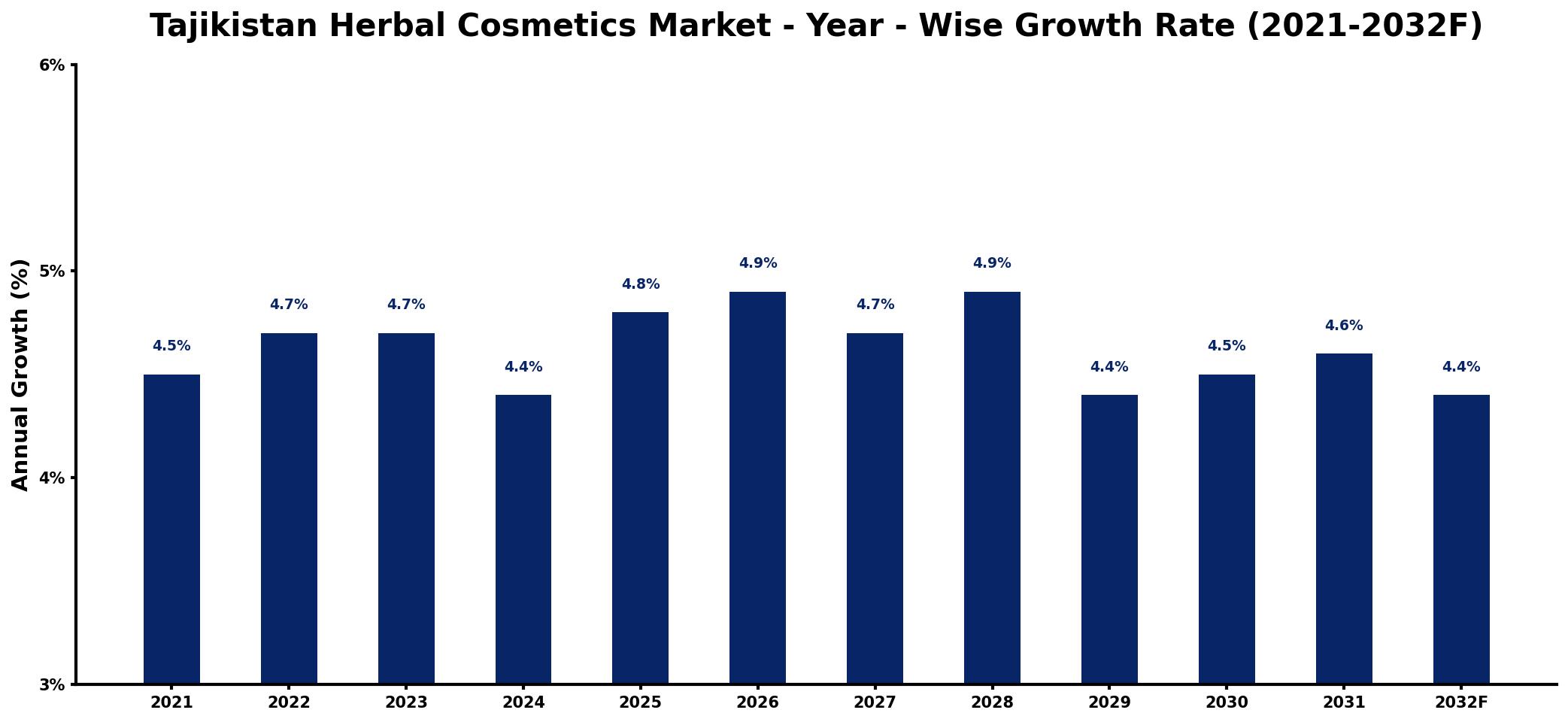
The table below presents the year‑wise growth rates along with the key drivers influencing the market
| Year | Growth Rate | Major Drivers |
| 2021 | 4.5% | Rising consumer demand for natural |
| 2022 | 4.7% | Increased investment in local production |
| 2023 | 4.7% | Growing interest in sustainable ingredients |
| 2024 | 4.4% | Expansion of retail distribution channels |
| 2025 | 4.8% | Emergence of new market players |
| 2026 | 4.9% | Enhanced marketing strategies and outreach |
| 2027 | 4.7% | Strengthening of online sales platforms |
| 2028 | 4.9% | expanding healthcare application demand |
| 2029 | 4.4% | Diversification of product offerings available |
| 2030 | 4.5% | Increased awareness of health benefits |
| 2031 | 4.6% | Growing popularity of eco-friendly packaging |
| 2032 | 4.4% | Development of niche market segments |
Note: Market size estimations and growth projections presented in this report are based on 6Wresearch's proprietary forecasting methodology, utilizing the latest available industry data, government publications, and primary research inputs.
Tajikistan Herbal Cosmetics Market Synopsis
Recent momentum in the Tajikistan herbal cosmetics market highlights a burgeoning consumer awareness about the advantages of natural ingredients in personal care products. As the market evolves, local brands leveraging traditional herbs are gaining traction, paving the way for sustainable growth and innovation.
Looking ahead, the market is set to expand significantly, driven by an increasing demand for herbal skincare, haircare, and body care products. This aligns with global trends favoring natural and organic solutions, positioning Tajikistan as a promising landscape for both domestic and international brands seeking to tap into the growing desire for environmentally responsible beauty products.
Tajikistan Herbal Cosmetics Market Key Takeaways
- Growing consumer preference for natural and eco-friendly beauty products is reshaping the market landscape.
- Local brands are increasingly focusing on traditional Tajik herbal ingredients, enhancing product authenticity and cultural significance.
- Distribution channels, including specialty stores and online platforms, are vital for market expansion and consumer accessibility.
- Government policies support the growth of domestic manufacturers and promote the use of locally sourced ingredients.
- Investment opportunities exist in manufacturing and marketing strategies that align with sustainable and organic trends.
Evaluation of Restraints in Tajikistan Herbal Cosmetics Market
Despite its positive outlook, the Tajikistan herbal cosmetics market faces significant restraints that hinder its full potential. Limited consumer understanding of the benefits associated with herbal products poses a barrier to market penetration. Additionally, competition from established international brands complicates local players' efforts to gain market share. Sourcing high-quality local ingredients remains challenging, further restricting product development. Coupled with the relatively low purchasing power of the population, these factors could impede the adoption of premium-priced herbal offerings. To overcome these challenges, comprehensive educational campaigns and enhanced marketing initiatives are essential to foster consumer trust and bolster demand for herbal cosmetics.
Tajikistan Herbal Cosmetics Market Trends
The demand for natural and organic products is reshaping the beauty landscape in Tajikistan. Key trends include a rising interest in traditional herbal ingredients such as rose oil, chamomile, and lavender, which not only resonate with local culture but also enhance product authenticity. The emphasis on sustainable packaging solutions is gaining traction, reflecting broader environmental concerns. Furthermore, as consumers become more wellness-oriented, the appeal of herbal cosmetics that promise gentle and chemical-free skincare is set to intensify.
Tajikistan Herbal Cosmetics Market Opportunities
A range of investment opportunities exists within the Tajikistan herbal cosmetics market, particularly in manufacturing, distribution, and retailing of herbal beauty products. Collaborations with local herbal suppliers can yield a competitive edge through the utilization of indigenous herbs and traditional beauty rituals. Additionally, creating marketing strategies that underscore the natural and sustainable attributes of herbal cosmetics can effectively capture the interest of eco-conscious consumers. As the market grows, the potential for innovative product lines tailored to local preferences becomes increasingly promising.
Government Initiatives in the Tajikistan Herbal Cosmetics Market
The Tajikistan government has recognized the significance of the herbal cosmetics market and is actively implementing policies to foster its growth. These policies encourage the use of locally sourced natural ingredients, support domestic manufacturers, and set quality and safety standards for products. Additionally, initiatives aimed at raising consumer awareness about herbal cosmetics benefits are underway, alongside regulatory measures to ensure a robust domestic industry while controlling imports. Overall, such government initiatives create a favorable environment for local producers and enhance the availability of high-quality herbal products for consumers.
Future Insights of the Tajikistan Herbal Cosmetics Market
The future of the Tajikistan herbal cosmetics market looks promising, with anticipated steady growth driven by increasing consumer awareness of the benefits of natural ingredients. As personal care and grooming habits continue to evolve, the preference for herbal cosmetics is expected to surge. Key factors fueling this growth include the expanding middle-class population, rising disposable incomes, and a collective shift toward organic and sustainable beauty solutions. Government efforts to promote traditional remedies and local products will likely further solidify the market's expansion trajectory, providing numerous opportunities for brands that align with consumer values.
Tajikistan Herbal Cosmetics Market Latest Developments (2025 - 2026)
In recent months, the Tajikistan herbal cosmetics market has seen a notable increase in product innovation, with brands launching new lines featuring local herbal ingredients. Consumer interest in eco-friendly practices has driven brands to adopt more sustainable packaging solutions. Additionally, promotional campaigns aimed at educating consumers about the benefits of herbal cosmetics have gained momentum, bolstering market awareness and encouraging trial. Overall, these developments reflect a dynamic market responding to evolving consumer preferences.
Tajikistan Herbal Cosmetics Market - Key Attractiveness of the Report
- 10 Years of Market Numbers
- Historical Data Starting from 2022 to 2025
- Base Year: 2025
- Forecast Data until 2032
- Key Performance Indicators Impacting the Market
- Major Upcoming Developments and Projects
Key Highlights of the Report:
- Tajikistan Herbal Cosmetics Market Outlook
- Market Size of Tajikistan Herbal Cosmetics Market, 2025
- Forecast of Tajikistan Herbal Cosmetics Market, 2032
- Historical Data and Forecast of Tajikistan Herbal Cosmetics Revenues & Volume for the Period 2022-2032F
- Tajikistan Herbal Cosmetics Market Trend Evolution
- Tajikistan Herbal Cosmetics Market Drivers and Challenges
- Tajikistan Herbal Cosmetics Price Trends
- Tajikistan Herbal Cosmetics Porter's Five Forces
- Tajikistan Herbal Cosmetics Industry Life Cycle
- Historical Data and Forecast of Tajikistan Herbal Cosmetics Market Revenues & Volume By Physical State for the Period 2022-2032F
- Historical Data and Forecast of Tajikistan Herbal Cosmetics Market Revenues & Volume By Solid for the Period 2022-2032F
- Historical Data and Forecast of Tajikistan Herbal Cosmetics Market Revenues & Volume By Semi-solid for the Period 2022-2032F
- Historical Data and Forecast of Tajikistan Herbal Cosmetics Market Revenues & Volume By Liquid for the Period 2022-2032F
- Historical Data and Forecast of Tajikistan Herbal Cosmetics Market Revenues & Volume By Product for the Period 2022-2032F
- Historical Data and Forecast of Tajikistan Herbal Cosmetics Market Revenues & Volume By Skin Care Product for the Period 2022-2032F
- Historical Data and Forecast of Tajikistan Herbal Cosmetics Market Revenues & Volume By Hair Care Product for the Period 2022-2032F
- Historical Data and Forecast of Tajikistan Herbal Cosmetics Market Revenues & Volume By Baby Care Product for the Period 2022-2032F
- Historical Data and Forecast of Tajikistan Herbal Cosmetics Market Revenues & Volume By Oral Care Product for the Period 2022-2032F
- Historical Data and Forecast of Tajikistan Herbal Cosmetics Market Revenues & Volume By Make-up Product for the Period 2022-2032F
- Historical Data and Forecast of Tajikistan Herbal Cosmetics Market Revenues & Volume By Distribution Channel for the Period 2022-2032F
- Historical Data and Forecast of Tajikistan Herbal Cosmetics Market Revenues & Volume By Supermarket for the Period 2022-2032F
- Historical Data and Forecast of Tajikistan Herbal Cosmetics Market Revenues & Volume By Pharmacy for the Period 2022-2032F
- Historical Data and Forecast of Tajikistan Herbal Cosmetics Market Revenues & Volume By Departmental Store for the Period 2022-2032F
- Historical Data and Forecast of Tajikistan Herbal Cosmetics Market Revenues & Volume By Beauty Spa/Salon for the Period 2022-2032F
- Historical Data and Forecast of Tajikistan Herbal Cosmetics Market Revenues & Volume By Internet Retailing for the Period 2022-2032F
- Historical Data and Forecast of Tajikistan Herbal Cosmetics Market Revenues & Volume By Specialty Store for the Period 2022-2032F
- Tajikistan Herbal Cosmetics Import Export Trade Statistics
- Market Opportunity Assessment By Physical State
- Market Opportunity Assessment By Product
- Market Opportunity Assessment By Distribution Channel
- Tajikistan Herbal Cosmetics Top Companies Market Share
- Tajikistan Herbal Cosmetics Competitive Benchmarking By Technical and Operational Parameters
- Tajikistan Herbal Cosmetics Company Profiles
- Tajikistan Herbal Cosmetics Key Strategic Recommendations






































