Tajikistan Ice cream Market Size, Share & Growth Rate
The Tajikistan Ice cream Market was estimated at USD 323 Million in 2025 and is projected to reach USD 424 Million by 2032, growing at a CAGR of 4.0% from 2026 to 2032. This growth trajectory is driven by the increasing disposable income among consumers, which enhances their purchasing power for indulgent products. Additionally, the evolving palate of a young population is demanding more innovative flavor profiles and healthier options, contributing to a vibrant market landscape.
Tajikistan Ice cream Market Year-wise Growth Rate and Key Drivers
This graph highlights how the Tajikistan Ice cream Market has steadily grown over the years, supported by major growth factors.
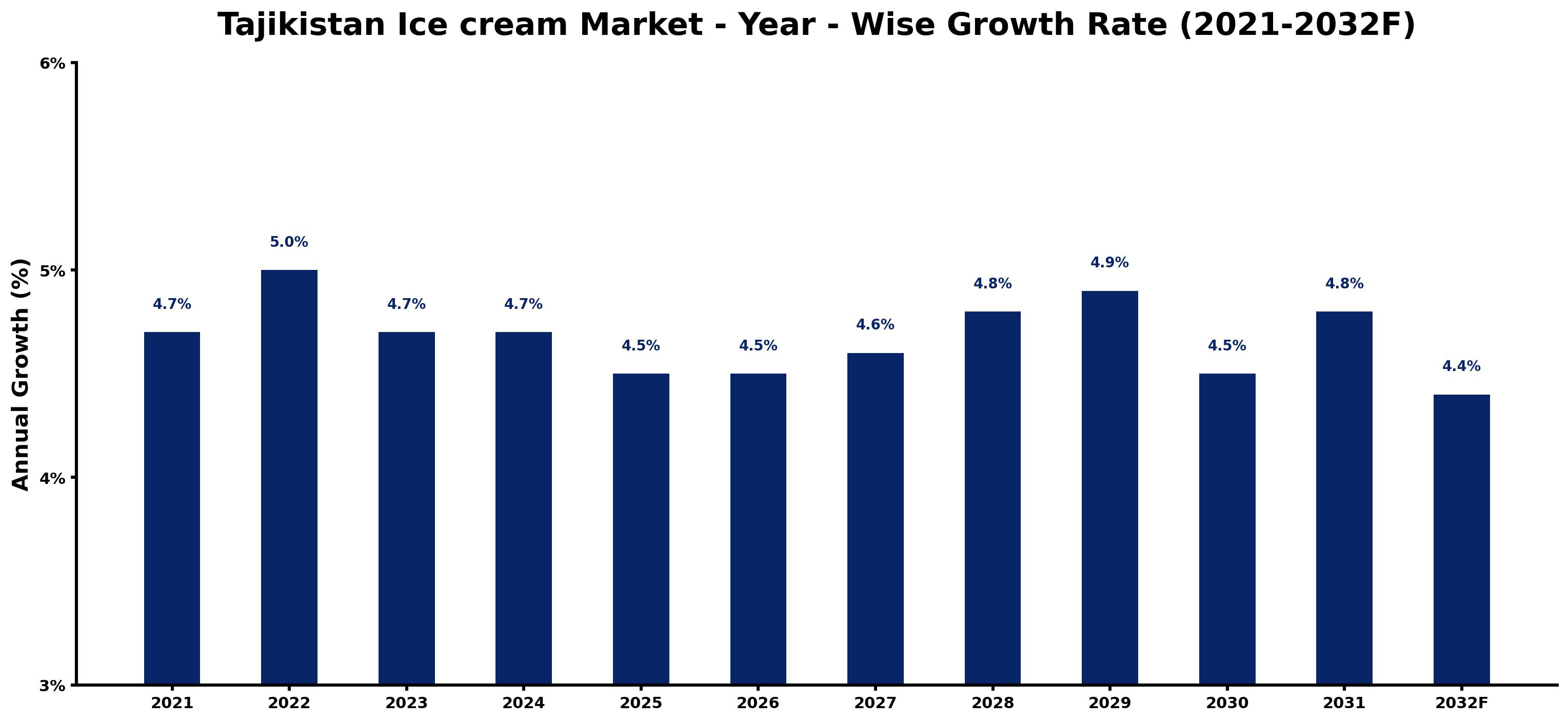
The table below presents the year‑wise growth rates along with the key drivers influencing the market
| Year | Growth Rate | Major Drivers |
| 2021 | 4.7% | Growing renewable energy integration projects |
| 2022 | 5.0% | Expansion of transportation and logistics networks |
| 2023 | 4.7% | Expansion of manufacturing activities |
| 2024 | 4.7% | Increasing adoption of advanced technologies |
| 2025 | 4.5% | Growing urbanization and commercial development |
| 2026 | 4.5% | Government infrastructure modernization initiatives |
| 2027 | 4.6% | Increasing industrial automation investments |
| 2028 | 4.8% | Increasing adoption of advanced technologies |
| 2029 | 4.9% | Expansion of manufacturing activities |
| 2030 | 4.5% | Increasing adoption of advanced technologies |
| 2031 | 4.8% | Growing renewable energy integration projects |
| 2032 | 4.4% | Rapid growth in telecom and data center sectors |
Note - Market size estimations and growth projections presented in this report are based on 6Wresearch's advanced forecasting approach, validated with industry datasets as of June 2026.
Tajikistan Ice cream Market Synopsis
Local dairy products play a crucial role in Tajikistan's ice cream production, ensuring the quality and freshness that consumers seek. Traditional favorites continue to dominate, yet the rise of exotic and gourmet flavors signals a shift towards a more diverse market offering.
The growing interest in health-conscious choices is further shaping the market, with consumers increasingly seeking low-sugar, organic, and dairy-free ice cream options. This trend is a reflection of broader global movements towards wellness and sustainability.
Tajikistan Ice cream Market Key Takeaways
- The market is experiencing steady growth, fueled by rising disposable income and changing consumer preferences.
- There is a notable shift towards premium and gourmet flavors, indicating a more sophisticated consumer base.
- Health and wellness concerns are driving demand for low-sugar and dairy-free alternatives.
- Distribution channels are expanding, providing better access to ice cream products across urban and rural settings.
- Government support through subsidies and regulations is fostering a competitive and sustainable market environment.
Evaluation of Restraints in Tajikistan Ice cream Market
Despite its growth potential, the Tajikistan ice cream market faces certain limitations. Economic conditions have led to a price-sensitive consumer base, impacting purchasing behavior. Additionally, inadequate infrastructure and distribution networks in remote areas hinder access to a broader audience. Seasonal demand fluctuations, particularly in extreme weather conditions, pose challenges for consistent sales and production planning. The increasing competition from international brands also pressures local manufacturers to innovate continuously in order to maintain relevance.
Tajikistan Ice cream Market Trends
Current trends indicate a marked inclination towards premium ice cream products, which attract discerning consumers seeking unique flavors and artisanal qualities. Moreover, single-serve and portable ice cream formats are gaining popularity, catering to the on-the-go lifestyle of young consumers. The focus on sustainability is also evident as consumers show preference for locally sourced ingredients, aligning with a growing demand for environmental responsibility within food production.
Tajikistan Ice cream Market Opportunities
Investors eyeing the Tajikistan ice cream market will find substantial opportunities as consumer demand for frozen desserts continues to rise. The introduction of innovative flavor combinations and premium product offerings can attract a larger audience. Expansion into various distribution channels, including supermarkets and online platforms, can enhance market reach. Collaborations with local dairy suppliers may further improve product quality while supporting the domestic economy, thus positioning brands favorably in a competitive landscape.
Government Initiatives in the Tajikistan Ice cream Market
The Tajikistan government has established various policies to regulate the ice cream industry, ensuring standards for quality and safety are upheld. This includes monitoring pricing practices to prevent unfair competition, as well as facilitating proper labeling and packaging requirements. Furthermore, the government provides support through subsidies and incentives to boost local ice cream production, creating a conducive environment for the industry's growth while simultaneously regulating imports to protect domestic manufacturers.
Future Insights of the Tajikistan Ice cream Market
Looking ahead to 2026-2032, the Tajikistan ice cream market is expected to continue its upward trajectory, driven by ongoing urbanization and modernization trends. As consumers increasingly seek convenience and indulgent frozen treats, the market is likely to expand further. The presence of international brands and enhancements in retail infrastructure will also foster competitive dynamics, paving the way for innovative products that cater to evolving consumer preferences. Strategic marketing and efficient distribution will be critical in harnessing these opportunities for growth.
Tajikistan Ice cream Market Latest Developments (May 2025 - June 2026)
Recent developments in the Tajikistan ice cream market indicate a growing collaboration between local manufacturers and international brands, aiming to leverage expertise in flavor innovation and production efficiency. Innovations in packaging aimed at enhancing convenience and preserving product quality are emerging. Additionally, the rising trend of health-conscious consumption is prompting brands to explore low-calorie and functional ice cream options, further diversifying the product landscape.
Tajikistan Ice cream Market - Key Attractiveness of the Report
- 10 Years of Market Numbers
- Historical Data Starting from 2022 to 2025
- Base Year: 2025
- Forecast Data until 2032
- Key Performance Indicators Impacting the Market
- Major Upcoming Developments and Projects
Key Highlights of the Report:
- Tajikistan Ice cream Market Outlook
- Market Size of Tajikistan Ice cream Market, 2025
- Forecast of Tajikistan Ice cream Market, 2032
- Historical Data and Forecast of Tajikistan Ice cream Revenues & Volume for the Period 2022-2032F
- Tajikistan Ice cream Market Trend Evolution
- Tajikistan Ice cream Market Drivers and Challenges
- Tajikistan Ice cream Price Trends
- Tajikistan Ice cream Porter's Five Forces
- Tajikistan Ice cream Industry Life Cycle
- Historical Data and Forecast of Tajikistan Ice cream Market Revenues & Volume By Sales?Types for the Period 2022-2032F
- Historical Data and Forecast of Tajikistan Ice cream Market Revenues & Volume By Impulse ice cream for the Period 2022-2032F
- Historical Data and Forecast of Tajikistan Ice cream Market Revenues & Volume By Take-home ice cream for the Period 2022-2032F
- Historical Data and Forecast of Tajikistan Ice cream Market Revenues & Volume By Artisanal ice cream for the Period 2022-2032F
- Historical Data and Forecast of Tajikistan Ice cream Market Revenues & Volume By Distribution Channel Type for the Period 2022-2032F
- Historical Data and Forecast of Tajikistan Ice cream Market Revenues & Volume By Supermarket/Hypermarket for the Period 2022-2032F
- Historical Data and Forecast of Tajikistan Ice cream Market Revenues & Volume By Convenience stores for the Period 2022-2032F
- Historical Data and Forecast of Tajikistan Ice cream Market Revenues & Volume By Ice cream Parlour for the Period 2022-2032F
- Historical Data and Forecast of Tajikistan Ice cream Market Revenues & Volume By Online for the Period 2022-2032F
- Historical Data and Forecast of Tajikistan Ice cream Market Revenues & Volume By Others for the Period 2022-2032F
- Tajikistan Ice cream Import Export Trade Statistics
- Market Opportunity Assessment By Sales?Types
- Market Opportunity Assessment By Distribution Channel Type
- Tajikistan Ice cream Top Companies Market Share
- Tajikistan Ice cream Competitive Benchmarking By Technical and Operational Parameters
- Tajikistan Ice cream Company Profiles
- Tajikistan Ice cream Key Strategic Recommendations






































