Tajikistan LED Traffic Signs and Signals Market Size, Share & Growth Rate
The Tajikistan LED Traffic Signs and Signals Market was estimated at USD 201 Million in 2025 and is projected to reach USD 269 Million by 2032, growing at a CAGR of 4.3% from 2026 to 2032. This growth trajectory is driven primarily by the governments commitment to enhancing road safety and modernizing traffic management systems across the nation. The increasing urbanization, coupled with the rising demand for energy-efficient traffic solutions, further propels the market forward, positioning LED technology as a preferred choice in traffic signaling.
Tajikistan LED Traffic Signs and Signals Market Year-wise Growth Rate and Key Drivers
This graph highlights how the Tajikistan LED Traffic Signs and Signals Market has steadily grown over the years, supported by major growth factors.
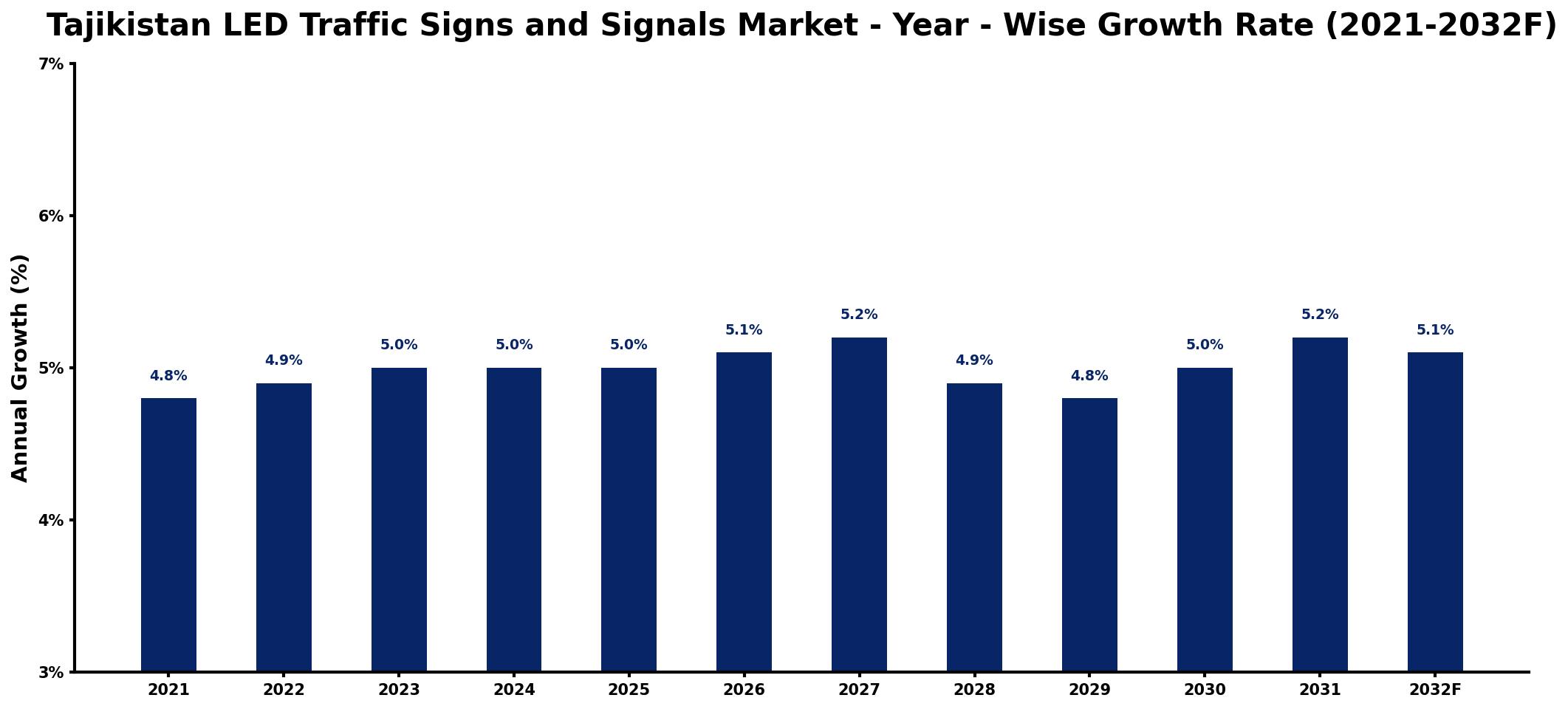
The table below presents the year‑wise growth rates along with the key drivers influencing the market
| Year | Growth Rate | Major Drivers |
| 2021 | 4.8% | Government investments in infrastructure projects |
| 2022 | 4.9% | Increased urbanization and population growth |
| 2023 | 5.0% | Rising focus on road safety |
| 2024 | 5.0% | Technological advancements in transportation |
| 2025 | 5.0% | Growing demand for smart cities |
| 2026 | 5.1% | Expansion of renewable energy initiatives |
| 2027 | 5.2% | Enhanced public transportation systems |
| 2028 | 4.9% | Improved regulatory frameworks supporting innovation |
| 2029 | 4.8% | Surge in eco-friendly initiatives |
| 2030 | 5.0% | Increased funding for urban development |
| 2031 | 5.2% | Growing awareness of environmental sustainability |
| 2032 | 5.1% | Rising public-private partnership opportunities |
Note: Market size estimations and growth projections presented in this report are based on 6Wresearch's proprietary forecasting methodology, utilizing the latest available industry data, government publications, and primary research inputs.
Tajikistan LED Traffic Signs and Signals Market Synopsis
In recent years, the Tajikistan LED traffic signs and signals market has gained momentum due to increased investments in infrastructure and a heightened awareness of road safety. This burgeoning demand is set against a backdrop of ongoing urbanization and modernization initiatives that aim to elevate the countrys transportation framework. As this focus sharpens, the market is expected to transition from conventional solutions towards more technologically advanced, energy-efficient LED systems.
Looking forward, the trajectory appears robust as the government seeks to integrate smart technologies into traffic management. The rising prevalence of connected systems will not only improve efficiency but will also enhance safety on the roads. As the market evolves, stakeholders must stay attuned to these changes to capitalize on emerging opportunities.
Tajikistan LED Traffic Signs and Signals Market Key Takeaways
- Government investments are a primary driver behind the market's growth and modernization.
- Increasing urbanization necessitates the shift towards more efficient traffic management systems.
- Smart technologies are gradually being integrated into traditional traffic solutions, enhancing safety and efficiency.
- Energy-efficient LED technology is favored over conventional options for its durability and visibility.
- Collaboration with local entities will be key for international players entering the market.
Evaluation of Restraints in Tajikistan LED Traffic Signs and Signals Market
Despite the positive growth outlook, several restraints may hinder the market's rapid expansion. Limited infrastructure development in certain regions could obstruct widespread adoption of LED traffic solutions, leaving some areas reliant on outdated systems. Additionally, economic instability and budget constraints may deter both public and private investment in upgrading traffic infrastructure. Compounded by a lack of technical expertise and awareness regarding the benefits of LED technology among stakeholders, these factors may inhibit market potential unless addressed comprehensively.
Tajikistan LED Traffic Signs and Signals Market Trends
Key trends shaping the Tajikistan LED traffic signs and signals market include a growing inclination towards smart city initiatives. This includes the integration of sensors and communication technologies within LED systems, fostering more interactive and responsive traffic management. Furthermore, the increasing demand for real-time data and analytics is compelling stakeholders to adopt advanced technologies that enhance overall traffic efficiency and safety.
In addition, the continuous development of LED technology itself is notable, with innovations focusing on improving durability and visibility under various environmental conditions. This trend assures customers of the long-term viability and cost-effectiveness of their investments, solidifying the appeal of LED traffic solutions in the market.
Tajikistan LED Traffic Signs and Signals Market Opportunities
The expanding Tajikistan LED traffic signs and signals market presents numerous investment opportunities. With government initiatives aiming to modernize traffic infrastructure, the demand for LED products is set to rise significantly. Suppliers can tap into this market by offering a range of products, such as pedestrian signals, traffic lights, and informational road signs, catering to both governmental and municipal needs. Furthermore, forming partnerships with local manufacturers or distributors can facilitate market entry and enhance growth prospects.
Government Initiatives in the Tajikistan LED Traffic Signs and Signals Market
The government plays a pivotal role in the Tajikistan LED traffic signs and signals market through policies designed to elevate road safety and enhance traffic management. Oversight from the State Traffic Safety Inspectorate of the Ministry of Internal Affairs ensures that traffic signs and signals meet established standards. Recent initiatives focus on modernizing traffic infrastructure by promoting energy-efficient LED technology, reflecting a strategic commitment to safe and sustainable transport systems.
Future Insights of the Tajikistan LED Traffic Signs and Signals Market
From 2026 to 2032, the Tajikistan LED traffic signs and signals market is expected to experience robust growth as the government enhances its focus on infrastructure and safety. The anticipated integration of advanced technologies into traffic management systems will drive demand for innovative solutions, leading to improved road safety outcomes. Additionally, as public awareness of energy-efficient solutions increases, there will be a stronger push towards adopting LED technology, solidifying its role in the future of Tajikistan's transportation landscape.
Tajikistan LED Traffic Signs and Signals Market Latest Developments (2025 - 2026)
Recent developments in the Tajikistan LED traffic signs and signals market indicate a strong shift towards adopting modern traffic management solutions. As governmental agencies prioritize infrastructure upgrades, initiatives are underway to enhance the visibility and energy efficiency of traffic systems. Partnerships are being formed between international technology providers and local authorities, aimed at streamlining the procurement process and fostering collaboration in the deployment of LED solutions. This proactive approach demonstrates a commitment to modernize the nation's traffic landscape.
Tajikistan LED Traffic Signs and Signals Market - Key Attractiveness of the Report
- 10 Years of Market Numbers
- Historical Data Starting from 2022 to 2025
- Base Year: 2025
- Forecast Data until 2032
- Key Performance Indicators Impacting the Market
- Major Upcoming Developments and Projects
Key Highlights of the Report:
- Tajikistan LED Traffic Signs and Signals Market Outlook
- Market Size of Tajikistan LED Traffic Signs and Signals Market, 2025
- Forecast of Tajikistan LED Traffic Signs and Signals Market, 2032
- Historical Data and Forecast of Tajikistan LED Traffic Signs and Signals Revenues & Volume for the Period 2022-2032F
- Tajikistan LED Traffic Signs and Signals Market Trend Evolution
- Tajikistan LED Traffic Signs and Signals Market Drivers and Challenges
- Tajikistan LED Traffic Signs and Signals Price Trends
- Tajikistan LED Traffic Signs and Signals Porter's Five Forces
- Tajikistan LED Traffic Signs and Signals Industry Life Cycle
- Historical Data and Forecast of Tajikistan LED Traffic Signs and Signals Market Revenues & Volume By Product for the Period 2022-2032F
- Historical Data and Forecast of Tajikistan LED Traffic Signs and Signals Market Revenues & Volume By LED Traffic Signals for the Period 2022-2032F
- Historical Data and Forecast of Tajikistan LED Traffic Signs and Signals Market Revenues & Volume By LED Traffic Signs for the Period 2022-2032F
- Tajikistan LED Traffic Signs and Signals Import Export Trade Statistics
- Market Opportunity Assessment By Product
- Tajikistan LED Traffic Signs and Signals Top Companies Market Share
- Tajikistan LED Traffic Signs and Signals Competitive Benchmarking By Technical and Operational Parameters
- Tajikistan LED Traffic Signs and Signals Company Profiles
- Tajikistan LED Traffic Signs and Signals Key Strategic Recommendations






































