Tajikistan Natural Fragrance Market Size, Share & Growth Rate
The Tajikistan Natural Fragrance Market was estimated at USD 280 Million in 2025 and is projected to reach USD 374 Million by 2032, growing at a CAGR of 4.2% from 2026 to 2032. This growth is largely driven by an increasing consumer preference for natural and organic products that resonate with the nations cultural identity. Furthermore, as sustainability concerns rise, consumers are gravitating toward fragrances that are both authentic and eco-friendly, paving the way for a burgeoning market in locally crafted scents.
Tajikistan Natural Fragrance Market Year-wise Growth Rate and Key Drivers
This graph highlights how the Tajikistan Natural Fragrance Market has steadily grown over the years, supported by major growth factors.
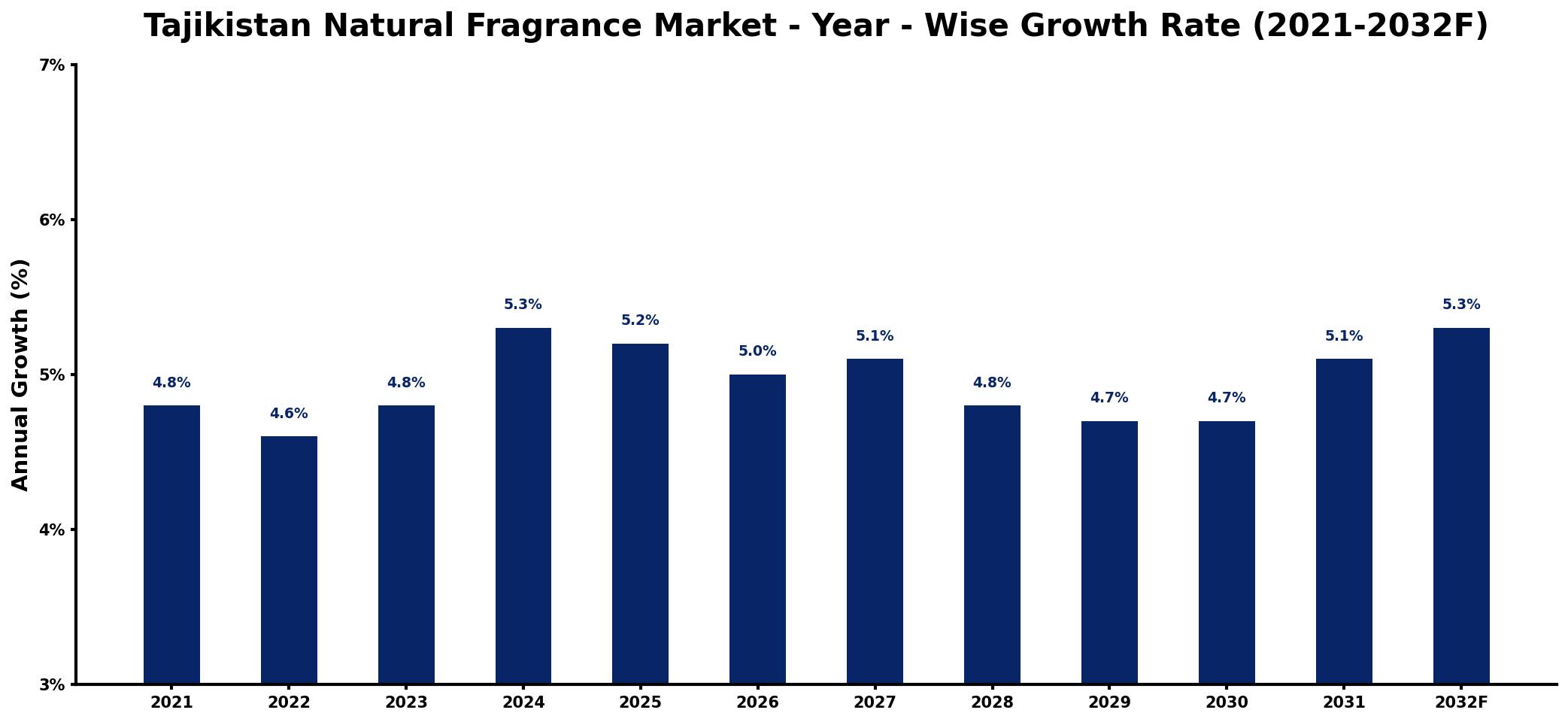
The table below presents the year‑wise growth rates along with the key drivers influencing the market
| Year | Growth Rate | Major Drivers |
| 2021 | 4.8% | Rising consumer interest in wellness |
| 2022 | 4.6% | Increased availability of organic ingredients |
| 2023 | 4.8% | Expansion of e-commerce platforms |
| 2024 | 5.3% | Growth in luxury personal care |
| 2025 | 5.2% | Surge in sustainable product demand |
| 2026 | 5.0% | Emergence of artisanal brands |
| 2027 | 5.1% | Investment in local production facilities |
| 2028 | 4.8% | Popularity of eco-friendly packaging |
| 2029 | 4.7% | Diversification of product offerings |
| 2030 | 4.7% | Collaboration with local artisans |
| 2031 | 5.1% | Focus on holistic lifestyle trends |
| 2032 | 5.3% | Integration of technology in marketing |
Note: Market size estimations and growth projections presented in this report are based on 6Wresearch's proprietary forecasting methodology, utilizing the latest available industry data, government publications, and primary research inputs.
Tajikistan Natural Fragrance Market Synopsis
In Tajikistan, the natural fragrance market thrives on the nation's rich heritage and an array of locally sourced botanicals. Fragrances crafted from traditional ingredients such as rose, lavender, and sandalwood hold immense cultural significance, appealing to consumers who value authenticity. The demand for these products continues to grow, as more consumers seek scents that reflect their roots.
Simultaneously, the influx of health-conscious consumers is reshaping market dynamics, favoring products devoid of synthetic chemicals. This shift is compelling local artisans and boutique brands to innovate and prioritize sustainable sourcing, ensuring the fragrances encapsulate the essence of Tajik culture while being environmentally friendly.
Tajikistan Natural Fragrance Market Key Takeaways
- The market is driven by a strong cultural preference for authentic, traditional fragrances.
- Consumer demand is shifting toward products made from organic and sustainable ingredients.
- Local artisans play a crucial role in shaping the market landscape.
- Challenges include competition from imported synthetic fragrances and limited access to high-quality raw materials.
- Investment in supply chains and marketing strategies is essential for local brands to thrive.
Evaluation of Restraints in Tajikistan Natural Fragrance Market
Despite its promising outlook, the Tajikistan Natural Fragrance Market faces significant restraints. One of the most pressing issues is the limited access to high-quality raw materials, which is exacerbated by geographic constraints and inadequate infrastructure for sourcing. Furthermore, the market grapples with competition from affordable imported synthetic fragrances that appeal to price-sensitive consumers. Cultural shifts also pose a challenge; younger generations tend to gravitate towards contemporary scents rather than traditional attars, which could restrict the overall market potential. Addressing these challenges requires a strategic approach focused on enhancing local production capabilities and strengthening brand recognition.
Tajikistan Natural Fragrance Market Trends
The market is witnessing a pronounced trend towards natural and organic ingredients, driven by heightened consumer awareness regarding health and environmental sustainability. Essential oils and botanical extracts are increasingly favored over synthetic compounds. Additionally, there is a revival of interest in traditional fragrances, which fosters a cultural appreciation for indigenous scents. Brands are now incorporating innovative practices, such as sustainable harvesting of local flora, to cater to this demand while reinforcing their market position.
Tajikistan Natural Fragrance Market Opportunities
Investment opportunities abound within the Tajikistan Natural Fragrance Market, particularly in sourcing and processing local botanicals that boast unique aromatic profiles. Collaborations with local farmers could create an ethical supply chain that benefits both producers and consumers alike. Furthermore, tapping into the rich heritage of Tajik herbal remedies offers avenues for developing culturally relevant products that resonate with both domestic and international markets. By focusing on sustainable practices and unique selling propositions, businesses can carve out significant market share in this evolving landscape.
Government Initiatives in the Tajikistan Natural Fragrance Market
The government of Tajikistan is actively promoting sustainable agricultural practices and preserving its rich biodiversity through various initiatives. Policies are in place to protect endangered plant species critical to fragrance production, fostering cultivation programs that support local farmers. Additionally, the government encourages organic farming methods and provides incentives for small-scale entrepreneurs in the fragrance industry. These efforts are designed to balance economic development with environmental conservation, creating a supportive environment for the natural fragrance market to flourish.
Future Insights of the Tajikistan Natural Fragrance Market
The outlook for the Tajikistan Natural Fragrance Market from 2026 to 2032 is promising, driven by an ongoing shift towards natural and organic products. As consumer preferences align with sustainable lifestyles, the market is expected to experience steady growth. Brands will likely concentrate on innovation, sourcing high-quality local ingredients, and adapting marketing strategies that resonate with the evolving consumer base. This progressive environment presents ample opportunities for both domestic and international players looking to make a mark in a culturally rich and sustainable market.
Tajikistan Natural Fragrance Market Latest Developments (2025 - 2026)
In recent months, the Tajikistan Natural Fragrance Market has seen a surge in collaborations aimed at enhancing the visibility of local artisans and their products. Workshops and trade fairs promoting natural fragrances have garnered significant attention, fostering a sense of community among producers. Additionally, there has been a noticeable increase in consumer engagement through social media platforms, which has amplified the reach of locally crafted fragrances. This heightened interest underscores the market's potential as it aligns with global trends favoring authenticity and sustainability.
Tajikistan Natural Fragrance Market - Key Attractiveness of the Report
- 10 Years of Market Numbers
- Historical Data Starting from 2022 to 2025
- Base Year: 2025
- Forecast Data until 2032
- Key Performance Indicators Impacting the Market
- Major Upcoming Developments and Projects
Key Highlights of the Report:
- Tajikistan Natural Fragrance Market Outlook
- Market Size of Tajikistan Natural Fragrance Market, 2025
- Forecast of Tajikistan Natural Fragrance Market, 2032
- Historical Data and Forecast of Tajikistan Natural Fragrance Revenues & Volume for the Period 2022-2032F
- Tajikistan Natural Fragrance Market Trend Evolution
- Tajikistan Natural Fragrance Market Drivers and Challenges
- Tajikistan Natural Fragrance Price Trends
- Tajikistan Natural Fragrance Porter's Five Forces
- Tajikistan Natural Fragrance Industry Life Cycle
- Historical Data and Forecast of Tajikistan Natural Fragrance Market Revenues & Volume By Ingredient for the Period 2022-2032F
- Historical Data and Forecast of Tajikistan Natural Fragrance Market Revenues & Volume By Essential Oils for the Period 2022-2032F
- Historical Data and Forecast of Tajikistan Natural Fragrance Market Revenues & Volume By Natural Extracts for the Period 2022-2032F
- Historical Data and Forecast of Tajikistan Natural Fragrance Market Revenues & Volume By Type for the Period 2022-2032F
- Historical Data and Forecast of Tajikistan Natural Fragrance Market Revenues & Volume By Top note for the Period 2022-2032F
- Historical Data and Forecast of Tajikistan Natural Fragrance Market Revenues & Volume By Middle Note for the Period 2022-2032F
- Historical Data and Forecast of Tajikistan Natural Fragrance Market Revenues & Volume By Base Note for the Period 2022-2032F
- Historical Data and Forecast of Tajikistan Natural Fragrance Market Revenues & Volume By Application for the Period 2022-2032F
- Historical Data and Forecast of Tajikistan Natural Fragrance Market Revenues & Volume By Fine Fragrances for the Period 2022-2032F
- Historical Data and Forecast of Tajikistan Natural Fragrance Market Revenues & Volume By Personal Care & Cosmetics for the Period 2022-2032F
- Historical Data and Forecast of Tajikistan Natural Fragrance Market Revenues & Volume By Household Care for the Period 2022-2032F
- Tajikistan Natural Fragrance Import Export Trade Statistics
- Market Opportunity Assessment By Ingredient
- Market Opportunity Assessment By Type
- Market Opportunity Assessment By Application
- Tajikistan Natural Fragrance Top Companies Market Share
- Tajikistan Natural Fragrance Competitive Benchmarking By Technical and Operational Parameters
- Tajikistan Natural Fragrance Company Profiles
- Tajikistan Natural Fragrance Key Strategic Recommendations






































